Category Archives: comment

Ingredients of Transition: Engaging Young People » Transition Culture

20 Dec 2010

Ingredients of Transition: Engaging Young People

Gathering young people’s visions of the future at the Great Unleashing of Transition Malvern Hills

Context

Part of any Transition initiative practicing INCLUSION AND DIVERSITY (2.2) is the successful engagement of young people in the process.  Given that Transition is about the creation of a more resilient future, then it is obvious that the people who will inhabit that world are central to the STRATEGIC THINKING (5.10) that goes into designing it.  Young people can also contribute a great deal to PRACTICAL MANIFESTATIONS (3.9) of Transition.

(We are collecting and discussing these Transition ingredients on Transition Network’s website to keep all comments in one place. Please leave feedback and comments, suggestions for alternative pictures, anecdotes, stories and projects for this ingredient here).

The Challenge

Engaging young people in community activities and in environmental campaigning is a challenge, and not just for Transition.  Yet if young people fail to engage or to see a role for themselves, Transition, in effect, has to do without the engagement of a significant sector of the community, and will also be without the energy that young people can bring.

Core Text

Transition is a process of intentionally designing a more localised and resilient future for the whole community.  Given that it is today’s young people who will be coming of age, starting families and building livelihoods in that world, it is vital that they are as integrated into the Transition process from an early stage as possible.  There is a tension here though, as for many teenagers, these larger issues aren’t so much on the radar.  I remember talking to a 17 year old girl at my local sixth form college during an exercise where students were asked for their visions of Totnes in the future as part of the creation of the Totnes and District Energy Descent Action Plan.  She told me “I don’t think years into the future… only three months ahead… learn to drive, go to college, learn to drive go to college”.  As one 21 year-old who wrote a comment on Transition Culture about this subject put it:

“…there is still a very natural inclination to cling to the oil-driven lifestyle. Our generation grew up with it, it’s all we ever knew. If you don’t go and read through history books, you’ll think that oil is a necessary part of human life”….

He, however, went on to initiate a Transition initiative in his community.  Transition initiatives have been using a range of ways to engage and involve young people.  For Joanne Porouyow at Transition Los Angeles, it is not a case of organising specific events for young people, rather “we have simply folded the young people right in as full participants in whatever the Transition groups are doing”.  In practice, this includes:

  • not making having children a barrier to parents participating in event, and making it OK to bring children to meetings
  • getting young people to run events, for example Transition Mar Vista (in LA) offered a workshop called ‘Repurposing old clothes’ which was run by the 16 year-old grand-daughter of a member of the group, and Transition LA’s ‘Cluck Trek’, a visit to several families who keep chickens, was led by the children of several chicken-owning families.

Picking up on this idea that the young people can be the teachers, blogs can be a great way to communicate insights and experience from getting involved with aspects of Transition.  During the research for this book, Gerri Smyth pointed out her granddaughter’s website, ‘My Chickens’, which she has set up to document her experiences keeping chickens.  Here’s how she describes the site in her ‘About’ section: “I am Loolahs, I am 8 years old. This blog is about my chickens and what we get up to.  I hope you like it”.  Blogging for kids is very easy to do these days and can offer a unique perspective on Transition, as can running workshops to teach them how to film and edit their own short videos, which again offer a particular angle on Transition.

Transition Belsize in London are setting up something called ‘Transition Kids NW3’ which will offer a range of workshops and activities to be decided by the kids themselves.  Initial ideas include foraging workshops, wildlife survival skills, cob building and dawn bird spotting.  Also in London, Transition Finsbury Park, also in London, is working with the local primary school.  They found the best time to try to engage parents and children is immediately at the end of school, especially when they are doing hands-on events.  They set up an after-school food growing club, which became so popular with the kids that Jo Homan, the organiser, said that kids could only come to the group if they brought their parents as well.   Running Transition events after school was also done by Transition Tynedale set up an organic vegetable stall in the school grounds, sourcing produce from a local MENCAP college, with some of the kids running the stall.

At Transition Scotland Support’s ‘Diverse Routes to Belonging’ conference in Edinburgh in November 2010, participants were invited to bring their kids, and a parallel programme of activities was run for them, organised by Sussex-based Moving Sounds.  The kids organised and presented the morning’s warm-up activity, and then prepared a performance piece to show that evening.  At the Transition North conference in 2009, a group of local teenagers, Ruby, Hayley, Eugene, Paddy, Adrian and Linda, through the Two Valleys Radio, spent the day of the event interviewing lots of the delegates and members of the local Transition initiatives, and then edited a voxpop piece which was presented to everyone at the end of the day.

Transition Ottawa in Canada worked with local media studies students at the local University who were set a project to make short films (under 5 minutes) to convey a powerful and practical message in order to inspire their fellow students to live more simply.  They were given six topics to choose from, food, water, energy, transport, waste and simple living, and members of Transition Ottawa went in and were available to the students if they wanted to ask questions.  The resultant films will be shown at Transition Ottawa events.

Even the youngest of young people can get involved in Transition!  Transition Town Letchworth run ‘Transition Tots’, which meets once a month, and where parents of children between 0 and 3 get together to discuss the “trials and tribulations of sustainable parenting” and to work on TTL projects[4].

One of my favourite examples of engaging young people in Transition comes from Transition Newent in the Forest of Dean.  Students there made the ‘Oil Memorial’, a project which featured in the Transition Network’s wiki-film ‘In Transition 1.0’.  A tower was built from blue plastic barrels, onto which were fixed many items, brought in by the children, which were made from oil.  The project emerged from the desire to, as Michael Dunwell of Transition Forest of Dean put it, “get people to understand all the things oil does for us.  I asked the children “what’s plastic made of”, and they replied “plastic””.   Looking back on the completed project, Michael said “it’s just fun, getting people involved in making something with a message … just to celebrate the incredible achievements that oil has brought for us, then to turn it into a memorial to say goodbye to it”….

In many settings you will need to make sure that anyone from your Transition initiative working in any direct way with young people will need to be CRB checked, and any institutions you work with will no doubt have child protection policies in place which will need to be observed.

The Solution

Giving children a voice is an important part of the process, as is helping them to express what they already know (which is sometimes far more than adults!) This can take people who work in schools by surprise and can be strikingly accurate.   Design into the activities of your initiative events and projects that engage local schools and youth clubs, and use media more accessible to them, Facebook, YouTube and so on.  Try to ensure that the voice of young people is represented in the Core Group.

Connections to other ingredients

For many young people, practical activities is one good way to engage them, so ARTS AND CREATIVITY (2.8) and THE GREAT RESKILLING (3.11) are very helpful.  MEANINGFUL MAPS (4.10) can also be very good for drawing out practical ideas for the future, as well as for mapping how young people see the world and what is of value to them.  Teaching young people the necessary skills for RUNNING PRODUCTIVE MEETINGS (2.4) and for RESPECTFUL COMMUNICATION (1.7) are skills that will last them a lifetime.  You should always be mindful though of the dangers of POST PETROLEUM STRESS DISORDER (1.1) when talking with young people about peak oil and climate change, and ensure a good balance between information and practical responses (a balance one should strive to achieve with adults too!).

Please leave any comments here.

Its not often I repost a blog item, but this one is so right on many levels
Can we really address carbon reduction with same thinking that created carbon problem in first place?

New thinking on CO2 reduction required?

A twitter comment from @imogenhumphris this morning stating that carbon reduction can only come from innovation made me think of the classic but overused Einstein quote used as title for this post.  This was followed this afternoon by an inspiring blog piece by Gaian Economics – Rethinking Resilience

Maybe we are approaching the problem of carbon reduction from the wrong direction. 

We need to stand in the future of a post carbon economy and start to focus on doing more of what we need to get us there

In classic sustainable thinking we focus on what less we can do with(less carbon, use less energy, fuel, resources etc) whilst still doing the same 'stuff'.  But maybe we should think of what more can we do – more local resources, more 'harmless' materials, more renewables … 

In the built environment we need more focus on building local resilient systems and communities, rather than trying to do what we have always done with less.

Low Carbon business plan for construction companies (extract from #IGT report)

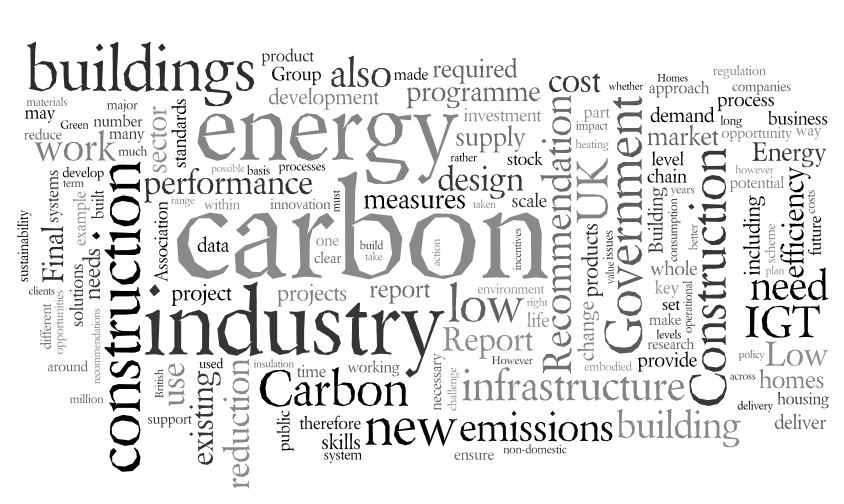
#IGT Report Wordle – Low Carbon Construction

… on developing a plan to reduce CO2 emissions from Construction activities

Through constructco2 we can now start to get an understanding for the level of CO2 emissions that arise solely from the construction activity, ie those within the control of the construction team.  Overall this is currently looking like 98kg per £100,000 contract value, or 1tonne for £1m. There are of course variances in this, and as soon as we have more projects completing a better picture will emerge.

This figure is arrived at through measuring the carbons arising from personnel travel, the material and waste transport emissions along with the fuels and energy used on a project. The front page of constructco2 shows a real time breakdown across these areas for projects using the tool.

But what does a tonne of CO2 look like? Borrowing an idea and concept from Carbon Coach Dave Hampton, I often use balloons in my sustainability workshops, with each delegate blowing up a party balloon. Each one of which represents about 10g of CO2. Imagine a medium sized workshop room / classroom filled with balloons and we starts to get a feeling for what a tonne can look like.


Now a very useful visual measure has been developed by University of Leicester, sponsored by Willmott Dixon, where a tonne of carbon is represented as  a cube larger than the average house at 560m3 (Although not new as a CO2 Cube created from 12 shipping containers to form the equivalent of a three-story building, was used to demonstrate what a tonne can look like at Copenhagen in 2009)

So for every £1 million of contract value we are emitting the equivalent of a large family house.  The SfC Strategic Forum for Construction calculates the turnover of the UK Industry to be in excess of £100billion. Therefore if my maths with big numbers is good we fill the equivalent of one hundred thousand homes with CO2 per annum through construction activities alone

What then are the areas we should address in developing a low carb plan to reduce levels and impacts of construction CO2?


passive – getting the foundations right , for example through ensuring all vehicles, plant, cabins and small tools used on site are as energy efficient as is possible, that we start to use renewable energy, eg solar power for small tools where possible and seek to use mains power as early as possible in the contract to avoid use of generators. And of course ensuring all project planning is optimised for minimum energy use.

active – addressing everyday activities to reduce energy and fuels used and hence emissions, through, for example, focus on local procurement to minimise travel and transport, encouraging car sharing, using lean construction to minimise time, reduce energy usage in site accommodation and plant, reduce waste and improve storage.

positive – we can attempt to balance those carbons still arising from construction through education and awareness of people and organisations on projects (so learning can be shared and taken to other projects and offices, also what goes around will come around; your staff and operatives for the next project will be better informed and more likely to save energy.) We can also look at carbon capture via planting of (additional) trees and landscapings

And of course using constructco2 to measure understand and reduce construction carbon.

Autodesk Project Vasari – a lite version of Revit to make BIM accessible and viable for all?

David Light on his blog Revit enthuses about a ‘lite’ version of Revit.

I am struggling to contain my excitement, but there is a storm a coming!!!

With Paul Morrell recently calling for more projects, indeed, all public projects to be managed through a BIM platform, could this be the killer that brings BIM within the use of all sectors in the built environment, ie design, construction and facilities management? (Cost and steep learning curve are often the main reasons for contractors and designers alike for not even exploring BIM).
Project Varasi is now live – sign in to the Autodesk Labs website to download
The version is a technology preview which I see will operate until May 15, 2011, a great opportunity to explore and learn?
http://www.youtube.com/v/_KqMmr_yhIs&hl=en&fs=1&hd=1
Detailed BIM modeling tools have been removed from Project Vasari but provides the opportunity to explore performance based 3D design

on a significant shift to the way we can procure buildings or facilities …

On Friday something remarkable and significant happened at Accrington Academy. 

Local contractors and construction related specialists came to present to Roots (a school student company comprising of 12-14 yr olds) expressing their interest in becoming involved with the Roots EcoClassroom, as part of a fresh approach to collaborative procurement devised by Martin and Alison at Classofyourown.

Roots themselves will be blogging themselves about the day over at www.rootscoyo.posterous.com. The day was also captured on twitter with the hashtag #rootseoi with a transcript here.

It was remarkable that it happened at all (through the innovative and forward thinking at Accrington Academy and those involved with Classofyourown) and remarkable for the enthusiasm and commitment shown by those presenting. 

Significant in that it can, no it should, or will, start to move end user engagement into a new arena, from an upfront tick box exercise to one of driving the procurement process. 

If secondary school students can drive procurement and select contractors, design and project teams for their new school build, so could office staff, hospital workers, retail workers, could procure for their new build or new facility. Procurement would then be based on real end-user needs and requirements. A significant shift in the way we procure buildings.

Derek Deighton from Blackburn College who sat in for the morning sessions later summed the day as:

It was absolutely awe inspiring today watching major companies presenting to the ROOTS team in the hope of getting business and the resultant Kudos of being a part of the Class Of Your Own project.


I feel this has the opportunity of being a global initiative through networks like Rotary International and  the Transition Town Movement.

One of the dangers of promoting children and students as clients, as drivers of the design, procure and build process is that it can look twee, even gimmicky. The EOI presentations proved that this is definitely not the case as far as Roots are concerned. Roots 

children asked intelligent mature questions and got considered answers.

On reflection, a significant moment was when one of the presenters was really taken aback and surprised that the children did not really know about CDM. Lets stop and think about this – why would a 13yr old know about CDM – but more importantly the questioner obviously thought that they should know. This proves that the children are being taken very seriously indeed, as any client should. (It so happened the Roots students who wrote their health and safety construction commitments were not at that particular interview, otherwise the response would have been very different!)

Overall the messages of the presentations were not dumbed down, the language used not simplified and there were many instances through the day that proved this was serious business: such as the handover of Annual Accounts, of legal proceedings for sustainable construction, of articles on collaborative working, and more. 

The contractors and others that presented had obviously worked hard to fine tune their excellent presentations, it showed that they had really focused on and addressed the requirements of Roots, and I know from comments have benefited and learnt much in doing so that can be translated to other projects.

It Just Worked

But the big question in my mind was – Why hasn't this done before? 

The next blog piece on this subject will discuss the process of this unique student (end-user) led procurement approach.

Essence and Spirit of #Collaborative Working and #IPD

I had good reason to revisit and re-acquaint myself with the working details of the Be Collaborative Working Form of Contract, (now the JCT Constructing Excellence Form of Contract 2009) over the weekend.   Once again I was stuck by the common sense of the collaborative overriding principle initially written way back in 2003. 


Why cant all projects have this as a guide that sums up the essence of Collaborative Working and Integrated Project Delivery, and is the spirit of working together?

The Overriding Principle

After 5 years of planning and raising funds its great to see our community MUGA in use