Another key piece of thinking in the Big Society and Community Based FM debate from NESTA
Author Archives: martin brown
What does the big society mean to construction and #facilities management?
and
The Big Society (Square Mile)
#CbFM Community Based Facilities Management – #FM contribution to #bigsociety thinking
Energy Efficiency in Facilities Management #FM: Guidance
Energy efficiency is becoming an increasingly important policy objective for the public sector organisations, not only because of the opportunity to minimise carbon emissions, but also because of the potential to unlock financial savings. Facilities managers have a key role to play in the delivery of energy efficiencies because of their responsibility for the operation and upkeep of the public sector estate.
This guidance is prepared for public sector sustainability and procurement professionals and their advisers to provide an overview of the issues and mechanisms which can be used in Facilities Management (FM) Contracts to drive energy efficiency.
This guidance was published in summer 2010 , and it is expected that as technologies and supplier best practice develops, it is expected that this guidance will need to be updated from time to time.
Out of Crisis: LCBPC Never waste a good crisis event.
Don Ward, Constructing Excellence presented to the Lancashire Construction Best Practice Club on Tuesday night, focusing on the Never Waste a Good Crisis report published at the end of 2009. The report contains four messages:
The industry has improved over the last decade
4 blockers have slowed the pace of change
Recession may provide the impetus needed for change
Collaborative working is even more important for this next era
Collaborative working has been the foundation of industry improvement and as Don explained the root ‘solution’ for current industry themes of safety, people respect, improving value and addressing sustainability.
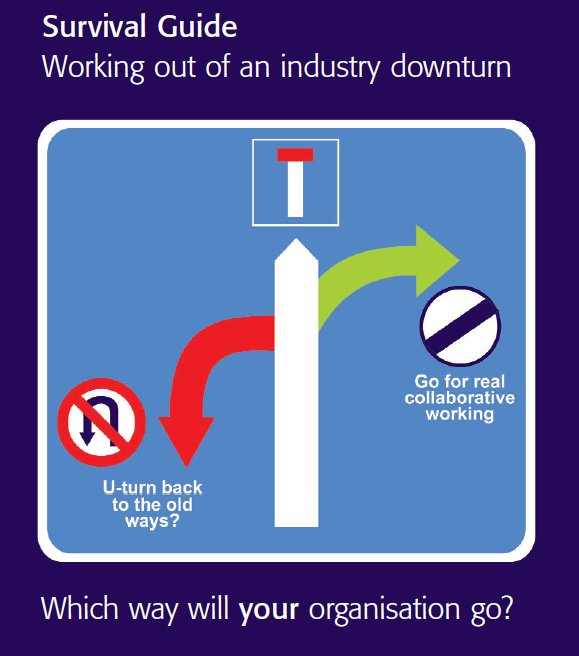
Don referred to the Collaborative Working Champions work and survival guide that stresses we need more effort to work collaboratively, doing nothing different is a dead end route and to revert to (adversarial) practices of the past suicide.
Addressing the question “what comes after frameworks”, the answer was “frameworks done correctly”, for improving value and not just as a cheaper or easier procurement route that can’t deliver value. (After presentation debate talked of the increase in framework hubs, such as the North West Hub, particularly as indications are that more public procurement will be done locally with end user management. These ‘new’ clients will look to join hubs that have ‘pre-selected’ contractors and designers.
As would be expected by anyone familiar with the improvement agenda, Don used the 1-5-200 approach to demonstrate the leverage of construction on business and organisational activity, reinforcing that we need to think business need, not buildings.
In the following excellent debate, concern was expressed by contractors on the expectation that they must continually reduce costs, profits and overheads, even when selected for frameworks. Consequently, argued Don, myself and others, there is a urgent need for reducing costs through the use of lean construction principles, identifying and reducing waste (time, energy, not just material waste) in construction, whilst at the same time addressing the carbon reduction agenda. Indeed the carbon agenda may well be driver here. It was pointed out we need to learn from other sectors who have adopted lean, throughout their supply chains and taken their lean solutions to the clients, rather than wait for project opportunities.
Don mentioned that the chief construction advisor Paul Morrell is mined to suggest that BIM ( Building Information Modeling) become compulsory for all public construction work, such are the benefits BIM can bring
With focus on the construction industry looking set to be the eco-refitting of existing buildings (to address rising energy costs and the Carbon Reduction Commitmentscheme) the question was asked do we have the skills, systems and resources to meet the £40b spend expected, or will we see new entrants into the industry. Tesco, Virgin or utilities companies where floated as potential drivers in this emerging sector. Will we be more trustting of these organisations to improve our homes, offices or schools than construction companies?
In response to the competition smaller SME contractors face when bidding against larger, regional or even national contractors, Vassos from iBE and David Kemp from Regenerate (Peninne Lancs) desribed the approach of SME clusters, or consortia of small contractors successfully pooling experience, resources and bid potential.
As a footnote, back in the 1950’s quality guru Edward Deming in Out of the Crisistalked of two options for pulling industry out of the then post world war crisis, either improve quality or reduce costs. What route will we take now?
————-
The next club event will be on the 16th Sept, at Blackburn looking at education and training innovations in the region. This will also be the club AGM
For more information on the Lancashire Best Practice Club contact myself atfairsnape@gmail.com The club are also on twitter @lcbpc as is constructing excellence @constructingexc
Dons presentation can be viewed / downloaded here
Never Waste a good Crisis report can be viewed / downloaded here
Sustainable Schools futures scenarios: Beyond BSF?
Our ‘doorways’ were Buildings & Grounds, and Energy & Water, with the scenario developed indicating what could be possible using the cancellation of the Buildings School for the Future programme as a driver for change
First, doorway statements extracts
- The way school buildings are designed constructed and managed affects their ‘ability’ to teach pupils about sustainable living.
- All schools, old and new manage and design buildings in a way that visibly demonstrate sustainable development to everyone who uses the school.
- Through their grounds, pupils are closer to nature, capture their imaginations in outdoor play and help them learn about sustainable living.
- All schools are models for efficiency, renewable energy and water conservation
A futures scenario looking back to 2010:2010
Building Schools for the Future programme axed for many schools.
Outcome:
Schools take ownership for developing sustainable schools. Previously they had relied on others (Government) to do it for them
Voice of pupils and teachers becomes more powerful influential in school development leading to 2012 when Sustainable school development is included in the new School Teaching Framework
2012
School Budgets cut further
Energy costs, especially oil costs soar
Carbon Reduction Commitments start to bite, within schools, public sector and large private organisations
Outcomes:
Real focus on energy saving measures in school
Joint ventures between industry and schools to use surplus heat from industrial / IT sector to heat schools, with pilots in 2012 and widespread use from 2014
New planning directives require any new schools to be sited near industry, but that clean and new industry to be sited near schools
Managing energy part of the School Teaching Framework
2013
Further cuts in education
Outcomes
Surge in local activism. parents and governors take hands on driving of sustainable school agenda
2014 Usable School Code introduced: Requirement for new school and major school refurbishments to be approved by parents, teachers and pupils.
2013
Carbon Offsetting focus and Carbon Reduction Scheme allows industry to supply renewable technology into schools free of charge under section 106 type agreements
Feed in Tariffs revised to make it extremely attractive to supply energy to grid
Outcome:
Schools bristle with eco-technology, providing far more energy than they use.
Schools used as energy ‘provider’ during school closed periods
Schools piloted as smart grid pioneers
Schools become learning centres for sustainable living
2014
Building directives require only local labour and materials to be used. Transport costs make new build prohibitive. In anticipation of a ban on non essential new build, their is a rush to refurb existing stock
Outcome
New school construction ceased.
Reclaiming and recycling of existing buildings for school use becomes best practice.
I just joined twitter, now what? … Finding ‘fit’ friends.
Tonights Moon taken on iPhone held to telescope (cropped and tinkered with on iPhone too)
Five areas to address to reduce carbon emissions arising from the construction / build process
Most everyone by now knows the purpose of a BIM … but how about social media based FIM’s: facilities intuition models?
BiM: Building intuition Modeling which claims
Most everyone in the AEC industry by now knows that the purpose of a building information model (BIM) is to generate and manage building data during its lifecycle. And that the model’s data – in the form of information – covers building geometry, light and energy analysis, geographic information, quantities for estimating costs and properties of building elements.
The article then makes the case for a knowledge, intuition based model that thinks for itself:
But what if the BIM was used to contain acquired knowledge, build intuition and generate insights?
The article also includes a reference to the work of @be2camp friend at Studio Wikitecture, Ryan Schultz, on the subject of Enabling Wiki: Task Definition for Distributed Management and
crowdsourcing as a business plan that allows individuals with diverse viewpoints to integrate
The themes of the post struck a chord with some of my thinking in this area and lead to my following post comment:
Based in the UK I am surprised at the comment: “Most everyone in the AEC industry by now knows that the purpose of a building information model (BIM) is to generate and manage building data during its lifecycle” The purpose and understanding of BIM here is very low and still regarded by the majority of the industry as a big innovative step, something for the future!
However its the thread of intuition that strikes a chord with my thinking on complexity, chaos thinking, facilities management and social media.
One of the main elements of complexity thinking is the notion of emergence, and that often emergence in directions not expected. As BIM matures and becomes more encompassing, so will the emergent uses and benefits. Hence managing or dealing with emergence comes close your thoughts on intuition.
I have been pushing the concept of FIM (Facilities Information Model) for a while, the argument being that the facility (ie building in use) is a higher level model to which a BIM (ie the creation of new buildings or facilities) is a subset.
A FiM (Facilities Intuition Model) could include the softer, POE, end user datasets and feelings. What is fascinating here is exploratory work of understanding facility users emotions and comments from social media such as twitter and foursquare. Start to wrap this into a BiM, FiM (Facilities Intuition Model) and we can see real potential.