
Sustainable #fm seminar at #facilitiesshow
Leave a reply

Press release received this am from the Federation of Master Builders claims that almost 44% thought homeowners were unlikely to take advantage of the Green Deal when it launches in autumn 2012, and may not be not be the green revolution the Government hopes it will be
Brian Berry, Director of External Affairs at the FMB said:
The Government is hoping that its Green Deal will persuade homeowners to make their homes more energy efficient but almost 44% of our members, small building firms that are in contact with homeowners on a daily basis, think homeowners are unlikely to take advantage of it. If the Government wants the Green Deal to be a success it should start by offering additional incentives. 70% of respondents to our survey believe that cutting VAT to 5% on all energy efficient materials and work would increase homeowner interest. More than a quarter also believe that council tax reductions would be the biggest incentive for homeowners.
“Small, local building companies should be the natural choice for homeowners wanting to retrofit their property or make it more energy efficient. However, nearly half of FMB members are worried that they will be squeezed out of the Green Deal market by the major energy companies and retailers and 58% felt that it was either very unlikely or unlikely that small and medium sized building companies would see their workloads increase as a result of the Green Deal. The FMB is therefore calling on the Government to help small building companies have equal access to the energy efficiency market by allowing an independent third party financial provider to handle Green Deal finance packages. This would help ensure that small building companies can compete fairly with the larger companies who will be offering ‘one–stop-shops’ to consumers.”
“The critical issue is encouraging consumers to take up the Green Deal. What is very concerning is that the Energy Bill, which is the legal basis of the Green Deal, is not ambitious enough. The Bill needs to set out a clearer plan to bring the UK’s homes up to standard if it is to succeed in making our homes greener and more energy efficient. To create consumer demand for the Green Deal additional incentives such a cut in VAT for energy efficient works and a reduction in council tax for retrofitted homes are also needed. These incentives would help ensure that the Green Deal is a success and that the Government can achieve its stated aim to be ‘the greenest government ever’.”
For more information please visit: www.fmb.org.uk
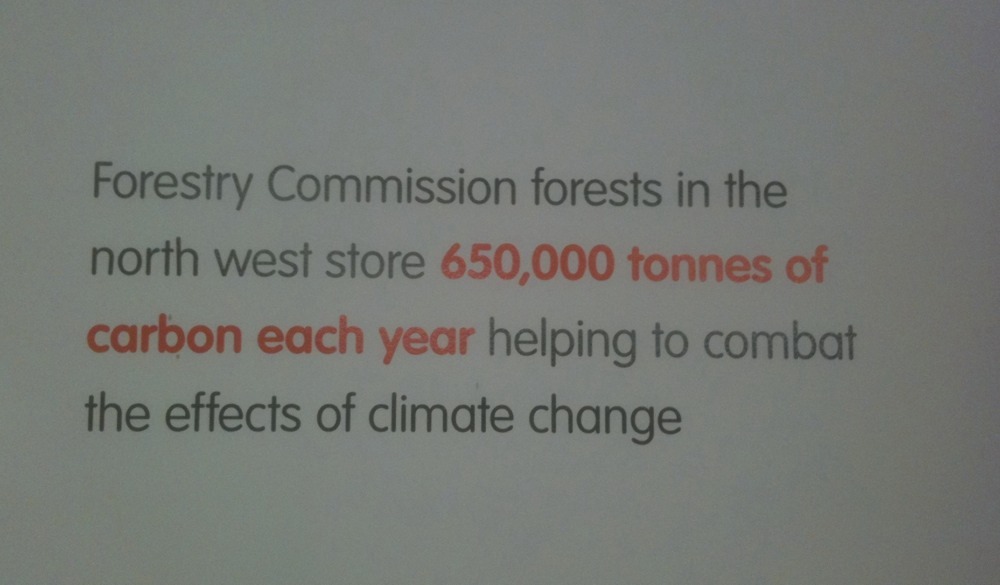
Sign spotted at Grizedale Forest in Cumbria yesterday:
Friend and colleague David Inman at DIEM Ltd has published this very useful Environmental Management update focusing on SWMP. Download this file

The UK’s Department of Energy and Climate Change (DECC) yesterday published its Carbon Plan, outlining the anticipated steps to reaching the country’s 2020 emissions targets. The document has been released in draft format, with a full version expected this autumn.
Aiming to encourage the UK to cut its carbon footprint while at the same time promoting green jobs and investment in the country, a revised version of the Carbon Plan will be released each year.
Prime Minister David Cameron, Deputy Prime Minister Nick Clegg and Energy and Climate Change Secretary Chris Huhne said, “This Carbon Plan sets out a vision of a changed Britain, powered by cleaner energy used more efficiently in our homes and businesses, with more secure energy supply and more stable energy prices, and benefiting from the jobs and growth that a low-carbon economy will bring.
Built Environment Issues:
Although in draft form the Carbon Plan indicates the direction it will take and the impact on the built environment through procurement, energy, transport etc. These are issues that should be addressed by organisations in the built environment from suppliers to designers, constructors and facilities management, and importantly addressed and championed by board members.
On Procurement
8.5 With an annual public sector spend in excess of £236 billion, procurement is a powerful lever that can reduce emissions and drive innovation. The establishment of minimum and best practice product specifications for government purchasing (Government Buying Standards) has improved the environmental performance of priority products, such as construction, transport, and information and communication technology.
On Transport
Transport is a major contributor to the UK’s energy demand and greenhouse gas emissions, as well as other polluting emissions, with the majority of those emissions coming from the oil-based fuels we rely on for road transport. We can all play a part in changing this by taking advantage of public transport and looking at innovative alternatives to travel such as video conferencing for some business meetings.
The Carbon plan cites the London 2012 Olympic and Paralympic Games approach to minimise emissions through construction material transport
Note that constructco2 indicates the biggest emitter of CO2 in the construction process is transport
On Homes and Eco Developments
Almost half of the UK’s greenhouse gas emissions are from the energy used to generate heat,4 with the vast majority of our homes still relying on fossil fuel powered gas boilers and with much of our building stock still poorly insulated and inefficient. There is a huge opportunity here, not only to cut greenhouse gas emissions and emissions of harmful pollutants, but also for households and businesses to save money, with the most significant and cost effective opportunities likely to come from better insulation and from replacing inefficient heating systems.
We need to ensure that the homes and buildings being built now and in the future are as energy efficient as possible, and the Government is committed to introducing ambitious energy efficiency standards for new homes and buildings. In the short term, this means ensuring that all fossil fuel boilers are as efficient as possible, but we also need to move towards lower carbon alternatives such as air and ground source heat pumps and consider decentralised options like Combined Heat and Power and district heating.
The Government wants to support and enable communities in their wish to adopt higher environmental standards for new homes including through:
• ensuring that there are robust sustainability standards for local authorities to use if they want to set higher standards than those in the national regulations in their local plans. For example, the Code for Sustainable Homes provides standards for the sustainable design and construction of new homes (including water efficiency) that meet or exceed those set out in The Building Regulations 2010; and supporting eco-towns and eco-developments where there is local support and a wish to adopt higher standards of sustainability and design.
More comments to follow
ConstructCO2 currently measuring construction carbon emissions on over 50 projects, ranging in value from £100k to £23m, is indicating a CO2 benchmark of
The split of this data, as below, indicates that the ‘culprits’ are travel and transportation, making the move to low carbon construction one of procurement and selection based on location, rather than costly technical and eco-bling solutions.

However, we have a very poor concept of what this level of emissions means and could look like. Fortunately, Willmott Dixons, in conjunction with Loughborugh University recently erected a temporary ONE TONNE CO2 cube
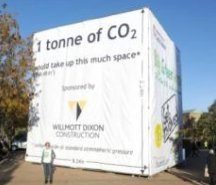
So for each small construction project of £100,000, the bread and butter of micro and SME contractors across the UK, we could be emitting:

And, (and this is where it starts to get a little scary) for each Million pound spend of construction we could be pumping this into the environment:

CO2 is colourless, and this may be a mixed blessing, for if it was coloured purple then we would be living in a 60’s imaged purple haze, or rather we wouldn’t as we would have taken action long ago

So, time for action, for construction and contracting organisations to commence monitoring, understanding and reducing their carbon emissions. And really its a no brainer, for each kg or tonne saved, we save the equivalent energy costs.
To explore ConstructCO2 use the login details of eyesonly@evolution-ip.com and pass word of eyesonly.

Whilst working on a number of PAS 91:2010 submissions, I am becoming acutely aware of the omission of many current and critical construction improvement themes, a quick word search through the document shows:

“This report, by the new economics foundation, sketches out how, in the light of the challenges we face both nationally and globally – consuming beyond our planetary limits, untenable inequality, growing economic instability, and a breakdown in the relationship between ‘more’ and ‘better – things could ‘turn out right’ by 2050 through the process of a ‘Great Transition’.

Initially presenting the case for change, the report goes on to discuss some of the steps required for such a transition, including a Great Revaluing, Redistribution, Rebalancing, Localisation, Reskilling, Economic Irrigation, and Great Interdependence.
It concludes with a discussion of two big challenges that need to be addressed before such a transition can be achieved, but also sets out steps that can be taken straight away to start the journey”
And the built environment features throughout the report in respect of how we recovered our lack of traditional skills, succeeded in addressing the localism issue and turned energy ineffective buildings into models of zero carbon.

 Fairsnape