Category Archives: comment

08 thoughts from think 08

I attended Think08 yesterday afternoon, visiting some of the free seminars and chatting to a good number of exhibitors. It was also good to meet up with fellow bloggers Phil, Mel, Paul, Rob and Casey for an early evening drink.

My impressions from the afternoon was that it didn’t quite have the buzz of last year but again a very worthwhile event to attend, pushing the boundaries of sustainability … but …

Resilience is the new sustainability

The biggest impression was that sustainability as a green label has run its course – has it been highjacked to mean sustainable business as usual, sustainabily? Someone at another online event recently planted this idea – sustainability is so 1990’s. We need a new describer – resilience. (A link to a post in draft)

I captured my key thoughts during the afternoon which coincidently numbered eight:

  1. its the way we use buildings, operate them and manage energy use that will have the biggest initial impact on energy performance – not necessarily new green ‘kit’
  2. focus on existing building stock not new build however ‘green’
  3. like wise focus on make existing communities sustainable – not new build eco towns and try to make them sustainable
  4. all this reinforces my view that sustainability in the built environment is a facilities management issue not a construction one – but when the fm sector will wake up to this is another post.
  5. among the exhibitors there were more planners / developers / investment organisations than noticed before, and encouragingly more colleges and universities
  6. does this lead to promoting services and competing on green issues – and the danger of greenwash though? – “choose use, we are the greenest with the best green credentials” and have been doing it for years
  7. why is nearly everyones sustainability concept, strategy or objectives a pastel coloured wheel?
  8. not as much focus on going zero – was that last years thing?

And Highlights for me – for being different:

Footpint friends– giving young people a voice on climate change and global warming.

Verveproperties and the Paintworks

I picked up far too much information which I will plough through – of note though was the information, papers and articles from the Town and Country Planning stand – informed views on sustainable communities and eco-towns.

… on what makes a building green

Build the best product, cause no unnecessary harm, use business to inspire and

implement solutions to the environmental crisis.

Patagonia’s Mission Statement

I have mentioned Patagonia the outdoor clothing organisation a few times before on this blog, and recently searching for a model CSR policy or statement for a Masters course I am in part delivering, went back to their web site and Yvon Chouinard’s Let My People Go Surfing book.

More on Patagonia’s approach to building here and Patagonia’s environmental, CSR, approach here. And if you like environmentalism mixed with the great outdoors, mountains, clothing innovation and quality, along with a sprinkling of built environment comments – then check out the blog from staff, customers and friends at The Clean Line

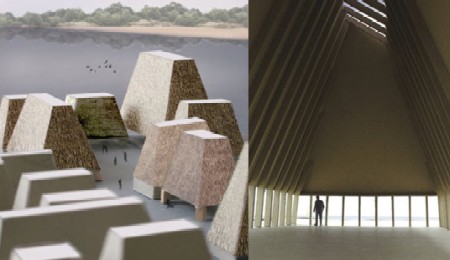
zero carbon ‘floating’ development for Preston

Green, innovative and zero carbon project development on our doorstep in Preston, Lancs, !

The RIBA have recently awarded a zero carbon design as the visitor center at the new Brockholes Wetland and Woodland Nature Reserve in Preston, to regenerate a former quarry site into a major visitor attraction.

The project called “A Floating World”, consists of zero-carbon floating buildings (the name coming from the fact that the zero-carbon buildings will be built on an island of floating pontoons)

Adam Khan Architects, won the RIBA design competition to work on the ‘jewel in the crown’ of Britain’s largest eco-regeneration scheme. The project is zero-carbon in both use and production, with materials of low embodied energy – thatch, willow, timber, with off-site prefabrication and on-site energy generation and waste treatment.

Floating world will feature cafe, shops, gallery, education areas and meeting rooms and is part of the £59 million Newlands Scheme, a project that will turn 900 hectares to community woodland and green space.

On announcement of the winner, Peter White, Head of Infrastructure & Development at the Northwest Regional Development Agency said:

“This site has the potential to become an important visitor attraction for the region, building on its rich natural assets and impressive biodiversity. The Agency is supporting its development through Newlands, a wide reaching scheme that aims to reclaim brownfield land and transform it into thriving community open spaces, and has so far invested £800,000 in Brockholes. The chosen design will not only create an inspirational open space for the local community to enjoy but will also enhance a key gateway into Lancashire and attract further investment into the area. We look forward to working with our partners to progress these plans.”

More on this as the project develops …

can data centers power all homes …

How green is your data center? Stumbled upon an amazing post and comments over at The It Sanctuary

According to figures from IT market research company Forrester Research, a data centre with 2,500 servers – relatively small compared to many out there – will devour enough electricity over the course of one month to power 420,000 homes for a year. *

That’s bad news for the environment – and it also takes its toll on a company’s bottom line. Analysts at IT market analyst firm Gartner calculate that energy expenditure typically accounts for about 10 per cent of the IT budget, and is likely to rise to as much as 50 per cent over the next few years, as energy prices continue to soar.

As the comments on the post hint at – how well is IT covered within an organisations ISO 14001 scope, impact and assessment exercises? Or even within their CSR, Corporate Social Responsibility remits? With something like 60% of a buildings / organisations energy requirement being IT related, it needs to be a central theme.

But its the ability of data center energy to power homes that needs urgent investigation. If these numbers are correct thats a staggeringly high, unbelievably high, number of homes and would resolve the domestic electricity demand at a stroke. I will check the research and invite Forrester Research to comment here,

ecological cities

Now the Eco City World Summit 2008 has concluded there is a rich source of live blog reports, reviews and videos over at the Eco City blog.   Go view and mine the collective source of global views on the future of cities

If you take away one thing from the summit : the ecological city message is summed up in the BBC Interview on the World service with Richard Register.

Other recommendations:

worldchanging ecocity highlights

Holly Pearson live blogged:  An incredible assemblage of the world’s brightest minds that are working to build greener cities and towns gathered for three and a half days of presentations, discussions, city tours, arts & culture, and celebration. As an urban planner for whom the sustainable cities movement is not only a passion but also a raison d’etre, professionally speaking, I found the conference to be nothing short of mind-blowing.

A Convenient Truth: Urban Solutions from Curitiba, Brazil

documentary focusing on innovations in transportation, recycling, social benefits including affordable housing, seasonal parks, and the processes that transformed Curitiba into one of the most livable cities in the world.

Brent Toderian – City of Vancouver’s Director of City Planning,  many projects related to the 2010 Winter Olympics, and visioning/CityPlans, including the new “EcoDensity” – the most livable city in the world, removing car facilities from the city, through a travel plan than favours walking.

Jaime Lerner Key Note

odd link

After mentioning Thoreau … yesterday

From Torontoist:

“This year, a more cryptic stencil has appeared on the Humber Bay Arch Bridge, boldly proclaiming “ISBN 486-28495-6” for all to see and ponder. This International Standard Book Number turns out to be a paperback edition of Henry David Thoreau’s Walden; Or, Life in the Woods.

In Walden, Thoreau wrote, “A lake is the landscape’s most beautiful and expressive feature. It is earth’s eye; looking into which the beholder measures the depth of his own nature.”

Photo by Val Dodge.

Posted by marc at 10:30 AM

From Marc Schillers excellent Woostercollective blog, 29 April 2008. Now awaiting some sort of explanation!

environmental literature top 5

Looking at the search topics entered to land at isite, the subject of environmental literature, movies, music and people features large. So starting a new mini series of environmental muses, I scanned my book shelf for what I would consider five of the more important environmental literature that has influenced my thinking over the years. Other topics will include music, environmental handbook or guidance texts, videos and people that have shaped my views.

Environmental Literature top 5:

Very much influenced by ecology, relationships with the great outdoors and connectivity with nature, these are not about climate change, about zero carbon or even sustainability, but fundamental to my understanding of how we approach environment and ecological issues.

Yvon Chouinard – Let My People Go Surfing: The Education of a Reluctant Businessman 

An autobiography that brings CSR firmly into business. Every time I have done the write thing for the environment I have made a profit write Chouinard, founder of the Patagonia clothing organisation. Any organisation serious about Corporate Social Responsibility should read and learn from this one.Not surprisingly Anti Roddick recommended this book for every school teaching business.

Henry Thoreau – Walden: Or, Life in the Woods 

The classic, often quoted, I first read this in-situ in New England in the late 1970’s after visiting Walden Pond, and remains a book that I dip into again and again. The notion of living simply in a cabin in the woods has always been appealing – but for me it would now be on the Isle of Skye with Internet access!

Aldo Leopold – A Sand County Almanac: With other Essays on Conservation from `Round River’ (Galaxy Books)

Aldo Leopold was an American ecologist and environmentalist, For me this contains a classic passage that still haunts me when I read it – reminding us of the connection we need to find between everyday life and nature.

We reached the old wolf in time to watch a fierce green fire dying in her eyes. I realized then, and have known ever since, that there was something new to me in those eyes—something known only to her and to the mountain. I was young then, and full of trigger-itch; I thought that because fewer wolves meant more deer, that no wolves would mean hunters’ paradise. But after seeing the green fire die, I sensed that neither the wolf nor the mountain agreed with such a view.

John Muir, My First Summer in the Sierra: The Journal of a Soul on Fire 

A journey in which Muir makes connections with nature. In the UK The John Muir Trust is one of the country’s leading guardians of wild land and wildlife. The Sierra Club, which he founded, is now one of the most important conservation organizations in the United States. His writings and philosophy strongly influenced the formation of the modern environmental movement.

Robert MacFarlane The Wild Places

A tour through McFarlane ‘s Wild Places in the UK serves as a reminder of why we need wild places, and what wildness means to us, even if we don’t get to see them, and only view them from maps, TV programmes and sat navs. It is also a book that laments about ecological damage. It is about experiencing the wild places, some to be found in very unexpected places. And in the case of McFarlane, experience means sleeping wild, including on frozen Lakeland tarns – and swimming in wild waters.

Limiting this list to 5 was hard and had to leave out Jim Perrin one of our best current essayists – from his 1970’s essay on the Centre for Alternative Technology (within Yes, to Dance: Essays from outside the Stockade) to his current piece in The Great Outdoors and Roger Deakin’s Wildwood: A Journey Through Trees

What would you add? What are your environmental literature muses?

resource efficiency could save construction industry millions

The latest report from the EA (The Environment Agency Science Report – The economic and environmental benefits of resource efficiency in construction ) calls for better resource management in construction. For this to happen, the report recommends Continue reading

Eco City 2008 videos

Videos from Eco City 2008 day one presentations are now up on the Eco City Blog.  As expected the key note speech from Lerner is well worth the view.  I will try to upload to here.

Reducing the environmental impact of existing non-domestic buildings

Addressing the existing uk building stock and in particular non domestic stock is mush talked about – but unlike housing not too much action as yet.

The All Party Urban Development Group is undertaking its latest inquiry, exploring ways to reduce the environmental impact of existing non-domestic buildings that are concentrated in our city centres and business districts. It will examine:

  • improving energy efficiency of existing urban buildings;
  • barriers to reducing emissions from urban buildings; and
  • the policy initiatives needed – including regulation, fiscal incentives, penalties and educational campaigns – to address these barriers effectively

More talk – or start of something with teeth?

There is also a Call for Evidence.