Monthly Archives: April 2019

XR: The Extinction Symbol, Business and the Built Environment

The current use of the extinction symbol by Extinction Rebellion, is establishing the symbol as the image of climate breakdown akin to the (CND) peace symbol. In addition, the vision, messages and demands from Extinction Rebellion, (echoed by Greta Thunberg, the SchoolsStrike4Climate and David Attenborough’s BBC Climate Change: The Facts) is resonating with business and the built environment sector. And as I mentioned in a tweet this morning – XR has done more for climate change, climate breakdown awareness than the sustainability movement has done, with (as the Guardian reported) Support for Extinction Rebellion in the UK has quadrupled in the past nine days as public concern about the scale of the ecological crisis grows.

The symbol represents extinction. The circle signifies the planet, while the hourglass inside serves as a warning that time is rapidly running out for many species. The world is currently undergoing a mass extinction event, and this symbol is intended to help raise awareness of the urgent need for change in order to address this crisis. Estimates are that somewhere between 30,000 and 140,000 species are becoming extinct every year in what scientists have named the Holocene, or Sixth Mass Extinction. This ongoing process of destruction is being caused by the impact of human activity. Within the next few decades approximately 50% of all species that now exist will have become extinct. Such a catastrophic loss of biodiversity is highly likely to cause widespread ecosystem collapse and consequently render the planet uninhabitable for humans.

https://www.extinctionsymbol.info

Although aimed at the Government, we can learn from XR – their demands are very closely aligned to those seeking a regenerative built environment

Extinction Rebellion ‘Demands’:

1 ACKNOWLEDGE: tell the truth by acknowledging and declaring a climate and ecological emergency, working with others to communicate the urgency for change

2 ACT: Act now to halt biodiversity loss and reduce greenhouse gas emissions to net zero by 2025

3 COLLABORATE: create and be led by the decisions of a Citizens’ Assembly on climate and ecological justice.
The recognition that the XR movement is ‘on to something’ is being recognised by business and the built environment – see for example An Open Letter to Business Supporters of Extinction Rebellion by Jim Bendell and It’s time to dump Earth Day and join the Extinction Rebellion by Lloyd Alter

We believed that we had time and techniques to reform this capitalist system towards something sustainable. It was a wonderful idea at the time, and even got its swansong with international agreement of sustainable development goals

Jem Bendell

Decarbonization by 2025 is a very tough goal, but …we have met tough goals before. We won’t get there by looking at bird photos and picking up litter on Earth Day once a year

Lloyd Alter

This mornings twitter conversation …

Neil Swift @NeilGSwift  Construction one of the biggest emitters XRconstruction could do good business?@invisiblstudio @FCBStudios @ArchitypeUK @fairsnape interested in your thoughts?

Martin Brown @fairsnape Indeed @NeilGSwift current activity @GretaThunberg @ExtinctionR #DavidAttenborough has done more to raise #ClimateBreakdown awareness than built environment sector has ever done, despite our products being (40%) of problem. We need a #XConstruction mindset urgently

Where to start? … ‘tell the truth’, … acknowledge a #ClimateEmergency exists and our built environment role .. and set zero carbon targets for 2025,

Martin Brown @fairsnape At the moment we are on track to fail our own industry strategy target carbon reduction 50% by 2025 … how will we explain that to next gen? #XConstruction

Whether you agree with Extinction Rebellion approach, or not, we need all means, advocates, media and approaches to raise awareness, tell the truth and starting acting.

USE OF EXTINCTION SYMBOL: No extinction symbol merchandise exists, and it never will do. The free use of the extinction symbol by individuals in their personal artwork or other forms of expression is strongly welcomed and encouraged, but any form of commercial use of the symbol is completely against its ethos and should therefore be refrained from. To reiterate, please do not use the symbol on any items that will be sold, or for any other fundraising purposes. There are no exceptions to this policy.
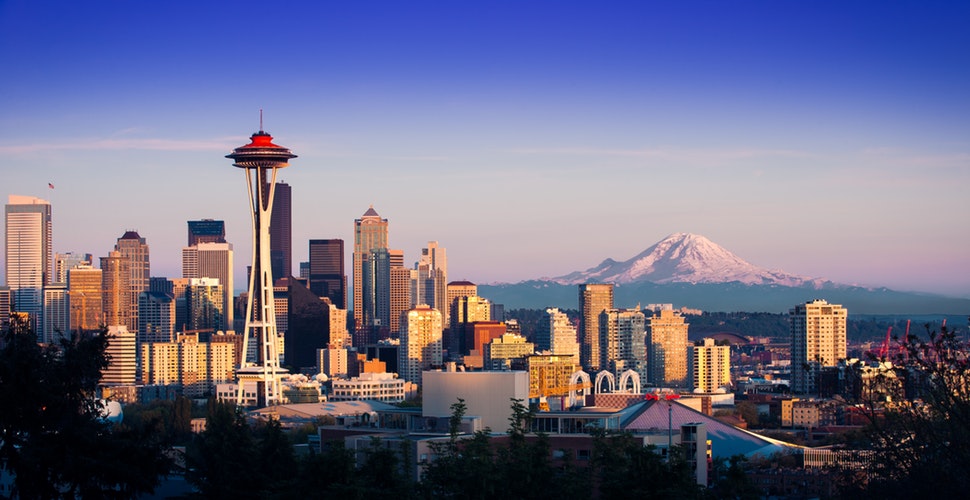
Collaboration + Abundance. A global community of change-makers. LF19

Looking forward to attending the ILFI Living Future 19 Conference in Seattle at the end of the month. A chance to catch up with brilliant colleagues from around the word who are advocating and pushing for a regenerative and just future. A global community of changemakers.

With a theme of Collaboration and Abundance there are a number of workshops and keynotes that are on my to do list, including; the launch of the Living Building Challenge 4.0 and the Bill McKibben and Mary Robinson keynotes.

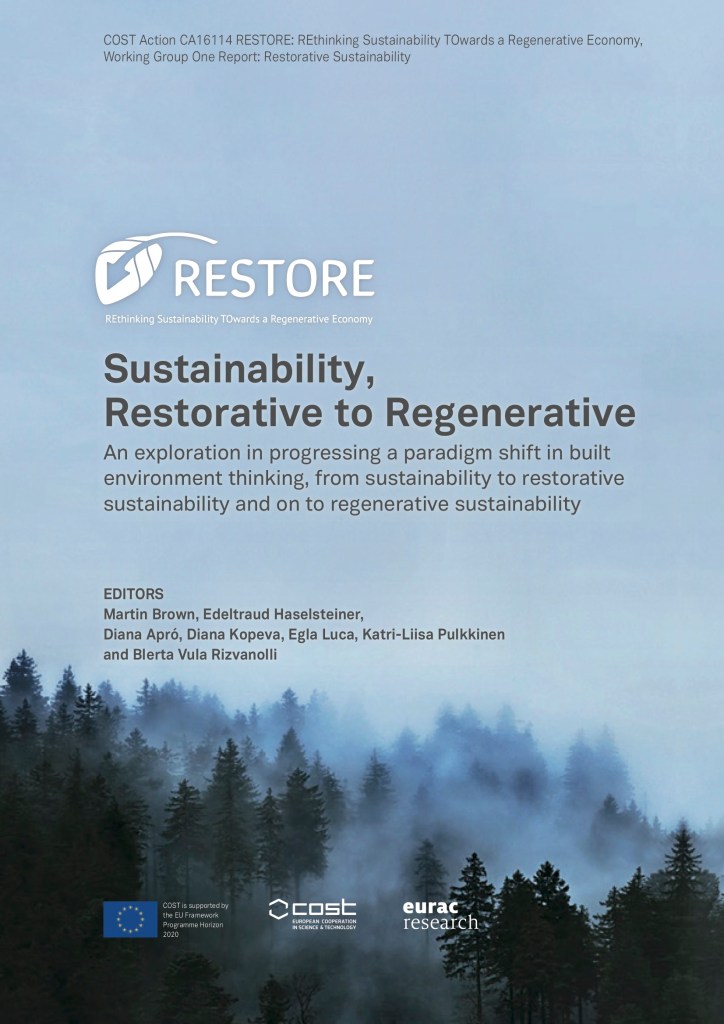
With colleagues from RESTORE, Carlo Battisti and Emanuele Naboni we will be sharing insights and the ground breaking work on regenerative sustainability, regenerative design and construction in Europe from the first two years of EU Cost ActionRethinking Sustainability Towards a Regenerative Future

Against a backdrop of school climate activists,, Extinction Rebellion, warnings from the IPCC that give us just 12 years to avoid irreversible climate collapse, and the doomsday scenarios in Uninhabitable Earth, the need for swift progress to a regenerative future is vital.

Extinct Rebellion
school climate activist 

Our 40% Sector

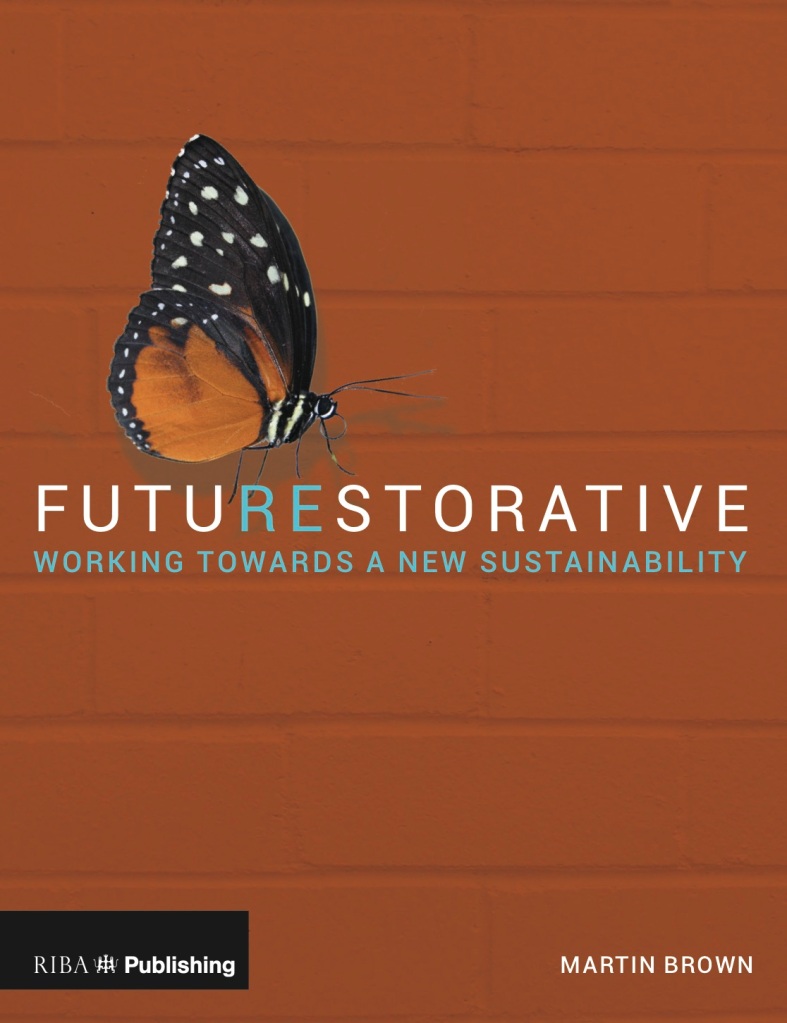
Within FutuREstorative I explored the 40% impact that the built environment has on climate change, on the environment and the people who work in or are affected by the sector.

Somewhere, somehow, in recent years the built environment sector has picked up the label of being the 40% sector, based on its (mostly) negative impact on the environment. Whilst many of the 40% ‘claims’ may be seen as anecdotal, even urban myth, they are very close to research based evidence, performance data or published papers.

Over recent years a number of events and conferences have been held to explore the 40% figure. Perhaps there is even a sense of pride in the 40% tag, rather than a sense of guilt. We should not and cannot be satisfied with targets of reducing carbon by 40% by 2025, for example, or reducing waste to landfill by (just) 50%, as stated in recent strategies.

We need the thinking, courage, leadership and aspiration within the whole industry to turn this around – with aspirations to become the 40% net-positive sector. To consider this impossible is to view impossibility as a fact, not an opportunity or challenge.

Here is an update from an earlier 2016 post with the background facts and figures that led me, and others, to call the built environment the 40% sector. (References including those cited in FutuREstorative are included at the end of this post.)

  • The built environment generates around 40% of all carbon emissions in the UK.
  • Construction accounts for 40% of the total flow of raw materials into the global economy every year (1)
  • 40% of a nation’s health costs are attributable to the built environment.
  • In 2014, 41% of total US energy consumption was consumed in residential/ commercial buildings – about 40 quadrillion British thermal units.(2)
  • Construction consumes over 40% of Europe’s energy and resources.
  • The built environment accounts for 36% of EU CO2 emissions and 40% of total EU energy.(5)
  • Lighting represented about 25% of energy use in 2010 and nearly 40% of carbon emissions within the non-domestic sector.
  • In 2050, capital city carbon will represent nearly 40% of the built environment’s emissions (versus 18% in 2010).
  • 40% of construction carbon is locked into material and waste transportation.(6)
  • Due to its significant environmental impact, the construction sector is now increasingly quoted as the “40% industry”; 40% of all energy and material resources .. 40% of CO2, 40% of waste from building and demolition (5)
  • 40% of the occupational cancer deaths and cancer registrations were from the construction industry (IOSH)
  • 42% (349MtCo2e) of UK carbon footprint attributable to built environment (UKGBC)
  • According to the latest Global Status Report from the Global Alliance for Building and Construction (GlobalABC), it is responsible for approximately 40% of energy-related greenhouse gas emissions. These emissions are found particularly in the construction (embodied carbon) and the operation (operational carbon) of buildings. (WBCSD)
  • In developed economies , the building sector accounts for up to 40% of total energy use, 30% of raw material use, almost 40% of greenhouse gas emissions and up to 40% of solid waste generation (6)
  • Buildings account for around 40 per cent of UK energy consumption UK Gov Construction Sector – Industrial Strategy
  • Buildings and construction are responsible for some 40% of energy consumption and related GHG emissions globally (Global Climate Action Summit)
  • Buildings are responsible for approximately 40% of energy consumption and 36% of CO2 emissions in the EU (7)
  • 30-40% traffic on road is construction related (WRAP)
  • 47% total construction cost consumed by waste and inefficiency (CALIBRE)
  • 37% total construction time is non productive (IBE partnerships)

Global Resources used in buildings (Willmott Dixon} (8)

  • Energy 45–50 %
  • Water 50%
  • Materials for buildings and roads (by bulk) 60%
  • Agricultural land loss to buildings 80%
  • Timber products for construction 60% (90% of hardwoods)
  • Coral reef destruction 50% (indirect)
  • Rainforest destruction 25% (indirect)

Estimate of global pollution that can be attributed to buildings(Willmott Dixon} (9)

  • Air quality (in cities) 23&
  • Climate change gases 50%
  • Drinking water pollution 40%
  • Landfill waste 50%
  • Ozone depletion 50%
  • The US construction sector contributes to 23% of air pollution, 50% of the climatic change, 40% of drinking water pollution, and 50% of landfill wastes
  • Research by the U.S. Green Building Council (USGBC), the construction industry accounts for 40% of worldwide energy usage, with estimations that by 2030 emissions from commercial buildings will grow by 1.8%.
  1. http://www.businessandbiodiversity.org/construction.html
  2. http://www.eia.gov/tools/faqs/faq.cfm?id=86&t=1
  3. https://ec.europa.eu/energy/en/topics/energy-efficiency/buildings
  4. http://www.constructco2.com
  5. (UNEP 2003 in Country Profiles on the Housing Sector: Russian Federation)
  6. (https://www.eurima.org/sustainable-construction.html)
  7. https://ec.europa.eu/energy/en/topics/energy-efficiency/energy-performance-of-buildings
  8. Hawken, P., Lovins, E and Lovins, H, Natural, Capitalism – Creating the next Industrial Revolution
  9. Brown MT, Bardi E. Handbook of energy evaluation. A compendium of data for energy computation issued in a series of folios. Folio #3: Energy of ecosystems. Center for Environmental Policy, Environmental Engineering Sciences, University of Florida


Questioning Sustainability

Again the question of what we mean by sustainability has arisen from various directions, and will, no doubt, continue to do so … Prompted by reading Lloyd Alters recent post in Treehugger, here are my thoughts …

Lloyd Alter in his TreeHugger post What’s a Better Term for Sustainable Design, calls for a vote between Sustainable Design and Responsible Design, citing standards such as One Planet Living, Living Building Challenge that go beyond sustainability.

I have long hooked on to a comment from Yvon Chouinard (Patagonia, The Responsible Company) that we should not be using the word sustainability until we give more back than we take, and that’s more back to the environment, but also to the place and culture in which we are based, the people we live and work with, those who work for us, and the society & communities in which we live work and play.

I am co-editing chapters for the forthcoming RESTORE Regenerative Design publication that also borrows much from regenerative standards, whilst embracing ecological perspectives, such as Commoners four laws of ecology. I would offer regenerative design as an alternative to sustainable or responsible design.

Listening to Bruce Springsteen’s brilliant Broadway performance I was struck by his piece on 1+1=3 – this is regenerative sustainability. It’s where the magic happens, it’s the magic of rock and roll, classical music, poetry where the sum of parts is far greater than the parts. Currently buildings and products struggle to make 1+1=2.

RESTORE 2018 publication (Sustainability, Restorative To Regenerative) defined regenerative sustainability as enabling eco and social systems to flourish but also pushed thinking forward, to embrace a Seva approach, where we design as part of nature, rather than apart from nature (the Eco stage). It requires a paradigm switch in how we see ourselves as part of nature.

This was highlighted on my recent visit to Future Build where more than one green building supplier used the expression of giving nature a home within our buildings. Seva thinking would reverse this, to promoting green build products that nature would tolerate in its home.

It is when the capacity of a place to sustain itself becomes ruptured that the human mind is forced to reflect upon ecology. Only then do most of us consider the interconnections between plants and animals and their environment. Ecology teaches that you cannot damage one part of a system without causing knock-on effects elsewhere. From Soul and Soil by Alastair McIntosh (a book I am currently reading described as ‘extraordinary, weaving together theology, mythology, economics, ecology, history, poetics and politics as the author journeys towards a radical new philosophy of community, spirit and place)

The abstract and papers for the forthcoming American Geographers event Nature’s New Urban Worlds: Questions of Sustainability perhaps reflects the current zeitgeist, where nature is being used in the design and forging of new urban worlds.

Within FutuREstorative: Towards a New Sustainability I flagged how the language we use is important, for clarity in what we are describing and attempting to achieve, but also in the often combative adversarial expressions we use, (of competitions, wining, beating etc) adopted from business and no doubt Sun Tzu’s Art of War thinking, and that we rarely, (although I must admit more increasingly), hear words of love, caring and compassion within the sustainability lexicon.

Is it ok to use the word sustainability?

My view, at the moment, is that it is ok to use the word sustainability, but not as something we have achieved, but as our striving for a tipping point (as per Chouinard’s quote). In this thinking we do not have many, if any, sustainable products or buildings. With perhaps exceptions such as natural, nature-based, building materials and buildings like the Bullitt Centre (not only for what it is today but also the ethos and philosophy on the way it was envisaged and designed)

I will be describing the work of RESTORE and the thinking behind Ego, Eco, Seva at the Living Futures 19 conference in Seattle on 2 May.

Time for Natural Climate Solutions

“The world faces two existential crises, developing with terrifying speed: climate breakdown and ecological breakdown. Neither is being addressed with the urgency needed to prevent our life-support systems from spiralling into collapse”.

So starts an open letter, initiated by George Monbiot and signed by a raft of influential climate, ecology and sustainability thinkers.

Natural Climate Solutions is a new initiative (website) calling on governments to back natural climate solution measures and “to create a better world for wildlife and a better world for people”. It should also be a call to us all in built environment sectors.

“We are championing a thrilling but neglected approach to averting climate chaos while defending the living world: natural climate solutions. Defending the living world and defending the climate are, in many cases, one and the same.”

Signatures to the letter and the Natural Climate Solutions include:
– school strikes activist Greta Thunberg,
– climate scientist Prof Michael Mann,
– writers Margaret Atwood, Naomi Klein and Philip Pullman
– campaigners Bill McKibben, David Suzuki and Hugh Fearnley-Whittingstall.
– former archbishop of Canterbury, former president of the Maldives, musician Brian Eno
– advocacy group directors John Sauven, Greenpeace UK, Craig Bennett, Friends of the Earth,Ruth Davis, RSPB, Rebecca Wrigley, Rewilding Britain

Recent research indicates that about a third of the greenhouse gas reductions needed by 2030 can be provided by the restoration of natural habitats, but such solutions have attracted just 2.5% of the funding for tackling emissions.

This is a huge issue for the built environment sector, where costing of approaches for technical carbon reduction solutions far outweigh costing of drawdown of carbon through living systems associated with our buildings and cities. If natural living systems are even considered as carbon solutions that is, to meet our Construction Vision target of carbon reduction by 50% by 2025.

We still see carbon as the enemy, through our too often one sided approach of reduce, reduce, reduce … So, given that, according to the IPCC, we have 12 years to avoid irreversible climate breakdown here are four actions we should embrace today:

  • Ecologists and Landscape Architects now, urgently need to become project leads.(1)
  • Locked in carbon should be the reported key carbon performance indicator and driver, not just the (scope1 and 2) carbon footprint
  • Lets start talking about upfront carbon and not embodied carbon. What matters is the carbon that is being emitted today, and the carbon that is being locked away today .(2)
  • Zero carbon is not enough, we can do better and go beyond zero, we don’t have time just to reduce carbon to zero.

How this aligns with my thinking, keynotes, advocacy and support for built environment client, design, contstruction, fm and academic organisations …

  • Rethinking Carbon – our need to focus on durable and living systems, not just fugitive carbon (3)
Ego, Eco, Seva
  • We need to move from the Eco phase we are currently locked into – to a Seva mindset, where we see buildings as part of nature, the natural ecosystem, not apart from it. (4)
Published 2016
  • FutuREstorative, published in 2016, explores natural and rewilding solutions enable the built environment to address climate breakdown
  • Advocacy, client and project through Living Building Challenge that drives for an ecologically robust future with imperatives such as habitat exchange, urban agriculture and more.
  • Exploring rewilding and regenerative agriculture thinking and its relationship with the built environment.

  1. this was the topic of a Specifi Think Tank in 2018 and received favourable agreement
  2. thanks to the TreeHugger ‘Upfront Carbon’ article by Lloyd Alter (et al) for this
  3. Carbon is not the Enemy
  4. A key outcome in the EU Cost Action RESTORE working group 1

Natural Climate Solutions … a small group of people working voluntarily to raise awareness of natural climate solutions and champion the work of organisations working in this field. who encourage you to support local projects, campaigns and initiatives near you and help ensure that this crucial and exciting answer our global crises receives the attention it deserves.

Blog post based on the Guardian, D Carrington, Article 030418