Monthly Archives: May 2020

Plastic: Are we good ancestors?

Plastic is the substance that has served as our most perfect container – and that now overwhelms our systems of containment.

Robert Macfarlane, Underland

Along with friends from the Longridge Environment Group I had the opportunity to co-view the Story of Plastic film recently courtesy of Chester and District FoE. The film was scheduled for box office cinema release but the Corona Virus has put paid to that.

The Story of Plastic travels around the globe, with time spent speaking with plastic sorters and zero waste activists mainly in Asia, and exposes a world wide seemingly unsurmountable catastrophe driven by corporate interests.

My overall feeling was that Plastic is one big social justice issue, that recycling is flawed. (Only 91% of plastic is effectively recycled) and that we really do need to understand the whole plastic life cycle story. In particular, understand how the fossil fuel and big chem industry is grooming those countries with poor waste facilities and regulations, with the false promise of a better world of plastic. This is in much the same way we in the west were groomed, way back in the 50’s and have been since, with promises of a throw away world, a world of Tupperware and of no more washing up.
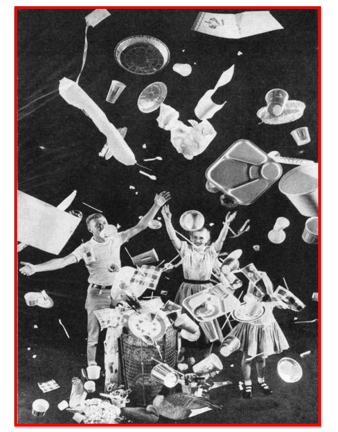
A biochem corporate voice in the 50’s promoting plastic promise’s us ‘the best is yet to come’

The Story of Plastic exposes the sham of recycling, that the whole life cycle of plastic is only possible because we have poverty to deal with our throw away culture. Enabling us to make room for more. Whilst seemingly complying with laws in the west, there is disregard for environmental responsibility elsewhere – for example shampoo sold in ‘recyclable’ bottles here (for which manufacturers contribute towards recycling) – but is sold in un-recyclable sachets in Indonesia (prohibited in the west and for which manufactures make no contribution on cleaning up)

Maybe we have focused too narrowly on reducing and eliminating single use plastics – the use once and last forever plastics – such as straws, coffee stirrers and bottles, and so our actions need to go deeper.

The film concludes with hope, with respair emerging from the despair, in the shape of EPR, Extended Product Responsibility and a Circular Economy, soon to be embedded in EU and hopefully UK legislation, to varying degrees and effectiveness. Such legislation cannot come soon enough, and needs to be global.

One of the first sustainability pecha kucha presentations I made some 10+ years ago, entitled Waste is Stupid, looked at the ‘Design Requirements’ made in Cradle to Cradle (and then borrowed for FutuREStorative some ten years later) concluding with what if we could rethink the way we made things, what if construction generated no plastic waste, and what if we had no toxic (Red List) materials in our buildings. Sadly 10 years on we need to ask the same questions

Alongside this viewing I am currently re-reading Underland, A Deeptime Journey by Robert Macfarlane as part of the Emergence Magazines book reading club. Macfarlane makes a number of comments on plastic, but the most striking and concerning, is how will we be looked upon by future generations in a future deeptime, when the surviving strata level, unearthed by future archaeologists, representing our age is one of plastic, and as Macfarlane asks, Are we good ancestors?

Philip Larkin famously proposed that what will survive of us is love. Wrong. What will survive of us is plastic,

Robert Macfarlane, Underland

Story of Plastic Trailer Link

The Longridge Environment Group have a showing of The Story of Plastic on the 27th May

Support this blog by becoming a Regenerator Patreon.

Construction: the next normal

As construction along with other sectors emerges from varying degrees of Corona lockdown we have an opportunity, a rare opportunity and the only one we may have in our life times to shape the next normal. Across the globe, the lockdown has provided many with benefits and appreciation of wellbeing, of deeper connections within family, friends, communities and of nature. Indeed nature, with clear skies, louder bird song and cleaner air has given us a preview of what our world, and our lives could be like. Lucy Jones writing in the Guardian sums this up in “Noticing nature is the greatest gift you can get from lockdown”

What then, for construction and the built environment. I was asked just this week to comment on a number of bullet points that have underpinned many construction training modules. It struck me they represented the old normal, the pre-covid normal, and one that we cannot, do not want to, return to, but one that we have to work, collaboratively to embed as the next business as usual. Whilst areas of the built environment have made impressive and huge advances on professionalism, business responsibility, sustainability, wellbeing and quality, there is much much more to be done.

Here then are my thoughts for the next normal, influenced by gems from the recent Living Futures 20 online conference and the wonderful insights from my guests on the Zoom Regenerative (ZR) series (See Footer Note)

The Old Normal: Understanding Clients NEEDS not Wants – What will Add Value to their Business – going Beyond Construction Go beyond understanding – anticipating customer needs before they articulate them    *   Your Differentiator?  – Why YOU – They know You can Build. So what?

The Next Normal: Be equipped with your unique and comprehensive tool box that everyone in the business can use – A tool box of soft and hard tools that are regenerative, not just focused on reducing impact, one that that can be opened up and offered to clients as appropriate. Successful organisations are skilled and flexible in all leading approaches Educate everybody quickly. We can all be regenerators, and collaboratively enable & cultivate living places, buildings and systems that thrive.

The Old Normal: Price is King – How are your solutions delver Value for Money – Cost, Time and Carbon Reduction – Meet Construction 2025 Targets

The Next Normal: Price is no longer king, but a balance and blend of many success indicators. Construction 2025 targets have been eclipsed by other targets – from the SDG’s to Paris 1.5DegC to IPCC and RIBA 2030 Challenge to name a few. What does this new landscape mean to construction targets. We need to reimagine a new construction Value for Money

Coming out of lockdown 80% public in a poll what health and wellbeing priority over GDP, so what will this mean for buildings, offices, homes, staff, construction sites?
We need to learn how to count in carbon, to become carbon literate, and to know what the carbon numbers mean for the construction economy, business profits and project success.

The Old Normal: Sustainability – Social, Economic, Environmental and Well Being- Going Beyond Accreditations !!

The Next Normal: We can no longer certify business as usual, we need to recognise and certify positive impact, and …
– Commit to climate action and decarbonise everything;
– Stop using anything single use , anything fossil fuel based, any red list material:
– Ask the What if questions – What if as in nature we generated no waste, what would construction look like with no disposable plastic?  
– Invite life (nature) back to projects, construction sites, understanding seasonal and ecological cycles, become ecology literate

The Old Normal: No Surprises – Predictability of Performance during Construction and in Whole Life

The Next Normal: Change the language in contracts, in offices and projects  – talk of love, compassion, collaboration, thriving and stop using competitive war words, talking of winning, beating, competitors and yes buts. Build relationships beyond transactions and profit. Act with urgency, passion and joy 

The question we now need to ask is, what light, fresh baggage will we take with us into the next normal (regenerative, collaborative, relationships, empathy, healthy) & what heavy, stale, baggage will we leave behind (conflict, pollution, waste, modern slavery, toxic) 

There’s a Buddhist teaching that says “What you think, you become. What you feel, you attract. What you imagine, you create.” Let’s move out of an obsession with the construction world we don’t want and start a revolution bringing into being the world we do want.

Zoom Regenerative (ZR)

ZR is a weekly zoom event celebrating regenerative buzz, thinking and activity from around the globe.

“Like a tree in a forest we will know that we are not alone, but part of a web, a network of life, healing, helping, nurturing each other, as it should always have been…” Llewellyn Vaughan-Lee

ZR is emerging into a wonderfully engaged and growing community that covers regenerative themes from Cycling to Energy, from Regenerative Business to Landscaping, from Carbon to Biophilia, from Construction to Rewilding, from Art to Economics, from BIM to Social Thriving and beyond… 

[UPDATE] Please please do read this wonderful post from Michelle Holliday, a recent ZR guest

Each weekly show is promoted through linkedin and twitter, (#ZoomRegen) but if you would to be placed on a mailing list please do contact me

Braided Reciprocity

Whilst writing a technical built environment blog post on emerging from the crisis of lockdown, I tuned into a wonderful book group session on Zoom with Robin Wall Kimmerer and Robert Macfarlane, with Robin reading from her book Braiding Sweetgrass, an exploration of our sense of place, our sense of reciprocity with nature.

Discussions between Robert, Robin and in the chat grounded on ‘reciprocity’ with nature, with place and with community, citing our 8pm UK hand clapping for key workers ” a beating of pots and pans with gratitude and reciprocity” Illustrating the power of the softer, arguably more urgent and important aspects of connectivity with nature and each other as we exit from lockdown and isolation.

One of the participants on the discussion was write David Abram, who by chance popped up in a tweet mention from Daniel Wahl this morning, quoting from Abram’s article in Emergence Magazine, (who hosted the book event, the nature writing course I am taking and other upcoming book reading groups as part of their community outreach)

Abrams writing “In the Ground of our Unknowing’ is insightful ‘finding beauty in the midst of shuddering terror, and isolated, we can turn to nature to empower our empathy for each other …. “

Right now, the earthly community of life—the more-than-human collective—is getting a chance to catch its breath without the weight of our incessant industry on its chest.

Much that influences the future shape of our societies will ride on how we emerge from this crisis—assuming we do emerge—how we transition out of the strangely suspended dreamscape in which we suddenly find ourselves adrift.

Governments and their administrative agencies will play their roles as best they can, each trying to claw or engineer its way back into the daylit realm. But the textures and tastes that eventually come to predominate, the rhythms of community in our bioregion, the generosity and convivial ethos of the larger body politic—or the robotic and bureaucratic rigidity of that body politic—will to a large extent be determined by the choices each of us makes in this cocoon-like, shape-shifting moment.

The future will be sculpted, that is, by the elemental friendships and alliances that we choose to sustain us, by our full-bodied capacity for earthly compassion and dark wonder, by our ability to listen, attentive and at ease, within the forest of our unknowing.