Category Archives: comment

#PQQplus Tips: No 3: Innovative Responses

In addition to including innovative content and experience in bids, be sure to make use of freely available social media that can demonstrate how innovative and forward thinking your organisation is. 

For example:
  • link to innovative products, processes and or awards for example
  • link to your staff linkedin profiles, in particular your proposed project manager!
  • link to any relevant presentations or slides on slideshare
  • and of course make use of URL shorteners (such as http://bit.ly/) to allow links to be used when the document is printed
Not only will such use of social media show innovative flair, it is for the time being a real differentiator, and makes maximum use of word limits.

However, as with all submissions ensure that content and any links are independently checked, either in house or externally, allowing good time to make amendments and improvements before submitting to your client.

#PQQplus Observations Comments and Tips: No 2 Know the Score

Well written and well crafted PQQ documents contain the scoring and weighting system that enables bidders to focus on what is important to the client, project or framework. Sadly many don't and leave respondees making assumptions and second guessing.

For clients and those producing PQQ's:
Ensure that the scoring and weighting you will use to assess the responses are included and communicated. This really does help the bidder focus on what is important to you, should make your selection easier and ensure a good fit with the selected contractor or project team.

For contractors:
If the PQQ does not contain the scoring and weighting that will be used in assessing your submission, don't make assumptions or second guesses, but ASK the client for it. If you don't one of your competitors may well do so (although this should then be shared across all bidders)  Only by knowing what is important to the client through the weighting used will you be able to produce a focused and hence winning bid.  If, after asking, there is still no scoring system available, use your intel and knowledge from previous bids, including bid feedback, for that client, or knowledge gained by yourselves or your subcontractors in working with that client.

#PQQplus Observations Comments and Tips: No1 The Questions

I review a fair number of PQQ's for contractors and designers immediately prior to submission to their clients, this blog will share some of my observations, comments and tips for improving your bids. 

First up is the obvious one of answering the question, and answering all of the 'parts' of a question. Yes may be obvious but I would say that on every PQQ I see, frustratingly, at least one question (or significant part) hasn't been addressed.

Address the question with the response the PQQ is looking for, not what you want to talk about.

Use coloured highlighters to mark up the different aspects that a question may be seeking a response for and address appropriately.

Prior to submission get an independent person to review, within or outside of the organisation, to provide a critical assessment to ensure all questions have been answered.

In tough competitive times, maximising points and scores from each question is paramount. Leaving unanswered, incomplete, or poorly addressed is just throwing opportunity away 

Co-production, #bigsociety and community based facilities management #cbfm #fm

Another key piece of thinking in the Big Society and Community Based FM debate from NESTA

“Co-production means delivering public services in an equal and reciprocal relationship between professionals, people using services, their families and their neighbours. Where activities are co-produced in this way, both services and neighbourhoods become far more effective agents of change.”

What does the big society mean to construction and #facilities management?

Having tuned in to the Big Society in the North event on Tuesday night by twitter I was taken by the similarity of themes between the emerging big society movement and be2camp. (unconference, uses of social media, community engagement etc) And of course the influence that big society may well have in relation to the built environment, on design and construction but perhaps more so on facilities management.

I have started a be2camp group, simply as a discussion forum for big society thinking from a be2camp perspective, and who knows could lead to a be2camp event focused on big society thinking. 

It would be great to have examples of what innovations, products and projects fit into the big society debate. Lets try and keep them within the be2camp scope of thinking though. That is the theme of Web2.0 and social media within the context of the built environment, sustainability, resilience, collaborative working and community engagement.

One of the big, elephant in the room questions though still to be addressed is what is big society, what does this all mean?

A few leads may help:

Julion Dobsons blog Living with Rats

Big Society in the North network


and

The Big Society (Square Mile)

#CbFM Community Based Facilities Management – #FM contribution to #bigsociety thinking

Energy Efficiency in Facilities Management #FM: Guidance

Energy efficiency is becoming an increasingly important policy objective for the public sector organisations, not only because of the opportunity to minimise carbon emissions, but also because of the potential to unlock financial savings. Facilities managers have a key role to play in the delivery of energy efficiencies because of their responsibility for the operation and upkeep of the public sector estate.

This guidance is prepared for public sector sustainability and procurement professionals and their advisers to provide an overview of the issues and mechanisms which can be used in Facilities Management (FM) Contracts to drive energy efficiency.


This guidance was published in summer 2010 , and it is expected that as technologies and supplier best practice develops, it is expected that this guidance will need to be updated from time to time.

Out of Crisis: LCBPC Never waste a good crisis event.

Don Ward, Constructing Excellence presented to the Lancashire Construction Best Practice Club on Tuesday night, focusing on the Never Waste a Good Crisis report published at the end of 2009.  The report contains four messages:

The industry has improved over the last decade

4 blockers have slowed the pace of change

Recession may provide the impetus needed for change

Collaborative working is even more important for this next era

Collaborative working has been the foundation of industry improvement and as Don explained the root ‘solution’ for current industry themes of safety, people respect, improving value and addressing sustainability.

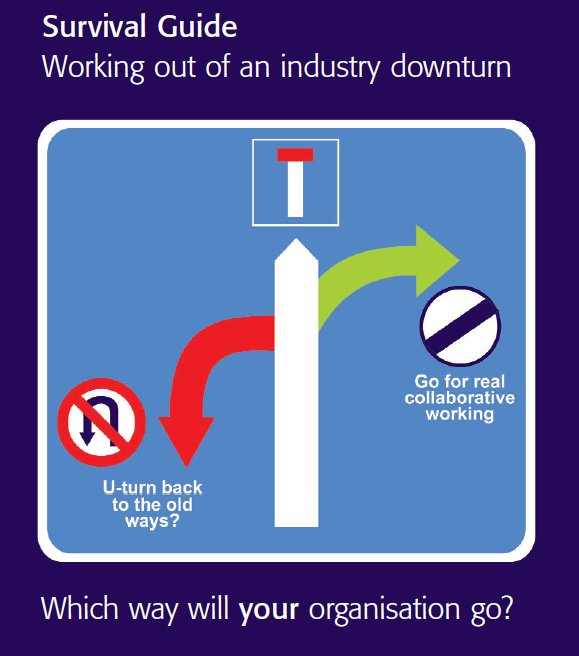
Don referred to the Collaborative Working Champions work and survival guide that stresses we need more effort to work collaboratively, doing nothing different is a dead end route and to revert to (adversarial) practices of the past suicide.

Addressing the question “what comes after frameworks”, the answer was “frameworks done correctly”, for improving value and not just as a cheaper or easier procurement route that can’t deliver value.  (After presentation debate talked of the increase in framework hubs, such as the North West Hub,  particularly as indications are that more public procurement will be done locally with end user management. These ‘new’ clients will look to join hubs that have ‘pre-selected’ contractors and designers.

As would be expected by anyone familiar with the improvement agenda, Don used the 1-5-200 approach to demonstrate the leverage of construction on business and organisational activity, reinforcing that we need to think business need, not buildings.

In the following excellent debate, concern was expressed by contractors on the expectation that they must continually reduce costs, profits and overheads, even when selected for frameworks. Consequently, argued Don, myself and others, there is a urgent need for reducing costs through the use of lean construction principles, identifying and reducing waste (time, energy, not just material waste) in construction, whilst at the same time addressing the carbon reduction agenda. Indeed the carbon agenda may well be driver here. It was pointed out we need to learn from other sectors who have adopted lean, throughout their supply chains and taken their lean solutions to the clients, rather than wait for project opportunities.

Don mentioned that the chief construction advisor Paul Morrell is mined to suggest that BIM ( Building Information Modeling) become compulsory for all public construction work, such are the benefits BIM can bring

With focus on the construction industry looking set to be the eco-refitting of existing buildings (to address rising energy costs and the Carbon Reduction Commitmentscheme) the question was asked do we have the skills, systems and resources to meet the £40b spend expected, or will we see new entrants into the industry. Tesco, Virgin or utilities companies where floated as potential drivers in this emerging sector. Will we be more trustting of these organisations to improve our homes, offices or schools than construction companies?

In response to the competition smaller SME contractors face when bidding against larger, regional or even national contractors, Vassos from iBE and David Kemp from Regenerate (Peninne Lancs) desribed the approach of SME clusters, or consortia of small contractors successfully pooling experience, resources and bid potential.

As a footnote, back in the 1950’s quality guru Edward Deming in Out of the Crisistalked of two options for pulling industry out of the then post world war crisis, either improve quality or reduce costs. What route will we take now?

————-

The next club event will be on the 16th Sept, at Blackburn looking at education and training innovations in the region. This will also be the club AGM

For more information on the Lancashire Best Practice Club contact myself atfairsnape@gmail.com The club are also on twitter @lcbpc as is constructing excellence @constructingexc

Dons presentation can be viewed / downloaded here

Never Waste a good Crisis report can be viewed / downloaded here

Sustainable Schools futures scenarios: Beyond BSF?

Beyond BSF: Notes from a recent Manchester Environment Education Network MEEN eventSmall groups looked at the Eight Sustainable Doorways (from theSustainable Schools Agenda) in a Standing in the Future type exercise. The doorway statements ‘had happened’, they were reality rather than ambition. The task was to outline what had taken place between way back in 2010 and now to make all this happen.

Our ‘doorways’ were Buildings & Grounds, and Energy & Water, with the scenario developed indicating what could be possible using the cancellation of the Buildings School for the Future programme as a driver for change

First, doorway statements extracts

  • The way school buildings are designed constructed and managed affects their ‘ability’ to teach pupils about sustainable living.
  • All schools, old and new manage and design buildings in a way that visibly demonstrate sustainable development to everyone who uses the school.
  • Through their grounds, pupils are closer to nature, capture their imaginations in outdoor play and help them learn about sustainable living.
  • All schools are models for efficiency, renewable energy and water conservation

A futures scenario looking back to  2010:2010
Building Schools for the Future programme axed for many schools.
Outcome:
Schools take ownership for developing sustainable schools. Previously they had relied on others (Government) to do it for them
Voice of pupils and teachers becomes more powerful influential in school development leading to 2012 when Sustainable school development is included in the new School Teaching Framework

2012
School Budgets cut further
Energy costs, especially oil costs soar

Carbon Reduction Commitments start to bite, within schools, public sector and large private organisations

Outcomes:
Real focus on energy saving measures in school
Joint ventures between industry and schools to use surplus heat from industrial / IT sector to heat schools, with pilots in 2012 and widespread use from 2014
New planning directives require any new schools to be sited near industry, but that clean and new industry to be sited near schools
Managing energy part of the School Teaching Framework

2013
Further cuts in education
Outcomes
Surge in local activism. parents and governors take hands on driving of sustainable school agenda
2014 Usable School Code introduced:  Requirement for new school and major school refurbishments to be approved by parents, teachers and pupils.

2013
Carbon Offsetting focus and Carbon Reduction Scheme allows industry to supply renewable technology into schools free of charge under section 106 type agreements
Feed in Tariffs revised to make it extremely attractive to supply energy to grid
Outcome:
Schools bristle with eco-technology, providing far more energy than they use.
Schools used as energy ‘provider’ during school closed periods
Schools piloted as smart grid pioneers
Schools become learning centres for sustainable living

2014
Building directives require only local labour and materials to be used. Transport costs make new build prohibitive. In anticipation of a ban on non essential new build, their is a rush to refurb existing stock
Outcome
New school construction ceased.
Reclaiming and recycling of existing buildings for school use becomes best practice.

I just joined twitter, now what? … Finding ‘fit’ friends.

Following the successful Midlands FM Forum session on Social Media last week there have been a number of questions related to how to find the ‘right’ people to follow. Rather than respond individually I thought a blog article would be in order.
Firstly its good news that the queries address how to find friends, not to increase followers. Dont get trapped into the scams and spams of increasingly followers. As you use twitter people will recommend you and follow you. Believe me!
Check out first
Before following someone I tend to read their last dozen tweets or so asking myself do I like the fit, the balance of work, information, interest and or social chat. By fit, I tend to look at whether they are pushing products or pushing themselves too much. Do the tweets show a one way channel or a conversation? is there even a person on the other end listening?
Using lists
Lists are an easy way of seeing who is tweeting on subjects of interest to you.
In the case of FM you could start with my FMForum list and FM lists:
and
but generally look at the lists of those you already follow, or indeed the lists that other users may have placed you in.
Follow Friday
Keep a twitter ear to the ground for recommendations from those you follow already. These are usually made on fridays (but not always)  and uses the hashtag #FF or #followfriday.  People get recommended for good reasons, check them out and follow if the ‘fit’ is right.
Friends of your friends
Have a look through the people who also follow those who you follow.
Directories
Within architecture, construction and FM there are many good lists to check out. Try
UK Construction follow @subutchers http://twitter.com/UKConstruction
ArchitectLeague another from Su, mainly for architects but has some great twitter users http://twitter.com/ArchitectLeague
FMLeague one of mine which needs up dating – for FM globally try http://twitter.com/fmleague
and
Twitterbase  from Building.co.uk – who’s who on twitter http://bit.ly/awT9vS
Using hashtags
Set up a search for hashtags specific to your sector and check out who is talking about that tagged topic. (Put #subject into twittersearch for example) Again for FM and built environment try these searches
#fmforum  (midlands fm forum)
#wifm (women in FM)
#be2camp (exploring web2.0 in the built environment)
#be2campbrum10 (be2camp event in Birmingham August 12th)
#be2campEast (be2camp event in Essex, June 24th)
#be2campNW (be2camp in Manchester June 15th)
Please feel free to add other routes to finding friends or send me a message at @fairsnape