Category Archives: construction

changing construction trend alert

Todays Trend alert from Shaping Tomorrow focuses on Changing Construction
Pre-fabricated Buildings
Author: Sheila Moorcroft
Could the announcement that a large part of the 2012 London Olympic Stadium may be deconstructed and sent off to Chicago for the 2016 Olympics trigger renewed interest in offsite, pre-fabricated construction techniques? Possibly yes; but a lot of regulation will need to change.

2008 KPI’s

Constructing Excellence issue 2008 KPI data

The latest UK Construction Industry KPI data is now available interactive and on-line at KPIzone (http://www.kpizone.com). Supported by the Department for Business, Enterprise and Regulatory Reform (BERR), KPIzone contains over 700 graphs and charts, together with industry standard KPI definitions and methods of measurement.

In the age of open source, and the fact that these KPI’s are a key measure behind the UK Sustainable Construction Strategy is it correct to charge for access to this data and KPI material? Surely if Constructing Excellence and the Government are serious about change in the sector then these should be open to all to encourage greater use. Of course the CE business model would be then around benchmarking and sharing, ie a support service rather than selling a product.

sustainable construction commitments launched

The UK Government today launches its Sustainable Construction Strategy, with a whole raft of targets, measures and reporting mechanisms. It seems like it has been a long time coming, the consultation period being most of last year. Construction minister Shriti Vadera comments “Our aim is to become a world leader in sustainable construction” (Building). Time will tell.

Looking back to the response from to consultation we submitted from the Collaboartive Working Champions, it seems the emphasis on integrated and collaboartive working, as a means to sustainability is recognised .

To achieve improved whole life value through the promotion of best practice construction procurement and supply side integration, by encouraging the adoption of the Construction Commitments in both the public and private sectors and throughout the supply chain.

Parts of the industry – clients, consultants, main contractors, specialist contractors*, and product manufacturers and suppliers – to be engaged in supply chains on 30% of construction projects and for 40% of their work to be conducted through integrated project teams. (By 2012)

It is also included with the construction commitments:

A successful procurement policy requires ethical sourcing, enables best value to be achieved and encourages the early involvement of the supply chain. An integrated project team works together to achieve the best possible solution in terms of design, buildability, environmental performance and sustainable development.

And note the reference to ethical sourcing, this is also picked up in the report as responsible sourcing, moving towards a cradel to cradle approach one would hope, maybe along the lines of BS6000, which will wake up a few people and organisations.

And as fellow CWC and blogger Paul over at ExtranetEvolution comments it is good to see ICT within the Innovation section.

I am not sure about the inclusion of the eco-town approach as a target though – has the strategy been hijacked, Trojan horse style, to embed political ambitions?

however, and here is my main observation, admittedly after only a single read but….

I am disappointed to see a lack of facilities management in the document. The strategy is as much about the use, the consumption of buildings as it is about their design and provision. (something about focusing on the 1, out of the 1:5:200 concept). I am now aware that the facilities management sector in the UK is just too weak as a voice to get involved and influence the built environment sustainability agenda. Something that must change.

Yes we may have here a viable construction strategy , but without the link to the end users and management of the facilities (note I avoid the word buildings) we may not have a strategy for a sustainable built environment.

Oh, and why a sustainable document that has a solid black cover. The additional quantity of ink that will be used every time this document is printed or copied will be huge. The answer of course is not to print – but we are not all in the mindset of reading from the screen yet.

Score …

time to re-read rethink construction…again

Following my post yesterday and having had chance to read the transcript of Egans speech on 10 years of rethinking, I am convinced that this is a must read for all in the construction, and indeed in the built environment, to understand What the report set out to do?; What’s going wrong?; and how do we fix it?.

I am sure Egans comments will be picked up and discussed by many in the UK built environment blogging fraternity,  giving a wider view – for example take look at Mel’s comments over at Elemental

Egan cites the successes within the demonstration projects, producing some 20-30% cost savings.  In addition I am aware of and work with projects that have achieved similar benefits that are not demonstration projects. Yet for many the understanding of Egan, the Rethinking Construction report and targets just isn’t there. KPI’s derived from the Egan Report are seen as a nusaince, something to get through for bidding, rather than used or real improvement.  At mosts events and training sessions I lead I have to distribute copies of Rethinking Construction.  (A copy can be downloaded through the documents link on the left hand side panel on this page)

Egan’s recommendation for the future is to … go back and read Rethinking Construction and try and get it right second time around.  The key for me, ever since first reading back in 1998 (although I must admit to providing some input, albeit remotely) was in the title Rethinking Construction.  And I think ever since I have used the Einstein quotation of not being able to solve todays problems with the pattern of thought that created them. Those that have embraced new patterns of thought with in the industry are those who see benefits in winning work, in profit and in working conditions generally.  Those who haven’t still fight for work in competion on lowest cost, (ie on lowest profit) struggle to make margins and profits and generally have a hard time of it.

Egan on productivity:

The activity rate on a building site is still probably I guess no better than 30-odd per cent, and yet 60-odd per cent is quite easily attainable with good pre-planning and having everything available when you want it on the site.

Egan on lowest cost

I think lowest cost tendering (and I think the government is absolutely the culprit here, they were very bad as the main buyer of projects, still buying the education department with lower cost tendering) is absolutely ridiculous.

Egan on collaboartive working:

And the point to remember is that it’s a team that does it – a designer, a construction team a supply chain and so on. Working hard together they can produce a good cost. But they can’t do it if they work separately. And lowest cost tendering starts them off as separate groups.

And on how to fix it:

So, I think if anybody wants to know how to reduce the cost of what they do a lot, they could read the ‘Rethinking Construction’ report all over again. Any of the steps you miss out will cost you. I think if you don’t do all of the steps you’ll fail. But in the mean time, I think there should be the concept of two teams of target costs with plus or minus 15% gained or pained between the client and the industry, and perhaps then we might start seeing some real improvements.

egan: four out of ten for effort

As reported on Building today, Sir John Egan Author of Rethinking Construction speaking at a reception at the House of Commons to mark 10 years since the publication of his report said he would rate the construction industry’s performance since as “four out of 10”.

Egan particularly criticised housebuilders for failing to follow the guidelines laid down in his report. “[Housebuilders] have made no cost improvements at all. Absolutely nothing. Also, their productivity processes actually generated much less than half of the demonstration projects.”

“I just don’t think they were trying. In this ‘nice decade’, as the Bank of England called it, they really didn’t try. And now they’ve got their comeuppance. It’s very, very sad.”

Egan said that housebuilders could have made progress with simple productivity and design improvements and more off-site building. “the houses could be costing a great deal less than they do, and there would still be a market.”

Egan went on to say that the government was partly to blame for “not trying” to be a good client in its construction projects.

Summing up the lasting impact of the report, Egan said: “We have to say we’ve got pretty patchy results. And certainly nowhere near the improvement we could have achieved, or that I expected to achieve.”

I would concur with Egan on this one, with some very successful exceptions, the principles and targets set by the Rethinking Construction report have not been understood or adopted let alone met. Many in the industry are not even aware of these targets. It continues to amaze me the lack of knowledge, in some cases of the existence, of the Egan report, across the industry and in education.

With a score of four, questions must surely be asked of the effectiveness of the organisations established, with government funds, to deliver Rethinking Construction.

corus system – carbon zero, neutral or greenwashed?

I couldnt let the Corus ad on the Building website go without comment.

Is the Corus Confidex Sustain® zero carbon, cradle to cradle, building envelope systems nothing more than elaborate greenwash? It would appear the claim of being carbon zero (and occasionally zero neutral in the same marketing) is based soley on carbon offsets.  A case of doing nothing different that paying others to handle the damage caused through production and transport, rather like the medevil indulgences?  Or is there something more here and Corus have truly been able to design, manufacture, transport and construct a zero carbon building envelope?

Comments invited as always

a guide to zero carbon homes

Zero carbon homes in 100 words.

The UK Green Building Council released a report this week defining what a zero-carbon house should be in practice. Download from here

Still to read in detail but on first read appears to be a welcomed, considered and helpful guide, with a time-line to help organisations on a route to zero.

There would however appear to be little focus on the construction process, the actual building of zero carbon homes, (an estimated 3-4 years or 11% of the total carbons in the homes life cycle). This is the one issue we desperately need to address, to get buy in from builders. Many of whom may look at this and conclude it has nothing to do with them – other than install or assemble different bits of eco kit and / or materials. For example, construction waste, construction site impacts and considerate contractors scheme – all part of the Code 6 requirements isnt mentioned within the guide. (Site waste management planning is mandatory)

Others, and I know fellow bloggers will, soon comment on the renewable energy and technology aspect of the guide… watch this space…

Finally (for now) I hope that this definition is the same in the soon to be released UK Construction Strategy for Sustainability !!

constructing excellence to restructure?

Paul at ExtranetEvolution carries the news that Constructing Excellence is to restructure, maybe even downsize to focus on delivering value to membership.

Constructing Excellence has announced an organisational restructure to enable a sharper focus on its core business of delivering value to its membership.

Over the last two years, Constructing Excellence has moved from its original Government grant funding to the leading industry membership body devoted to industry improvement. Throughout this transition period it has also won commercially-funded work and other government commissions. Following a review of the mission and objectives of the organisation, the Board of Constructing Excellence agreed that a clearer focus on membership was needed and that the emphasis of future work must be on our core business of performance measurement and knowledge sharing.

Chairman Bob White said: “At CE, we are committed to improving industry performance through working with our members who come from the entire built environment supply chain including clients. We have become increasingly aware during our transition period that performance measurement and demonstration is the vital ingredient to further industry improvement. However, it would be fair to say that, in our transition from government grant funding, some of the diversification into commercial areas such as ad hoc commissions or consultancy has proved an obstacle to focusing on our core mission.”

Don Ward, Chief Executive of Constructing Excellence, added: “The starting point for our members is a conviction that integration and collaborative working is the foundation for industry change. Measurement and demonstration are how we best add value in this regard, and the restructure will enable us to deliver these better.”

Like Paul I have been involved with Constructing Excellence from Design Build Foundation, Movement for Innovation and BE. Circumstances (not having an employer anymore to pay my time for involvement) mean my involvement is limited to the Collaborative Working Champions group and the local Lancashire Best Practice Club.  I do sense though that the initial aims – based soundly on the Egan report, may have run their day and been lost in a now wider scope of CE, and as Don says – time to refocus on the key themes of collaboration and integration, themes that are essential to the success of all industry initiatives – including sustainability.

We will have to await what the changes will bring – but hope for a stronger CE, a CE to support the grass roots of the industry, to move forward to address the challenges of the the next ten years.

Which ties in nicely with the survey for your views on the next ten years – rethinking constructing ten years after

rethinking construction – ten years after

From Constructing Excellence:

Reviewing change in the UK construction industry and the next ten years, your chance to shape the future of the industry by learning from the past

CE are reviewing the last ten years of improvement and its impact, kick-started by John Egan‘s landmark report – Rethinking Construction – and before that the Latham Report – Constructing the Team, llooking forward to the next ten years as well, and seek your views as an opinion former in the UK construction sector.  Looking for your views, on how the projects you work on have changed over the last decade or so and what you think the drivers for change are, or should be, for the future.

We aim to discover what has been achieved; who has benefited, and how; and what now needs to change. Our findings will form part of the basis for a major new industry report which seeks to set the agenda for the next ten years, so in completing this survey you will be helping to set the future agenda. The survey can be found at: http://www.constructingexcellence.org.uk/survey/EganPlus10.jsp

You can register at the end of the survey to receive a copy of the report, so you can see how its findings may affect you and your company in the future. Thank you in advance for your help, in enabling us to continue the process of improvement essential for the future prosperity of the UK built environment sector.

zero carbon ‘floating’ development for Preston

Green, innovative and zero carbon project development on our doorstep in Preston, Lancs, !

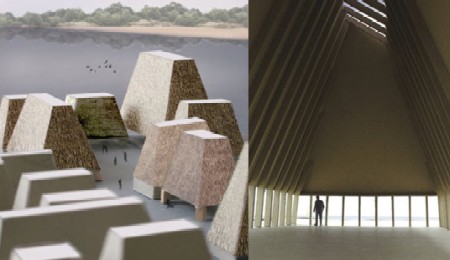
The RIBA have recently awarded a zero carbon design as the visitor center at the new Brockholes Wetland and Woodland Nature Reserve in Preston, to regenerate a former quarry site into a major visitor attraction.

The project called “A Floating World”, consists of zero-carbon floating buildings (the name coming from the fact that the zero-carbon buildings will be built on an island of floating pontoons)

Adam Khan Architects, won the RIBA design competition to work on the ‘jewel in the crown’ of Britain’s largest eco-regeneration scheme. The project is zero-carbon in both use and production, with materials of low embodied energy – thatch, willow, timber, with off-site prefabrication and on-site energy generation and waste treatment.

Floating world will feature cafe, shops, gallery, education areas and meeting rooms and is part of the £59 million Newlands Scheme, a project that will turn 900 hectares to community woodland and green space.

On announcement of the winner, Peter White, Head of Infrastructure & Development at the Northwest Regional Development Agency said:

“This site has the potential to become an important visitor attraction for the region, building on its rich natural assets and impressive biodiversity. The Agency is supporting its development through Newlands, a wide reaching scheme that aims to reclaim brownfield land and transform it into thriving community open spaces, and has so far invested £800,000 in Brockholes. The chosen design will not only create an inspirational open space for the local community to enjoy but will also enhance a key gateway into Lancashire and attract further investment into the area. We look forward to working with our partners to progress these plans.”

More on this as the project develops …