Category Archives: energy

musing on a carbon 1:5:200

Reading many items and articles on the carbon issues that the built environment faces in the coming years, I have jotted a number of random thoughts in google notebook, which may one day be useful ‘spin’ for example:

…almost every building uses more energy than design calculations …… technology alone is not enough …… design 20%, people 80% … attitudes and behaviour towards energy use need to change …….. it is our responsibility to make sure that the building users understand what they need to do to meet the carbon objectives set at the design stage…… people just change the lightbulbs and appliances as soon as they move in ……. eco bling in buildings is too complex for fm’s so they switch it off and open the window..

And then, describing the 1:5:200 concept to someone today, it clicked, maybe it is the  1:5:200 thinking that joins these snippets together and is a new paradigm required in relation to sustainability and carbon management.

Maybe, if  the impact of construction is set to 1, then could the impact or influence of fm be 5 and the impact of building users 200? (in this thinking the influence of design is 0.1)

(and of course, as with the cost 1:5:200, these are indicative magnitudes to illustrate relationships between construction fm and buildings in use, not absolute figures)

Comments welcome ….

facilities carbon management

Indication that carbon management is becoming a key element of the facilities management role is evident through the Guardian article Cut and Run which focuses on UCLAN’s excellence performance in obtaining the Carbon Trust Standard.

The Carbon Trust says that universities and higher education institutes spend more than £200m each year on energy, and emit 3.2m tonnes of carbon dioxide over the same period – the equivalent of heating more than a million average households.

This puts the facilities management of carbon into perspective – not only as an environmental obligation but also as a social and moral one.  And yet “there is currently a capacity gap in the skills required to manage carbon reductions across large institutions”  FM organisations and institutes take note!

Interestingly UCLAN see the big challenge in carbon reduction as being travel:

Though the university lobbies the council for improvements, problems with the interchange between rail and bus timetables, for example, discourage students and staff from using them. This means transport is a factor in the university’s carbon performance that is proving particularly difficult to improve upon.

Now wash your hands and reduce your carbons … 

I have a slight concern over the quote from Richard Rugg, head of the public sector department at the Carbon Trust. “carbon management is essential. It needs to be viewed in the same way as health and safety”  

In terms of resources, focus and appropriate funds a big yes, but carbon management (as indeed is H and S) is a people, hearts and mind topic, not one of policing, instruction and order as Health and Safety is in danger of becoming / has become.  Facilities Management tend to be fast and easy with littering (even spamming?) walls with notices and instructions to visitors building users… no more please !!

defining zero carbon

As a post on this blog noted at the end of last year, the definition of zero carbon buildings is currently under consultation by the Department for Communities and Local Government.

I am in full agreement with Casey over at Carbon Limited who blogs for a call to arms on this one, this consultation is so important that all in the built environment should engage with.

The outcome definition will shape and determine design, construction, building services  and facilities management into the future, in a similar (but more profound way) that the HASAW and CDM and other milestone legislations have done.

(from zero carbon consultation:summary)

At the core of the document is the government’s preferred framework for reaching zero carbon. In order of priority:

  1. A minimum standard of energy efficiency will be required.
  2. A minimum carbon reduction should be achieved through a combination of energy efficiency, onsite low and zero carbon (LZC) technologies, and directly connected heat. This is referred to as achieving carbon compliance.
  3. Any remaining emissions should be dealt with using allowable solutions, including offsite energy.

The zero carbon definition will have profound implications for…

… the built environment client in the choice and cost implications

design –  a change the design parameters,

construction, for example with airtight construction calling for a build quality and quality control we are not too good at. (Research at Leeds Met is showing that the cost of retro fixing air leaks in new buildings is  a hugely costly exercise *)

building services – on energy sourcing and management.

And of course on the way buildings are used, run and managed.

If you haven’t read it yet, you can download it here.  or as Casey puts it – get involved or forever bitch about it in the pubs.

(* more on this later)

on zero carbon britain

Reading zerocarbonbritain that details how Britain can eliminate emissions from fossil fuels in 20 years and break our dependence on imported energy.

In relation to buildings it requires …

“changes to the building stock that may initially be unpalatable to traditional thinkers and environmentalists alike, due to the scale of demolition, new build, and refurbishment required”

Report can be downloaded here

Community Solar Power

To illustrate that solar power can be effective in communities and in existing homes, and for inspiration in our (uk) developments,  take a look at this article over at greenbuildingelements

A community in Canada has an unusual form of solar power that can provide over 90% of the annual heating and hot water needs for the homes, despite being situated in a cold Alberta location where winter temperatures can reach -33 degrees C (-27 F).

on the zero carbon house

Barratt Developments has unveiled what it calls the first zero-carbon house developed by a volume housebuilder, built at the Buildings Research Establishment in Watford, packed with the latest technology, including solar panels, rainwater harvesting and an air source heat pump.

Its new kind of concrete walls and floors, combined with super insulation and triple-glazed windows, means its heat requirement will be minimal as it is airtight. Fresh air is brought into the building through a heat exchanger, which extracts the heat from outgoing stale air and puts it back into the house.

Mark Clare, chief executive of Barratt, said it would not be easy to reduce the cost of the prototype to commercial levels but he was confident it could be done. The important thing, he added, was to build houses that people would buy.

The public and builders still need to be convinced, according to the NHBC Foundation report, and it would seem todays kids – who will buy the homes – Kids dream homes – whose dream homes aren’t high on eco features.

The UK Green Building Council released a report this week defining what a zero-carbon house should be in practice. This is likely to form the basis of the legislation that the government is soon going to work on.

Housebuilders had been unhappy at the costs of going zero carbon and had wanted to be able to invest in off-site renewable energy such as wind turbines that would be cheaper for them. But the government is likely to endorse the GBC proposals that a zero-carbon house should produce almost all its energy on site or very near by in, say, a communal heat and power system.

Barratt plans rolling out its zero-carbon homes on the site of Hanham Hall hospital near Bristol. It will build 200 of them, a third of which will be affordable to lower-income buyers. All will be code level six and will completed in 2011, five years ahead of the deadline.

Source

a guide to zero carbon homes

Zero carbon homes in 100 words.

The UK Green Building Council released a report this week defining what a zero-carbon house should be in practice. Download from here

Still to read in detail but on first read appears to be a welcomed, considered and helpful guide, with a time-line to help organisations on a route to zero.

There would however appear to be little focus on the construction process, the actual building of zero carbon homes, (an estimated 3-4 years or 11% of the total carbons in the homes life cycle). This is the one issue we desperately need to address, to get buy in from builders. Many of whom may look at this and conclude it has nothing to do with them – other than install or assemble different bits of eco kit and / or materials. For example, construction waste, construction site impacts and considerate contractors scheme – all part of the Code 6 requirements isnt mentioned within the guide. (Site waste management planning is mandatory)

Others, and I know fellow bloggers will, soon comment on the renewable energy and technology aspect of the guide… watch this space…

Finally (for now) I hope that this definition is the same in the soon to be released UK Construction Strategy for Sustainability !!

revolutionary wind turbines

Selsam is flying wind-turbines for maximum power. It’s like a kite, only with giant spinning blades. Looks so scifi …. resembling a field of wind-swept reeds swaying on the horizon

Source: twitter from inhabitat

zero carbon ‘floating’ development for Preston

Green, innovative and zero carbon project development on our doorstep in Preston, Lancs, !

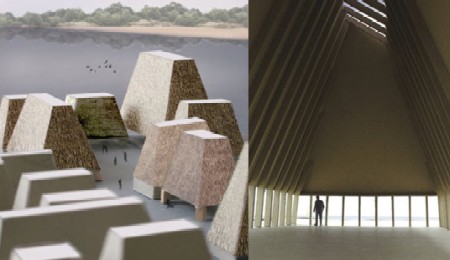
The RIBA have recently awarded a zero carbon design as the visitor center at the new Brockholes Wetland and Woodland Nature Reserve in Preston, to regenerate a former quarry site into a major visitor attraction.

The project called “A Floating World”, consists of zero-carbon floating buildings (the name coming from the fact that the zero-carbon buildings will be built on an island of floating pontoons)

Adam Khan Architects, won the RIBA design competition to work on the ‘jewel in the crown’ of Britain’s largest eco-regeneration scheme. The project is zero-carbon in both use and production, with materials of low embodied energy – thatch, willow, timber, with off-site prefabrication and on-site energy generation and waste treatment.

Floating world will feature cafe, shops, gallery, education areas and meeting rooms and is part of the £59 million Newlands Scheme, a project that will turn 900 hectares to community woodland and green space.

On announcement of the winner, Peter White, Head of Infrastructure & Development at the Northwest Regional Development Agency said:

“This site has the potential to become an important visitor attraction for the region, building on its rich natural assets and impressive biodiversity. The Agency is supporting its development through Newlands, a wide reaching scheme that aims to reclaim brownfield land and transform it into thriving community open spaces, and has so far invested £800,000 in Brockholes. The chosen design will not only create an inspirational open space for the local community to enjoy but will also enhance a key gateway into Lancashire and attract further investment into the area. We look forward to working with our partners to progress these plans.”

More on this as the project develops …

can data centers power all homes …

How green is your data center? Stumbled upon an amazing post and comments over at The It Sanctuary

According to figures from IT market research company Forrester Research, a data centre with 2,500 servers – relatively small compared to many out there – will devour enough electricity over the course of one month to power 420,000 homes for a year. *

That’s bad news for the environment – and it also takes its toll on a company’s bottom line. Analysts at IT market analyst firm Gartner calculate that energy expenditure typically accounts for about 10 per cent of the IT budget, and is likely to rise to as much as 50 per cent over the next few years, as energy prices continue to soar.

As the comments on the post hint at – how well is IT covered within an organisations ISO 14001 scope, impact and assessment exercises? Or even within their CSR, Corporate Social Responsibility remits? With something like 60% of a buildings / organisations energy requirement being IT related, it needs to be a central theme.

But its the ability of data center energy to power homes that needs urgent investigation. If these numbers are correct thats a staggeringly high, unbelievably high, number of homes and would resolve the domestic electricity demand at a stroke. I will check the research and invite Forrester Research to comment here,