Tag Archives: built environment

“This Changes Everything” Paris Agreement and the Built Environment

That the Paris Agreement has come into force today, 4th November 2016, some four years early, now ratified by the requisite number of nations, is a huge milestone and speaks volumes for the global recognition and consensus to reduce carbon emissions.

cop21 article 2 draft

Back in December in Paris, the built environment was recognised as a major contributor to the carbon problem as well as having a major role to play in a low carbon sustainable future. (See How significant was the first Buildings Day at COP21?)

Now, then, is the time to review our approaches to taking carbon out of the built environment, through design, through the operation of buildings and in the manufacture and construction processes.

Through ConstructCO2 we know that up to 70% of construction carbons are travel and transport related, and much of this through diesel fuelled vehicles, further adding to our air quality problems and stretched health services. Construction transport impact must now be a primary target for sustainable construction.

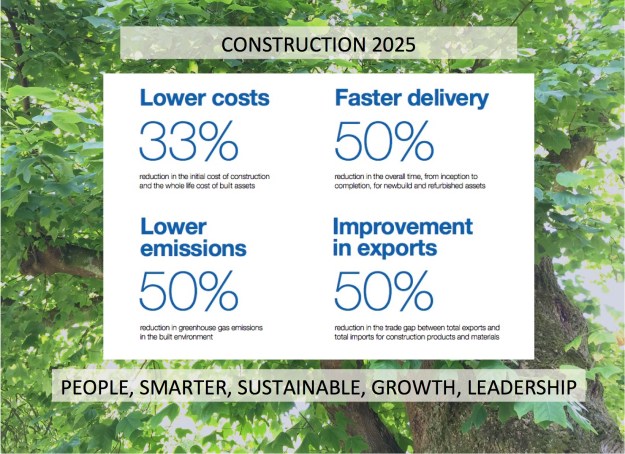
In the UK, our most recent industry target is within Construction 2025 Vision – to reduce emissions by 50% by 2025. Consider however that this was written when the consensus for carbon reduction was based on a 2 degree target for temperature increase. We are now looking at 1.5 degree as the emerging consensus, and that changes everything.

construction-2025-headlines

There is a sense of urgency here, and as I explored and commented within FutuREstorative ‘we no longer have the luxury of being only less bad’ but need to be doing more good, and in doing so heal the future.

less-bad-more-good-chart

In 2015 the UK Green Construction Board noted that ‘reducing built environment carbon emissions (50% from 1990 levels by 2025) is now out of reach with current practice’, and as Namoi Klein wrote in This Changes Everything (2015) “There are no non-radical approaches left before us in addressing climate change’

But we do have approaches, tools and initiatives to ensure that the built environment can contribute to a 1.5 degree future, again as explored in FutuREstorative and illustrated here in this infographic:

carbon-image

As we celebrate the Paris Agreement coming into force, lets also take the opportunity to look forward and start working collaboratively within the built environment towards a 1.5 degree future. And in doing so,to address the other hugely important aspects of the Paris Agreement, adopt the Sustainable Development Goals.

Chart_of_UN_Sustainable_Development_Goals

Brexit is moving UK from client status into the supply chain

There have been many, and there will be many ‘what Brexit means for …’ articles, blogs and opinions. Here is my take on how I see the impact for the built  environment and sustainability. It is a blog post that I started on June 24th, but with each passing day, hour, a new twist has emerged …

flag_yellow_lowFar from dust settling after the EU Referendum that saw ‘Leave’ gain a slender majority, we are seeing more dust being kicked up from the daily political, financial and environmental developments. What all this means for the built environment, as many organisations are telling me in emails, tweets and statements is unclear and remains to be seen. It is still unbelievable that political and industry organisations and companies did not and still do not really have a plan in the case of an out vote, and what the implications of triggering Article 50 would entail.

What we see however is the UK on the brink of a self inflicted move from client, or framework prime contractor status to supply chain status and all the implications that would bring. No longer would we be setting the trading and governance conditions but having to negotiate, and ultimately comply.

And with the mature supply chain conditions that most in the built environment are now familiar with, this entails, fair, ethical , equitable and environmentally sound practices and governance across an organisation. Practices that are not only limited to the goods or services provided to a client (in this case the EU) but across all operations.

And the pandora’s box of potential implications, a few good but mostly disastrous in the short term, we now face in the built environment include …

A continuation of OJEU – the EU tendering and procurement process. (an Housing Association pre-referendum article foresaw this as a possibility , to ensure open access to contracts as a good ethical and fair trading practice)

Compliance with EU environmental standards, such as air quality and the Near Zero Buildings directive. Although many of the EU environmental issues have, over time been incorporated into e.g. Building Regs, as a government we have fought most EU environmental legislation, particularly air quality regulations. Boris Johnson, described as Trump-Lite in his approach to the environment, has been accused of withholding failing air quality statistics in London schools, hampering any real improvement. Now, to trade with EU it is highly likely that air quality thresholds will be an imposed condition in light of the recent statements from EU officials that they remain committed to protecting health and wellbeing of all European citizens.

Uncertainty and worry questions the free movement of skills, talent and people on which the built environment has thrived. Free movement of skills has been vital for construction on site, in Architectural practices, Environmental consultancies, Universities and other research organisations. Even BIM, which through free movement of IT talent, many of whom based in London and created the innovative IT hub, that has helped us become a BIM world leader. Not surprisingly there are warnings that IT and multi-i organisations will seek more EU centric locations, for example Berlin, relocating away from London and the UK.

Indications are that we will see short and long term price increases in construction materials. 60% of all imported construction materials come from the EU. Exported services will be expected at a lower cost which may prove to be unviable.  Imported timber, increasingly the structural material of choice – will be subject to trade and cost implications This should of course bolster Grown in Britain timber, but that itself may well be subject to wider EU trading implications – as a supply chain would be expected to do so to demonstrate good governance and ecological considerations.

The construction industry is often the barometer for the health of the economy – and hence a prelude for a recession. It requires amongst other factors, strong confidence in a pipeline of work flow. That pipeline had slowed pre referendum, with a number of contracts having Brexit clauses, and now, post referendum in some cases (e.g. infrastructure projects) come to (a temporary) stop. With the value of construction organisations being reduced, so will funds available for innovation, investments in new technologies (digital and BIM) and crucial for the industry, education, training and development.

On a wider macro sustainability level, leaving the EU risks weakening efforts to protect human rights, tackle corruption, environmental destruction and climate change, all which require a collaborative effort with our neighbours. I have already heard “that as FSC is a EU Legislation requirement we can now use unsustainably sourced timber?”

Facing all of these potential implications, never before in the sector have we needed our modern day, mature approaches to improving the built environment. These include lean construction, a diverse and ethical sector, collaboration not silo’d isolation, sound training and development, BIM, and a restorative sustainability approach that is not weakened to doing even less just to reduce the built environments sustainability impact.  

At the same time we need to speed up the incorporation of the UN Sustainable Development Goals as the sectors sustainability mission.Chart_of_UN_Sustainable_Development_Goals

Far from taking back control, we may be handing over what control we had as we take a new position within the supply chain. But then … who knows what will occur, if and when and by whom article 50 is ever triggered.

So what now? The Brexit debate has moved from the binary referendum to a complex cocktail of political issues. It is possible we will see a snap election, less likely the called for 2nd referendum, but we will have new leaders of our main parliamentary parties and debates that focus not only the future of the EU but the UK itself. All will have huge impacts for the built environment.

As individuals we have avenues to register our concerns, through social media advocacy, through our institutions and membership organisations, through the call for a 2nd referendum, and as this is now a political issue through MP lobbying.

We should also see a step up in appropriate lobbying from built environment groups – now is not the time to wait and see, now is the time for groups such as RIBA, CIOB, CE, UKGBC, CIBSE, ICE, IEMA etc etc … to mobilise, be proactive and lobby government, potential party leaders and MP’s with responsibilities within the built environment spectrum, to protect our industry and all the wonderful progress made through union with the EU.

This blog is my view of the post referendum uncertainty, an interpretation from experience and knowledge of the sector, but undoubtedly also informed through reading many many articles, blogs and tweets, too many to reference here at the moment, but also worth reading are:

For a US perspective, Lloyd Alter: What impact will Brexit have on green building in Britain?

Understanding Article 50: David Allen Green  This is what sovereignty looks like

Are we Building Schools for the Future???

Dangerous and dilapidated, poorly built and wasteful. Too many school buildings are failing our children + teachers wellbeing and educational attainment reports the RIBA in a comprehensive POE research based paper that calls for a Government review.

Since the early 2000’s Building Schools for the Future programme, through to the current EFA and Academy programmes it is concerning to read our schools still do not have civilised environments, foster health, wellbeing and happiness, delight and inspire children and teachers*

The RIBA report focuses on how design impacts on wellbeing but sadly omits the body of research and knowledge on biophilia and importance of connectivity with nature.

schoolsbanner-Cropped-660x424cropped

RIBA’s new report into the state of school buildings, Better Spaces for Learning reveals:

  • 1 in 5 teachers have considered quitting because of the wretched condition of the school buildings they have to teach in
  • The Government’s Education Funding Agency’s new school building programme is too rigid and is leading to waste and poor value for tax payers
  • Over 90% of teachers believe well-built and designed schools improve educational outcomes and pupil behaviour
  • Over-engineered schools, with Government-specified equipment that only costly consultants know how to operate, is costing £150 million per year which could have been avoided if schools were designed better

A new report on the state of school buildings in the UK has been published today (Wednesday 11 May) by the Royal Institute of British Architects (RIBA). Using the largest ever analysis of primary and secondary school buildings in the UK, a nation-wide poll of teachers, and extensive engagement with school buildings experts, RIBA’sBetter Spaces for Learning report makes the case for an urgent review of the Government’s Education Funding Agency’s current school building programme.

The report emphasises the importance of well-designed school buildings on young people’s wellbeing, behaviour engagement and crucially, attainment.

RIBA has identified that good school design can reduce running and maintenance costs, in some cases by more than several times a teacher’s average salary a year; it could have prevented the English school estate from spending upwards of £150m annually on unnecessary operation and maintenance costs.

The new report is further insight into the Government’s own assertion that just 5% of the nearly 60,000 school buildings across the UK are performing as intended and operating efficiently.* The prevalence of damp, leaky classrooms and asbestos-ridden buildings in British schools means too many pupils and teachers are struggling to learn and teach in conditions damaging to their health and education.

Better Spaces for Learning reveals that the Government’s current programme of building new schools is inefficient – with a lack of flexibility to make the best possible use of resources, and little opportunity for school staff to input into the design of their own new buildings. RIBA believes that the Government programme must be improved to guarantee better outcomes for our public money.

RIBA President Jane Duncan said:

“This country is in the grip of the worst shortage of school places in living memory. Our report highlights the vital importance of school design and how it affects the general health and wellbeing of their users, our children and their teachers. As limited funding is available to deal with the growing problem, every penny spent on schools must deliver maximum value for money. Award winning well-designed, successful schools with happy pupils and productive staff like Burntwood School in London shouldn’t be the exception, they should be the standard.

“How can we expect our children to compete with the world’s best when too many of our school buildings are substandard? Educational improvements resulting from the current programme of school building are not reaching the basic standards that British taxpayers and our economy expects. We need to do better for all of our children and their hardworking teachers. We urge the Government to review its programme of building new schools.”

(*to use Living Building Challenge parlance).

Patagonia Worn Wear – UK Tour

“Let’s all become radical environmentalists” commented Patagonia chief executive Rose Marcario “As individual consumers, the single best thing we can do for the planet is to keep our stuff in use longer. This simple act of extending the life of our (stuff) through proper care and repair reduces the need to buy more over time, thereby avoiding the CO2 emissions, waste output and water usage required to build it.”

This remains in my mind, one of the more useful of circular economy thinking approaches

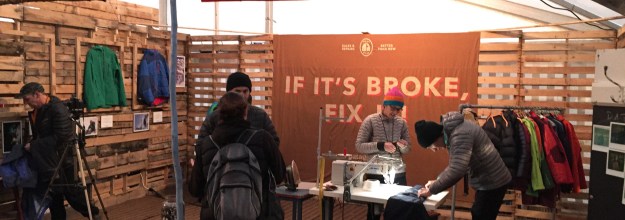
Patagonia’s Worm Well bus will be setting up temporary workstations at venues across the UK to repair garments, free of charge.

IMG_0759

Worn Wear at Kendal Film Festival 2015

The UK leg is part of a wider five-country mission across Europe to extend the life of outdoor enthusiasts’ clothing. It starts on 15 April in the UK and Germany before moving on to other European countries.

Dates and details are on the Patagonia Worn Wear website.

It would be great to see this extended into other areas, more built environment related areas, for example, FM organisations holding free equipment repair workshops in buildings they operate, construction and consultancy organisations returning to their buildings and providing free sustainability advice and repair service … The opportunities based on circular economy business models are huge.

Put simply, if it’s broke, fix it! Dont replace it

Related previous post: (2012) Construction CSR Makeover: can construction learn from Patagonia?

How significant was the first Buildings Day at COP21?

banner-nama-cop21_800-percent

In coming years, hopefully very significant. This was the first time that the built environment has been recognised as important in any global, United Nation climate change summit.

We now have the recognition that buildings and construction have a major impact and influence on climate changes, being part of the problem but also key to climate change solutions

My thoughts from following inspiring feeds from Paris and elsewhere, through the twitter hashtags of #COP21, #BuildingsDay #BuildBetterGreen #BackClimateAction and others:

I felt ashamed by the approach of our government in weakening and dismantling sustainability strategies for homes and buildings whilst others around the world are deepening their green building strategies

That the built environment players (leaders, companies, advocates, agencies, academics) all need to collaborate to ensure a sub 2 degrees warming path is central to sustainability strategies

Not once did I see BIM mentioned or cited as part of the building environment solution. BIM needs to engage with the leaders and decision makers who are shaping the design, construction and operation of buildings.

Encouraged to hear of net positive approaches, being restorative and regenerative in built environment sustainability approaches. Not only for carbon reduction but for social and health strategies to be ‘net-positive’

Encouragingly there have been many great pledges from GBC members around the world – including the UK.

Whilst major contractors and manufacturers were visible in making commitments or presenting the built environment world of contracting, of SME’s and supply chains right across the sector still needs to engage, and understand that business as usual may not be that usual in the coming year.

Finally – with the built environments impact on climate change, often quoted as 40% of the problem, making the real change to get on a sub 2 degree global warming path may seem impossible. Globally, through design and construction we need to reduce emissions by 84 GtCO2 by 2050 – thats taking over 22.000 coal fired power stations out of service.

Yet impossible is only a challenge – and as Steve Jobs said – its kind of fun to do the impossible.

What Is COP21?

Understand COP21 in these 7 graphics (via Green Biz)

France is chairing and hosting the 21 th Conference of Parties to the Framework UN Convention on Climate Change (COP21 / CMP11) from 30 November to 11 December 2015. This is a crucial conference since it must lead to a new international climate agreement, applicable to all, to keep global warming below 2 ° C.

18 countries (Austria, Brazil, Cameroon, Canada, Finland, France, Germany, Indonesia, Japan, Mexico, Morocco, Norway, Senegal, Singapore, Sweden, Tunisia, Ukraine, United Arab Emirates, United States of America), and over 60 organisations launched an unprecedented Global Alliance for Buildings and Construction to speed up and scale up the sector’s huge potential to reduce its emissions and literally build greater climate resilience into future cities and infrastructure.

Global Alliance for Buildings and Construction to Combat Climate Change

Lendlease: Accelerating Wellbeing in Built Environment

In November 2015, Lendlease, one of the world’s leading integrated infrastructure and real estate groups, announced a global alliance with Delos, aiming to accelerate the integration of human health and wellness outcomes in the built environment. This alliance will include identifying pioneering projects in Australia, Asia, the United Kingdom and the United States, which will pursue WELL Certification and provide ‘WELL ready’ workplaces for tenants.

Untitled 5Geoff Dutaillis, group head of sustainability at Lendlease said, “Supporting the next generation of buildings and places that get it right for people, as well as the environment is very important….The built environment has a critical role to play in helping cities and governments transition towards a low carbon future; however, it’s the direct impact on human capital and productivity through increased focus on supporting human health and wellbeing which is the untapped potential.”*

The WELL Building Standard is the first protocol of its kind to focus on “improving human wellness within the built environment by identifying specific conditions that, when holistically integrated into building interiors, enhance the health and wellbeing of the occupants.” The WELL Building Standard is a performance-focused system for measuring, certifying and monitoring features of the built environment that impact human health and wellbeing including air, water, nourishment, light, fitness, comfort and importantly mind.

Wellness and Happiness: The Next Built Environment / CSR Frontier 

WELL Building Institute launches pilot programs for new sectors.

Designing Buildings Wiki: Well Building Standard 

The Papal Encyclical relevance to the Built Environment sector

Todays launch of the Papal Encyclical has much relevance for Built Environment sector on sustainability, the relationship of buildings with nature, on waste, energy, health, biophilia and even touching on BIM, (TechnoScience).

There is also a nice resonance with language from standards such as the Living Building Challenge, and other ecological restorative approaches to new perspectives on sustainability.

In particular Paragraph 150 (see below) should become a touchstone for modern, restorative, sustainable design.

It’s a hefty document, but here below are the salient sections relating to the built environment:

26. Investments have also been made … in methods of construction and renovating buildings which improve their energy efficiency. But these good practices are still far from widespread

44. Nowadays, for example, we are conscious of the disproportionate and unruly growth of many cities, which have become unhealthy to live in, not only because of pollution caused by toxic emissions but also as a result of urban chaos, poor transportation, and visual pollution and noise. Many cities are huge, inefficient structures, excessively wasteful of energy and water. Neighbourhoods, even those recently built, are congested, chaotic and lacking in sufficient green space. We were not meant to be inundated by cement, asphalt, glass and metal, and deprived of physical contact with nature.

58. In some countries, there are positive examples of environmental improvement: rivers, polluted for decades, have been cleaned up; native woodlands have been restored; landscapes have been beautified thanks to environmental renewal projects; beautiful buildings have been erected; advances have been made in the production of non-polluting energy and in the improvement of public transportation. These achievements do not solve global problems, but they do show that men and women are still capable of intervening positively.

103. Technoscience, when well directed, can produce important means of improving the quality of human life, from useful domestic appliances to great transportation systems, bridges, buildings and public spaces. It can also produce art and enable men and women immersed in the material world to “leap” into the world of beauty. Who can deny the beauty of an aircraft or a skyscraper?

143. Together with the patrimony of nature, there is also an historic, artistic and cultural patrimony which is likewise under threat. This patrimony is a part of the shared identity of each place and a foundation upon which to build a habitable city. It is not a matter of tearing down and building new cities, supposedly more respectful of the environment yet not always more attractive to live in. Rather, there is a need to incorporate the history, culture and architecture of each place, thus preserving its original identity. Ecology, then, also involves protecting the cultural treasures of humanity in the broadest sense. More specifically, it calls for greater attention to local cultures when studying environmental problems, favouring a dialogue between scientific-technical language and the language of the people. Culture is more than what we have inherited from the past; it is also, and above all, a living, dynamic and participatory present reality, which cannot be excluded as we rethink the relationship between human beings and the environment.

149. The extreme poverty experienced in areas lacking harmony, open spaces or potential for integration, can lead to incidents of brutality and to exploitation by criminal organizations. In the unstable neighbourhoods of mega-cities, the daily experience of overcrowding and social anonymity can create a sense of uprootedness which spawns antisocial behaviour and violence. Nonetheless, I wish to insist that love always proves more powerful. Many people in these conditions are able to weave bonds of belonging and togetherness which convert overcrowding into an experience of community in which the walls of the ego are torn down and the barriers of selfishness overcome. This experience of a communitarian salvation often generates creative ideas for the improvement of a building or a neighbourhood

150. Given the interrelationship between living space and human behaviour, those who design buildings, neighbourhoods, public spaces and cities, ought to draw on the various disciplines which help us to understand people’s thought processes, symbolic language and ways of acting. It is not enough to seek the beauty of design. More precious still is the service we offer to another kind of beauty: people’s quality of life, their adaptation to the environment, encounter and mutual assistance. Here too, we see how important it is that urban planning always take into consideration the views of those who will live in these areas.

180. There are no uniform recipes, because each country or region has its own problems and limitations. It is also true that political realism may call for transitional measures and technologies, so long as these are accompanied by the gradual framing and acceptance of binding commitments. At the same time, on the national and local levels, much still needs to be done, such as promoting ways of conserving energy. These would include favouring forms of industrial production with maximum energy efficiency and diminished use of raw materials, removing from the market products which are less energy efficient or more polluting, improving transport systems, and encouraging the construction and repair of buildings aimed at reducing their energy consumption and levels of pollution.

232. Not everyone is called to engage directly in political life. Society is also enriched by a countless array of organizations which work to promote the common good and to defend the environment, whether natural or urban. Some, for example, show concern for a public place (a building, a fountain, an abandoned monument, a landscape, a square), and strive to protect, restore, improve or beautify it as something belonging to everyone.

The Brightest Greenest Buildings Europe 2015

Untitled2

Brightest! Greenest! Buildings EUROPE Opens 10th June 2015 at 10am CET

The free-to-attend carbon neutral virtual exhibition dedicated to Europe’s most successful and greenest building projects and green building solutions opens on June 10th. 

Following on from the success of last years ExpoC21, (Sustainability Made Cool – my blog review here) the format for this year, under the title of Brightest! Greenest! Buildings, is very different.

UntitledThe Expo will run over a number of months with an evolving focus and a great Schedule of Events.

The launch of Brightest! Greenest! Buildings EUROPE 2015 on 10 June 2015  includes presentations by Delta Development Group, C.F. Møller, The Carbon Trust, MIPIM’s Innovation Forum, OVG Real Estate, Europe’s Green Building Councils, BUILD UPON: Co-Creating Europe’s National Renovation Strategies, launch of baseEUcities, and many more!

Brightest! Greenest! Buildings EUROPE 2015, as a virtual exhibition has been designed and organised an international team to promote the greenest building projects and associated solutions in Europe. Our exhibition and conference will reach 50+ countries in the European market in a very efficient manner. Last year, we had the participation of over 1500 of the greenest and most successful real estate investors, project developers, designers, green building consultants and rating tool assessors and other services as well as and technologies, products, and materials providers.

Organized under the patronage of the European Commission, Brightest! Greenest! Buildings EUROPE 2015 is very low cost for exhibitors, free for attendees, eliminates travel time and the associated carbon emissions, and benefits from the support Green Building Councils across Europe as well as other expert organisations. From our current partnerships and future efforts, we believe we will easily reach our target of 10000 high quality attendees and strong media coverage during the 12 month exhibition period.

Our introduction brochure and website – www.BrightestGreenestBuildings.eu – provides all the information about the event, the great organizing team, and the promotional plan and highlights from last year’s event. Booth features are described in the “Why Exhibit” section. Exhibitors can also configure their virtual booths in just a couple of hours using their existing promotional material.

We invite you to take a demonstration tour with our team of the virtual trade fair platform to see first hand how this works. Tours are scheduled at 3:30pm (Central European Time) on Tuesdays and Wednesdays and at 10:30am on Fridays. Please note, the deadline to register to exhibit for the 10 June launch event is 29 May 2015.

UK_collaborative_logoAs in 2014, the UK Living Building Challenge Collaborative will have a presence at Brightest! Greenest! Buildings EUROPE 2015, join us on the 10th June and throughout the exhibition!

Related: Why EXPOC21 is a vital event for the built environment

So what was / is Climate Week Paris and how relevant to the built environment?

You couldn’t have missed the #CWParis hashtag and tweets from the Business Climate Summit in twitter streams over the past few days. The Climate Week Paris business meeting hosted by The Climate Group was scheduled six months before Paris hosts the UN conference where almost 200 countries are set to seal a (yet another) global climate change pact.

Key events included a Business & Climate Summit and Climate Finance Day, with world’s leading companies and policymakers brought together to demonstrate that low carbon makes good business, and good environmental sense

There were calls from many company executives at Paris urging governments to introduce more carbon pricing systems, such as a carbon tax or emissions trading schemes.

Relevance to built environment

With the Built Environment contributing the (rule of thumb) 40% of Carbon emissions, and a huge influence on business operation the sector had a presence through advocacy organisations and businesses with large built environment assets, but from reports seen and feeds followed, there was a very low presence from built environment providers – if any!

A high level session on transition to a ‘Low Carbon Built Environment’ (with a panel led by Christiana Figueres @CFigueres, Executive Secretary of the UN Framework Convention on Climate Change (UNFCCC) and chaired by Sandrine Dixson-Declève, Director of Cambridge Institute for Sustainability Leadership) discussed how “architect, town planners and engineers, collaborating with the construction, real-estate, materials & technology and financial communities, could showcase solutions for the built environment that can be deployed in Europe and inspire worldwide action”

One of the main points addressed was the lack of visibility suffered by the construction sector, as topics like energy efficiency and net positive standards are often seen as highly-technical and not understood by the general public.

Key to meeting the global goal of decarbonisation by 2050 is seen as the transition of new and existing buildings to EU Net Energy Standards . The EU Standard Requires “Member States shall ensure that by 31 December 2020 all new buildings are nearly zero-energy buildings; and after 31 December 2018, new buildings occupied and owned by public authorities are nearly zero-energy buildings”

Marks and Spencer (M&S) announced that they joined RE100, a global initiative for major companies committing to 100% renewable power, through their Plan A programme to lower carbon emissions from their activities and building operations.

The World Green Build Council promoted and launched its BuildUpon report during Climate Week Paris, aiming to create a building renovation revolution in Europe. See the Imagine a Built Environment that Enables a High Quality of Life for All  report

The BuildUpon report includes two notable actions,

  • identifying and engaging with ‘Unusual Suspects’, those not as yet engaged in the low carbon built environment dialogue.
  • A proposed open source wiki for information, the RenoWiki, a comprehensive summary of renovation initiatives across the 13 project EU countries, “to bring clarity on how national renovation strategies can strategically build upon the current landscape and how identified solutions might be scaled-up across other countries”

And, as reported in the Guardian Article “in an unprecedented alliance, 25 global news publishers have agreed to share climate change content to raise awareness in the runup to the next UN summit and agreed to scrap licensing fees for climate change content so that members of the alliance can freely republish articles.”

A call then to the Built Environment news publishers to do similar, to share climate change content and bring that content out from behind paywalls?

(I am grateful for informative tweets, sharing news and links from Climate Week Paris from friend , @WeMeanBusiness, @GuardianSustBiz, @SDDecleve @ClimateGroup and others in Paris)

EcoBuild launch a vision for a Built Environment future …

Ecobuild, in association with Building has published ‘Future of the Built Environment’ as part of the launch for EcoBuild 2015.  The white paper, a collection of thought pieces from leading industry players, assesses the future of the sector, painting a very useful picture for a not-so-far into the future built environment.

It is set of future scenarios, encompassing beauty, circular economy, health, equity and eco systems. And in this respect closer to the regenerative sustainability philosophy of Living Building Challenge and the Well Building Standard than it is of current, more energy performance focused BREEAM and Regulations.

Jane Henley, Chief Executive Officer, World Green Building Council sees the next chapter for green building as one of health, wellbeing and productivity, arguing that business may be less interested in the mechanical and energy issues of a building than they are on how investing in better indoor environments will lead to better returns on their greatest asset: people

Rick Willmott, Chief Executive, Willmott Dixon sees a contracting future as one of climate adaption, carbon targets and collaborative construction with a leadership that ‘digs deeper’. The circular economy will be key, offering industry tremendous opportunities. Willmott cites the rising energy costs and depletion of finite natural resources that will lead to a mushrooming market for recycled materials, and a move to designing buildings with deconstruction in mind from the outset.

Munish Datta, Head of Plan A & Facilities Management, Marks & Spencer sees the future being about beautiful buildings, “We spend 90% of our time in buildings so why shouldn’t they be beautiful”, delivered from an industry that is holistic,where every role, from developers to facilities management, is incentivised to design, build, operate and re-use buildings for their life.

Paul King, Chief Executive Officer, UK Green Building Council sees that there is a great deal a new government, of whatever hue, can do to create the conditions in which a sustainable built environment industry can thrive. It can save more money than it needs to spend, it can set clear and consistent policy direction, and it can lead by example. “Frankly, to do anything else would be to squander an opportunity for growth the UK simply cannot afford”

Sarah Richardson, Editor, Building, sees the sector on the cusp of a radical transformation, with a growing sense that new technologies are not just an optional extras but key to delivering necessary efficiencies. However, to realise any transformation, a shift in the demographic of the sector itself is required, to attract a broader mix of talent that can imagine a future free from the constraints of the past.

Peter Caplehorn, Deputy CEO, Construction Products Association sees a key challenge for the industry being to get out of buildings the performance we design into them

Ike Ijeh, Architectural Critic, Building and Building Design describes  a future sustainable environment as one which has established a holistic vision for integrated urban development where every aspect of the city is specifically planned and designed to maximise social, economic and environmental benefits for its inhabitants while at the same time minimising its ecological footprint. The city itself no longer relies on an ecosystem, it becomes one.

Recommended reading for all in the sector, the EcoBuild paper can be downloaded from here