Tag Archives: Living Building Challenge

Have we picked the low hanging fruit of Sustainable Construction?

low hanging fruitThe mid 90’s saw my first involvement with sustainable construction, as Business Improvement Manager, setting up strategy and awareness programmes for Mowlem Construction, driven it should be noted to address client bid requirements in PFI and Prime Contracting.

At that time Brundtland’s definition from 1987 was fresh and it made good sense to include it in strategies and as a definition.

In hindsight, one of the problems of this approach is that it reinforced the thinking of that time, that environmental management, and by default sustainable construction belonged firmly and squarely within the Health and Safety departments.  A misconception that many organisations still subscribe to, or struggle to move away from.

But, since then, sustainability thinking has moved on from environmental management as H&S add on, to a wider view of sustainability that includes social and business responsibility, ethical procurement and localism and is now heading for a challenging future greener and deeper agenda

It is encouraging to note the move away from what I have referred to as ‘accommodationalist‘ thinking – ie doing only what we are required to do by law, no more no less. In fact this  thinking is now being challenged by the Governments red tape initiative, proposing to remove certain sustainability related legislation

Over the last 7 years I have been supporting organisations map out and chart progress on their ‘Route to Zero‘, identifying actions necessary today, tomorrow and most likely into the future. We may be in the position of being able to say we have picked off the low hanging fruit from the sustainability tree.

Most construction companies now have a sustainability policy and project approaches that are ISO 14001 accredited, to deal with better management of waste,  recording transport construction miles, employing locally and so on.

But now the real work begins, reaching higher into the greener, more dense canopies of the tree, with a new, emerging set of challenging actions that will take us closer to our zero impact ambitions.

Amongst these new challenges we can see:

  • Collaborative and circular economy thinking. For example what if every building improved with age, improved in its function, its resilience, its performance.  Became more ‘durable‘?  Contracts would not only need to cover the design and construction of buildings, but a new form of collaboration between provider and user that included continuous improvement criteria.  Such Circular Economy thinking would force new collaborations across the supply chain, across discipline and with clients.
  • Convergence of data, information rich ICT environments, an Internet of Things linked to metering sensors that will provide real time feedback on performance of the buildings and of the construction process, driving improved and sustainable resource utilisation. Getting us closer to zero waste and  zero carbon emissions.
  • Responsible specification and procurement, that is not only local but considers ethical and most importantly the health impact of building product ingredients. (see the Healthy Product Declaration Standard)
  • Challenging standards, that bring new deep green philosophies and certifications for buildings and facilities, as we see with the Living Building Challenge
  • The inclusion of costing nature within construction projects. ‘Cheap’ buildings may only be cheap because the real social, environmental costs have been externalised for someone else, often society and the public purse to deal with. Time to bring those externalised costs back into the project costs?
  • A mindful built environment sector, or one that has mindfulness, ie ‘in the moment’ awareness of the impact the design, the construction, the maintenance, use and deconstruction of the building will have upon the environment and nature. Mindfulness is a huge and complex topic but an important sustainability concept we will hear far much more of in 2013.

The first Green Vision tweetchat for 2013 will explore some of these issues on the 28th January at 8pm using the hashtag #GVisChat, asking the question are we getting closer to ‘Zero’?

If you would like to know more on how the Fairsnape Route to Zero mapping and charting programme can help your business, please do make contact

Update – Presentation on this theme 
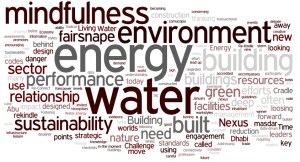
Water Energy Nexus – a built environment mindfulness

screenshot.26

As a lead-up to Abu Dhabi Sustainability Week, January 13-17, Masdar is sponsoring a blogging contest called “Engage: The Water-Energy Nexus.”

The winner will be invited to Abu Dhabi as VIP media to cover the week’s high-profile events.

The following is my entry. Please vote for me here

Water Energy Nexus – a built environment mindfulness

Could we be facing a near perfect storm within the built environment, as our sustainability efforts, our energy and water performance efforts, or perhaps lack of effort hit an environmental cliff.

Consider:

  • 85% of buildings that will be in use in 2050 are already standing today, and many many of them, commercial, leisure and domestic were designed and constructed prior to any meaningful sustainability guidelines. Buildings that are water energy cavelier, designed and managed with a cornucopia view of resources
  • The built environment sector is often called the 40% sector on account of using 40% of the worlds resources, energy and water whilst generating 40% of the worlds waste.
  • Increasingly our lifestyles, workstyles and infrastructure styles are demand evermore energy and water.
  • We are making poor, behind target progress on energy reduction, water conservation and carbon reduction through our design, construction and use of buildings
  • Even today in 2012 water lacks behind energy in performance import for new build and refurbishment
  • We have a facilities management profession that adopts a status quo maintainence basis, often with low level SLA’s demanding same focus as water and in some cases energy performance
  • We are entering a future of big data, where rational, cold evidence based approaches will dominate, driven by Building Information Management. Whilst a very welcomed performance improvement for the sector we may be in danger of loosing the experience intuitive.
  • The dominating sustainable construction codes such as BREEAM and LEED are in danger of becoming corporate checklists, often criticised for the ability to trade water performance points against cycle travel provision points.

Addressing a Water / Energy Nexus

Looking forward the built environment should be looking for both strategic data-driven leaders and managers balanced with strategic creative leaders. This is particularly the case in facilities management sector, where the intuition that comes from deep knowledge of how buildings use water and energy, once a key skill of the building facilities manager that we are sadly loosing and one of the key green skills to rekindle.

We have a need for ‘Mindfulness’ in the built environment. A deep green understanding of the buildings relationship with nature, guided by building codes and green sustainability standards. And as a designer, as a builder as an inhabitant, develop an in-the-moment awareness connectivity or dis-connectivity with the nature and water / energy resources.

We need a move away from assessments looking at impact on the environment, but rather turning tables to look at how the facility connects with nature and its environment.

We can see standards such as the Living Building Challenge as a way forward with each building regarded as a flower, using only the water and energy that falls on the building.

We need new levels of engagement and relationship between building and user. For example the CIRS Vancouver UBC building, itself a LBC accredited building, refers to its users as inhabitants – requiring each to sign a charter that recognises the engagement expected

As I wrote in an earlier blog we need 3 New ‘R’s for built environment sustainability, and its impact on the water energy nexus

Re-Design. No longer are transactional efforts in conserving water and energy enough. Radical revolution in design thinking needed that encompasses Cradle to Cradle thinking, Circular Economy,

Re-Connect. Time to rethink our relationship with nature, a relationship that is deeper, that is deep green mindfulness. A direction that Living Building Challenge promotes – every building contributing to, not taking from its environment.

Re-Kindle. Time to rekindle the sustainability water / energy debate – moving away from the negative, harassment to doing less bad, to encouraging a move towards a positive new world of doing more good, better. Fostering Resilience.

3 R’s for rethinking built environment sustainability

OLYMPUS DIGITAL CAMERA

Its over ten years since rethinking construction became the driving force for improving the construction industry. Back then, in 1998, sustainability wasn’t on the agenda for many construction organisations, and didnt feature in Egans influential report.

Now at the close of 2012, it is of course one of the key challenges for construction.

But is it now just a ‘must do, tick box’ matter, rather than a real agenda for improving, reducing costs and reducing our impact?

Earth2.0 Hub in an excellent blog post ( The Future of Business – inspired by and in harmony with nature.) provides a framework and the language of 3 R’s for future businesses working in harmony with the earth .  And its a framework we should learn from, borrow, adopt or adapt  at project and business level in rethinking built environment sustainability; Re-Design, Re-Connect and Re-Kindle.

Re-Design. Not only design of buildings, but to re-design the way we build. No longer are transactional efforts (reducing waste, conserving energy and recycling) enough.

How?: Take a look at Cradle to Cradle thinking, Circular Economy, Designing out toxic materialsDesigning out Landfill

Re-Connect. Time to rethink our relationship with nature. However just including nature as a natural capital to be costed is not meaningful approach. We need a relationship that is deeper, that is deep green thinking.

How?: take a look at Living Building Challenge – what if every building, like a flower, contributed to its environment. Or the One Planet Living ten principles

Re-Kindle. Time to rekindle the sustainability debate – moving away from the negative, harassment to doing less bad, to encouraging a move towards a positive new world of doing more good,  better. Resilience.

How?: Learning and benchmarking from other industries and sectors, for example Patagonia, or closer to the built environment, Interface Flooring

This blog, since 2005, has had as a tagline built environment improvement and its connectivity to the natural world . Since then, it has been a core philosophy within fairsnape.

cropped-pc210049flip.jpg

Since 2005 we have organised and facilitated benchmarkwalks, discussing sustainability issues , across and within sectors, whilst walking in the natural environment. Rather than in the conference of training room. You would be amazed how diffierent, how green, sustainability discussions when conducted in the great outdoors. Try it !

Cradle to Cradle, Circular Economy, Healthy Products Standard, Designing Out Landfill , Interface UK, and the UK Living Building Challenge all featured in our #GVis2012. Green Vision Conference in Leeds on the 12 Dec 2012.

>>> See Green Vision event material, links, blogs and more here  <<<<

<<< Read the Cradle to Cradle tweetchat transcript here <<<

The Living Building Challenge UK Collaborative will be ‘launched’ at this event on the 12th.

And, Cradle to Cradle is the book-topic for our Dec #GVisChat tweetchat on Dec 10th at 8pm.

Ash disease and the built environment

There has been a huge amount of coverage in the media, and indeed across social media on Ash dieback disease, but little as yet related to the built environment, and the role we may have played in the spread of the disease or the potential impact it may, no will, have on the built environment.

Despite the UK Government (DEFRA) slow response, not to mention odd instructions to wash boots dogs and children after visits to the countryside, the causes of Ash Dieback seems to be emerging as:

  • Climate Change
  • Bio Security, or lack of
  • Demand for instant landscaping

The built environment is accountable for around 40% of climate change issues (waste, transport, carbon, energy etc) but its the increase in demand for instant green that may be our biggest contribution.  Odd isn’t it that efforts to plant trees and plants to provide green landscapes and green roofs in response to CO2 and biodiversity issues may have opened the door to yet bigger problems.

There is of course a great example of complexity theory at play here, we can no longer rely on cause effect thinking, but need to consider wider, biodiversity consequences. As Muir is quoted as saying ” when we tug at one part of nature we tug at the whole of nature”

  • We face a tidal wave of diseases with over 30 damaging pathogens identified poised, ready to threaten UK trees and plants. See Guardian article.
  • We face movement and transport restriction on timbers from Ash, Scots Pine and other plants, both in landscaping and use in construction, finishes and furniture.
  • We need to rethink, and fast

20121104-160816.jpg

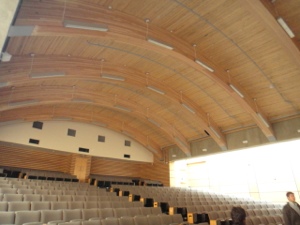
I am reminded of my visit to UBC CIRS building in Vancouver last year and the gorgeous timbers in the atrium and main hall, timbers ‘salvaged’ from local forests affected by pine beetle disease and closely monitored by the Living Building Challenge.

As we launch Living Building in the UK with a UK collaborative, it may well be that the certification of future green buildings in the UK is through standards such as the Living Building Challenge, that give hard earned recognition to buildings and facilities that, like plants, contribute to making the world a better place.

The CIRS Building was recently profiled in our CKE Green Vision series with a presentation from Max Richter at Perkin+Will.

Green Vision is a key driver in launching Living Building thinking into the UK. Look out for more announcements at the next Green Vision conference event on the 12th Dec in Leeds and across the web. (Hashtag #GVis2012)

For more information on the Living Building collaborative in the UK, leave a comment, get in touch or pop over to our Living Building UK Collaborative page on Facebook and say hello.