Author Archives: martin brown

So what was / is Climate Week Paris and how relevant to the built environment?

You couldn’t have missed the #CWParis hashtag and tweets from the Business Climate Summit in twitter streams over the past few days. The Climate Week Paris business meeting hosted by The Climate Group was scheduled six months before Paris hosts the UN conference where almost 200 countries are set to seal a (yet another) global climate change pact.

Key events included a Business & Climate Summit and Climate Finance Day, with world’s leading companies and policymakers brought together to demonstrate that low carbon makes good business, and good environmental sense

There were calls from many company executives at Paris urging governments to introduce more carbon pricing systems, such as a carbon tax or emissions trading schemes.

Relevance to built environment

With the Built Environment contributing the (rule of thumb) 40% of Carbon emissions, and a huge influence on business operation the sector had a presence through advocacy organisations and businesses with large built environment assets, but from reports seen and feeds followed, there was a very low presence from built environment providers – if any!

A high level session on transition to a ‘Low Carbon Built Environment’ (with a panel led by Christiana Figueres @CFigueres, Executive Secretary of the UN Framework Convention on Climate Change (UNFCCC) and chaired by Sandrine Dixson-Declève, Director of Cambridge Institute for Sustainability Leadership) discussed how “architect, town planners and engineers, collaborating with the construction, real-estate, materials & technology and financial communities, could showcase solutions for the built environment that can be deployed in Europe and inspire worldwide action”

One of the main points addressed was the lack of visibility suffered by the construction sector, as topics like energy efficiency and net positive standards are often seen as highly-technical and not understood by the general public.

Key to meeting the global goal of decarbonisation by 2050 is seen as the transition of new and existing buildings to EU Net Energy Standards . The EU Standard Requires “Member States shall ensure that by 31 December 2020 all new buildings are nearly zero-energy buildings; and after 31 December 2018, new buildings occupied and owned by public authorities are nearly zero-energy buildings”

Marks and Spencer (M&S) announced that they joined RE100, a global initiative for major companies committing to 100% renewable power, through their Plan A programme to lower carbon emissions from their activities and building operations.

The World Green Build Council promoted and launched its BuildUpon report during Climate Week Paris, aiming to create a building renovation revolution in Europe. See the Imagine a Built Environment that Enables a High Quality of Life for All  report

The BuildUpon report includes two notable actions,

  • identifying and engaging with ‘Unusual Suspects’, those not as yet engaged in the low carbon built environment dialogue.
  • A proposed open source wiki for information, the RenoWiki, a comprehensive summary of renovation initiatives across the 13 project EU countries, “to bring clarity on how national renovation strategies can strategically build upon the current landscape and how identified solutions might be scaled-up across other countries”

And, as reported in the Guardian Article “in an unprecedented alliance, 25 global news publishers have agreed to share climate change content to raise awareness in the runup to the next UN summit and agreed to scrap licensing fees for climate change content so that members of the alliance can freely republish articles.”

A call then to the Built Environment news publishers to do similar, to share climate change content and bring that content out from behind paywalls?

(I am grateful for informative tweets, sharing news and links from Climate Week Paris from friend , @WeMeanBusiness, @GuardianSustBiz, @SDDecleve @ClimateGroup and others in Paris)

Circulate News Launched

The Ellen MacArthur Foundation has launched Circulate, an online platform for news and thought-leadership on circular economy thinking, providing a central location for information and news on circular economy related topics.

Content on Circulate falls into three distinct types:

  • fortnightly featured articles with a journalistic focus, from a range of writers;
  • daily updated news articles from various industries and on a number of subjects, accompanied by comment from the Circulate editorial team;
  • and suggested reading material recommended by the Ellen MacArthur Foundation team.

Circulate has a twitter account at @circulatenews

Tesla’s Powerwall: a game changer for BIM and Built Environment Sustainability?

Following the announcement from Elon Musk, we have seen energy and sustainability commentators proclaiming the new Tesla PowerWall a game changer for energy management, and for good reasons, moving from centralised energy to local energy management.tesla-demand

Tesla estimate that with only 9 million Powerwall devices, carbon targets to address climate change can be achieved and that’s not such a big number given the number of cars in the world. What happens when every home, office, building has a Powerwall (or similar: there will be others) enabling local energy management, connected to the internet of course.

The Information Age Is Over. Welcome to the Infrastructure Age.

The Powerwall has also be heralded as an example of the emerging ’world view’ age, we are leaving the Age of Information to enter an Age of Infrastructure. An age that will focus on the way not only energy but how information is managed, transported and communicated, constantly and in real time – the Infrastructure of Information.

Imagine future Building Information Management models that up date instantly and constantly based on incoming data feeds from building’s internet of things , from weather, from other BIM’s building user data and so on

The age of Infrastructure, in which the internet of things is a key element will mash up physical and cyber spaces. Will BIM’s also start to blur the boundary between physical and web space, making Augmented Reality the tip of an iceberg. Building Infrastructure Management anyone?

But of course there is the security aspect:

There are the inevitable dangers that come with infusing physical space with all the vulnerabilities of cyberspace. People will hack your building; they’ll inject malicious code into delivery drones; stealing your phone might become the same thing as stealing your car.

Whilst this could well give us near perfect buildings and facilities, it could also take us one step closer to the Blade Runner vision of cities and buildings that is the antithesis of the environment, restorative sustainability thinking movement, and a danger “We’ll still be mining unsustainably to support our glorious batteries and photovoltaics and smart dance clubs”

It is shaping up to be an incredible fast paced journey ahead for the built environment and even more reason for sustainability watchdogs, and for educational focus.

Sources/Credits:

Tesla’s new Powerwall battery could be world-changing

Tesla Powerwall: Game-changing batteries for homes and businesses, starting at $3,000

The Information Age Is Over. Welcome to the Infrastructure Age.

The Internet of Things (IoT)— an integrated fabric of devices, data, connections, processes, and people.

RegenerativeBIM … moving the GreenBIM debate

green bimBuilding Information Management offers huge benefits to Sustainability and to GreenBuild, but needs to move from GreenBIM to RestorativeBIM

Bringing together the two most important themes of todays built environment, Sustainability and BIM, the ThinkBIM and Green Vision programmes at Leeds Beckett are setting the agenda for GreenBIM.

However we need to guard against GreenBIM falling into a trap of being Sustainability and BIM as usual, but to move GreenBIM into the visionary, Regenerative Sustainability arena, as adopted by Green Vision through their association with the Living Building Challenge.

Rethinking BIM for the Ecological Age

It does seems a waste that all the creative and innovative thinking and energy being put into BIM should only incrementally improve built environment sustainability, and that we will be a little less bad next year, a bit more less bad by 2018

Aligning the innovation of BIM and the forward thinking of Regenerative Sustainability provides an immense opportunity that could and should powerfully push the overall built environment agenda forward. And, through the intelligence of a RegenerativeBIM, ensure that each element, not just the building, contributes in a net-positive manner, doing more good, not just doing incrementally less bad.

Where GreenBIM is today and where Green BIM needs to be, RegenerativeBIM.

Where GreenBIM is today and where Green BIM needs to be, RegenerativeBIM.

Imagine then if every building, indeed every ‘facility’ was designed, constructed and operated through a RegenerativeBIM, that;

> is designed and constructed specifically in relation to its ‘place’, positively impacting and benefiting its immediate environment.

> becomes a provider of water, cleaning all that falls on the building and providing clean water to adjacent facilities.

> generates more energy than required and contributes the net positive difference to nearby homes, community buildings.

> contains no harmful materials. There should be no place in a GreenBIM for materials on Red Lists. An intelligent RestorativeBIM could not allow materials or products such as PVC, formaldehyde, or SPF’s. Every Product Data Sheet would include the elements of the Living Product Challenge, with every product having a net-positive Handprint

>  are based on biophilic and biomimic principles. RegenerativeBIM would constantly ask the question, How would nature approach this?

> focus on a positive, salutogenetic health principle – on making people healthy, not as present on the negative stopping people getting less ill. (Big difference!)

> cleans the air, emitting better quality than intaking.

> delights and encourages creativity …

> intelligently and digitally inspires and educate the next …. BIM.

Such an approach is not only possible but arguably the responsible approach we must take. An approach that in a short time could be the accepted way of designing, constructing and maintaining buildings.

OLYMPUS DIGITAL CAMERA

These ideas will be explored further in upcoming ‘GreenBIM’ events hosted through Green Vision, ThinkBIM and CE Yorkshire.

Watch this space.

On #tweetchats and future #sustldrconv conversations …

By Martin Brown and Andrea Learned

It has been huge fun co-hosting the sustainability leadership conversation since back in early 2013. This labor of love has introduced us to new ideas, leaders and friends, both in social media and in real life. However with emerging additional commitments (Martin with his forthcoming FutuREstorative book, Andrea in her new We Mean Business role) we have decided to scale back.

slc

What ambitiously started as monthly chats, then dropped to every two months or so. We now propose to drop to 3 or less per year, likely with Martin taking the lead and Andrea an occasional guest host.

Having given time freely to run the conversation series for a few years now, we have huge respect for others who run regular successful chats on twitter. They are time consuming and don’t happen overnight. Guests and topic are sought, questions and anticipated responses discussed, promotion and invites managed, in addition to the hosting and post chat transcripts … it all takes more time than the casual tweet-chat observer might realize.

Tweet chat hosts are by no means simply hosts. Instead, they need to be fairly knowledgeable in the topic and to know their way around, have experience in and be well known on across social media. They need to have developed a trusted reputation within their topic’s community, and thus, be able to persuade a fair number of people to take an hour from an already busy day to learn in an often very new-to-them way.

Through #sustldrconv we feel we have established a brand for sustainability conversations. We’ve held very successful conversations, connected many twitter users through excellent guests, and shared great content (see some of our Storify accounts). Perhaps most important to us, we know from feedback that we’ve moved the needle on sustainability awareness for many.

Keen to not lose that influence or brand, sustldrconv will continue, but on a less rigid footing, holding chats to meet demand, related to our own work or research and related themes. That said, the experience and skill we have developed should not go to waste. For example Martin will continue to be “for hire” as Tweetchat consultant and Andrea will be using her strengths, perhaps more behind the scenes, with her work the rest of this year.

In addition we would not be adverse for our great friends, guests and contributors to the series so far to ‘guest’ host future #sustldrconv from. If that interests you, please so get in touch.

Social media technology is changing fast. Martin has often commented that the tweet chat is the new benchmarking. No longer do we need to travel and spend to understand what others are doing. There is so much initial fact-finding that can be done from our offices or homes, with little more than an hour’s chat investment. It will be interesting to see how the tweet chat element of twitter develops or is eclipsed by new applications. (Will this year’s SXSW-emergent social media app Meerkat or twitters own Periscope replace some twitter sharing?)

We thank you for your interest in, and support of, #SustLdrConv these past years. We have enjoyed learning with you, and have felt so rewarded by perhaps getting even a handful of you more interested in the power of Twitter and sustainability.

Martin and Andrea

Ecological Handprints: Construction materials that do more good not just less harm

One of the more interesting and potentially industry game changing announcements coming out from the ILFI 2015 conference in Seattle last week was the launch of The Living Product Challenge (LPC).

Initially introduced at the LF 2014 conference with more detail released this year along with more on the concept of the “Ecological Handprint” (not a new concept, but one that is set to gain more parlance now adopted by the ILFI)

The LPC challenges manufacturing organisations to make products with a positive “handprint” i.e. encouraging products that are net-positive and transparent throughout the entire life cycle. (Ecological Handprints will measure the positive impact that a product causes across its life cycle, such as harvesting more water and generating more energy than was required to make the product)

There could be reservations with a requirement for LPC accredited organisations to hold  other ILFI standards such as Just and Declare, seeming a little incestuous perhaps. However sticking to the LBC approach of philosophy first, advocacy second and accreditation third, lets focus on the philosophy and advocacy to improve the sector, and address certification issues later. Living Product Challenge is looking to operate in an increasingly crowded healthy material transparency and green directory arena, yet the absolute-ness of the criteria, (you do or you don’t) will undoubtedly differentiate.

Buildings that consists solely of products and technologies that themselves do more good than harm, across environmental, social and economic spectrums, in manufacture, construction and in use is a very powerful statement for a regenerative future.

And its an approach of course that responsible organisations within the built environment should be adopting. And here are a whole new set of questions to ask; before designers specify materials; when contractors procure products and as facilities management upgrade/replace products.

The philsophy:

Re-imagine the design and construction of products to function as elegantly and efficiently as anything found in the natural world.

Products are informed by biomimicry and biophilia; manufactured by processes powered only by renewable energy and within the water balance of the places they are made.

Products improve our quality of life and bring joy through their beauty and functionality.

Imagine a Living Product whose very existence builds soil; creates habitat; nourishes the human spirit; and provides inspiration for personal, political and economic change.

Like the Living Building Challenge (LBC), the LPC consists of 20 specific “Imperatives” under seven “Petal” categories. All 20 requirements are needed for full LPC certification, or Imperative and Petal certification options . Many of the imperatives will be familiar to those already au fait with the Living Building Challenge, with a few new additions and definations, for example:

Positive Handprint: The manufacturer must demonstrate that the product gives more than it takes over its entire life cycle,

Net-Positive Waste: Water use and release from manufacturing the product must work in harmony with the natural water flows of the site and its surroundings.

Net Positive Material Health: The product must be safe for human exposure during manufacturing, use and end-of-use.

Human Thriving: The product must contribute to an active, healthy lifestyle and be designed to nurture the innate human/nature connection.

Product Fit to Use: Durability, warranty, and useful lifespan must have a direct relationship to environmental impact and embodied energy.

Equitable Product Access: Products sold to consumers must be affordable to the people who manufacture them, and products used in buildings must not unduly impair the affordability of those buildings.

The Living Product Challenge ‘brochure’ pdf can be downloaded from here. The UK LBC Collaborative will be getting to grips with the LPC over the coming weeks, with a view to providing more information and introduction sessions later in the year.

Sources #LF15 Tweets,  https://living-future.org

Twitter for Sustainable Business

17062008118“I didn’t know twitter could be used for business, I thought it was just for complaining and moaning on poor service” A comment from a recent chat on a construction site illustrates the level of understanding of twitter and social media within the sector.

OK, it is maybe more daunting to start using twitter today than it was four or so years ago when I wrote in the Guardian “Why Construction Should Engage with Social Media”, but the reasons and rationale for doing so remain the same, but now perhaps with more urgency.

I am often asked where to find the best source for up to date information and thinking on sustainability in the built environment, in design, in construction and in facilities management . My response is the same as in 2011, i.e. “There is probably no better, and certainly no more accessible, tool for keeping abreast with sustainability thinking, development, papers, case studies and failures than twitter”

We were reminded by Martha Lane Fox, in her Dimbleby Lecture this week of Aaron Swartz’s comment “It is not OK not to understand the internet anymore” and too right, its akin to not understanding or wanting to engage with email or the telephone or the radio or …

So just where would we start today? 

I liken twitter and social media to the radio, it’s live, it’s full of great comments and content, but also non stop and full of unwanted content or ‘noise’. Therefore one of the modern skills we have developed is filtering out noise from that we are really interested in – we use programme schedules, our beloved wireless sets to tune in and occasionally use the off switch. In twitter we can do this through lists, through hashtags and with suitable applications (think apps such as tweetdeck as your digital wireless) Not only is this now an essential life and business skill, for directors, managers and others in the built environment, its sadly not one included in the sector’s education and training.

There are great social media training courses out there – but many are the equivalent of the Letter Writing Courses that many us would have attended pre-email days. Informative and entertaining with many wow tips, but the content was soon eclipsed and rarely applied, which is why I continue to recommend and deliver one to one coaching over time.

Following hashtags such as #GreenBIM, #UKBIMCrew #CSRchat #sustldrconv will bring up to date thinking, links and help direct to your twitter stream. Start building your lists for great content and insight, check out the top 500 lists curated by Jim McClelland, for example: Built Environment SustainabilityGreen Infrastructure or BIMAnd keep your twitter ear open for curated lists: for example: 30 CSR Pro’s to follow in 2015 or the EcoBuild 2015 Influencers list

“Resistance to twitter is futile” as my colleague Andrea Learned wrote in her Linkedin article recently. You will start using it sometime soon, your competitors are most likely using it today, your staff are, and the most informed on built environment sustainability issues certainly are.

Ahead of Paris #COP21: Construction Carbon targets wake up call?

Most if not all of our construction sustainability / carbon strategies,standards and targets are based on preventing an increase in global warming temperatures beyond 2 deg C.  That may well have to change, with harsher, tougher targets becoming essential.

As reported in Science Daily, the 2 deg target is increasingly under pressure as being ‘utterly inadequate’ for protecting those at most risk from climate change, with targets of 1.5 or even 0.8 being proposed.  The long-term goal to stay below 2°C warming is currently undergoing a 2013-15 Review, the results of which are expected this June and could be adopted in Paris at COP21 in December 2015.

mb-m-and-c-4-green

A slow, pale green approach? Do we need to reset our sustainable construction map and compass?

It may well be that our slowness in moving forward with carbon reductions over the last decade or so is now catching up and that the effort to cap carbon and or temperature rises will become more and more difficult.

In construction we have seen site based carbons increase, and whilst there maybe a decrease in construction transport emissions, that can be attributed to efficiencies in vehicle efficiency. Globally we are increasingly procuring materials and services farther and farther away from contracts.

Cowed: A Book Review

imagesCowed:  The Hidden Impact of 93 million Cows on America’s Health, Economy, Politics, Culture and Environment, 

Denis Hayes and Gail Boyer Hayes

Do Cows hibernate Dad? asked one of my sons a decade or so ago when we moved into rural Lancashire, noticing that cows were absent in the fields during winter months and as then not aware of the noisy, steamy and rather smelly over wintering cow sheds. One of the rural spring treats which we will witness soon, is when the cows are let out into the spring green fields, where they literally can jump for joy like spring lambs. the word cavorting* would seem invited for just this occasion.

Cowed is an entertaining and educating insight into the American relationship with its cattle, triggered by the authors visit in the UK and noticing how very different cattle in UK fields appeared to that seen or indeed out of sight in the US.

From Cowboys through to intelligent, mechanised milking, Denis and Gail provide real insights from their environmentalism knowledge, (Denis was cofounder of Earthday in the 70’s, now founder /CEO of the Bullitt Foundation in Seattle and a recent guest on our #sustldrconv series,  Gail is an Environmental lawyer, health writer and editor)

Throughout, I was reminded of John Muir’s comment that ‘when we tug on one part of nature we find it joined to everything else”, This may be as on the day I started reading Cowed, I visited a botanical garden in Vancouver where this quote was engraved into the floor and entrance screens.

Nevertheless, for me it summed up one of Cowed’s core themes. That the Cow, which we have removed from natural habituation and domesticated or rather industricated, is now so intrinsically linked to so many aspects of our lives from food to furniture and in doing so, uncoupled from its natural connections and bio-relationship with soil, air and water.

Cowed provided, for me a straightforward  explanation of the recent research, debate and controversy on natural cattle grazing patterns and impact for soil carbon sequestration based around the work of Allan Savory. This is something I had come across before on a TED talk but poorly understood.

Living in rural Lancashire I easily recognised the description of dairy farming within the first few pages, but I struggled to recognise the US description of cattle management in the remainder of the book, perhaps with the exception of the cattle ranching images from old Westerns!. Yet Cowed does highlight issues we here in the UK need to be aware of and guard against as concepts of mega farms are proposed and debated here.

*to jump or move around in a playful way, sometimes noisily, and often in a sexual way

Rethinking Water, Reclaiming Water #WorldWaterDay

This year the World Economic Forum identified “water” as one of the top 5 biggest societal and economic risks for the next 10 years. Climate change is affecting the water cycle, with water variability increasing and extreme events (floods and droughts) becoming more common and increasingly costly. The impact that the built environment has on water management in just about every other sector is significant, making water performance of buildings a corporate or social responsibility issue.

Here in the UK we may not have the acute water issues as for example being experienced in Perth or in California where they have less than a year’s supply of water. This shortage is due to a number of reasons such as removing water from the aquifers and not returning it (or indeed returning it treated with chemicals, and the reduced levels of snowpack, acute this year, that top up these aquifers)

Yet, in the UK we are experiencing floods and water shortages, restrictions and droughts more frequently, so rethinking water, in design, in construction and in building operations can only be a good thing.

The UK Living Building Challenge Collaborative has been exploring the Challenges’ Water Imperative and developing an overlay or interpretation guide for UK projects and clients looking to adopt Living Building Challenge approaches.

The Water Petal intent is to To meet all water demands within the carrying capacity of the site and to mimic natural hydrological conditions, using appropriately-sized and climate-specific water management systems that treat, infiltrate or reuse all water resources on-site.

Lets unpick that a little …

“Water Demands” One theme emerging, from the work of this group and my visit to a number of LBC projects in the Pacific NW is that we need to rethink water and the performance of buildings in water management, giving it the same focus as we do energy. Not to see water as an additional design criteria, but to be at the core of design, calculating and seeking ways top reduce water load, as we would with energy.

Reducing ‘water load’ for a building use can be achieved through waterless or composting WC’s such as those in the Bullitt Centre or though recycled water systems such as the busy VanDusen botanical garden visitor Centre in Vancouver.

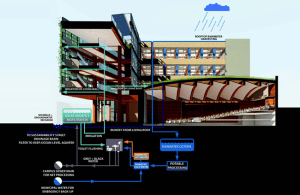
13.2-ReclaimedWater“All water” – the CIRS building at the University of British Columbia in Vancouver – a sustainability research lab – is utilizing a Solar Aquatic System designed to mimic the purification processes of naturally occurring water systems in close proximity to human inhabitation, such as streams and wetlands, to produce clean water for use in the building

“Net Positive” – LBC projects will be water net-positive, for example, via the large underground (56k gallon water tank)  the Bullitt Centre can survive for 104 days without accessing mains water, the CIRS building can supply grey water to adjacent buildings.

“Reuse” Good buildings will recycle and reuse grey water more than once using natural systems. And without using materials deemed ‘toxic”, i.e. those on the Living Building Challenge’s Red List such as Chlorine and PVC. On a domestic level, water reclaiming systems such as Nexus eWater are enabling the recycling of rain water and grey water many times in a domestic closed loop system

CAm_KRWWAAAz5xw

Systems that treat Good buildings will treat all water on site, ensuring no leachates and other nasty’s run off into the ground, into water systems, just as trees do, and as trees did that most likely stood on the site in the past, ensuring the aquifers remained as pure as possible.


IMG_2008

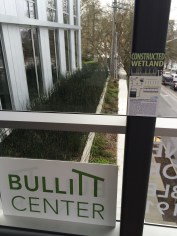
Thinking beyond SUDS, Constructed wetlands can and arguably should be incorporated into the structure of the building as well as being part of the landscaping.

Viewing buildings as a system of interconnected buildings is key to integrated design, rather than seeing each as stand-alone buildings. Here great synergies can be gained, moving reclaimed or harvested water from one building to another to meet need, using buildings as storage or as filters for others.


Construction phase … projects can develop water hierarchies, as we do waste and energy hierarchies, perhaps with a water plan, addressing the question “Why do we use drinking quality water for washing down site plant, keeping dust down etc.”

And to FM and building operations – spreading the water conservation message, through signage and through occupant ‘charters’ can all help gain respect for special water technologies within the facility. Going further Catering and food outlets could serve two vegetarian meals for every one meat – as the CIRS building does – to reinforce the vastly different quantities of water required to provide meat produce and veg / fruit produce (not to mention energy and travel impact)

And, on drinking water The WELL Building Standard for Water requires and promotes safe and clean water through proper filtration and other methods, requiring the appropriate quality of water for various uses. Again without harmful chemicals or materials.

IMG_2035So on World Water Day, a call to UK universities with a strong built environment and sustainability programme and values. Make your next university estates project a sustainable water building, along the philosophy of the Living Building Challenge, as a research project as the CIRS building does, or as a demonstration of what is possible – core to the Bullitt Centre remit. Influencing and inspiring the next generation of built environment professionals is so important.

“The era of harm reduction, half steps, and lesser evils is behind us. As a society, we need to be bold in ways that were once unimaginable. Luckily in the building sector, we now can imagine where we need to go”

If you would like more information on the work of the UK Living Building Challenge or indeed on the standard itself, please get contact me on fairsnape@gmail.com or Donna on d.m.lee@leedsbeckett.ac.uk or indeed follow us on twitter @fairsnape and @livingbldgUK