Category Archives: carbon

eco facilities management for government?

The UK  Government has come under criticism recently for not tackling environmental issues with enough vigour to be seen as a role model or exemplar, and failing to meet its own targets.

See: the Sustainable Development Commission report two thirds of departments were not on track to meet the target of reducing emissions by 12.5 per cent by 2010, while a similar report from the National Audit Office criticised civil servants for failing to keep accurate carbon emissions data. Those reports were accompanied by another study from the Commons Public Accounts Committee which claimed rules on sustainable procurement were being widely ignored by civil servants.

Now Companies providing green products and services can now expect a major boost after the government yesterday unveiled its long-anticipated delivery plan for meeting its targets on environmentally sustainable procurement and carbon emissions.

Following on from its recent commitment to ensure all government IT operations are carbon neutral by 2013, the Cabinet Office released a 167-page plan outlining how it intends to ensure departments consider environmental sustainability when making procurement decisions and better meet targets to cut emissions, waste and water use across their facilities.

We can expect these requirements to trickle down the supply chains for service provision (facilities management, IT  and construction) reinforcing the notion of supply chains based on environmental and carbon management, not just cost, and certainly not lowest cost

Source and Links:

UK Governments sustainable procurement and carbon emissions delivery plan announced

Government outlines green procurement overhaul

carbon trust standard

The Carbon Trust new certification acknowledges organisations that reduce their greenhouse gas emissions without using offsets.

The Carbon Trust Standard certifies that an organisation has genuinely reduced its carbon footprint and is committed to making further reductions year on year.

“Our research shows that not only do consumers currently mistrust business’ climate change claims, but that business thinks existing carbon award schemes are confusing and lack credibility,” said Carbon Trust Chief Executive Tom Delay. “What business and consumers both share is a desire for one, credible way to prove an organisation has not only measured, but actually reduced their carbon emissions year-on-year without the use of offsetting.”

The 12 case study organisations who have acheived the standard are Abbey Corrugated, B&Q, Crown Prosecution Service, Dept. of Environment, Food and Rural Affairs, Dept. for International Development, DSM Nutritional Products – Dairy production site Scotland, King’s College London, London Fire Brigade, Morrisons, Thames Water, Trinity Mirror and University of Central Lancashire.

is ISO 14001 working?

I picked up a copy of the Patagonia outdoor apparel catalogue over the weekend.  In addition to the photos and products, these catalogue are always a good read to see how a leading organisation is approaching and communicating their environmental and ecological ethos.  A link to their website allows you to track the impact of specific Patagonia products from design through delivery, through interactive mini-site Footprint Chronicles™

What caught my eye was a comment on ISO14001, and on how Patagonia, to ensure that our (leather in footwear) leaves the smallest possible footprint, we only use (tanneries) with an ISO14001 registration. This strict set of environmental standards measures how efficiently a company uses natural resources, how its process impact on the environment and how closely it adheres to local and international environmental regulations.

Wow, if only this were the case in the built environment. Although I often make the link between effective ISO14001 application and reducing the carbon and ecological footprint but its not often I have seen others make the link.  Of course this needs much much more than just achieving and maintaining with a tick box mentality.  The concept of ISO 14001 remains good, but from experience of taking organisations through the assessment process it is far too easy to attain with tokenism and without really addressing real change on environmental and ecological issues.

As we are now head long into reducing the impact of the built environment may be its time to tighten up on ISO14001 accreditation and requirements.  What difference would a project with the entire supply chain working to ISO 14001 achieve?   I am aware that customers and clients believe this is what they get when in procurement they insist on ISO 14001 of the main or prime contractor.  In reality it may be just the main contractor who holds the standard, who conducts the impact assessment, who then takes the do-as-little-as-possible-in-the-hope-we-are-not-audited approach.

Or, as the example given for greenwash Sin of Fibbing -being certified ISO 14001 compliant (“ok, its our holding company actually, not our business unit”)

We have seen a number of fast track and 14001 made easy programmes for the sector recently – I question if this no more than a bandaid, get-the-badge to get through tenders approach, or a real contribution to improving environmental performance.  Often these are process based, web based, electronic approaches with pre-written templates that ignore the hearts and mind, people element so crucial to implementing the systemic change in ethos required.

Within the built environment we need, the strict set of environmental standards measures how efficiently a company uses natural resources, how its process impact on the environment and how closely it adheres to local and international environmental regulations. That covers ALL aspects of the sector and is continually improved.

Related isite links:

Responsible Sourcing to BS6000

isite’s Guide to Effective ISO 14001

my blog fights climate change

A number of people have asked why 350 on the my blog fights climate change badge, well, its the parts per million of CO2 in the atmosphere that we must aim for if we want to keep the planet relatively safe. I feel this is an important message to spread, as most of our targets for reductions are based on 450 ppm. If the 350 ppm is right, and it has the backing of many eminent scientists, our targets (in the UK) should be 80% and not 60% by 2050, which is a huge huge difference.

Readers of isite will know I am not totally in agreement with offsetting – but take a look at Brighter Planet and make your own minds up and get a badge.

UK’s first carbon neutral city

It was only a matter of time before the extension of eco homes, eco villages and eco towns was applied to eco cities in the UK, after all the rest of the world has eco-cities.

I should mention the great work being done at a community level over in Ashton Hayes – aiming to be England’s first carbon neutral village (which I believe is a great case study on Community based FM in practice)

But who would have thought Sterling would be the first city in the UK to be brave enough to go carbon neutral?

One to watch … Carbon Neutral Stirling

This raises a number of questions, mainly though, in my mind, what requirements will there be on sustainability and carbon management of construction and of facilities management of buildings in the citiy?

on zero carbon and routes to get there …

There have been some very worthwhile and considered articles and comments on the definition of and feasibility of zero carbon recently – take a look at Mels post .. and Phils post for excellent round ups and for good technical comment take a look at CarbonLimited from Casey

The difference in opinions and views is healthy – maybe there is no ‘one’ definition, maybe we should not waste (mental) energy on defining – but as per the zero accidents, zero waste and zero defects debates of recent years accept it as a worthwhile, Utopian goal and work how how to best get there. I recall from my TQM days the concept of zero waste drives lean management approaches, but absolute zero waste is not ‘defined’ – it is a philosophy.

From the supply, contractors, perspective the very confusing debate on what is zero carbon just encourages the ‘keep heads down until it blows over approach’. Understandable, but a strategy that will return to haunt those not prepared to address the changes we will have to make. Most do not have a strategy or vision for moving to a low carbon future, content to be led by circumstances.

Within the Route to Zero programme I run, we start to understand, from industry intelligence, what an organisations customers, shareholders, people and even suppliers are expecting in the context of zero carbon over the next 10 – 20 years. From this intellenge we can develop a maturity matrix of strategies and objectives that would be necessary, ie a Route to Zero. A matrix that would be reviewed regulaly as ‘requirements’ will unfold and change and most likely toughen up. Armed with such a route-map, organisations may not achieve zero , but have the evidence that they are thinking of a zero future.

And as to the general public, those who will buy the zero carbon homes, Mel is correct in pointing out the confusion we as an industry may be giving, a damaging message maybe? What home owners would like to know is the balance between capital purchase and the running costs per month, and what savings per month would a code 6 or zero carbon home give me over a traditional home? Take a look at the house sale literature in the states – this is exactly what green homes are sold on – a reduction in energy bills, making the purchase of green homes desirable, a no brainer and making non green homes nearly unsaleable.

Ad then there is the existing housing stock issue …. which is where effort must be put, not on new build, eco challenges, eco home etc etc ….

Carbon Trust could do better

Carbon Trust “could do better”

The government-backed Carbon Trust’s contribution to reducing UK carbon dioxide emissions is “pretty small beer” and it can do better, the Committee of Public Accounts said in a report on Tuesday.

on the zero carbon house

Barratt Developments has unveiled what it calls the first zero-carbon house developed by a volume housebuilder, built at the Buildings Research Establishment in Watford, packed with the latest technology, including solar panels, rainwater harvesting and an air source heat pump.

Its new kind of concrete walls and floors, combined with super insulation and triple-glazed windows, means its heat requirement will be minimal as it is airtight. Fresh air is brought into the building through a heat exchanger, which extracts the heat from outgoing stale air and puts it back into the house.

Mark Clare, chief executive of Barratt, said it would not be easy to reduce the cost of the prototype to commercial levels but he was confident it could be done. The important thing, he added, was to build houses that people would buy.

The public and builders still need to be convinced, according to the NHBC Foundation report, and it would seem todays kids – who will buy the homes – Kids dream homes – whose dream homes aren’t high on eco features.

The UK Green Building Council released a report this week defining what a zero-carbon house should be in practice. This is likely to form the basis of the legislation that the government is soon going to work on.

Housebuilders had been unhappy at the costs of going zero carbon and had wanted to be able to invest in off-site renewable energy such as wind turbines that would be cheaper for them. But the government is likely to endorse the GBC proposals that a zero-carbon house should produce almost all its energy on site or very near by in, say, a communal heat and power system.

Barratt plans rolling out its zero-carbon homes on the site of Hanham Hall hospital near Bristol. It will build 200 of them, a third of which will be affordable to lower-income buyers. All will be code level six and will completed in 2011, five years ahead of the deadline.

Source

a guide to zero carbon homes

Zero carbon homes in 100 words.

The UK Green Building Council released a report this week defining what a zero-carbon house should be in practice. Download from here

Still to read in detail but on first read appears to be a welcomed, considered and helpful guide, with a time-line to help organisations on a route to zero.

There would however appear to be little focus on the construction process, the actual building of zero carbon homes, (an estimated 3-4 years or 11% of the total carbons in the homes life cycle). This is the one issue we desperately need to address, to get buy in from builders. Many of whom may look at this and conclude it has nothing to do with them – other than install or assemble different bits of eco kit and / or materials. For example, construction waste, construction site impacts and considerate contractors scheme – all part of the Code 6 requirements isnt mentioned within the guide. (Site waste management planning is mandatory)

Others, and I know fellow bloggers will, soon comment on the renewable energy and technology aspect of the guide… watch this space…

Finally (for now) I hope that this definition is the same in the soon to be released UK Construction Strategy for Sustainability !!

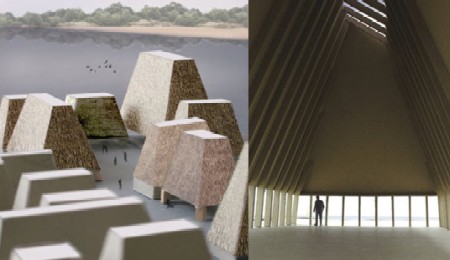
zero carbon ‘floating’ development for Preston

Green, innovative and zero carbon project development on our doorstep in Preston, Lancs, !

The RIBA have recently awarded a zero carbon design as the visitor center at the new Brockholes Wetland and Woodland Nature Reserve in Preston, to regenerate a former quarry site into a major visitor attraction.

The project called “A Floating World”, consists of zero-carbon floating buildings (the name coming from the fact that the zero-carbon buildings will be built on an island of floating pontoons)

Adam Khan Architects, won the RIBA design competition to work on the ‘jewel in the crown’ of Britain’s largest eco-regeneration scheme. The project is zero-carbon in both use and production, with materials of low embodied energy – thatch, willow, timber, with off-site prefabrication and on-site energy generation and waste treatment.

Floating world will feature cafe, shops, gallery, education areas and meeting rooms and is part of the £59 million Newlands Scheme, a project that will turn 900 hectares to community woodland and green space.

On announcement of the winner, Peter White, Head of Infrastructure & Development at the Northwest Regional Development Agency said:

“This site has the potential to become an important visitor attraction for the region, building on its rich natural assets and impressive biodiversity. The Agency is supporting its development through Newlands, a wide reaching scheme that aims to reclaim brownfield land and transform it into thriving community open spaces, and has so far invested £800,000 in Brockholes. The chosen design will not only create an inspirational open space for the local community to enjoy but will also enhance a key gateway into Lancashire and attract further investment into the area. We look forward to working with our partners to progress these plans.”

More on this as the project develops …