Category Archives: comment

Tesla’s Powerwall: a game changer for BIM and Built Environment Sustainability?

Following the announcement from Elon Musk, we have seen energy and sustainability commentators proclaiming the new Tesla PowerWall a game changer for energy management, and for good reasons, moving from centralised energy to local energy management.tesla-demand

Tesla estimate that with only 9 million Powerwall devices, carbon targets to address climate change can be achieved and that’s not such a big number given the number of cars in the world. What happens when every home, office, building has a Powerwall (or similar: there will be others) enabling local energy management, connected to the internet of course.

The Information Age Is Over. Welcome to the Infrastructure Age.

The Powerwall has also be heralded as an example of the emerging ’world view’ age, we are leaving the Age of Information to enter an Age of Infrastructure. An age that will focus on the way not only energy but how information is managed, transported and communicated, constantly and in real time – the Infrastructure of Information.

Imagine future Building Information Management models that up date instantly and constantly based on incoming data feeds from building’s internet of things , from weather, from other BIM’s building user data and so on

The age of Infrastructure, in which the internet of things is a key element will mash up physical and cyber spaces. Will BIM’s also start to blur the boundary between physical and web space, making Augmented Reality the tip of an iceberg. Building Infrastructure Management anyone?

But of course there is the security aspect:

There are the inevitable dangers that come with infusing physical space with all the vulnerabilities of cyberspace. People will hack your building; they’ll inject malicious code into delivery drones; stealing your phone might become the same thing as stealing your car.

Whilst this could well give us near perfect buildings and facilities, it could also take us one step closer to the Blade Runner vision of cities and buildings that is the antithesis of the environment, restorative sustainability thinking movement, and a danger “We’ll still be mining unsustainably to support our glorious batteries and photovoltaics and smart dance clubs”

It is shaping up to be an incredible fast paced journey ahead for the built environment and even more reason for sustainability watchdogs, and for educational focus.

Sources/Credits:

Tesla’s new Powerwall battery could be world-changing

Tesla Powerwall: Game-changing batteries for homes and businesses, starting at $3,000

The Information Age Is Over. Welcome to the Infrastructure Age.

The Internet of Things (IoT)— an integrated fabric of devices, data, connections, processes, and people.

RegenerativeBIM … moving the GreenBIM debate

green bimBuilding Information Management offers huge benefits to Sustainability and to GreenBuild, but needs to move from GreenBIM to RestorativeBIM

Bringing together the two most important themes of todays built environment, Sustainability and BIM, the ThinkBIM and Green Vision programmes at Leeds Beckett are setting the agenda for GreenBIM.

However we need to guard against GreenBIM falling into a trap of being Sustainability and BIM as usual, but to move GreenBIM into the visionary, Regenerative Sustainability arena, as adopted by Green Vision through their association with the Living Building Challenge.

Rethinking BIM for the Ecological Age

It does seems a waste that all the creative and innovative thinking and energy being put into BIM should only incrementally improve built environment sustainability, and that we will be a little less bad next year, a bit more less bad by 2018

Aligning the innovation of BIM and the forward thinking of Regenerative Sustainability provides an immense opportunity that could and should powerfully push the overall built environment agenda forward. And, through the intelligence of a RegenerativeBIM, ensure that each element, not just the building, contributes in a net-positive manner, doing more good, not just doing incrementally less bad.

Where GreenBIM is today and where Green BIM needs to be, RegenerativeBIM.

Where GreenBIM is today and where Green BIM needs to be, RegenerativeBIM.

Imagine then if every building, indeed every ‘facility’ was designed, constructed and operated through a RegenerativeBIM, that;

> is designed and constructed specifically in relation to its ‘place’, positively impacting and benefiting its immediate environment.

> becomes a provider of water, cleaning all that falls on the building and providing clean water to adjacent facilities.

> generates more energy than required and contributes the net positive difference to nearby homes, community buildings.

> contains no harmful materials. There should be no place in a GreenBIM for materials on Red Lists. An intelligent RestorativeBIM could not allow materials or products such as PVC, formaldehyde, or SPF’s. Every Product Data Sheet would include the elements of the Living Product Challenge, with every product having a net-positive Handprint

>  are based on biophilic and biomimic principles. RegenerativeBIM would constantly ask the question, How would nature approach this?

> focus on a positive, salutogenetic health principle – on making people healthy, not as present on the negative stopping people getting less ill. (Big difference!)

> cleans the air, emitting better quality than intaking.

> delights and encourages creativity …

> intelligently and digitally inspires and educate the next …. BIM.

Such an approach is not only possible but arguably the responsible approach we must take. An approach that in a short time could be the accepted way of designing, constructing and maintaining buildings.

OLYMPUS DIGITAL CAMERA

These ideas will be explored further in upcoming ‘GreenBIM’ events hosted through Green Vision, ThinkBIM and CE Yorkshire.

Watch this space.

On #tweetchats and future #sustldrconv conversations …

By Martin Brown and Andrea Learned

It has been huge fun co-hosting the sustainability leadership conversation since back in early 2013. This labor of love has introduced us to new ideas, leaders and friends, both in social media and in real life. However with emerging additional commitments (Martin with his forthcoming FutuREstorative book, Andrea in her new We Mean Business role) we have decided to scale back.

slc

What ambitiously started as monthly chats, then dropped to every two months or so. We now propose to drop to 3 or less per year, likely with Martin taking the lead and Andrea an occasional guest host.

Having given time freely to run the conversation series for a few years now, we have huge respect for others who run regular successful chats on twitter. They are time consuming and don’t happen overnight. Guests and topic are sought, questions and anticipated responses discussed, promotion and invites managed, in addition to the hosting and post chat transcripts … it all takes more time than the casual tweet-chat observer might realize.

Tweet chat hosts are by no means simply hosts. Instead, they need to be fairly knowledgeable in the topic and to know their way around, have experience in and be well known on across social media. They need to have developed a trusted reputation within their topic’s community, and thus, be able to persuade a fair number of people to take an hour from an already busy day to learn in an often very new-to-them way.

Through #sustldrconv we feel we have established a brand for sustainability conversations. We’ve held very successful conversations, connected many twitter users through excellent guests, and shared great content (see some of our Storify accounts). Perhaps most important to us, we know from feedback that we’ve moved the needle on sustainability awareness for many.

Keen to not lose that influence or brand, sustldrconv will continue, but on a less rigid footing, holding chats to meet demand, related to our own work or research and related themes. That said, the experience and skill we have developed should not go to waste. For example Martin will continue to be “for hire” as Tweetchat consultant and Andrea will be using her strengths, perhaps more behind the scenes, with her work the rest of this year.

In addition we would not be adverse for our great friends, guests and contributors to the series so far to ‘guest’ host future #sustldrconv from. If that interests you, please so get in touch.

Social media technology is changing fast. Martin has often commented that the tweet chat is the new benchmarking. No longer do we need to travel and spend to understand what others are doing. There is so much initial fact-finding that can be done from our offices or homes, with little more than an hour’s chat investment. It will be interesting to see how the tweet chat element of twitter develops or is eclipsed by new applications. (Will this year’s SXSW-emergent social media app Meerkat or twitters own Periscope replace some twitter sharing?)

We thank you for your interest in, and support of, #SustLdrConv these past years. We have enjoyed learning with you, and have felt so rewarded by perhaps getting even a handful of you more interested in the power of Twitter and sustainability.

Martin and Andrea

Ecological Handprints: Construction materials that do more good not just less harm

One of the more interesting and potentially industry game changing announcements coming out from the ILFI 2015 conference in Seattle last week was the launch of The Living Product Challenge (LPC).

Initially introduced at the LF 2014 conference with more detail released this year along with more on the concept of the “Ecological Handprint” (not a new concept, but one that is set to gain more parlance now adopted by the ILFI)

The LPC challenges manufacturing organisations to make products with a positive “handprint” i.e. encouraging products that are net-positive and transparent throughout the entire life cycle. (Ecological Handprints will measure the positive impact that a product causes across its life cycle, such as harvesting more water and generating more energy than was required to make the product)

There could be reservations with a requirement for LPC accredited organisations to hold  other ILFI standards such as Just and Declare, seeming a little incestuous perhaps. However sticking to the LBC approach of philosophy first, advocacy second and accreditation third, lets focus on the philosophy and advocacy to improve the sector, and address certification issues later. Living Product Challenge is looking to operate in an increasingly crowded healthy material transparency and green directory arena, yet the absolute-ness of the criteria, (you do or you don’t) will undoubtedly differentiate.

Buildings that consists solely of products and technologies that themselves do more good than harm, across environmental, social and economic spectrums, in manufacture, construction and in use is a very powerful statement for a regenerative future.

And its an approach of course that responsible organisations within the built environment should be adopting. And here are a whole new set of questions to ask; before designers specify materials; when contractors procure products and as facilities management upgrade/replace products.

The philsophy:

Re-imagine the design and construction of products to function as elegantly and efficiently as anything found in the natural world.

Products are informed by biomimicry and biophilia; manufactured by processes powered only by renewable energy and within the water balance of the places they are made.

Products improve our quality of life and bring joy through their beauty and functionality.

Imagine a Living Product whose very existence builds soil; creates habitat; nourishes the human spirit; and provides inspiration for personal, political and economic change.

Like the Living Building Challenge (LBC), the LPC consists of 20 specific “Imperatives” under seven “Petal” categories. All 20 requirements are needed for full LPC certification, or Imperative and Petal certification options . Many of the imperatives will be familiar to those already au fait with the Living Building Challenge, with a few new additions and definations, for example:

Positive Handprint: The manufacturer must demonstrate that the product gives more than it takes over its entire life cycle,

Net-Positive Waste: Water use and release from manufacturing the product must work in harmony with the natural water flows of the site and its surroundings.

Net Positive Material Health: The product must be safe for human exposure during manufacturing, use and end-of-use.

Human Thriving: The product must contribute to an active, healthy lifestyle and be designed to nurture the innate human/nature connection.

Product Fit to Use: Durability, warranty, and useful lifespan must have a direct relationship to environmental impact and embodied energy.

Equitable Product Access: Products sold to consumers must be affordable to the people who manufacture them, and products used in buildings must not unduly impair the affordability of those buildings.

The Living Product Challenge ‘brochure’ pdf can be downloaded from here. The UK LBC Collaborative will be getting to grips with the LPC over the coming weeks, with a view to providing more information and introduction sessions later in the year.

Sources #LF15 Tweets,  https://living-future.org

Twitter for Sustainable Business

17062008118“I didn’t know twitter could be used for business, I thought it was just for complaining and moaning on poor service” A comment from a recent chat on a construction site illustrates the level of understanding of twitter and social media within the sector.

OK, it is maybe more daunting to start using twitter today than it was four or so years ago when I wrote in the Guardian “Why Construction Should Engage with Social Media”, but the reasons and rationale for doing so remain the same, but now perhaps with more urgency.

I am often asked where to find the best source for up to date information and thinking on sustainability in the built environment, in design, in construction and in facilities management . My response is the same as in 2011, i.e. “There is probably no better, and certainly no more accessible, tool for keeping abreast with sustainability thinking, development, papers, case studies and failures than twitter”

We were reminded by Martha Lane Fox, in her Dimbleby Lecture this week of Aaron Swartz’s comment “It is not OK not to understand the internet anymore” and too right, its akin to not understanding or wanting to engage with email or the telephone or the radio or …

So just where would we start today? 

I liken twitter and social media to the radio, it’s live, it’s full of great comments and content, but also non stop and full of unwanted content or ‘noise’. Therefore one of the modern skills we have developed is filtering out noise from that we are really interested in – we use programme schedules, our beloved wireless sets to tune in and occasionally use the off switch. In twitter we can do this through lists, through hashtags and with suitable applications (think apps such as tweetdeck as your digital wireless) Not only is this now an essential life and business skill, for directors, managers and others in the built environment, its sadly not one included in the sector’s education and training.

There are great social media training courses out there – but many are the equivalent of the Letter Writing Courses that many us would have attended pre-email days. Informative and entertaining with many wow tips, but the content was soon eclipsed and rarely applied, which is why I continue to recommend and deliver one to one coaching over time.

Following hashtags such as #GreenBIM, #UKBIMCrew #CSRchat #sustldrconv will bring up to date thinking, links and help direct to your twitter stream. Start building your lists for great content and insight, check out the top 500 lists curated by Jim McClelland, for example: Built Environment SustainabilityGreen Infrastructure or BIMAnd keep your twitter ear open for curated lists: for example: 30 CSR Pro’s to follow in 2015 or the EcoBuild 2015 Influencers list

“Resistance to twitter is futile” as my colleague Andrea Learned wrote in her Linkedin article recently. You will start using it sometime soon, your competitors are most likely using it today, your staff are, and the most informed on built environment sustainability issues certainly are.

Ahead of Paris #COP21: Construction Carbon targets wake up call?

Most if not all of our construction sustainability / carbon strategies,standards and targets are based on preventing an increase in global warming temperatures beyond 2 deg C.  That may well have to change, with harsher, tougher targets becoming essential.

As reported in Science Daily, the 2 deg target is increasingly under pressure as being ‘utterly inadequate’ for protecting those at most risk from climate change, with targets of 1.5 or even 0.8 being proposed.  The long-term goal to stay below 2°C warming is currently undergoing a 2013-15 Review, the results of which are expected this June and could be adopted in Paris at COP21 in December 2015.

mb-m-and-c-4-green

A slow, pale green approach? Do we need to reset our sustainable construction map and compass?

It may well be that our slowness in moving forward with carbon reductions over the last decade or so is now catching up and that the effort to cap carbon and or temperature rises will become more and more difficult.

In construction we have seen site based carbons increase, and whilst there maybe a decrease in construction transport emissions, that can be attributed to efficiencies in vehicle efficiency. Globally we are increasingly procuring materials and services farther and farther away from contracts.

Rethinking Water, Reclaiming Water #WorldWaterDay

This year the World Economic Forum identified “water” as one of the top 5 biggest societal and economic risks for the next 10 years. Climate change is affecting the water cycle, with water variability increasing and extreme events (floods and droughts) becoming more common and increasingly costly. The impact that the built environment has on water management in just about every other sector is significant, making water performance of buildings a corporate or social responsibility issue.

Here in the UK we may not have the acute water issues as for example being experienced in Perth or in California where they have less than a year’s supply of water. This shortage is due to a number of reasons such as removing water from the aquifers and not returning it (or indeed returning it treated with chemicals, and the reduced levels of snowpack, acute this year, that top up these aquifers)

Yet, in the UK we are experiencing floods and water shortages, restrictions and droughts more frequently, so rethinking water, in design, in construction and in building operations can only be a good thing.

The UK Living Building Challenge Collaborative has been exploring the Challenges’ Water Imperative and developing an overlay or interpretation guide for UK projects and clients looking to adopt Living Building Challenge approaches.

The Water Petal intent is to To meet all water demands within the carrying capacity of the site and to mimic natural hydrological conditions, using appropriately-sized and climate-specific water management systems that treat, infiltrate or reuse all water resources on-site.

Lets unpick that a little …

“Water Demands” One theme emerging, from the work of this group and my visit to a number of LBC projects in the Pacific NW is that we need to rethink water and the performance of buildings in water management, giving it the same focus as we do energy. Not to see water as an additional design criteria, but to be at the core of design, calculating and seeking ways top reduce water load, as we would with energy.

Reducing ‘water load’ for a building use can be achieved through waterless or composting WC’s such as those in the Bullitt Centre or though recycled water systems such as the busy VanDusen botanical garden visitor Centre in Vancouver.
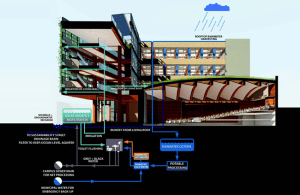
13.2-ReclaimedWater“All water” – the CIRS building at the University of British Columbia in Vancouver – a sustainability research lab – is utilizing a Solar Aquatic System designed to mimic the purification processes of naturally occurring water systems in close proximity to human inhabitation, such as streams and wetlands, to produce clean water for use in the building

“Net Positive” – LBC projects will be water net-positive, for example, via the large underground (56k gallon water tank)  the Bullitt Centre can survive for 104 days without accessing mains water, the CIRS building can supply grey water to adjacent buildings.

“Reuse” Good buildings will recycle and reuse grey water more than once using natural systems. And without using materials deemed ‘toxic”, i.e. those on the Living Building Challenge’s Red List such as Chlorine and PVC. On a domestic level, water reclaiming systems such as Nexus eWater are enabling the recycling of rain water and grey water many times in a domestic closed loop system

CAm_KRWWAAAz5xw

Systems that treat Good buildings will treat all water on site, ensuring no leachates and other nasty’s run off into the ground, into water systems, just as trees do, and as trees did that most likely stood on the site in the past, ensuring the aquifers remained as pure as possible.


IMG_2008

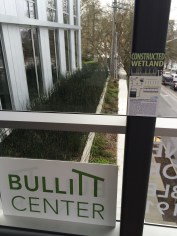
Thinking beyond SUDS, Constructed wetlands can and arguably should be incorporated into the structure of the building as well as being part of the landscaping.

Viewing buildings as a system of interconnected buildings is key to integrated design, rather than seeing each as stand-alone buildings. Here great synergies can be gained, moving reclaimed or harvested water from one building to another to meet need, using buildings as storage or as filters for others.


Construction phase … projects can develop water hierarchies, as we do waste and energy hierarchies, perhaps with a water plan, addressing the question “Why do we use drinking quality water for washing down site plant, keeping dust down etc.”

And to FM and building operations – spreading the water conservation message, through signage and through occupant ‘charters’ can all help gain respect for special water technologies within the facility. Going further Catering and food outlets could serve two vegetarian meals for every one meat – as the CIRS building does – to reinforce the vastly different quantities of water required to provide meat produce and veg / fruit produce (not to mention energy and travel impact)

And, on drinking water The WELL Building Standard for Water requires and promotes safe and clean water through proper filtration and other methods, requiring the appropriate quality of water for various uses. Again without harmful chemicals or materials.

IMG_2035So on World Water Day, a call to UK universities with a strong built environment and sustainability programme and values. Make your next university estates project a sustainable water building, along the philosophy of the Living Building Challenge, as a research project as the CIRS building does, or as a demonstration of what is possible – core to the Bullitt Centre remit. Influencing and inspiring the next generation of built environment professionals is so important.

“The era of harm reduction, half steps, and lesser evils is behind us. As a society, we need to be bold in ways that were once unimaginable. Luckily in the building sector, we now can imagine where we need to go”

If you would like more information on the work of the UK Living Building Challenge or indeed on the standard itself, please get contact me on fairsnape@gmail.com or Donna on d.m.lee@leedsbeckett.ac.uk or indeed follow us on twitter @fairsnape and @livingbldgUK

Mike Wigglesworth 1958 – 2015

Stob Coire Easain

Just under three weeks back we heard the incredibly sad news that life long friend and mountain companion Mike Wigglesworth succumbed to a heart attack. From the late 60’s early days of cutting mountain teeth through scouting and venture scouting to ski touring, alpinism and bothy trips through wilds of Scotland, Mike had been a constant source of inspiration and friendship on so many levels and will be hugely missed.

Although here in Canada, our thoughts are so much with friends back home today.

Thanks for your friendship Mike. The memory of your obvious delight, (often seemingly nonchalant, hands in pockets) in striding across Scottish or Alpine ridges will remain one of my lifetime pleasures.

Not knowing the construction industry carbon footprint is not acceptable.

Minimising and reducing carbon in construction has been a central plank of industry sustainability strategies for a good many years. It is therefore embarrassing for the industry, as Construction Manager reports, that we don’t still don’t have an industry handle on or indeed understand construction carbon figures.

An earlier Sustainability Strategy for Construction set a 2012 target of 15% reduction from the 2008 figure of 48T of CO2 / £million spend which should give us about 42 T / £m at 2012 with targets for further reductions by 2020 and 2050 in line with UK reduction targets.

Although … Peter Hansford “The strategy is to achieve a 50% cut in construction sector emissions from 1990 levels by 2025, and the GCB (Green Construction Board) is tasked with making it happen”

Indications are that, dispute a focus on sustainability, with just about every organisation in construction self-claiming to be sustainable,  construction emissions actually rose by 13% over the period 2008 – 2012.

As a major emitter of CO2, (when adding in transport and travel) the construction has a socially responsibility to address and reduce.

The fact that as an industry we don’t really know is down right unacceptable.

Our ConstructCO2 tool shows an average of 97.5kg / £k based on all construction types. As we gain more data (currently 300 projects) we can break this down into more meaningful targets, but since the first project on ConstructCO2 our benchmark has not fallen below 90kg/£K. (As an industry we should be below 40kg/£K)

When we founded ConstructCO2, we set out to keep it simple to record and used the strap line of Monitor, Understand and then Reduce.  Having monitored for a number of years we now understand the causes of construction carbon

Ashford School CCO2 A2 Poster

and can take steps to reduce through proactive planning.

Reducing Construction Carbon - Infographic


Why then, as industry we do not understand or monitor Construction CO2?

  • Cash in King, Carbon is Queen was a rallying call from Construction Advisor Paul Morrell – but very few rallied.
  • BREEAM hasn’t followed through – with just the requirement to record travel, transport and energy use, but not to reduce, monitor over time or collate. As an industry we have a mass of disparate spreadsheets across the country containing probably all the data we need.
  • Recording data at site level is deemed too time consuming, put into the too busy to do box by contractors, excepting of course the enlighten contractors using ConstructCO2 who see the benefits of doing so – or their clients are telling them to do so.
  • In the main, clients are not requiring projects to record and act on carbon emissions as a project key performance indicators.
  • Reducing carbon at site entails a collaborative approach from all on construction method, specification, procurement, planning, sub contractor management and so on. We simply don’t collaborate on reducing CO2.

Benefits of Monitoring CO2 (as reported by ConstructCO2 users)

  • Every kg of CO2 reduced equates to x£ not spent
  • Reducing CO2 from material and waste transport improves the local spend
  • Reducing mileage CO2 from personnel travel reduces driving time stress on operative & managers, improves productivity and time on site. Car sharing also reduces the fuel cost of operatives and managers.
  • Understanding the carbon issues enables more informed procurement, selection and logistics management

As Shaun McCarthy, Director of the Sustainability Supply Chain School said on twitter, its not Rocket Science,

Indications are that the GCB and WRAP UK will take up the mantle of managing data on construction carbons. Lets hope they talk to ConstructCO2, understand our lessons learnt and keep it simple but effective.

The UK Living Building Challenge Collaborative Report

The following was first published on the CKE blog:

The UK Living Building Challenge Collaborative met this week at Squire Patton Boggs in Leeds and saw construction professionals, architects, landscape architects, software vendors, sustainability experts and representatives from Leeds Beckett University discuss Standard V3 and the future of the UK Collaboratives.

Martin Brown gave an inspiring introduction to version 3.0, launched earlier in the year, covering the standards principles, petals and key imperatives. This was followed with a great discussion on the Living Building Challenge and relevance in the UK sector.

Martin emphasised that the Challenge is ‘A visionary path to a regenerative future’. Whereas other standards are focused on doing ‘less bad,’ the Living Building Challenge is based on the philosophy of doing more good, that is, restorative sustainability. We should no longer be satisfied with creating buildings that have negative impacts however small they may be, but look to create buildings, structures, and communities that contribute back to the environment and nature.

The Living Building Challenge uses a less technical, but more powerful, softer language than most standards, and puts topics such as beauty, education and biophilic design back into the equation.

Many present commented that a welcomed aspect was the inclusion of ‘health, happiness, beauty, nature’ within the standard.

Indeed the standard uses a metaphor of a flower, with seven petals, each of which comprises of several imperatives, 20 in total. All of these must be met in order to obtain full certification and the status of a Living Building.  We heard there are currently 201 registered projects worldwide.

2015 Plans

We are currently the only collaborative in the UK, however, we will be sharing this status with London due to launch in the spring and interest is growing elsewhere across the country.

During 2015 we will explore each of the Petals individually through workshops which will be held on the second Wednesday of each month, before the Green Vision evening and half day sessions. The timetable will be:

February 11th  – Place

March 11th –Water

April 22nd  –  Energy

May 13th – Health and Happiness

June 10th – Materials

July 8th – Equity

Aug – Beauty and Education

To drive these workshops, we are looking for ‘champions’ to head each ‘petal’. If you feel that you are an expert on any of the standard areas, or passionate about specific imperatives, or just want to get involved please send us an email at CKEEvents@leedsbeckett.ac.uk

We will also deepen the relationship with projects interested in registering and pursuing certification. And the exciting news here is that we have one potential project ready to register and other in development. Other activities will include design competitions, project charrette support, and a UK overlay to the International Standard with terminology, regulations and standards appropriate to the UK sector.

We are also compiling a library of UK building case studies that illustrate Living Building Challenge concepts. If you are aware of any projects, your own perhaps that addresses any of the standard imperatives or philosophies please do let us know for inclusion into our library.

We look forward to you joining our Collaboratives and getting involved, with your projects perhaps, in this exciting new era for built environment sustainability.

As Martin has said many times, ‘it’s time to heal the future’…