Category Archives: comment

seren-dipity timelines?

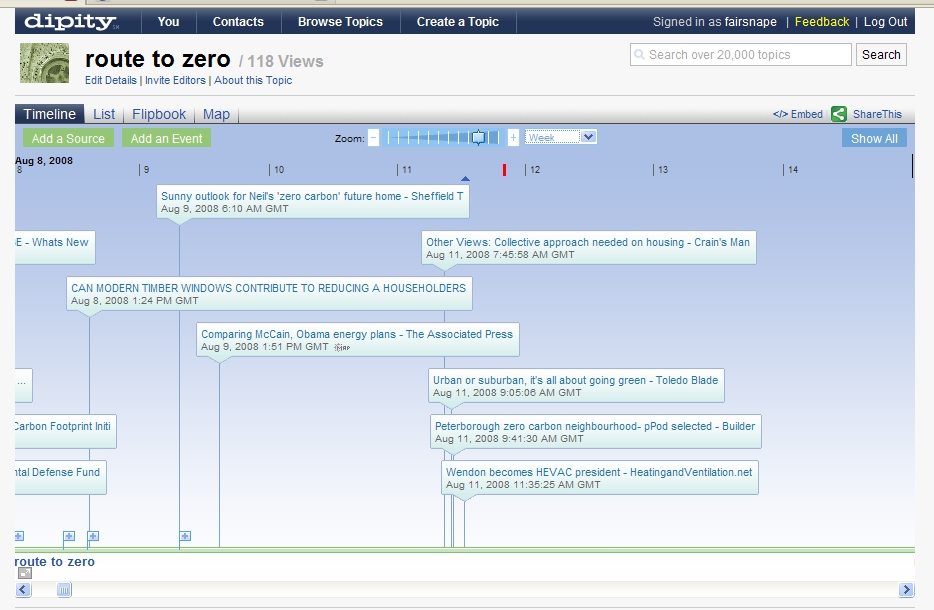
Over the last few days a number of people have asked for information on Dipity or the link to Route to Zero timeline I use in presentations, or have set up timelines such as Paul on his EvolutionExtranet and for be2camp.

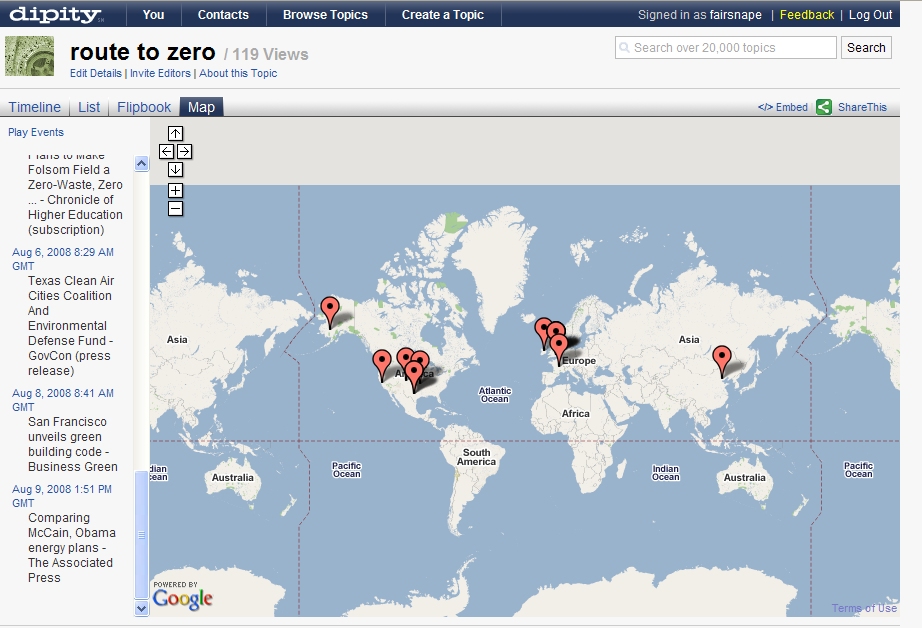
Dipity is incredibly easy to use and allows the aggregation of a number of sources ( news feeds, google searches, RSS feeds from blogs etc) into one timeline, as a flip book, a list or even as a google map. It provides a great and quick way to search through any topic, following the news or developments.

It also provide a futures timeline potential, either as a organisational planning tool, or a futures foresight approach. I am working with an organisation to visually map out their business plans, intentions, strategies or milestones, and in discussion with a construction project to record progress on site.  This is an obvious use of timelines, as the Walter Mill Ateliers project demonstrates

:

roof top driving school

From green roofs to multi use roofing – this driving school on top of a Tokyo  building illustrates creative use of existing buildings.  One wonders if there would be any additional insurance requirements for the instructors.

Source: Worldchanging

Sustained summer reading and listening

Stuck for a rip-roaring read or an essential soundtrack to your summer break?  BSJ online asked 13 loyal readers of the sustainability channel to put forward their cultural favourites for the holiday season. Try out this über list of print or plastic (or MP3) which range from the sublime (Proust, Glenn Gould) to the ridiculous (Howard Jones and a singing bear)

You can find the full list of the favourite books on the LibraryThing.com website

Contributors (a who’s who of the UK sustainability and blogging world?):

Mark Brinkley, Housebuilder’s Bible author and blogger.

Paul Scott, Head of Fire and Risk, Faber Maunsell

Sophy Twohig, Director, Hopkins

John Goodbun, Architect, founder, WAG

Mel Starrs, housing team, Inbuilt, and blogger

Rob Annable, Axis Design Architects

Brian Scannell, NES

Julian Crawford, Sustainable Committee lead at Gensler Architects

Martin Brown, founder, Fairsnape and blogger at isite

Andrew Warren, Director, Association for the Conservation of Energy

Paul Wilkinson, BIW Technologies

Paul Crossley, sustainability manager, RLF

Jim Webster, director, 3d Reid Architects

Phil Clark, editorial director, Sustainability

Michael Willoughby, reporter, Sustainability

the alchemy between digital and build

Jeff Jarvis writing in the Guardian yesterdayCoelho finds the perfect alchemy of print and digital describes how digital web 2 approaches such as blogs and twitter can enhance the core business,  through engaging with readers (customers?), giving away freebies and getting ideas and inputs from fans for the next project.  All this contributes to Coelho being number two best selling author in the world, with over 100m sales.

Now this has got me thinking – what are the similarities in the built environment world of design, support, build and maintain?  Certainly we can twitter for new ideas on the next project, give away freebie designs and management tools, blog about successes, projects and problems, collaborate with strangers on the other side of the globe.   The technology is there, but …. where is that key to make it come alive, where or what is that alchemy between digital and build?

In the support I provide to organisations as an introduction to the world of web 2, moving them away from searching for to having important leads and information delivered, using igoogle and RSS, I am amazed how many still see the web as a time consuming one way search device and an email machine.  (Contact me for more on this, email, twitter or leave comment below)

You’ve got too much e-mail

It happened with cigarettes. It happened with red meat. And carbs. And SUVs. And now it’s happening with e-mail … according to the LA Times ….  there’s a real backlash against our growing in-boxes.

Are emails really evil?  Is there an alternative approach to emails or indeed an alternative web technology?  Is twitter really the new email?  How do we unplug from emails?

These are the questions we hope to address at be2camp in October.

It is great news that Suw Charman has joined the us as an unorganiser and will talk, present or debate at the be2camp event, (hopefully all three!)

(Look out too for Suw’s forthcoming Guardian article on this topic)

Think maybe over but thinking goes on

It was disappointing to read Phils blog post yesterday that the Think sustainability conference and exhibition is to be discontinued by CMP, but the reasons given do make sense.

Having visited both Think 07 and Think 08, I would say that Think 07 made an important contribution to built environment sustainability, shaping agendas and providing a forum for discussion and innovation.  I am afraid I cannot say the same for Think 08.   Was it as Phil suggests the lack of ‘names’ (07 had Al Gore on video link for example), or was it the all too corporate feel of 08?  (see 08 thoughts from 08)

It should be noted the sterling job Phil did with Think, and it is a pity lessons cannot be learnt to have a Think 09. But whilst Think may be over the thinking goes on.

One of the topics this raises is the face to face event versus the virtual on line event. I have blogged many times on this, arguing for a mixture, and making real event material available online at the same time, either through closed streaming or through public streaming into second life. There is always the cost (and now carbon travel debate) of attending real events if you are not in the host city.

Paul (fellow Be2camp unorganiser) also comments on this at EvolutionExtranet noting from  Sustainability Now (also organised by Phil ), that pure online events are not the perfect alternative either. (see my comments on sustainability now)

So are large national exhibitions and conference days numbered?  Logic would say yes, maybe being replaced by smaller, regional and local events.  But then the Green Build and Eco City mega conferences in the USA tend to suggest otherwise as they attract tens of thousands to the event with many thousand others tuning in online. One noticeable aspect of these is the live blogging, podcasting the open approach to have a myriad of blogging media partners across the globe. This use of Web2, allows dialogue into and out of the events months before and months after the actual physical event, making them much more of a web presence than an event.  There is even the opportunity to twitter questions live into panel debates.

Looking ahead to upcoming sustainability events I am involved with actually gives comfort that we will / have avoided the issues Think may have fallen into.

Be2camp

The idea for an ‘event’ to explore web2 approaches within the built environment came from attending other barcamp and pecha kucha events. These have a unique buzz and vibrancy lacking at corporate feel events.

Be2Camp to be held on October 10th (London) is being organised on unconference or BarCamp principles, with a very open approach to determining the agenda, the attendees decide!  The organisers based in three continents communicate through twitter, skype and blogs, again very open, allowing anyone to contribute. Consequently it has the feel of being very much a peoples event, and grows in spirit and scope as more join the planning.  It is planned to stream happenings out from the event onto the web and possibly a parallel event within second life.

Constructing the Sustainable Way

The Elevate East Lancs sustainability conference scheduled for October organised through Creative Concern. This has been referred to as the eco build or green build of the north, but is much much more than that. Yes it will have names, but will also be the celebration of the local sustainable stars competition that  has been running for months. Care has been taken to ensure that the workshops are practical, learning and sharing sessions, there will be second life link ups and open mic pecha kucha question time evening events planned.  Again it is shaping up to be a peoples event.

(The website for this event is scheduled to go live today I am told – so watch this space)

local authority in peak oil tranisition

Last week, Somerset County Council voted unanimously to endorse a motion that they become the UK’s first ‘Transition Local Authority’ reported the Transition Culture blog yesterday

What this means is that SCC will take a more integrated approach to its planning processes, putting peak oil, sustainable communities and climate change at the heart of its forward planning, which would/should/will include its construction and maintenance procurement and management.

Is this the start of local authorities adopting a wider and longer term view of sustainability?  It will be very interesting now to see the PQQ (preliminary qualification questionnaire) issues the county ask of its bidders, the selection criteria used in procurement and the performance indicators.  One big impact should be the real focus on local labour, local materials and construction miles.

Just as the built environment sector is (slowly) getting to grips with answering basic environmental questions with in bidding documents, this may not only move the goal posts but put them on a different playing field.  Try addressing a PQQ question along the lines  “What steps have you taken to address peak oil”

At last we may have some real effort in addressing the impact we in the built environment have on the environment and climate change.

As the Transition Culture blog states: Something Wonderful Just Happened in Somerset

The proposal put before the Council ran as follows;

That this Council

  1. Acknowledges the work done by communities in Somerset on Transition Towns and that the independence of the Transition Movement is key to its grass roots appeal.
  2. As demonstrated in its Climate Change Strategy, fully endorses the Transition Town Movement and subscribes to the principles and ethos of the organisation’s goals to reduce dependence on fuel oil and create more sustainable communities.
  3. Commits to providing support and assistance to all towns in Somerset that wish to join this initiative to help them achieve the goals they set for themselves as local communities, as demonstrated under the ‘Community Initiatives’ section of the Climate Change Strategy.
  4. Therefore, requests the Scrutiny and Executive Committees to consider through the council’s strategic planning process; allocating funds to assist in achieving the outcomes of the Transition Towns Movement in Somerset and requiring all directorates to engage with and provide support for Transition Initiatives in Somerset

Through the work outlined above, seeks to become the first Transition Authority in the UK. Agrees to undertake a review of its budgets and services to achieve a reduction in dependence on fuel oil and produce an energy descent action plan in line with the principles of the Transition Initiative.

latest Grid Works issued

The latest issue of Grid Works has been issued and is available for download from here or from vendors on the Public Works area within Second Life.

Once again CivilE Writer (editor) has pulled together an excellent journal that illustrates how second life and other virtual worlds can be used to improve the real world built environment.

In this issue:

  • Conference in a sewer.
  • Using Second Life for architectural design and planning
  • Built Environment Tour to introduce you to Second Life
  • Job Seeking in the Virtual World
  • Website reviews of the UK FixMyStreet and FillThatHole from mysociety.org

The next edition of Grid Works will feature colleges and universities in Second Life offering engineering and related science programs in real life and/or Second Life. If you know of a school that should be included in this issue, let us know by e-mailing the following information:

•Name and real life location of school
•Location of school in Second Life
•Second Life contact information for school

(I guess I should declare an interest as contributing editor through my second life avatar Brand Woodin)

Grid Works is published quarterly for $L0 per year in Second Life.

a welcome for tougher eco towns

The Guardian reports today that Caroline Flint has toughend up the eco town requirements:

the whole development should be “zero-carbon”, including business sites, and the average home should be within a 10-minute walk of frequent public transport and neighbourhood services.

environmental threshold for individual homes to meet level 4 of the Code of Sustainable Homes, while those built from 2016 will have to adhere to the same zero-carbon standards as all other new homes. (level 6)

at least one worker per household in the government’s new ecotowns should be able to get to their job by walking, cycling or using public transport,

a minimum of 40% of land within the town should be undeveloped green space, with at least half of that open to the public

successful bids will have to submit planning applications to local authorities, and confirmed previously announced requirements for 30% affordable housing.

Is this welcomed toughening a moving of the goal posts during the bidding period, but one that shows the government is listening to and learning from the voices from environmentalists, bloggers and nimby anti eco-towners?

Particularly welcomed is the whole development carbon zero approach – not just the homes.

on be excellent

Around 10 or so years ago I was part of a BE (now constructing excellence) development group which produced the Be Excellent document and tool.

The premise was to increase the awareness of constructions relationship within facilities management and excellence through collaboration by mean of a self, or facilitated assessment tool.

What is Be Excellent?
Be Excellent is a simple but rigorous examination of business practice for all disciplines within the construction industry using the EFQM Business Excellence Model as the platform and take on board the important criteria for Collaborative Working, Supply Chain Management and the “design through to operational requirements” of Facilities Management.
If answered honestly and thoroughly, Be Excellent will identify those areas which an organisation needs to concentrate on to improve performance. Whether the organisation decides to make these a priority is a question of where each sits within their overall strategic plan.

During these last two weeks I have support a number of organisations with Be Excellent, so, with ‘excellence’ being on my mind,  I share my thoughts here.

I continue to use this approach as a first step analysis, helping groups or organisations understand where to put improvement energies and efforts.  It works best as a consensus approach, with a number of assessments done across the width and depth of the organisation, providing an unique and revealing assessment of approaches, deployment and results.  An assessment I refer to as a peoples view of the organisation, which is often at odds with a purely management view.

And here is a main difference between this consensus approach and the top down ISO 9001 improvement or quality models.  People want to be involved, or at least have a voice in shaping improvements, not to be forced into improvements via independent audit non conformance’s.

EFQM ( European Framework for Quality Management) arose out of the 1980/90’s TQM (Total Quality Management) ideas.  The UK construction sector at that time flirted with TQM but never really made the initiative ‘stick’, as it was just that an initiative with a shelf life, and not sustained. Indeed one of the factors that moved me away from employment with large contracting was the lack of ‘stickability’ on improvement, flitting across what was in vogue or required by any client at any one time. It was, and still remains, an add-on to business.

And yet the orginal philosophy and premise of EFQM remains strong and sound, providing an holistic view of any organisation, and in particular the connectivity between functions, approaches and processes, often revealing the weaknesses in the typical siloed organisation.  For example EFQM and Be Excellent force you to address questions such as:

  • How are you strategies, objectives and policies founded on customer intelligence and requirements, now and into the future?
  • How do you manage, recruit and develop people in line with your vision and strategies, How does leadership act as a role model?
  • How do you procure resources to deliver your strategies, are finances, knowledge and information aligned to your strategies, or are they a barrier, and
  • Do processes really translate your vision, objectives and strategies into operations or are they there to satisfy some other ‘tick’ box?

There is an scoring mechanism alongside Be Excellent , but this serves as a device to prioritise actions, and it is the action planning that is the main outcome. From these action plans facilitated workshops can drill down to the real root of issues, using for example the Toyota Five Whys approach, a main ingredient of lean construction or six sigma. Its is amazing where you get to on asking the fifth why, for example a recent exercise identified an issue of poor recognition for good work, 5 whys drilled it down further as:

  • We don’t hear about good things
  • We don’t tell people about success’s
  • We don’t like to blow our own trumpets
  • We look for wrongs not rights in reviews
  • Our lessons learnt exercises focus on negatives and not positives

A programme was then put into place to review the lessons learnt process, to capture good learning points so they can be repeated, in addition to problems to avoid.

Over the years the trends from Be Excellent have become very clear:

  • we are good at approaches, new initiatives, new management systems, achieving ISO standards and other on the wall certificates.
  • we are ok, but not so good at deployment, that is deployment of the approach is not sustained, either over time, or across an organisation, and often suffers at the whim of changing management.
  • we are poor at learning, at analysing results for trends causes, and comparisons, and then on closing the loop to improve.

Sadly, this reflects the view of Deming back in the 1950’s, that we do not close the Plan Do Check Act loop, even less so see this as a spiral, with the Act taking us to a better, more informed Plan position for the next project or time period.  Be Excellent provides the peoples view to kick start and to sustain the improvement cycle.

A copy of  Be Excellent can be downloaded from here and you if would like to discuss this topic in more detail contact us here.