Category Archives: innovation

picture that tells a 1000 words

This is cool.

This image, easily generated at Nokia Barcode Generator site contains links to my site.

Anyone with a barcode reader can zap the images and instantly ‘read’ the information and save to contacts.

Also works with text and links.

Could we see all business cards looking like this one day.  Or profile images on social networking sites replaces by the picture that tells a thousand words.

Badges at conferences could be far more interesting, and a great ice breaker as people get close to zap each other.

on sustainability now

Last Tuesday I attended the Building Sustainability Now conference event, from my study, popping out from the event and discussions only to deal with phone calls and other work issues. I also made a good number of new contacts, either through email address exchange or social connections such as Linkedin. Oh and I didn’t use the car on that day.

Phil Clark has posted lessons learnt from the event, which as Paul Wilkinson points out must be seen as a success judging by the numbers registered and attended.  Phil has asked for ‘delegates’ feedback so here are my two pennies:

I loved the chat room in the lounge but would agree that there needed to be themed areas, as sometimes the debate was hard to follow.  The excellent moderator services of carbon coach Dave Hampton kept the discussion alive, particularly on the climate change debate with Brad, which must go as a classic on on-line forum debates.

However, being used to other forms of online events, I found the interface too static and became tiring too quickly.  For example compare with Second Life events where there is action, avatars moving, places to virtually visit, camp fires to sit around and discuss issues, the opportunity to talk in open chat or on a one to one or in a group, to pass information and links to others etc make it a more ‘live’ experience.

The question has been asked-  is the industry ready for Web 2.0 ?.  I would answer yes, but needs a little nudge and encouragement to join in. The increase in information that is communicated through web2 is increasing all the time, and the cost of attending real events (fees, travel and time away from office) will improve the take up I am sure.  And again I must plug the up and coming October Be2Camp event, which will have introduction sessions to web2.0 as well as exploring the leading edge of web2 and possibly web3 communications.

As to costs, I had a choice of event to attend last Tuesday – Sustainability Now – free and I could participate in my own time in my own office, or a Business in Virtual Worlds event – cost £599, travel to London, and a fixed agenda of speakers. Its a no brainer.

Outside of the event, I found it fascinating the twitter conversations that were taking place, on themes and discussions from within the event, illustrating the use of Web2. For example I was able to send a twitter message to Rob Annable, (who was online at the event, but not in the lounge when the discussion was praising his eco-terrace project), suggesting he pop back into the lounge.  Reinforcing my view Twitter stands to be the next email and texting killer application.

I did have technical problems in viewing the presentations – Real Player playing up this end – but question why recorded events where played at set times – maybe these should be available on demand

I like the exhibitors place but found a number of questions emailed to the stands still remain unanswered.

As to more international input, there has to be a programme that caters for international time zones to attract.  Nothing worst that turning up at an event real or virtual to find everyone has gone home.  In fact this may be one of the work-life balance issues that virtual events need to address.  I sometimes find myself on line in Second Life debates at 2 in the morning – because they are held in the sunny Californian afternoon time zone.

But saying all that it was an excellent event Phil, well done – and I hope that it will be repeated.

where is the service user innovation …

I attended the SCRI event on Service User Innovation in Salford Uni’s new Lady Hale Building yesterday, listened to four influential speakers and participated in thoughtful discussions and break outs.

POE (post occupancy evaluations) were mentioned too often – I have an issue with POE  as a means to evaluate performance, and as they have been referred to before are the wrong tool for the wrong job.  Yes there needs to be post project evaluation, for as Ian Cooper notes, every building project without a feedback loop is a prototype. But to measure people performance through their relationship with the building is the wrong starting point. After all its about the service users ‘experience’

The four key speakers were Prof Peter Barratt at BuHu Salford University – key message here for me was his comment that all the successful projects were led by Facilities Management, his case studies included the Sydney Opera House and Wm McCormack Place in Cairns as part of the Australian Facilities Management Action Agenda, the Trondhiem Hospital where the construction team were selected by psychologists to ensure they understood health issues, and John Zeisel‘s work in Boston USA with Alzheimer’s centers

Neil Sachdev, Sainsburys Commerical Director, illustrated how they engage with their customers on store design,

John Lorimer from Manchester City Council on testing furniture with pupils against a background of how the school environment shapes and influences education , and

Nigel Oseland on POE’s who also . Nigel also introduced the Dunbar’s number concept of 150 and talked on biophilia kinship, of our history of camp fires and story telling, of seeking nature and space and waymarking, but now confined into office cubicles.  (We need to get out more, tell stories have camp fire meetings and connect with nature – not surprising then the increase in barcamps and benchmarkwalks)

The investment in really engaging with and empowering end users is impressive. Five years in the case of John Zeisel in understanding Alzheimer’s needs in the USA , a huge investment from Sainsbury’ s and the patient work in understanding pupil and teacher needs from Manchester City Council.  None of these three examples start with the building, but with the users.  Why then as an industry do we fool ourselves we can do the engagement stuff with one or two value management exercises and a POE?

I was not alone in noting an under theme of web 2.0 in the presentations and discussions.  There was the mention of pupils using second life to determine space and colour requirements, of the use of Web2 (twitter maybe, blogs, or facebook groups) in getting real, unsolicited, feedback from facilities users. I sensed though it was something to put on the wish list and get on with the business in hand.

It is a pity this was an under theme as to me as is where the real service user innovation lies. Service users make use of web2 technology outside of the work place, ie in second life, in twittering, in facebook, in myspace … etc etc etc.  The innovation is in using this in design and facilities management.  We seem to be blind to or just awakening to its potential. The potential to allow continuous dialogue between service users and service providers / designers   This is not rocket science – those using twitter can contact the government on issues (and get a response) and be kept in touch with the Prime Ministers actions, speeches and even thoughts.

And then where – consumers constantly in dialogue with a supermarket on store layouts, on colour, on products and costs – office users ditto with the fm’s on suggestions and wc complaints –  pupils on school design, residents on city facilities and urban design – on eco town developments,  and all in real time as it happens.

Definitely a topic to be discussed at the be2camp event in October

sustainable construction commitments launched

The UK Government today launches its Sustainable Construction Strategy, with a whole raft of targets, measures and reporting mechanisms. It seems like it has been a long time coming, the consultation period being most of last year. Construction minister Shriti Vadera comments “Our aim is to become a world leader in sustainable construction” (Building). Time will tell.

Looking back to the response from to consultation we submitted from the Collaboartive Working Champions, it seems the emphasis on integrated and collaboartive working, as a means to sustainability is recognised .

To achieve improved whole life value through the promotion of best practice construction procurement and supply side integration, by encouraging the adoption of the Construction Commitments in both the public and private sectors and throughout the supply chain.

Parts of the industry – clients, consultants, main contractors, specialist contractors*, and product manufacturers and suppliers – to be engaged in supply chains on 30% of construction projects and for 40% of their work to be conducted through integrated project teams. (By 2012)

It is also included with the construction commitments:

A successful procurement policy requires ethical sourcing, enables best value to be achieved and encourages the early involvement of the supply chain. An integrated project team works together to achieve the best possible solution in terms of design, buildability, environmental performance and sustainable development.

And note the reference to ethical sourcing, this is also picked up in the report as responsible sourcing, moving towards a cradel to cradle approach one would hope, maybe along the lines of BS6000, which will wake up a few people and organisations.

And as fellow CWC and blogger Paul over at ExtranetEvolution comments it is good to see ICT within the Innovation section.

I am not sure about the inclusion of the eco-town approach as a target though – has the strategy been hijacked, Trojan horse style, to embed political ambitions?

however, and here is my main observation, admittedly after only a single read but….

I am disappointed to see a lack of facilities management in the document. The strategy is as much about the use, the consumption of buildings as it is about their design and provision. (something about focusing on the 1, out of the 1:5:200 concept). I am now aware that the facilities management sector in the UK is just too weak as a voice to get involved and influence the built environment sustainability agenda. Something that must change.

Yes we may have here a viable construction strategy , but without the link to the end users and management of the facilities (note I avoid the word buildings) we may not have a strategy for a sustainable built environment.

Oh, and why a sustainable document that has a solid black cover. The additional quantity of ink that will be used every time this document is printed or copied will be huge. The answer of course is not to print – but we are not all in the mindset of reading from the screen yet.

Score …

wikitecture wins international open source competition

A web2 collaborative project I have been following through second life and wiki architecture has been the open source architecture design competition via Open Architecture Network.

Delighted then to receive the following good news alert from Ryan at Wikitecture:


Wikitecture Wins International Competition: 3D-Wiki Used to Compose an Open-Source Entry

Chicago, IL, June 09, 2008 – Out of 566 registered entries from 57 countries, Studio Wikitecture won the overall ‘Founder’s Award’ for their open-source entry to a competition hosted by Architecture for Humanity on the Open Architecture Network. In keeping with the collaborative spirit of the Open Architecture Network, their entry for a tele-medicine facility in Western Nepal was chosen “for embracing a truly collaborative way of working using online crowdsourcing and Second Life as a way to create a highly participatory design approach.” Source


Having conducted a number of experiments over the last year into the feasibility of applying an open-source paradigm to the practice of architecture, the Studio Wikitecture group developed a 3D-Wiki plug-in on the virtual reality platform, Second Life, that they used to help build consensus among the numerous contributors in this open-source project.

The ‘Wiki-Tree’ as it was called, acted as a version tracking system that worked very much like a conventional Wiki, but instead of tracking text documents in a linear history as you see in Wikipedia, the ‘Wiki-Tree’ tracked versions of 3-dimensional models and saved them within a continually evolving 3-dimensional digital tree ‘canopy’. Similar to Wikipedia, this 3D-Wiki allowed this loose, self-organized group of contributors to share ideas, edit the contributions of others, and vote on which design iterations should be considered for further refinement.

Over and above the actual building design, Studio Wikitecture’s entry proposed that the wiki-tree and virtual model live on pass the competition and be used to help incorporate feedback from the Nepalese community and end-users into evolving design.

In addition, they proposed that the virtual platform would allow individuals from around the world to experience the local site and conditions as the project evolves over time, further expanding the outreach, awareness and support for this project to a global audience.

The winning entry was the result of Studio Wikitecture’s 3rd Wikitecture experiment to explore the procedures and protocols necessary to practice a more open and distributed approach to architectural design. Of those, the group explored prediction market voting procedures to assure consensus or ‘Crowd Wisdom’, as well as developed a contribution assessment system to divvy up fair ownership among all the contributors.

The Final Competition Boards: http://flickr.com/photos/studiowikitecture/sets/72157604038184909/show/

A time-lapse video of the evolving design:

http://youtube.com/watch?v=amCi90zH3VI

A video illustrating how the ‘Wiki-Tree’ works:

http://youtube.com/watch?v=Z3eWKIJxzyc

A journal article outlining, in detail, the three Wikitecture experiments:

http://crescendodesign.com/103_chase.pdf

The accompanying website:

http://studiowikitecture.com/ (click on ‘go’ twice to enter anonymously)

The Blog:
http://studiowikitecture.wordpress.com/

revolutionary wind turbines

Selsam is flying wind-turbines for maximum power. It’s like a kite, only with giant spinning blades. Looks so scifi …. resembling a field of wind-swept reeds swaying on the horizon

Source: twitter from inhabitat

… on what makes a building green

Build the best product, cause no unnecessary harm, use business to inspire and

implement solutions to the environmental crisis.

Patagonia’s Mission Statement

I have mentioned Patagonia the outdoor clothing organisation a few times before on this blog, and recently searching for a model CSR policy or statement for a Masters course I am in part delivering, went back to their web site and Yvon Chouinard’s Let My People Go Surfing book.

More on Patagonia’s approach to building here and Patagonia’s environmental, CSR, approach here. And if you like environmentalism mixed with the great outdoors, mountains, clothing innovation and quality, along with a sprinkling of built environment comments – then check out the blog from staff, customers and friends at The Clean Line

zero carbon ‘floating’ development for Preston

Green, innovative and zero carbon project development on our doorstep in Preston, Lancs, !

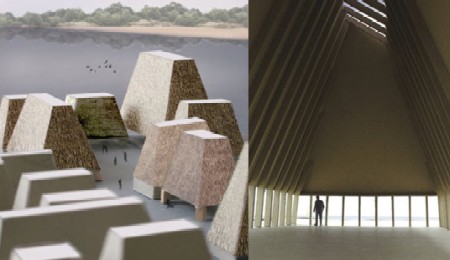
The RIBA have recently awarded a zero carbon design as the visitor center at the new Brockholes Wetland and Woodland Nature Reserve in Preston, to regenerate a former quarry site into a major visitor attraction.

The project called “A Floating World”, consists of zero-carbon floating buildings (the name coming from the fact that the zero-carbon buildings will be built on an island of floating pontoons)

Adam Khan Architects, won the RIBA design competition to work on the ‘jewel in the crown’ of Britain’s largest eco-regeneration scheme. The project is zero-carbon in both use and production, with materials of low embodied energy – thatch, willow, timber, with off-site prefabrication and on-site energy generation and waste treatment.

Floating world will feature cafe, shops, gallery, education areas and meeting rooms and is part of the £59 million Newlands Scheme, a project that will turn 900 hectares to community woodland and green space.

On announcement of the winner, Peter White, Head of Infrastructure & Development at the Northwest Regional Development Agency said:

“This site has the potential to become an important visitor attraction for the region, building on its rich natural assets and impressive biodiversity. The Agency is supporting its development through Newlands, a wide reaching scheme that aims to reclaim brownfield land and transform it into thriving community open spaces, and has so far invested £800,000 in Brockholes. The chosen design will not only create an inspirational open space for the local community to enjoy but will also enhance a key gateway into Lancashire and attract further investment into the area. We look forward to working with our partners to progress these plans.”

More on this as the project develops …

interseasonal heat transfer

Pams second post on snow and ice clearance over at Public Works blog, reminded me of two items I had collected into my google notebook for future isite posts.

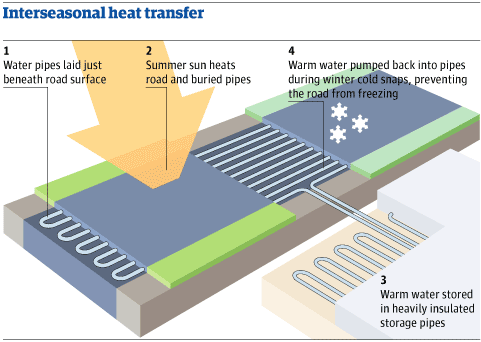
The GuardianReported in the Guardian Friday last Under Road heaters may beat snow and ice , the Highways Agency plans to install pipes underneath a section of road to gather solar energy in summer and recirculate it in winter. Experts hope the scheme could be a way to treat the roads which are the first to freeze.

The scheme, known as interseasonal heat transfer, or IHT, will lay a network of plastic pipes filled with water just below the road surface. In summer, when road temperatures can reach 40C, the water is warmed and pumped to pipes insulated with polystyrene. In winter, when sensors detect the temperature at 2C, warm water is pumped back under the road to heat the ground and prevent ice forming.

Also a Guardian mp3 audio item to download Which discusses the technology and approach to using IHT on UK roads.

Too cool for schools – featuring a pièce de résistance of the building as the construction of the world’s first IHT system underneath the playground. IHT will take heat from the sunshine that falls on the tarmac playground, then stores it and releases it in the winter to heat the school.

Facilities Management now in Second Life

The inaugural Centre for Facilities Management Second Life (SL) seminar took place today, Wednesday April 2nd 2008. The seminar, facilitated by Martin Brown, (aka Brand Woodin in SL) focused on Sustainable FM, but also referred to the developing research area of Community-based FM which looks at FM outside of the traditional boundaries and organisational settings and suggests the FM has a role to play in community (in its broadest sense) settings also.

By putting FM into context the debate began to consider the effect FM has or could have on the environment. It led to debating issues such as transition towns (see Totnes as an example) – what role does FM have?; and building consumption -v- building production – to what extent is this about FM usability agenda or is it just an issue for the construction community?

The debate also led to discussion about developing a wider definition of FM which encompasses the sustainability agenda and could be accommodated by the wider construction community. Such a definition could look at how FM could be a means to facilitate understanding about the environment, about communities and about facilities. Debate then ensued as to what the tag line for this could be!

Wednesday April 9th 2008 was the second Centre for Facilities Management SL event. The seminar was delivered by Helsinki Institute of Technology by Nils Gersberg (aka Nils Lowenstark in SL) and looked at Pro-work research.

Pro-work is a relatively new research concept and focuses on how organisations and teams in organisations work together, and how they develop knowledge. The debate considered how different types of organisations – for example those that use hot-desking, those that employers freelancers / contract staff, those requiring staff to come to the office or work from home – develop their strategies for team collaboration. Additionally the effect dispersed working -v- office based working has on FM was also considered, and this debate connected back to the previous weeks debate on sustainability considerations as well as wider definition and working practices of FM.

Thanks to Eleanor Jackson for the above text ( aka Salfordfm Destiny in SL)

Centre for Facilities Management Second Life has a meeting place presence in Second Life on the Manchester UK sim.  Drop by and say hello and participate within our debates.

Email for further information on CFM in SL or future meetings.