Tag Archives: built environment

Water Energy Nexus – a built environment mindfulness

screenshot.26

As a lead-up to Abu Dhabi Sustainability Week, January 13-17, Masdar is sponsoring a blogging contest called “Engage: The Water-Energy Nexus.”

The winner will be invited to Abu Dhabi as VIP media to cover the week’s high-profile events.

The following is my entry. Please vote for me here

Water Energy Nexus – a built environment mindfulness

Could we be facing a near perfect storm within the built environment, as our sustainability efforts, our energy and water performance efforts, or perhaps lack of effort hit an environmental cliff.

Consider:

  • 85% of buildings that will be in use in 2050 are already standing today, and many many of them, commercial, leisure and domestic were designed and constructed prior to any meaningful sustainability guidelines. Buildings that are water energy cavelier, designed and managed with a cornucopia view of resources
  • The built environment sector is often called the 40% sector on account of using 40% of the worlds resources, energy and water whilst generating 40% of the worlds waste.
  • Increasingly our lifestyles, workstyles and infrastructure styles are demand evermore energy and water.
  • We are making poor, behind target progress on energy reduction, water conservation and carbon reduction through our design, construction and use of buildings
  • Even today in 2012 water lacks behind energy in performance import for new build and refurbishment
  • We have a facilities management profession that adopts a status quo maintainence basis, often with low level SLA’s demanding same focus as water and in some cases energy performance
  • We are entering a future of big data, where rational, cold evidence based approaches will dominate, driven by Building Information Management. Whilst a very welcomed performance improvement for the sector we may be in danger of loosing the experience intuitive.
  • The dominating sustainable construction codes such as BREEAM and LEED are in danger of becoming corporate checklists, often criticised for the ability to trade water performance points against cycle travel provision points.

Addressing a Water / Energy Nexus

Looking forward the built environment should be looking for both strategic data-driven leaders and managers balanced with strategic creative leaders. This is particularly the case in facilities management sector, where the intuition that comes from deep knowledge of how buildings use water and energy, once a key skill of the building facilities manager that we are sadly loosing and one of the key green skills to rekindle.

We have a need for ‘Mindfulness’ in the built environment. A deep green understanding of the buildings relationship with nature, guided by building codes and green sustainability standards. And as a designer, as a builder as an inhabitant, develop an in-the-moment awareness connectivity or dis-connectivity with the nature and water / energy resources.

We need a move away from assessments looking at impact on the environment, but rather turning tables to look at how the facility connects with nature and its environment.

We can see standards such as the Living Building Challenge as a way forward with each building regarded as a flower, using only the water and energy that falls on the building.

We need new levels of engagement and relationship between building and user. For example the CIRS Vancouver UBC building, itself a LBC accredited building, refers to its users as inhabitants – requiring each to sign a charter that recognises the engagement expected

As I wrote in an earlier blog we need 3 New ‘R’s for built environment sustainability, and its impact on the water energy nexus

Re-Design. No longer are transactional efforts in conserving water and energy enough. Radical revolution in design thinking needed that encompasses Cradle to Cradle thinking, Circular Economy,

Re-Connect. Time to rethink our relationship with nature, a relationship that is deeper, that is deep green mindfulness. A direction that Living Building Challenge promotes – every building contributing to, not taking from its environment.

Re-Kindle. Time to rekindle the sustainability water / energy debate – moving away from the negative, harassment to doing less bad, to encouraging a move towards a positive new world of doing more good, better. Fostering Resilience.
Ash disease and the built environment

There has been a huge amount of coverage in the media, and indeed across social media on Ash dieback disease, but little as yet related to the built environment, and the role we may have played in the spread of the disease or the potential impact it may, no will, have on the built environment.

Despite the UK Government (DEFRA) slow response, not to mention odd instructions to wash boots dogs and children after visits to the countryside, the causes of Ash Dieback seems to be emerging as:

  • Climate Change
  • Bio Security, or lack of
  • Demand for instant landscaping

The built environment is accountable for around 40% of climate change issues (waste, transport, carbon, energy etc) but its the increase in demand for instant green that may be our biggest contribution.  Odd isn’t it that efforts to plant trees and plants to provide green landscapes and green roofs in response to CO2 and biodiversity issues may have opened the door to yet bigger problems.

There is of course a great example of complexity theory at play here, we can no longer rely on cause effect thinking, but need to consider wider, biodiversity consequences. As Muir is quoted as saying ” when we tug at one part of nature we tug at the whole of nature”

  • We face a tidal wave of diseases with over 30 damaging pathogens identified poised, ready to threaten UK trees and plants. See Guardian article.
  • We face movement and transport restriction on timbers from Ash, Scots Pine and other plants, both in landscaping and use in construction, finishes and furniture.
  • We need to rethink, and fast

20121104-160816.jpg

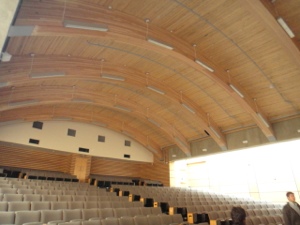
I am reminded of my visit to UBC CIRS building in Vancouver last year and the gorgeous timbers in the atrium and main hall, timbers ‘salvaged’ from local forests affected by pine beetle disease and closely monitored by the Living Building Challenge.

As we launch Living Building in the UK with a UK collaborative, it may well be that the certification of future green buildings in the UK is through standards such as the Living Building Challenge, that give hard earned recognition to buildings and facilities that, like plants, contribute to making the world a better place.

The CIRS Building was recently profiled in our CKE Green Vision series with a presentation from Max Richter at Perkin+Will.

Green Vision is a key driver in launching Living Building thinking into the UK. Look out for more announcements at the next Green Vision conference event on the 12th Dec in Leeds and across the web. (Hashtag #GVis2012)

For more information on the Living Building collaborative in the UK, leave a comment, get in touch or pop over to our Living Building UK Collaborative page on Facebook and say hello.

Heros and Texts for a future Built Environment based on #CSR

“suddenly the air smells much greener now”

Listening to ‘These Streets’, lyrics by Paolo Nutini summed up the brilliant, inspiring Green Vision conference in Leeds – exploring CSR within the built environment.

A mix of talks, presentations, round table discussions and pecha kuchas from Mel Starrs, Eden Brukman, Tamara Bergkamp, Eddie Murphy, Martin Brown, Faye Jenkins, Claire Walker, Rick Hamilton, Mark Warner, Pedro Pablo Cardoso-Castro, Andy Ainsworth, Paula Widdowson and many others showed that there is real emergence and a future for a Built Environment founded on social responsibility principles.

The air smells much greener …

We heard of excellent progress being made by individuals, projects and organisations on the CSR journey, and how behind these are great influential thinkers, often outside of the sector, many, unsurprisingly, related to the ‘outdoor’ sector.

Many of the speakers were enthusiastic in sharing CSR heros and recommended CSR reading. So here, as a summary, or reading list are those mentioned during the day. I wonder how many of these are on the reading list within design, construction and fm education? (Book titles link to Amazon)

Yvon Chouinard

Rock climber, environmentalist and outdoor industry businessman, noted for his contributions to climbing, climbing equipment and the outdoor gear business. His company @Patagonia is widely acclaimed for its environmental and social focus. According to Fortune magazine, Chouinard is arguably the most successful outdoor industry businessman alive today.

The Responsible Company What we have learnt in the first 40 years at Patagonia by Yvon Chouinard and Vincent Stanley (see my blog)

Let My People Go Surfing Yvon Chouinard – Probably the ‘must read book’ to understand CSR in Business

(On my blog: How can construction learn from Patagonia?)

Ray Anderson

Founder of Interface Inc., one of the world’s largest manufacturers of modular carpet for commercial and residential applications and a leading producer of commercial broadloom and commercial fabrics. He was known in environmental circles for his advanced and progressive stance on industrial ecology and sustainability.

Ray was was posthumously awarded an Outstanding Achievement award at this year’s Guardian Sustainable Business Awards in 2012. (There is a related, must watch, video here: John Elkington describing the work and legacy of Ray Anderson)

Confessions of a Radical Industrialist: Profits, People, Purpose: Doing Business by Respecting the Earth (2009) Later released in paperback as Business Lessons from a Radical Industrialist in 2011.

Paul Hawken

An environmentalist, entrepreneur, and author. Ray Anderson of Interface credited The Ecology of Commerce with his environmental awakening. He described reading it as a “spear in the chest experience”, after which Anderson started crisscrossing the country with a near-evangelical fervor, telling fellow executives about the need to reduce waste and carbon emissions.

Hawken’s book, Natural Capitalism: Creating the Next Industrial Revolution (1999) coauthored with Amory Lovins and Hunter Lovins, popularized the now-standard idea of natural capital and direct accounting for ecosystem services, a theme revisited by Rio +20 and likely to become more mainstream across the built environment.

Janine Benyus

Her 1997 book Biomimicry: Innovation Inspired by Nature defines Biomimry as a “new science that studies nature’s models and then imitates or takes inspiration from these designs and processes to solve human problems”. Benyus suggests looking to Nature as a “Model, Measure, and Mentor” and emphasizes sustainability as an objective of biomimicry. Key thinking in the Living Building Challenge principles, as is

E O Wilson

Edward Osborne Wilson an American biologist, researcher, theorist, naturalist and author. In the mid 80’s developed the concept of Biophilia, the connection between humans and nature, which translates into architecture and the built environment as comfort, well being and productivity through exposure to natural light and natural surrondings or imagry.

Anita Roddick

Dame Anita Roddick, human rights activist and environmental campaigner, best known as the founder of The Body Shop, a cosmetics company producing and retailing beauty products that shaped ethical consumerism The company was one of the first to prohibit the use of ingredients tested on animals and one of the first to promote fair trade with third world countries. Roddick was involved in activism and campaigning for environmental and social issues, including involvement with Greenpeace andThe Big Issue.

John Elkington

John Elkington @volansjohn is a world authority on corporate responsibility and sustainable development. He is currently the Founding Partner & Executive Chairman of Volans, a future-focused business working at the intersection of the sustainability, entrepreneurship and innovation movements

His latest book The Zeronauts, Breaking the Sustainability Barrier describes many of todays inspirational leaders : “Just as our species broke the Sound Barrier during the 1940s and 1950s, a new breed of innovator, entrepreneur, and investor is lining up to break the Sustainability Barrier”

Jorgen Randers

2052: What will the world look like in 2052

Jeff Hollender,

Jeffrey Hollender is an American businessperson, entrepreneur, author, and activist. He was well known for his roles as CEO, co-founder, and later Chief Inspired Protagonist and Executive Chairperson of Seventh Generation Inc., the country’s largest distributor of non-toxic, all-natural cleaning, paper and personal care products. www.jeffhollender.com/

Gary Hirshberg,

Gary Hirshberg is chairman and former president and CEO of Stonyfield Farm, an organic yogurt producer, based in Londonderry, New Hampshire. Now part of the Danone group.

Published in January 2008, Stirring It Up: How to Make Money and Save the World is a book about socially minded business that calls on individuals to realize their power to make a difference in the marketplace, while doing business in ways that adhere to a multiple bottom line – one that takes into consideration not only finance, but the environment and health as well.

Jeffrey Swartz,

Jeffrey Swartz is the former president and CEO of The Timberland Company an organization that believes that doing well and doing good are inextricably linked. Timberland’s commitment is to reducing global warming and preserving the outdoor environment.

David and Claire Hieatt,

Founders of Howies a clothing company based in Cardigan Bay, Wales produces eco-friendly T-shirts, jeans and sportswear, and aims to have ethically correct practices. Howies use natural fabrics as alternatives to petrochemical-derived modern fabrics. Examples include organic cotton, Merino wool and recycled cotton. Howies T-shirts often have images or slogans with political or environmental themes

Dee Hock

Dee Ward Hock is the founder and former CEO of VISA , described systems that are both chaotic and ordered, and used for the first time the term “chard” and chaordic,combining the words chaos and order.

More?

Over to you –

Follow the discussion on twitter with the #GVis2012 hashtag.

Who are your CSR Heros and CSR Texts to add to this Built Environment inspirers list?

What additions or comments would you make to the entries above?

A full record (video, blog, tweets, presentations, storify) of the Building CSR Event is being curated on the be2camp event page here.

Could built environment leaders cut it in a digital world?

An excellent Communique newsfeed from Nancy Settle-Murphy this morning, at looking at effectiveness of leaders in a virtual world.  It strikes me this is a lesson perhaps for built environment and construction leaders as we move into a communication era that is increasingly digital, web based, social media enabled and BIM (Building Information Model) focused:

Even the most experienced team leaders can make us weep with boredom. They torture us with their monotone narrations of 10-Mb slide decks. They regale us with irrelevant minutiae, while sidestepping the really important stuff. Their meetings are more like monologues, with everyone else listening from the sidelines. And for the most part, they probably imagine they’re pretty interesting people!

When we experience boring leaders face-to-face, we have to at least pretend to be somewhat interested. We might take notes (even if it’s a shopping list!), throwing in a few occasional nods so we won’t be called on to replay key points. Copious amounts of caffeine help to some degree, as do the many bio breaks we’ll inevitably need as a result. And who hasn’t had a colleague place an “emergency” phone call in extreme cases of ennui?

Tuning out boring virtual leaders is far easier. Once you put yourself on mute, there’s no end to the more important things you can do, like responding to emails, writing up your latest status report, or finding the best price on that new digital camera you’ve been pining for. (If you work from home, this “important” work can extend to laundry, dinner prep, weight-lifting and more.) As long as you’re within earshot of the conversation, your team leader may assume you’re present while in fact you are completely absent.

So, how can boring virtual leaders learn to become more captivating? (And no, it is not an inherent skill that some are just born with!) In this issue, I take a look at some steps even the blandest leader can take to evolve into an engaging, stimulating and captivating leader, from near or far.

No one actively aspires to be boring. And yet regrettably, few leaders actively attempt to be interesting.

Read on … from Nancy Settle-Murphy on Commique 

Reinvigorating built environment sustainability leadership

An excellent blog post on sustainability.com suggests what a reinvigorated agenda for change may look like.

We could learn a lot from this, for new and reinvigorated leadership in sustainability within the Built Environment sector, particularly in the UK as we move into a new era of green deals, PAS 2030’s and a renewed focus on improving our existing building stock:

Simple: For most, the discussion remains new, the lexicon confusing. We need to quickly and clearly cut through that to reach new audiences.

Fresh: People are jaded. They haven’t given up, but need to be convinced that the next change effort will be different, more meaningful.

Connect: Too many experience sustainability as intellectual, abstract, not very well connected to the here and now. (We need to revisit our understanding and connection to natural cycles of the earth, seasons, solar and lunar, the core purpose of sustainability)

Systemic: Progress to date has been limited because it is too often a single company or other actor leading only within a narrow scope. Solutions must now begin to cross traditional boundaries, create new coalitions and value networks and drive change to scale.

Adaptive: Uncertainty abounds, and yet cannot remain an excuse for further delay or loss of momentum . We must anticipate and react quickly to setbacks, sharp curves and emerging issues, and above all, keep moving.

Collaborative: Even with the explosion of supporting technology, collaboration remains a messy and difficult affair, but if new coalitions are to propagate and succeed, the agents involved must embrace and practice vastly more of it.

Distributed: Globalization and the democratization of communications run counter to the old “cult of the elite.” Leadership is perhaps now far more likely to be bottom-up than top-down, but even if not, the crowd will have the final word.

Policy-Independent: There is consensus (and frustration) that government remains either unwilling or unable to respond. We need a pathway to success that welcomes government if they will play a role, but is not in any way dependent on political leadership.

Re-Generative: While we can – and should – start by revisiting and distilling the wisdom of those who pioneered the sustainability movement, we must also invite present-day and future leaders to augment, refresh and build upon it. In this way, we may create a virtuous cycle of innovation and insight needed to propel us forward.

And I would add:

Visibility, Let’s make use of the explosion and ubiquity of the communication and dialogue tools that social media provides, to increase visibility of best practice, to learn and to share.

Link to original post

Sustainability in Built Environment dominates Guardian Sustainable Business Awards

Sustainability in the Built Environment dominates Guardian Sustainable Business Award winners:

At British Land – winner of the Guardian Sustainable Business built environment award:

As the relationship with Camden council shows, British Land takes its corporate responsibility seriously and this is reflected in the goals for Regent’s Place. From design to construction, the project team has been expected to apply the highest standards of ISO 14001 certified sustainability brief for developments. As a consequence, all the new office buildings have Breeam “excellent” sustainability ratings.

From fit-out to property maintenance the developer has worked with occupiers and on-site teams to use natural resources efficiently, with a waste guide and sustainability brief for management – leading to 8% less like-for-like energy use since April 2010.

When the masterplan is complete, the Regent’s Place estate will double in size, providing 2m sq ft of office, retail and residential space for 14,000 workers and residents. What an opportunity, then, for a showcase site with sustainability at its core.

At Sainsbury’s – winner of the Guardian Sustainable Business energy award:

Crayford Sainsbury’s biggest UK store … is a breakthrough project – the first time a UK supermarket has used the so-called geo-exchange system to tap natural geo-thermal energy trapped deep under the ground.

At the heart of the system is an advanced ground-source heat pump that is linked to boreholes that capture and store waste heat from the store. This is released, when needed, to provide heat and hot water for the store and on-demand cooling for refrigeration.

Most importantly, it has allowed the supermarket group to increase the size of the store with no increase in either energy use or carbon emissions. The expanded store has exactly the same footprint as the smaller store it replaces.

As such, Crayford provides a blueprint for the UK’s second biggest grocer as it plots its future store development. The system will be used on several new and redeveloped stores now being planned.

At Tescos: winner of the Guardian Sustainable Business carbon award:

An all-timber new look store in Ramsey, Cambridgeshire, is meanwhile creating a zero-carbon template for future store development at home and abroad.

A range of new technologies is being tested, including sun-pipe lighting, renewable combined heat and power (CHP), harvested rainwater to flush toilets and run carwashes, the first ever LED car park lighting system and on-site renewable energy production. Similar stores in the Czech Republic and Thailand will be built in the coming months.

Some 614 UK stores have also been fitted with electronic energy boards showing staff at all levels, and in real time, if their store is operating in an energy efficient way and suggesting ways to improve the results.

The Livingston distribution centre in Scotland will soon be equipped with a six megawatt CHP plant, while the California distribution centre has one of the largest roof-mounted solar installations in North America.

And

at InterfaceFLOR – winner of the Guardian Sustainable Business waste and recycling award:

In 1995 InterfaceFLOR, a carpet tile and commercial flooring company, launched mission zero, a promise to eliminate all of its negative environmental impacts by 2020.

Born from an “epiphany” that founder and chairman Ray Anderson had on reading Paul Hawken’s The Ecology of Commerce, the mission moved the company away from the “take, make, waste” cycle of manufacturing towards a more sustainable business model.

The path to mission zero is made up of seven clear and ambitious goals, ranging from eliminating waste and using wholly renewable energy to maximising recycling and using resource-efficient transport.

For InterfaceFLOR, eliminating waste meant eliminating the concept of waste, not just incrementally reducing it. Recycling is seen as a last resort and only considered in cases where waste cannot be prevented or reused in any way. It’s an approach the judges thought eminently replicable.

At Capgemini – short-listed for the Guardian Sustainable Business built environment award.

Capgemini has established a new approach for building energy efficient data centres. Rather than build from scratch, it has used an existing building ‘shell’ and populated it with prefabricated modules, similar to those used as mobile hospitals by the British army in Afghanistan.

This in itself minimises the environmental impact that would come with a new-build project and cuts development time from 18 months to just 22 weeks.

Merlin aims to achieve a step-change in every aspect – from the smart engineering of the building to the use of many innovative features, such as fresh-air cooling, battery-free uninterruptible power supply (UPS) and use of recyclable or reusable materials.

The key feature is the cooling system, which combines fresh air and pre-evaporative cooling. It is set up to ensure the tightest possible real-time control of temperature, humidity and air-flow at minimum energy cost.

Merlin includes new “flywheel technology” in its UPS system, with kinetic energy replacing high-carbon batteries.

FMB Building a Greener Britain

In a week when Ken Livingston and joined forces with Sian Berry (Green Party) against Boris Johnson, in their pursuit for the next London Mayor, warning of his negative and regressive green views and plans, the FMB (Federation of Master Builders) released a press statement calling Boris Johnson’s vision for London housing – “fresh thinking’.

Details of the FMB campaign can be found at Building a Greener Britain

Jayne Curtis at the FMB has provided the following  commentary:

 As you will see from the press release the FMB says: “Boris Johnson, the Conservative Party mayoral candidate for London, hits the nail on the head when he says that fresh thinking is needed to get more homes built, and that the quality of what we build is as important as the quantity, says the Federation of Master Builders (FMB) commenting on
his housing manifesto, ‘Building a Better London’.”

The press release goes on to say: “The question still remains about what to do with London’s existing housing stock? Boris Johnson needs to consider how to make London’s existing housing stock greener and more energy efficient.”

The FMB would also like to point out that it does not favour any mayoral candidate and is keen to work with whoever is elected. The FMB works with all political parties; as you will see from the Building a Greener Britain campaign, which is endorsed by David Cameron, Leader of the Conservative Party, and Nick Clegg, Leader of the Liberal Democrat Party.

The Building a Greener Britain campaign is focusing on refurbishment and how to reduce carbon emissions in the built environment. The FMB has commissioned research which is being conducted by the Low Carbon Futures team at the Oxford University Environmental Change Institute and is being lead by Gavin Killip, one of the authors of the 40% House report, and Dr Nick Eyre, former Director of Strategy at the Energy Saving Trust.

The vast majority of buildings that are with us now will be around in 2050, the date when the Government hopes to have lowered carbon emissions by 80%, with buildings contributing 47% of the UK’s total carbon emissions it is therefore vital that something is done to look at how we can reduce carbon emissions from the existing building stock.

With three quarters of FMB members carrying out RMI work on existing buildings, the FMB has a key role to play in helping the Government achieve its target to cut carbon emissions by 80% by 2050. The ground breaking research will present a series of practical policy recommendations aimed at government which will help encourage
householders to make their homes greener. In order to help the government the FMB strongly believes that builders should play a full and constructive role in building the new greener Britain.