Tag Archives: construction

Patagonia Worn Wear – UK Tour

“Let’s all become radical environmentalists” commented Patagonia chief executive Rose Marcario “As individual consumers, the single best thing we can do for the planet is to keep our stuff in use longer. This simple act of extending the life of our (stuff) through proper care and repair reduces the need to buy more over time, thereby avoiding the CO2 emissions, waste output and water usage required to build it.”

This remains in my mind, one of the more useful of circular economy thinking approaches

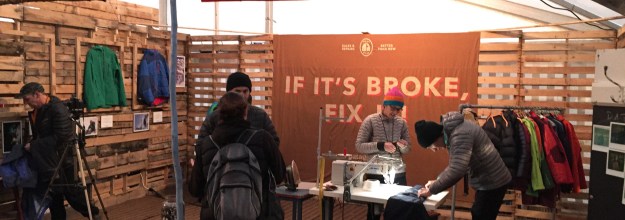
Patagonia’s Worm Well bus will be setting up temporary workstations at venues across the UK to repair garments, free of charge.

IMG_0759

Worn Wear at Kendal Film Festival 2015

The UK leg is part of a wider five-country mission across Europe to extend the life of outdoor enthusiasts’ clothing. It starts on 15 April in the UK and Germany before moving on to other European countries.

Dates and details are on the Patagonia Worn Wear website.

It would be great to see this extended into other areas, more built environment related areas, for example, FM organisations holding free equipment repair workshops in buildings they operate, construction and consultancy organisations returning to their buildings and providing free sustainability advice and repair service … The opportunities based on circular economy business models are huge.

Put simply, if it’s broke, fix it! Dont replace it

Related previous post: (2012) Construction CSR Makeover: can construction learn from Patagonia?

The Price of Construction Carbons

screenshot.14

Distribution of Construction CO2

ConstructCO2 now allows the calculation of a ‘shadow’ carbon price for carbon emissions from the construction process. The default price is set at £29 / tonne, based on current available data as used by other organisations within their shadow carbon pricing exercises (1) However ConstructCO2 also allows for any user or project to set their own carbon price.

Carbon pricing is increasingly being used to drive carbon reductions, through internal costing arrangements, and as awareness or preparation for what many see as an inevitable carbon future regulations or taxation.

In the light of the Paris Agreement, the calls from businesses and activists to put a price on carbon are becoming louder. To keep global warming below the Paris target of 2 deg C, the UN Intergovernmental Panel on Climate Change says the world will need to get to zero net emissions urgently.

Construction processes are part of the climate change problem but a vital part of the solution , and by introducing an operating cost by factoring emissions into bottom-line calculations through carbon pricing will be part of the construction industry contribution to carbon reduction.

See FT article: Companies accelerate use of carbon pricing and for example the advertising group WPP, who use an internal price of £29 a tonne of CO2 when buying or refitting buildings to understand “the impact of future energy and carbon regulations on our business”.

Outstanding North West Young Construction Professionals

CDA-logo-e1458568790817I am delighted to be providing social media advice and support in promoting this years Construction Development Alliance (CDA) Outstanding Young People in Construction awards. (Follow @cdaliance and #CDAAwards16 for news, promotions and updates)

The awards recognise outstanding individuals age 16-25 years old in work, sixth form, college or university. With 5 categories, this is an opportunity to acknowledge and recognise those who really are the future of our great Construction Industry in the North West.

The 2016 awards, sponsored by SIKA, the CDA  and others as noted below will be presented by TV jouranlist Dominic Littlewood on the 6.30pm on the 26th May 2016 at Burnley Mechanics, Burnley

The Awards nominated Charity is the YMCA young Persons Housing Project

Award nominations for outstanding young people in construction

The Construction Development Alliance 2016 CDA Awards will recognise up to five outstanding young people between the ages of 16 and 25 who exemplify the best attributes of the North West’s young construction folk. Nominations are invited for each of the five categories listed below. There will be a trophy and prizes, plus the opportunity to be considered as the overall winner and a substantial prize.

The categories are:-

1. Overcoming adversity in construction

Sponsor: DTPC

Someone who has achieved success in college or at work, either through their position, determination, exam success, career progression, leadership, deals negotiated or financial results despite overcoming some form of adversity.

2. Young designer of the year

Sponsor: Booth King Partnership

Someone who has achieved success in design either at college or at work, in any form of design associated with the construction industry for example architectural, interior design, mechanical, electrical, structural, landscape etc.

3. Young apprentice in construction

Sponsor: Vinci Construction

An apprentice working in a construction related profession who has achieved success and or been recognised by others as being an outstanding candidate in what they have achieved in their role as an apprentice.

4. Young construction professional

Sponsor: Parker Wilson Consulting

Someone who has demonstrated exceptional performance of their duties either at college or working in their specific field. The candidate must promote leadership skills, inspire and encourage others. A positive “can do” attitude and a willingness and desire to continue to learn, develop and become better in their chosen field. Candidates are invited from individuals in all sectors. We will be looking for success in college and or at work, with evidence of career progression, leadership skills, creating a project and making it happen, inspiring and motivating others to make it happen, good negotiation skills or even financial results. The successful person will be a role model, who has clear values and has made a sustained difference this year.

5. Young construction environmentalist

Sponsor: Clement Acoustics

Someone who has achieved success in a construction related profession or college course that has an environmental element to a project and has made a significant contribution towards protecting and improving the environment. This may include (but is not limited to) organising an environmentally friendly project, undertaking and developing energy saving initiatives, or generating awareness about climate change or other environmental issues. The candidate should be someone who has organised a program, project or activity for the benefit of a community and engaged, inspired and motivated people or public bodies to get involved in the particular charitable or social cause. We will be looking for someone who has made an environmental difference this year.

Overall Winner

Sponsor:  D&M Creative

To be announced on the night

Other sponsors of the awards evening include Eric Wright Construction 

How to Nominate your Construction Outstanding Young Person of the Year

For entry forms:

Visit CDA Website at http://www.cdalliance.co.uk/ 

Or access the pdf entry form from here 


FutuREstorative: Working Towards a New Sustainability

FR_Visuals_FINAL

Publishing July 2016

Publication of FutuREstorative (set for Jul 2016) edges closer with the books product page going live on the RIBA Bookshop.

FutuREstorative: Working Towards a New Sustainability

Description

This book aims to further the debate on new sustainability thinking in the built environment, by bringing together a selection of short contributions from thought leaders in the UK and the rest of the world with an overarching narrative from Martin Brown.

Although progress in sustainable solutions has been made over the past decade, the trend is still one of a woefully wasteful construction industry. This book aims to show that being ‘less bad’ is no longer good enough.

The book also spotlights digital sharing and collaboration through social media and BIM as new tools in the ‘sustainability toolbox’ which provide unique and powerful opportunities to rapidly advance sustainability thinking, development and action.

  • Author: Martin Brown
  • Format: Book
  • Pages: 128
  • Publisher: RIBA Publishing
  • Date Published: Jul 2016
  • Stock Code: 85971
  • ISBN: 9781859466308
  • Binding: Paperback

Every Breath We Take

The 2016 Every Breath We Take report from the Royal College of Physicians is a sobering update on human and cost consequences of poor air quality. And not only outdoor air quality, notoriously poor within many of our cities, but also consequences arising from indoor air quality, significantly triggered through the design, construction and operation of the buildings we live, work and play in.

RCPCH-1“Each year in the UK, around 40,000 deaths are attributable to exposure to outdoor air pollution, with more linked also to exposure to indoor pollutants”
The report estimates that the cost to society, business and health services in the UK adds up to more than £20 billion every year.

This is a prime example of how, in the built environment we externalise the real cost of low cost construction.

The report focuses on pollutants from buildings that occur during operation, but also touches on pollutants during construction. The high volume of construction transport, predominantly diesel in addition to the pollutants known to be asthmatics, organic & mineral dust, or carcinogenic (asbestos fibres in older buildings, formaldehyde and VOCs in newer builds)

The built environment is responsible for an increasingly complex cocktail of air quality issues:

“Looking to the future, newer ‘green’ workplaces will be constructed, and newer technologies will be developed for use within them. The latter include significant developments in, for example, the use of advanced materials and three-dimensional printing. The construction, occupancy and exposure profiles of newer workplaces will lead to the potential for novel inhaled hazards and risks, and vigilance will be required in order to identify the occupational lung problems attributed to the workplaces of tomorrow”

Every Breath We Take makes a number of recommendations:

Lead by example in the NHS. Is it acceptable to design, build and maintain health facilities that themselves are not net health positive.

Quantify the relationship between indoor air pollution and health. Pressures for ever more energy efficient buildings with lower carbon footprints raise the potential of reducing air quality in homes, offices and schools. An holistic and collaborative effort is required across built environment organisations, research and health organisations to develop policies and standards.

Lessons:

Following the findings of the Every Breath We Take report, there really should be no air quality performance gap, even a small gap will result in human health issues and externalised health costs.

Adopting the increasingly popular Living Building Challenge and Well Build Standard, air quality must become a key element of performance gap analysis. Design stage set the required air quality threshold that is validated post construction, with a fully occupied facility over a 12 month proofing period, and the on a regular on going basis. Established standards such as BREEAM and LEED must make award of certification dependent on proven air quality.

This is a CSR (Corporate Social Responsibility) issue of high magnitude for those who commission buildings, those who design and construction and those who manage buildings, anything less can not be acceptable to a responsible built environment sector.

Based on extract from FutuREstorative


Ready for a Circular Economy?

IMG_1100My recent talk at Green Vision Circular Economy event held at the Re:Center, University of Bradford, focused on Design for DeConstruction principles and raised a number of questions, for example;

  • The Circular Economy is not just simply new generation waste recycling – are we rethinking design and construction systems and processes. (slide 2)
  • How can we convert Site Waste Management Plans to Material Conservation Management Plans? (slide 3)
  • Is BIM ready to embrace design for (secondary) reuse, after the first design purpose?How well do we understand the difference between Material Passports and Product Data Sheets? (slide 5)
  • How can we remove toxic materials from buildings so that we do not build in more health problems for future use, future buildings and future generations? (slide 7)
  • Are we limiting circular economy potential through greater integrated Mechanical, Electrical and Plumbing systems? (slide 15)
  • Is there really a place in construction 2016 for Substances that are Hazardous to Health? (slide 24)

Related Post: Circular Economy and the Built Environment

Circular Economy and the Built Environment

KONICA MINOLTA DIGITAL CAMERA

Updated: Ready for a Circular Economy?

This coming week sees a number of circular economy events, for example Green Vision 10th Feb  (#GVis2016) in Bradford and ConstructCE 12 Feb (#cethinking) in London. Also see the Build Well 2016 Feb 10/11 event in the USA.  If you are at all interested in learning more about Circular Economy and its current popularity in construction, get along to at least one for these, and, engage via their twitter streams

This blog has mentioned and covered concepts of Circular Economy, Cradle to Cradle and related themes on many occasions, including the 2008 Constructing Excellence Lancashire Waste is Stupid event and presentation for that asked the question when did the construction Take Make Dump become acceptable, and why it remains so.

Whilst we see an increase in interest and a hunger to understand, an occasional interface with mainstream sustainability (as represented by BREEAM) and with BIM (GreenBIM), circular economy thinking struggles to gain any real traction within the built environment.

Research shows that the circular economy could be worth up to £29billion to the UK economy. It remains unclear how much of this would be construction related, but is this another area we can apply the rule of thumb 40% factor to, making a significant impact on the sector?

The Living Building Challenge provides a great framework for circular economy thinking, requiring for example, Conservation Plans not just Site Waste Management Plans, and pulls on the DfD (Design for Disassembly or Design for Deconstruction) principles as a guide for material selection and management within Living Building Challenge projects.

And it is DfD principles that will form the core of my talk at the Green Vision circular economy with examples from recent visits in the UK, Europe, Canada and the US.

Circular Economy and DfD principles present great opportunities and challenges for todays design and construction within the world of BIM. Can we for example design buildings with materials and components that have a secondary designed life after the first? and, how can we incorporate materials and components that are already insitu within existing buildings? The Alliander company ‘new’ HQ building in the Netherlands demonstrates it is possible, using concepts such as Material Passports to incorporate 80% raw materials from existing buildings and have designed re-use potential for 80% of the new building.

However, if we are serious in designing and constructing buildings with circular economy thinking, with a planned lifetimes reaching to 250 years, as for example in the case of Bullitt Centre, is it acceptable or responsible to specify or include unhealthy or toxic chemicals or materials?  We would be potentially locking risks into many years of use and potentially many future buildings. A good place to start is to ensure the buildings are LBC Red List compliant. The Bullitt Centre has demonstrated toxic material free buildings are possible in six-storey, city centre commercial buildings.

The era of just harm reduction should really be history, and, in an age of responsible construction, the Precautionary Principle (to do no harm where evidence of health or ecological risk exists), should be forefront in design. And if unhealthy or toxic materials are really unavoidable, then project Deconstruction Plan’s must detail the designed replacement rationale and methodology as soon as healthy alternatives become available.

FR_Visuals_FINAL

Circular thinking and DFD are explored within my upcoming RIBA publication FutuRestorative as inspirations and challenges for a new sustainability in the built environment.

Event Links:

Green Vision 10th Feb   Hashtag #GVIs2016 @lsigreenvision

CE Thinking 12 Feb  Hashtag #CEthinking @constructCE 

Build Well 2016 Feb 10/11 @BuildWELL_EBNet

Introduction to the Living Building Challenge + Project Workshop

UK_collaborative_logoWe are pleased to announce an Introduction to the Living Building Challenge (LBC) on Tuesday 9th Feb 2016 at the Cuerden Valley Park Visitor Centre, Berkeley Drive, Bamber Bridge, Preston PR5 6BY at 1pm.

The event will be led by Martin Brown of Fairsnape, the LBC UK Ambassador and supported by Barbara Jones and Hannah Hunt of the Straw Works Design team.

The event is free but we will accept donations of £5 or more towards costs.

Programme:

13.00 Introduction to the Living Building Challenge

including associated programmes: JUST, DECLARE, Living Product Challenge and Administration of LBC: Handbooks, Dialogue, Documentation, Certification

14:00 Understanding/Confirming LBC Requirements for CVP and the Seven Petals:

  • Place
  • Water
  • Energy
  • Health and Happiness
  • Materials
  • Equity
  • Beauty and Inspiration

16:30 Summary of Actions

17:00 Close

Background to the Event

Straw Works have designed and successfully achieved Planning approval for a new Visitor Centre at Cuerden Valley Park (CVP), with the support of Chorley Borough Council. It is currently under construction by volunteers of the CVP, with Straw Works providing support and running training courses where necessary. The project is registered with the LBC, the first UK project to be registered, with funding from Veolia, who are part funding the whole project. http://www.strawworks.co.uk

The Living Building Challenge™ is the built environment’s most rigorous performance standard. It calls for the creation of building projects at all scales that operate as cleanly, beautifully and efficiently as nature’s architecture. To be certified under the Challenge, projects must meet a series of ambitious performance requirements over a minimum of 12 months of continuous occupancy. https://living-future.org/lbc

Martin Brown, Fairsnape, is a sustainability consultant, LBC Ambassador and UK Collaborative Facilitator. His new book, published by RIBA, FutuREstorative, exploring Inspirations + Challenges for a New Sustainability, publishes in summer 2016.

FR_Visuals_FINAL

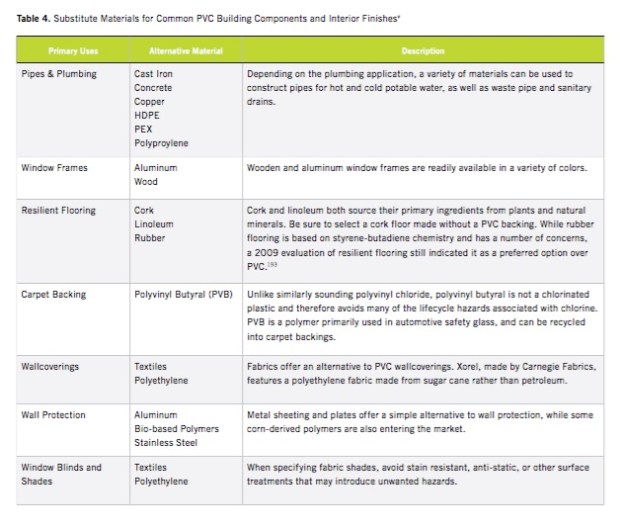
Avoiding PVC health hazards through substitute materials.

Aside from building materials that present obvious and accepted hazards to health (asbestos, leadpaint etc) it is PVC that generates the most discussion when exploring the Materials RedList imperative in Living Building Challenge training or workshop sessions. To design and construction buildings that are PVC free seems impossible to many, but LBC projects are doing just that through viable alternatives.
PVC imageThe Perkins+Will white paper, Healthy Environments, Whats New (and Whats Not) with PVC published last week (16th Nov) reviewed why PVC is on their ‘precautionary list’ in light of recent advances in PVC chemistry and manufacture. The white paper, a collaboration with the Healthy Building Network, to promote health in the built environment, concluded that despite advances in production, PVC should remain on their precautionary list.

Influential materials rating systems, including the Living Building Challenge building certification and Cradle to Cradle product certifications recommend avoiding PVC. Influential building owners such as Kaiser Permanente and Google have adopted PVC avoidance policies. Perkins+Will, an international architecture practice with about 1,000 architects, included PVC in its Precautionary List as a substance for which to seek alternatives.

“Exposure to a single PVC fire can cause permanent respiratory disease… Due to its intrinsic hazards, we support efforts to identify and use alternative building materials that do not pose as much risk as PVC to fire fighters, building occupants or communities.”  Richard M Duffy, International Association of Fire Fighters139

This does not mean that Perkins+Will has eliminated the specification of all PVC-based products. Instead, in keeping with the precautionary principle, when evidence indicates a relevant adverse finding as it relates to human health or negative environmental impact, Perkins+Will seeks to, where possible and appropriate, present alternatives to building owners for their consideration. The goal is to empower design teams to make informed decisions, recognising that this is an issue where scientific certainty is elusive.

Perkins+Will includes PVC on the Precautionary List because it presents hazards to people and the environment, beginning with its synthesis and continuing through its manufacture into products, use, and additional significant hazards during its disposal or recycling.

The white paper includes detailed analysis on the Health Hazards Associated With PVC and Hazardous Emissions from PVC, but the section on Avoiding PVC hazards through substitute materials will be of great help for those seeking PVC free constructions.

Avoiding PVC hazards through substitute materials

Mobilising the Construction Sector for Climate Action

We now know that buildings and the built environment are a key factor to our climate change problem, whilst at the same time, a vital part of climate change solutions.

2015 is seen by many as the turning point in the fight against climate change. In December, France hosts the 21st “Conference of the Parties”, or COP21, with a goal of reaching a binding agreement to limit global warning to between 1.5degC to 2degC.

Without significant action by the built environment sector, this target can not be met

December 2015 


The built environment sector’s crucial role in mitigating climate change is finally being recognised. For the first time in the history of climate negotiations, A ‘Buildings Day’ will be held December 3 at the COP21 UN conference on climate change in Paris.

  • Helping to put the buildings and construction sector on the below 2 °C path
  • Aligning existing initiatives, commitments and programmes to achieve greater scale and increase the pace of efficiency actions
  • Catalysing stronger collaboration and targeting sectoral and cross sectoral climate action and solutions for all

17062008118

Now then, is the time for every built environment organisation; funder; client; designer; constructor; and maintainer, to revisit and to recommit to sustainability goals that will not only seek to limit global warming through reducing carbon and other greenhouse gas emissions, but also seek to be net positive.

More than 30 per cent of global greenhouse gas emissions are buildings related, with emissions from buildings set to double by 2050 if we continue business as usual. Not addressing climate change will increase the risks and vulnerability of countries, regions and local communities. The forecast rapid urbanisation, without action will accelerate impacts.

Yet:

  • The built environment sector offers one of the most cost-effective and economically beneficial paths for reducing energy demand and associated emissions while at the same time supporting adaptation and resilience to climate change.
  • Many low-energy, renewable and deep renovation solutions are available. Proven policy, finance and technology actions exist.
  • The economic, health, and social benefits of sustainable buildings are significant. Buildings provide shelter, places to live, work, learn and socialise, directly affecting our daily lives. Providing more than 50 per cent of global wealth, and one of the largest employers at local level, the sector also offers a path to poverty alleviation.
  • Buildings are long-term ventures. Today’s new buildings are tomorrow’s existing stock. Failure to act now would lock in growth in GHG emissions for decades.

Better Build Green is the World Green Building Council’s new campaign which focuses on the UN climate change negotiations – COP21 in Paris. The campaign aims to show the world that green buildings offer one of the best and most cost-effective ways to tackle climate change and help keep global temperature rises within the two degrees limit. The message is simple: not only had we better build green if we are to reach a two-degree world tomorrow, but we are better off today if we do.

Sources:

UN Environment Programme Buildings Day 

Friends of Europe

Better Build Green

The New Economy – Why Buildings Matter in Fights Against Climate Change

Fairsnape iSite: Beyond Sustainability