Tag Archives: sustainability

Towards a Responsible and Sustainability Construction Economy

Increasingly we hear more and more on emerging sustainable, responsible, collaborative economies. For example:

Patagonia, following on from Chouinard’s Responsible Business have launched their Responsible Economy initiative, and wisely, not having the answers shape the programme with the mission to start the debate – and ‘catch the wave‘.

Recently the TSSS and Earthshine launched an interesting and influential paper, BluePrints for a Sustainable Economy whose aim is to share a journey with people around the world, to help generate greater awareness of the issues and possibilities, to promote debate, to provide a sense of hope for what might be, and how we could all make the transition towards a more sustainable economy.

In the introduction to Towards New Innovative Collaborations  I wrote “Our built environment collaborative working journey is now venturing into new territories. The future for a responsible built environment will increase both  pressure and opportunities beyond collaboration and partnerships to co-collaborate and co-create hybrid projects, moving to open innovations that in turn stimulate further opportunities. 

So, what would a responsible, collaborative and sustainable economy for the construction sector look like?

Lets have the conversation.

How do we move from being the 40% negative sector to the 40% positive sector? How do we heal the future?

Untitled

“We can not call it a sustainable construction economy when we take more from nature than we give back”

We are seeing a number of excellent initiatives emerging, particularly in the area of restorative sustainability, converging on a sustainable construction economy – but what are the barriers, where are the leaders and drivers who will get us there?

This is just one of the topics planned in our Sustainability Leadership Conversations – join our Google+ community and participate in our twitter based conversations. The next conversation on Nov 5th with Eric Lowitt explores the Collaborative Economy.

Mindful Construction – pre-frontal cortex ramblings

photo (2)I caught up with Anne Parker last week over a morning tea and stroll around the grounds of the Apple Store Cafe in Scorton where we discussed mindfulness in construction as a key to unlock many of the current  issues facing construction, including sustainability and technology. We started to scratch out possible format, content and venue for a Mindful Construction Conference in the new year, but more on that over the coming weeks.

Anne delivered a Be2talks talk at our event back in September following which I asked her for a few thoughts on mindfulness:

Ramblings from My Pre Frontal Cortex – Anne Parker

The hills had never looked so green, the motorway signs had never looked such a Mediterranean blue, the mid summer sunset wrote lyrics all of its own.

Had I just taken some playful hallucinogenic drugs?  No of course not – I had just left a CIOB AGM! Yes, I had just given a talk on ‘Mindfulness in Construction and Engineering’ at this professional forum and it had given me the most amazing experience and affirmation.  Let me explain.

‘Mindfulness’ is a way of living, a way of managing the mind and the body that has origins in Eastern Traditions and has been steadily tested, researched and validated by Western Science.  What do you know about your brain and your body?  Have you learnt about it so that you can maximise the quality of your daily life?  Can you maximise the power of your brain to optimise your performance at work?  Do you understand the range of processes within your mind and body that influence your ability to innovate, tolerate change and work collaboratively with others?  Perhaps you thought that this was at the level of skill or talent without going any further into anatomy or physiology.

This is a hugely exciting time as sciences converge.  The fusion of ideas is generating new insights and models but more interestingly means that new language, metaphors, images or styles import and export ideas and practices from one arena into another.

I had found that it was my mission to bring Mindfulness into certain industries without any pictures of rainbows or women sitting on beaches in yoga postures.  With no reference to ‘Gods and Goddesses Within’ or to Yin and Yang I had found a set of idioms with which I was bringing this stuff into industries with possibly a very low tolerance to ‘airy fairy ideas’.  I was passionate about communicating the genius of these practices to men and women who could feel the benefits of this learning in their busy lives in practical or demanding jobs.  So far the exercise had been a thorny experience but I knew it was what I was here to do.  I persevered.  The talk at this CIOB AGM was part of my mission.  And it was a turning point.  This audience on this summer’s night gave such an enthusiastic, high energy response to the teachings of these disciplines that I was lifted beyond measure.

The joy of my internal world was being reflected back to me on that motorway drive home.  Brains, Mind, Body, Wellbeing, Buildings, Construction – the whole concept was beginning to flow.  Surely everything that has ever been built or made or constructed started off in someone’s mind?  So isn’t it worth having a look in there, exploring it? Working with it or taming it?  The construction of the outside reflection is what we shall live in years to come…..

Mindfulness.  It is worth your investigation.

Is the next step a conference on Mindfulness and Neuro-Leadership for the Construction and Engineering industries? Would love to hear your thoughts….

Anne’s talk to Be2Talks, The Cuddle Hormone’: Mindfulness, Sustainable Construction and Social Media  can be viewed here 

Could Google technology transform BIM and the built environment?

Snapseed (2)Have Google developed the next era of Building Information Modelling (BIM Level 3?) or even an alternative?

Reports via GLOBES News from Google X , the company’s secret development unit, (the unit responsible for driverless cars and Google Glass) provides exciting but tantalising news of a new construction technology, known as Genie. Google X’s construction technology project had a budget of $5 million.

Genie is described as a ‘platform with online-based planning applications to help architects and engineers in the design process, especially for skyscrapers and large buildings. The platform includes planning tools of expert architects and engineers and advance analytics and simulation tools. Genie standardises and automates the design and construction processes with unlimited design options, enabling an architect to preserve the building’s uniqueness in the urban environment’

And, not surprisingly given Googles interest and activity in sustainability and healthy buildings, ‘Genie was presented as a revolutionary technology for the construction of sustainable and environmentally-friendly buildings of a quality never before known’ (Google fund healthy construction product programmes in the US and are reportedly looking to use the Living Building Challenge Red List material approach on the new London project) 

Linking the transparency of construction products into BIM objects, (or Genie objects?) giving more information for selecting healthy, responsible materials seems a likely approach in a left field shake up for construction as  ‘a  technology  that will change the conservative global construction industry through a fundamental and revolutionary change in how buildings are designed, built, and maintained’

And … with big ambitions

Genie could save 30-50% in prevailing construction costs and shorten the time from the start of planning to market by 30-60%.

Not all of Googles projects make it mainstream or survive (think Google Wave) but success Google platforms rapidly gain mass take up (from search to Chrome browser to Google+) and with the global built environment looking for a solution that is perhaps more accessible, more collaborative and at lower cost than BIM, Genie could be a game changer, or even a sector changer.

And where else is there an innovation project with a budget of $5million to address the economic and sustainability failings of the built environment.

One to follow very closely, but it would appear the Genie has been released from a BIM bottle.

The full GLOBES report can be found here

Grey to Green sustainability – revisited

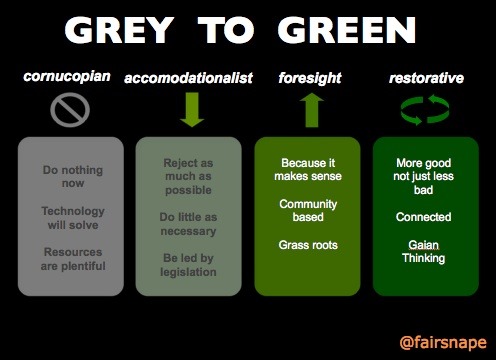
Grey to GreenWhere are you on the Grey to Green spectrum is a question I often ask at sustainability and CSR sessions with clients or in workshops.

Cornucopian Thinking: The glass that will always refills itself no matter what we do. Indeed the natural and financial environment will turn full circle and everything will be ok again. In fact we need do nothing different now as some emerging technology (carbon capture perhaps?) will make all of our problems go away. And if our customers and staff don’t like the way we operate, then, well, there are always the competition to turn to.

Accommodationalist Thinking: To accommodate the minimum, often to stay within the law, comply with ISO standards and satisfy the minimum requirements of our customers and staff. A key to this pattern of thinking is where sustainability and CSR sits within the organisation. Sitting alongside Health and Safety functions (for convenience) then it will always remain a bolt-on, which makes it difficult to move to a role that has a voice at a board level.

Foresight Thinking: Thinking based on the premise sustainability makes good business sense. Moving beyond the minimum and starting to embed CSR within the organisation. CSR and sustainability, as a function, sits at the centre of the organisation, often a dedicated CSR post with a voice at board level. Business impact understanding goes beyond the environmental and includes assessments on, for example, diversity or equality impact.

Restorative Thinking: Stems from the realisation of a greater holistic good as the driver for CSR approaches, alongside a recognition of connection with nature or the planet. There is a growing number of businesses in this thinking, epitomised for example by the 1% for the Planet group of organisations. In fact, I often give a copy of or recommend reading Yvon Chouinard’s Let My People Go Surfing to those I work with.

The Living Building Challenge, the most rigorous of green building certification schemes is firmly based on restorative thinking, doing more good – not just doing less bad.

There is a growing body of evidence linking good CSR and sustainability thinking to good business sense, but perhaps no one has summed this up so brilliantly and simply as Yvon Chouinard stated at Patagonia: “every time we do the right thing for the planet we make a profit.”

Tipping the Point

Somewhere along this grey to green spectrum there is a tipping point, where the switch from minimising the bad to maximising the good kicks in. I’d like to think of this as salutogenesis for sustainability and CSR. (Salutogenesis is an emerging and important school of thought within health care and increasingly within social well being that makes the switch from a focus on what makes us ill to a focus on what makes us stay healthy.)

In need of ideas on moving your business sustainability from grey to green?  Join in on the conversation on Twitter, subscribe to this blog (see right  hand column) or get in touch

(We can also help with Innovation Voucher funding to support your sustainability innovation ideas!)

Award nominations for fairsnape projects

benchmarkI am rather in awe and delighted that a number of the social media and sustainability advocacy projects I am supporting have been nominated for Be2camp social media awards.

This fairsnape blog, started way back in 2005 as Excelsus and from 2007 as iSite, has been nominated for Best sustainability or built environment blog along with some excellent co-nominees!

The @fairsnape twitter account has been nominated for Best AEC use of Twitter

Green Vision -the brilliant deep green programme as part of Leeds Met and the Leeds Sustainability Institute is nominated for the Best AEC community, network or application

The Sustainability Leadership Conversation (#sustldrconv) initiative kicked off by Andrea Learned and myself earlier this year has been nominated as Best virtual or hybrid event

ConstructCO2 – the online construction carbon and geo-spend tool has been nominated for the Best ‘internet of things’, location-based or mobile app

and the excellent ThinkBIM  programme, web supported through be2camp with Paul Wilkinson and myself has also been nominated for the Best virtual or hybrid event

Please do take a few minutes to check out the nominations for this years awards and vote for those that inspire (hopefully those listed above!!)

(As social media advocates at be2camp we encourage the active online involvement of supporters, we didn’t follow  approach of many awards programmes – no decisions made by judges or panels in private here, the nomination and voting process for be2awards is crowd sourced across social media and is totally transparent and independent )

Where Greendeal should be …

08062008085

At many of the Green Deal workshops, roundtable discussions and presentations (eg More than Just a GreenDeal) I have led over the last year or so , I have challenged thinking with the question, how did we get to 2013 without a clear strategy in improving the efficiency of our existing buildings?

Its as though we waited for Green Deal then set about finding solutions. I know there has been masses of research and development in this area – but no clear agreed solution or strategy.

Many of the solutions are presenting themselves as technology or renewable solutions, rather than behavioural approaches. Have we put energy consumption behavioural science in the ‘too difficult’ or ‘not enough profit’  box?  The hottest new thing in energy efficiency may not be solar panels, wind turbines or eco bling — but computers. ( See Big data analytics and smart meters are allowing utilities to use more renewable power while reducing energy waste)

Encouraging then to see the Guardian Sustainability Business report “The power of behavioural design: looking beyond nudging” describing the powerful integration of big data, behaviour insight and mobile technology in pursuit of reducing energy consumption in homes and buildings.

The American energy software company, Opower, uses a powerful combination of big data and behavioural design to make consumers use less energy

The ambition of the collaborative project between Warwick Business School and Honeywell Building Solutions is to reduce the energy consumption of organisations by applying a combination of relevant technology and behavioural design

And this is just where Green Deal thinking needs to be thinking, on a hierarchy of behaviour, fabric and renewables – not the other way around as we appear to be at the moment – and quickly.

Constructing social media leadership …

OLYMPUS DIGITAL CAMERAOver the last year or so we have seen growth and a big change in attitudes to social media, with perhaps in twitter particular, now an accepted element in today’s communication mix.

Those who a few years back were adamantly against social media have now joined, often with a fanfare of “we’ve arrived, we’re innovative” (look at us!) and with some organisations once totally anti social media now proclaiming expertise in helping others.

Back in 2012 I wrote in the Guardian (Why the construction sector should engage with social media) that one of the barriers to social media take up, and hence by default a barrier to collaborative working communications,  BIM, learning and sharing  and general construction improvement is the reluctance of directors and senior managers to recognise, embrace or enable social media. Of course there are as ever some great exceptions to this,  But all too often directors have tinkered out of curiosity, and empty LinkedIn and twitter accounts set up now tell a different story … of organisations and directors who are poor communicators.

So why are built environment organisation leaders slow to embrace these communication platforms? Maybe its the:

Need to retain control – the beauty of social media is in its open sharing, we can never know who staff will reach, converse with, learn from, share with, collaborate with and how those we converse with will respond.

Lack of understanding Digital communications is expanding rapidly, beyond the understanding of many. Consequently many directors feel vulnerable in engaging with something they don’t understand, so stay away.

Fear of just being a fad. Without a clear vision of how social media will evolve, and how it can be used strategically to benefit an organisation, many directors are reluctant to invest in seemingly unchartered waters.

And all this is sad for a 21st century construction sector, where communications are so often the root cause of most of our problems, where most companies promote a vision of innovative, open, collaborative and where most directors sell themselves as enabling role models for innovation.

Social media presence is increasingly used as a good test of an organisations, and indeed the organisation’s leaders  claims within PQQ’s, Bids and PR material to be innovative, having effective internal and external communications.

Earlier this year we started Sustainability Leadership Conversations, powered by social media, to enable leaders of smaller built environment organisations to engage with the sustainability conversations that take place across across social media. Initially these are  monthly twitter conversations with leading individuals, but will expand to facilitate conversations between organisations, between UK and USA SME organisations. Join us and discuss on the 01 Oct  for our next sustainability leadership conversation by using and following the #SustLdrConv hashtag.

Having a strategy for social media in your organisation is essential, as it is with other initiatives, and should be the starting point for adopting social media approaches. To discuss support for getting your strategy underway, get in touch (Martin in UK, Andrea in USA)

If you are UK based, we can help you apply for Innovation Voucher funding to ensure your social media, digital communication and BIM journey sets off on the right footing. (Next application closes in October)

Sustainability: in equilibrium … or pedalling squares?

cover

For me one of the best cycling reads of the year so far is Velo by Paul Fournel (review here) a collection of zen like thoughts on, well, all things cycling. And one I really do recommend for your summer readings.

From one of the brilliant posts, Circles:

To ride a bike is to make circles. You have to think about that when you pedal, as a little reminder the movement of the legs is circular,  you have to grant it this and turn the cranks roundly.

Cyclists have a sense of this.  As soon as the cadence falls and fatigue mounts they say they are peddling squares.

Cyclists have their own gyroscope, producing not only movement but equilibrium, the faster you turn your legs. the more harmonious this equilibrium becomes.

A cyclists equilibrium is a circular equilibrium

And so it is with sustainability, to keep moving forward, we need to keep circling think Edwards Deming Plan Do Check Act circle,

We need to keep pedalling, we need equilibrium,

The faster your progress, the greater your sustainability equilibrium, where all ‘competing influences are balanced’

Snapseed (1)

If you slow, become distracted or fatigue, sustainability efforts are no longer circular and become square, and if you stop you fall off …

Helping your sustainability stay circular

Excellence in Sustainability Leadership

low hanging fruitSince TQM days, the EFQM has remained my go-to framework for understanding organisational approaches, practices and performance. Of the nine criteria,  Leadership has always presented a challenge to those leaders not directly engaged and driving the organisations policies and strategies:

How Leaders develop and facilitate the achievement of the vision and mission, develop values required for long term success and implement these via appropriate actions and behaviours, and are personally involved in ensuring that the organisation’s management systems are developed

In 2004, the EFQM Corporate Social Responsibility Framework  was developed, giving more definition to sustainability and social responsibility leadership.

Excellent leaders ensure the mission, vision, values and ethics of the organisation reflect a socially responsible culture which they role model and reinforce with the organisations people and relevant stakeholders

They are personally involved in ensuring the management system addresses current and future social, environmental and economic issues

Leaders ensure that any organisational change takes into account CSR and Sustainability commitments.

What do you think? Does this criteria still hold good 10 years on ?

In preparing this post, as part of our Sustainable Leadership Conversation initiative, Andrea Learned challenged me to mention a  leaders I see as demonstrating these excellence traits. A tough call, but outside of the built environment I would include Yvon Chouinard at Patagonia (See Responsible Business),  within the built environment I would include Ray Anderson at Interface. Yet in everyday construction we can see signs of such leadership, for example with those at Marks and Spencers (PlanA), Adrian Penfold at British Land (open sharing CSR ) and leaders in SME organisations, making change through real engagement, (such as Malcolm Clarke at Baxall Construction in Kent)

Who would you nominate as a sustainability leader?

Join us and discuss on the 30th July for the first sustainability leadership conversation by using and following the #SustLdrConv hashtag.

Launching the Sustainable Leadership Conversation

imagesSustainability is moving into new territories, with new leaders and leadership styles emerging.

Across all industries, we now see many leading organisations stepping forward and placing sustainability truly at the core of their leadership.  At the same time, the use of social media is increasingly being used as a powerful tool for engaging, learning and sharing for collective sustainability leadership and organisational development.

Whether through corporate accounts or personal accounts tied to corporations, social media has the power to provide role models who are willing to share their experience and wisdom with others – through content creation (articles, blog posts) and content curation (sharing of key research or important discussions happening in a variety of places online).

The development of this sustainability leadership, amplified through social media is to be celebrated and shared broadly to impact the biggest picture we are all so passionate about – a sustainable future.

That’s why we, Andrea Learned and Martin Brown, have decided to come together, collaborate, and to co-host something we’ll call #sustldrconv (Sustainability Leadership Conversation). Our intention is to develop a sustained (pun could not be avoided!) and fluid conversation on just this topic.

Ideally, this will develop into a programme of Twitter conversations (and move into other networks) all toward understanding the issues facing sustainability leadership and how to use social media to learn and grow as quickly and solidly as possible.

We hope that our independent backgrounds and solid sustainability social networks will ensure a thoughtful and fun transfer of sustainability learning across sectors – and indeed transatlantic collaboration across ‘the pond’ and beyond.

The built environment, perhaps more than any other field/industry/category has huge influence on sustainability, and cannot be considered in isolation.  Every corporation, NGO, private and public sector organization operates within it.  What happens in the built environment has huge implications for all.

#SustLdrConv will kick off (July 30 at 12 noon PT, 3 pm ET, 8 pm BST) with a tweetchat, with examples of such partnerships, ideas or powerful new ones  and exploring the questions: So just what is sustainable leadership? Are we ready to partner with built environment organisations to co-create a sustainable future?

#SustLdrConv will, in the future develop beyond tweetchats, and include interviews, case studies, learning material and coaching.  The intention will be to continue these conversations across and outside social media boundaries.

#SustLdrConv is about how companies and people, those already on the journey and those still under the radar, are gathering experience and wisdom that we can all learn from.

#SustLdrConv will enable the transfer of innovative leadership

#SustLdrConv will support leaders in using social media for effective business engagement and future co-creation.

Background Reading:

A Low Carbon Diet For Construction Boards

Why the Sustainability Leadership Pipeline Begins with Women 

Are tweetchats the new digital benchmarking

Andrea, (@AndreaLearned) based in Seattle USA, is an author and communications strategist with a deep background in marketing to women (her book: Don’t Think Pink), but an even deeper passion for forwarding sustainability thought leadership.

She leverages social media to build “face to face” relationships between and among the field’s big thinkers – nurturing partnerships, developing content and spreading sustainability wisdom through every channel. Andrea’s personal interest in the built environment arises from her belief that it is the one unifying topic from which almost any business can see the case for sustainability.

Martin, (@fairsnape) based In Lancashire UK, is a business improvement advocate and consultant, founder of Fairsnape. As a built environment strategist he is committed to enabling success within and across organisations with a focus on sustainability, collaboration and social media. He is a Living Building Challenge Ambassador and partner with Green Vision, facilitating web-enabled events and #GVisChat tweet-chats for a green built environment.

(This blogpost  also appears on Andrea’s blog and elsewhere)