Author Archives: martin brown

Seattle, Vancouver and Squamish: a sustainability visit.

Having just returned from a visit / tour of sustainability projects in the Cascadia, NW pacific area of Seattle, Vancouver and Squamish, combined with a outdoor vacation, I am now sorting copious notes, photos and observations from the trip that will form future blog posts and inclusion in my forthcoming book, FutuREstorative.

File 16-03-2015 22 55 55

There were so many ‘highlights’ of the trip that will feature in future articles, but, as a quick summary:

The lack of snow inhibited any real winter sports without really venturing deep into backcountry. I was later to learn that this year ‘pineapple express’ wind and low snowpack levels will have an adverse affect on water aquifers across the region.

Walking and biking in forests where bear, cougar and coyote roamed and (worryingly, so early in the year) had been spotted during our visit introduced a fission of alertness not known in the UK or Europe and made for interesting discussions on re-wilding the UK countryside!

A return visit to the Austrian House at Lost lake Whistler, a Passive House gift from Austria to the 2006 Olympics and Canada’s first PH registered project.

Understanding the distinctive heavy timber architecture of the Squamish area, and visits to buildings at the stunning location of Quest Campus, Squamish and the Environmental Learning Centre at the North Vancouver Outdoor School in Brackendale (winner of a Wood Design Award held in Vancouver that week)

Meeting with Sustainable Leadership Conversation co-host and friend Andrea Learned who took me on a great cycle tour through her ‘hood –  the Seattle Ballard area and along the Waterfront with stop offs at the Tractor Tavern (home of garage and grunge) Stone34 (Leed Platinum Brooks HQ) finishing with great social media / sustainability discussions over dinner.

Visits to Living Building Challenge projects, the CIRS building at University of British Columbia, the Bullet Centre in Seattle and the VanDusen visitor centre Vancouver as well as understanding other notable sustainability buildings such as the MEC HQ in Vancouver and Stone34 in Seattle.

Water featured in visits and discussions, in particular that we should start to address water in the same way we do for energy performance in buildings – from the impact on “fossil-water” through to buildings, like the Bullitt Centre acting like trees and returning 80% of water that falls on the building to the aquifer and in using the 20% many times in closed loop systems. And of course those waterless composting toilets …

Whilst in the Bullitt Centre it was fun to to provide a live update back to and converse with the Living Building Challenge UK Collaborative water petal workshop in Leeds.

But it wasn’t just the big restorative sustainability concepts that inspired, often it’s the small but awesome detail that is essential in reinforcing the messages, like the CIRS building on UBC where the solar aqua filter plant room is positioned at the entrance, viewed by all entering the building as a reminder. But perhaps the best message being in CIRS café area where two vegetarian meals are served for each meat meal, reinforcing the message of the resources in land and water to provide the meat meal compared to that of the vegetarian.
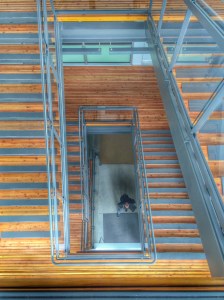
File 17-03-2015 09 03 34It was of course great to visit the Bullitt Centre and question behind the stories covered on the web and numerous articles; it really is an inspiring building and lives up to its green reputation. But now the real challenge starts – “to replicate the Bullitt Centre a thousand, a million times and fast” Over an iced tea with Denis Hayes we discussed the real possibility of a Bullitt Centre type project in Manchester as the hub for iDSP, the Institute for Design Space and Place.

Many inspiring chats and discussions gave insights into restorative sustainability for example with Tim Herrin at CIRS, with Brad Khan who really knows the Bullitt Centre inside out, with Denis Hayes, with the LBC team (great to meet and catch up with Amanda Sturgeon, Eric Corey Freed,  Hilary Mayhew, Stacia and Bonnie) and, completely by chance, at a Vancouver dinner party, a planner involved in the LBC certified Childcare facility at Simon Fraser University. An evening meal with Ken Carty, author and retired political scientist at UBC provided interesting insights into Canadian politics.

I guess no visit to the Pacific NW could be complete without getting to understanding some of the environmental politics – particularly to the north of British Columbia where the TNG and the proposed Northern Gateway oil sands bitumen pipeline is being fought to prevent environmental damage to an awesome wilderness areas. A visit to the newly opened, community located, Patagonia store in Vancouver provided further insights to Patagonia’s environmental and responsibility activity in the area via their excellent ‘zine booklet published for the stores opening ‘In the Land of the Misty Giants’ (issuu version here)

I should of course mention the reason d’etre for the trip was triggered by my partner, Soo Downe and her midwifery week at UBC with the highlight of her public lecture at the Inaugural Elaine Carty Midwifery Programme (Storify here)

But who would of thought that Cows would feature in my tour. Denis Hayes kindly gifted me a copy of his new book Cowed co-written with his wife Gail Boyer Hayes. Cowed provides a fascinating insight to how Cows impact so much both on our lives and the environment and was a great read on the long flight back from Vancouver.

So, many people to thank for such a great vacation and study tour, from Brett at the awesome Squamish airBNB, Andrea Learned, the ILFI team, our friends and hosts in Vancouver, those who gave time to talk or provide tours, Denis Hayes, Tim Herring, Brad Kahn and many more. And of course great company, thanks Soo, Chris and Emma

Future posts will use the hashtags #futurestorative and/or #VanSea2015

Mike Wigglesworth 1958 – 2015

Stob Coire Easain

Just under three weeks back we heard the incredibly sad news that life long friend and mountain companion Mike Wigglesworth succumbed to a heart attack. From the late 60’s early days of cutting mountain teeth through scouting and venture scouting to ski touring, alpinism and bothy trips through wilds of Scotland, Mike had been a constant source of inspiration and friendship on so many levels and will be hugely missed.

Although here in Canada, our thoughts are so much with friends back home today.

Thanks for your friendship Mike. The memory of your obvious delight, (often seemingly nonchalant, hands in pockets) in striding across Scottish or Alpine ridges will remain one of my lifetime pleasures.

Backcasting for a future sustainability.

The UK Living BuildiUK_collaborative_logong Challenge Collaborative hosted at Leeds Sustainability Institute at Leeds Beckett University is currently  working through the Standards petals and imperatives to develop a UK translation or ‘overlay. It is therefore timely to revisit and remind us of Mel Starrs insightful review of the Living Build Challenge following her visit to our Green Vision conference that focused on aspects of the LBC.

“For those who might not have come across the Living Building Challenge yet, it is a deep, deep green target based certification scheme. The ‘challenge’ is described as ‘the most advanced measure of sustainability in the built environment possible today and acts to diminish the gap between current limits and ideal solutions’. The International Living Future Institute, who operate the scheme, have approached green building certification from the opposite end than say BREEAM or LEED. Rather than starting with where we are today and adding incremental improvements, they have ‘backcasted’ from their ideal end point.

Full article here

SnapseedIndeed it was this idea of backcasting and in particular this image shared via twitter from an ILFI conference some years back that really ignited the formation of the UK Living Building Challenge Collaborative. Backcasting cos sustainability can be seen as an approach that sets future restorative and visionary end points with required practices and imperatives in order to back cast a path and encouraging rethinking of current approaches for getting there. Rather than as with current mainstream sustainability standards, that focus on making current practices a little less harmful through incremental improvement steps.

The Collaboratives exploration of the Petals continues on 11th March with Water and then 22nd April with Energy. More information of these, past sessions and future dates can be found here.

Not knowing the construction industry carbon footprint is not acceptable.

Minimising and reducing carbon in construction has been a central plank of industry sustainability strategies for a good many years. It is therefore embarrassing for the industry, as Construction Manager reports, that we don’t still don’t have an industry handle on or indeed understand construction carbon figures.

An earlier Sustainability Strategy for Construction set a 2012 target of 15% reduction from the 2008 figure of 48T of CO2 / £million spend which should give us about 42 T / £m at 2012 with targets for further reductions by 2020 and 2050 in line with UK reduction targets.

Although … Peter Hansford “The strategy is to achieve a 50% cut in construction sector emissions from 1990 levels by 2025, and the GCB (Green Construction Board) is tasked with making it happen”

Indications are that, dispute a focus on sustainability, with just about every organisation in construction self-claiming to be sustainable,  construction emissions actually rose by 13% over the period 2008 – 2012.

As a major emitter of CO2, (when adding in transport and travel) the construction has a socially responsibility to address and reduce.

The fact that as an industry we don’t really know is down right unacceptable.

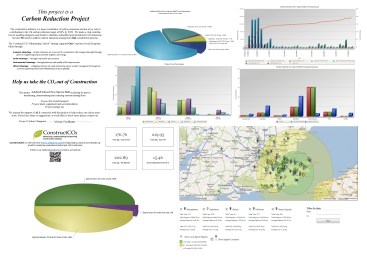
Our ConstructCO2 tool shows an average of 97.5kg / £k based on all construction types. As we gain more data (currently 300 projects) we can break this down into more meaningful targets, but since the first project on ConstructCO2 our benchmark has not fallen below 90kg/£K. (As an industry we should be below 40kg/£K)

When we founded ConstructCO2, we set out to keep it simple to record and used the strap line of Monitor, Understand and then Reduce.  Having monitored for a number of years we now understand the causes of construction carbon

Ashford School CCO2 A2 Poster

and can take steps to reduce through proactive planning.

Reducing Construction Carbon - Infographic


Why then, as industry we do not understand or monitor Construction CO2?

  • Cash in King, Carbon is Queen was a rallying call from Construction Advisor Paul Morrell – but very few rallied.
  • BREEAM hasn’t followed through – with just the requirement to record travel, transport and energy use, but not to reduce, monitor over time or collate. As an industry we have a mass of disparate spreadsheets across the country containing probably all the data we need.
  • Recording data at site level is deemed too time consuming, put into the too busy to do box by contractors, excepting of course the enlighten contractors using ConstructCO2 who see the benefits of doing so – or their clients are telling them to do so.
  • In the main, clients are not requiring projects to record and act on carbon emissions as a project key performance indicators.
  • Reducing carbon at site entails a collaborative approach from all on construction method, specification, procurement, planning, sub contractor management and so on. We simply don’t collaborate on reducing CO2.

Benefits of Monitoring CO2 (as reported by ConstructCO2 users)

  • Every kg of CO2 reduced equates to x£ not spent
  • Reducing CO2 from material and waste transport improves the local spend
  • Reducing mileage CO2 from personnel travel reduces driving time stress on operative & managers, improves productivity and time on site. Car sharing also reduces the fuel cost of operatives and managers.
  • Understanding the carbon issues enables more informed procurement, selection and logistics management

As Shaun McCarthy, Director of the Sustainability Supply Chain School said on twitter, its not Rocket Science,

Indications are that the GCB and WRAP UK will take up the mantle of managing data on construction carbons. Lets hope they talk to ConstructCO2, understand our lessons learnt and keep it simple but effective.

Biomimicry: the tool to facilitate our transition to the ecological age

unnamedHaving just finished reading Michael Palwyn’s Biomimicry in Architecture as background reading  for upcoming book, Healing the Future, I am looking forward to the Green Vision session on Biomimicry and Biophilia with Richard James MacCowan (Director and Co-Founder,Biomimicry UK ), Yaniv Peer (Associate – Exploration) along with others TBC.  (This GreenVision event is key for anyone in the built environment with an interest in sustainability and looking to improve knowledge and awareness of biomimicry and biophilic developments, Registration and more detail here)

Richard James MacCowan, Re-thinking Nature The world that we live in faces enormous challenges such as climate change, food security, biosphere integrity and freshwater use. Nature can play a strong role to tackle some of the most pressing challenges of our time. Solutions are at our fingertips, they are cost effective and we know how to implement them. Richard’s talk will focus on developments, research, case studies and future opportunities that this vital strand of sustainability can offer our industry.

Yaniv Peer (Associate – Exploration): Radical Nature  At a time when architecture and society urgently need to reconsider their relationship to the natural world there are few more exciting and innovative ways to find solutions to our current and future challenges than the discipline known as Biomimicry. This field uses nature as a mentor, learning from its ingenious adaptations that have undergone 3.8 billion years of research and development to produce exceptionally well evolved solutions. This talk will explore three projects of the London based Exploration Architecture Ltd and how it is that they use biomimicry in their work to offer new solutions to some of the biggest challenges we face today. 

And it’s not just material innovation that can benefit here. We can learn from nature for construction process and improvement. Indeed nature works with small and continuous feedback loops, always learning, adopting and evolving to its changing environment. Through learning and applying such feedback loops to design, to construction and to management of facilities we will be able to achieve far better sustainable processes, buildings and facilities.

I was struck by a review comment from Peter Head @PeterHeadCBE (Chair, Global Consulting Planning at Arup) on the cover of Michael Palwyn’s book:

“Between now and 2050 I think Biomimicry is going to be one of the main tools that will facilitate the transition from the industrial age to the ecological age” 

Agree!

Untitled

30 CSR Pro’s to Follow in 2015 …

This is interesting. Triple Pundit have published their list of 30 CSR Pro’s to follow in 2015 authored by @Mary_Mazzoni

8476983849_eeba1942cb_z-300x300

Whilst being honoured to be included within such a great community, I was particular interested in the fact that all three of the UK people listed (Jim McClelland @SustMeme, Mike Barry @planamikebarry and myself @Fairsnape) are all connected with the property or built environment sector.

Is this indicative of the change in construction, property and built environment approach to CSR, moving away from a ‘donate and volunteer’ context to one of addressing the real social and environmental responsibilities of an organisation and of the industry. Further that we can and indeed should learn from other organisations and thought leaders within other sectors.

It also illustrates the power of social media and of twitter in particular to learn and share. Within the triple pundit list there are a number of tweet chats (for example #CSRChat hosted by @susanmcp1 and our #sustldrconv Sustainable Leadership Conversation* that I co-host monthly with @AndreaLearned who is also listed)

I have commented often that I see tweet chats as the new benchmarking. No longer do we need to go through ‘benchmarking protocols’ to understand innovations and improvements elsewhere, we simply find the chat appropriate to our needs, join in engage and learn.

To help in following the CSR accounts listed by Triple Pundit I have created a twitter list here – please do follow or subscribe – if you really want the leading edge thinking and commentary on CSR you couldn’t do much better!

* a good number of #sustldrconv guests and friends (for eg @PeggyatKC @KayakMediaTweet @costrike @AmanSinghCSRalso feature within this list, which reinforces the fact we are on target with our conversation series.

A Green Deal that could have done so much. RIP

It could have been such a good deal, but it now seems the Green Deal, the green flagship of our current government is dead.

Going back to 2011/12 – the concept of a scheme that promised to reduce fuel poverty, reduce carbon,  improve our housing stock, and create a vibrant, certified (PAS2030) market sector – Green Deal looked brilliant. It certainly put sustainability thinking on the agenda of many organisations in the construction, maintenance, services and built environment sectors.

My workshops and presentations at that time, More Than Just a Green Deal tried to widen the debate – embedding more resilient and sustainability thinking into green deal. (see related Green Deal blog posts here)

But somehow along the way Green Deal got lost, became mired in politics, in energy company greed and bureaucratic red tape. The company set up by the Government to aggregate loans for the Green Deal was bailed out recently with a multi-million-pound loan of public money.

‘In a parliamentary inquiry held in September, MPs called the Green Deal a “disappointing failure”, with flawed planning that has left consumers without promised cashback and improvement works’

And plans for non domestic Green Deals seems to have quietly fizzled away in the corner …

A recent article in the Telegraph Your Money section Householders See Red Over Green Deal catalogued problems of the scheme

The Government’s flagship energy efficiency policy has become a headache for thousands of householders left with bungled installations or waiting for promised cash back payments that fail to materialise. In some cases, the energy companies responsible for carrying out the works have left householders with botched improvement works in the rush to meet energy efficiency targets’

One of the organisations supported to attain PA2030 under the MCS scheme has had certification for the last few years, yet has never had the opportunity for any installation under the scheme, yet must undergo re-accreditation on an annual basis. In light of the effort, system development and training the organisation went through, this is now a big frustration and laughing matter, making them very suspicious of further government backed green schemes.

Consequently Green Deal is unlikely to appear on any of the main political party manifesto for the coming election – and therefore most likely to be dismantled.  But of course it should be there, we need to be addressing one of the big sustainability issues in domestic building stock.

Back in 2012 I posed the question “how did we get to 2012 and still not have a viable solution to housing building performance”? We now need to ask the question – “how did we get to 2015 and still not have a viable solution DESPITE 2 years of promises, effort and funded approaches”?

A pity, a real pity and wasted opportunity.

64 hour Living Building Challenge European Competition

I am delighted to have been asked to support and tutor the 64 hours European Competition and design workshop based on the Living Building Challenge to be held in Trento, Italy, April 2015.

Below is abridged flyer info from organisers Macro Design Studio.

REGENERATION_BANNER

Macro Design Studio in collaboration with ILFI is proud to organize REGENERATION, a design competition in Europe entirely based on the Living Building Challenge protocol.

REGENERATION as the first “generation” of young professionals (architects, engineers) that can “regenerate” with their own ideas the built environment, getting the best possible performances for the building.

REGENERATION is the first design competition in Europe entirely based on the Living Building Challenge protocol.

The Living Building Challenge™ (LBC) is a building certification program, advocacy tool and philosophy that defines the most advanced measure of sustainability in the built environment possible today and acts to rapidly diminish the gap between current limits and the end-game positive solutions we seek. LBC is a Visionary Path to a Regenerative Future.

REGENERATION is a design workshop in which teams composed of young professionals are called to develop a project of sustainable requalification of an existing public building for the local community.

Every team should respond to specific requirements defined in the announcement Integrative design, synergistic development of the project and sharing of expertise are necessary prerogatives to tackle this challenge.

The purpose of the competition is to show the best sustainable regeneration project for the existing building in terms of architecture, energy efficiency, livability and relationship with social, urban and natural context

REGENERATION will take place at Centrale Fies, Dro (Trento – Italy), on April 15th to 18th, 2015.

Selection of 15 young participants is open via the Application Form with a deadline of January 30th 2015.

Official language: English.


For more information on the purpose and how to participate, see

Related:

Fairsnape Blog Living Building Challenge posts

UCLan LBC Design Competition: House of the Rising Sun 

Rethinking Sustainability Research: Eight Global Challenges

mb-m-and-c-1-blue“We must start to envision what a positive future looks like and work to make this happen”  Bob Watson, Chair of Future Earth’s Interim Engagement Committee.

Further reinforcement that good or best practice may not be enough, with the need to identify the ‘required practice’ to enable us to address big sustainability issues is central to Future Earth’s recently published Strategic Research Agenda 2014  .  This concept, (mentioned many times by myself in presentations, seminars and on this blog) resonates well with the Living Building Challenge and restorative sustainability thinking or forward visioning.

The Strategic Research Agenda 2014 publication, result of a year-long global consultation on priorities for global change research, calls for a rethink  in research to address serious environmental, social and economic threats.

The Strategic Research Agenda 2014 focuses on three themes: firstly, on understanding how the planet is changing; secondly, on deploying integrated, interdisciplinary science to address urgent sustainable development needs; and thirdly, on transforming development to be more sustainable in the long term, through eight global sustainability challenges;

  1. Delivering water, energy, and food for all.
  2. Decoupling carbon emissions from economic growth.
  3. Safeguarding land, freshwater and marine natural assets.
  4. Building healthy, resilient and productive cities.
  5. Promoting sustainable rural futures.
  6. Improving human health by incorporating global change concerns.
  7. Encouraging sustainable consumption and production patterns.
  8. Improving governance and early warning systems to respond to complex future threats.

‘The Strategic Research Agenda 2014 advocates not just a set of research priorities, but also a novel way of doing science. This approach is detailed in the Future Earth 2025 Vision and includes a strong emphasis on full integration among scientific disciplines, on engagement with societal partners in co-designing and co-producing knowledge, on international collaboration, on producing knowledge that is valuable to decision-makers, and on generating the solutions that society needs’ Strategic Research Agenda 2014

Download: strategic_research_agenda_2014.pdf

Source

Green BIM – a thinkBIM round table summary

OLYMPUS DIGITAL CAMERAGreen BIM is healthy, yet only just coming of age with a long way to go. Here is the outline and summary and the Green BIM round table I chaired at the brilliant ThinkBIM/Green Vision event in Leeds on 3rd Dec. More information, reports, blogs and videos from the event can be found through the ThinkBIM blog

Introduction:

The world of sustainability and green building is moving rapidly into the circular economy and health & wellness arena, not only for healthy buildings but also for healthy, ethical and just material inclusion. This round table explored how BIM relates to Restorative Sustainability, Red List and Healthy Materials and the Circular Economy:

  •      Can BIM assist in ‘restorative sustainability’ ie not just doing less bad, but doing more good.
  • What safeguards do we have to prevent unsustainable, unhealthy or toxic materials from inclusion into BIM Models.
  • How is BIM addressing increasing influence of bio-sustainability – biomimicry, biophilia, bio-urbanism.
  • What is the role for new thinking illustrated by the Well Building Standard and Living Building Challenge in BIM development? (and of course BREEAM, LEED, PH developments etc)
  • What data do we have, do we need relating to the impact of healthy / toxic materials on occupant health – or should we just follow the precautionary principle?
  • Deconstruction of buildings is increasingly a design consideration – how can BIM assist circular economy thinking as buildings as material banks

Summary 

Green BIM is coming of age, but has a lot of maturing to do to address the emerging wider sustainability thinking and agenda.

Material Passports can provide a good tracker for materials on source, ethics, health and more. With a Level 3 BIM thinking of linking databases, material passport datasets can link to / interigate health databases. Waiting for legislation may not be acceptable – we need to adopt the precautionary principle and act on known / identified risks to prevent or pre-empt another asbestos/lead paint scenario

Currently GreenBIM focus is on energy reduction issues, yet for many large organisations the well being of staff to minimise staff costs is a bigger driver. There is a space for BIM to incorporate wellness of building occupants in modelling. POE experiences and stories need to be channelled back into BIM development thinking. Is there a need for social / well bing knowledge or expertise within the early BIM development stages – identified within the BIM documentation for example?

BIM presents opportunities and options we haven’t seen before to really add value to the life cycle of buildings, including dis-assemble and re-use in the cradle to cradle sense, but also to add value to the well being of occupants. The 1:5:200 model can shape this thinking but there needs to be long term commitment of the project members to the whole life value ( the 200!) of the facility (and beyond)

There is exciting development within the worlds of BIM (digital tools) and sustainability (restorative) for example Google Flux, and the notion of the BIM being a seed that can be ‘planted’ to grow buildings which are respondent to the local conditions and local environment whilst being respondant to occupant and client requirements

A BIM could be seen as a operating system which comprises of a  number of apps that can be chosen and incorpated into the facilities, building or client portfolio, such apps could be cost, environmental, sustainability or all the way to restorative sustainability with net positive waste, energy and water.

Exciting times ….

The round table ran twice with excellent participation from all attending, thank you.

During the Green BIM round table we mentioned a good number of references:

Living Building Challenge  and UK Living Building Challenge Collaborative 

Well Build Standard

World Green Build Council – Health, Wellbeing and Productivity in Offices: The Next Chapter for Green Building

Delta Developments, in particular Cradle to Cradle biz park 2020

Google Flux see Randy Deutsch Blog 

Material Passports Cradle to Cradle application in Ship Building

EPD