Author Archives: martin brown

climate chaos inevitable

Scary article from Mark Lynas in yesterdays Guardian:

Climate chaos is inevitable. We can only avert oblivion

Sometimes we need to think the unthinkable, particularly when dealing with a problem as dangerous as climate change – there is no room for dogma when considering the future habitability of our planet …

…. the question now is whether humanity can summon up the courage and foresight to save itself, or whether business as usual – on climate policy as much as economics – will condemn us all to climatic oblivion.

2008 KPI’s

Constructing Excellence issue 2008 KPI data

The latest UK Construction Industry KPI data is now available interactive and on-line at KPIzone (http://www.kpizone.com). Supported by the Department for Business, Enterprise and Regulatory Reform (BERR), KPIzone contains over 700 graphs and charts, together with industry standard KPI definitions and methods of measurement.

In the age of open source, and the fact that these KPI’s are a key measure behind the UK Sustainable Construction Strategy is it correct to charge for access to this data and KPI material? Surely if Constructing Excellence and the Government are serious about change in the sector then these should be open to all to encourage greater use. Of course the CE business model would be then around benchmarking and sharing, ie a support service rather than selling a product.

sustainable construction commitments launched

The UK Government today launches its Sustainable Construction Strategy, with a whole raft of targets, measures and reporting mechanisms. It seems like it has been a long time coming, the consultation period being most of last year. Construction minister Shriti Vadera comments “Our aim is to become a world leader in sustainable construction” (Building). Time will tell.

Looking back to the response from to consultation we submitted from the Collaboartive Working Champions, it seems the emphasis on integrated and collaboartive working, as a means to sustainability is recognised .

To achieve improved whole life value through the promotion of best practice construction procurement and supply side integration, by encouraging the adoption of the Construction Commitments in both the public and private sectors and throughout the supply chain.

Parts of the industry – clients, consultants, main contractors, specialist contractors*, and product manufacturers and suppliers – to be engaged in supply chains on 30% of construction projects and for 40% of their work to be conducted through integrated project teams. (By 2012)

It is also included with the construction commitments:

A successful procurement policy requires ethical sourcing, enables best value to be achieved and encourages the early involvement of the supply chain. An integrated project team works together to achieve the best possible solution in terms of design, buildability, environmental performance and sustainable development.

And note the reference to ethical sourcing, this is also picked up in the report as responsible sourcing, moving towards a cradel to cradle approach one would hope, maybe along the lines of BS6000, which will wake up a few people and organisations.

And as fellow CWC and blogger Paul over at ExtranetEvolution comments it is good to see ICT within the Innovation section.

I am not sure about the inclusion of the eco-town approach as a target though – has the strategy been hijacked, Trojan horse style, to embed political ambitions?

however, and here is my main observation, admittedly after only a single read but….

I am disappointed to see a lack of facilities management in the document. The strategy is as much about the use, the consumption of buildings as it is about their design and provision. (something about focusing on the 1, out of the 1:5:200 concept). I am now aware that the facilities management sector in the UK is just too weak as a voice to get involved and influence the built environment sustainability agenda. Something that must change.

Yes we may have here a viable construction strategy , but without the link to the end users and management of the facilities (note I avoid the word buildings) we may not have a strategy for a sustainable built environment.

Oh, and why a sustainable document that has a solid black cover. The additional quantity of ink that will be used every time this document is printed or copied will be huge. The answer of course is not to print – but we are not all in the mindset of reading from the screen yet.

Score …

wikitecture wins international open source competition

A web2 collaborative project I have been following through second life and wiki architecture has been the open source architecture design competition via Open Architecture Network.

Delighted then to receive the following good news alert from Ryan at Wikitecture:


Wikitecture Wins International Competition: 3D-Wiki Used to Compose an Open-Source Entry

Chicago, IL, June 09, 2008 – Out of 566 registered entries from 57 countries, Studio Wikitecture won the overall ‘Founder’s Award’ for their open-source entry to a competition hosted by Architecture for Humanity on the Open Architecture Network. In keeping with the collaborative spirit of the Open Architecture Network, their entry for a tele-medicine facility in Western Nepal was chosen “for embracing a truly collaborative way of working using online crowdsourcing and Second Life as a way to create a highly participatory design approach.” Source


Having conducted a number of experiments over the last year into the feasibility of applying an open-source paradigm to the practice of architecture, the Studio Wikitecture group developed a 3D-Wiki plug-in on the virtual reality platform, Second Life, that they used to help build consensus among the numerous contributors in this open-source project.

The ‘Wiki-Tree’ as it was called, acted as a version tracking system that worked very much like a conventional Wiki, but instead of tracking text documents in a linear history as you see in Wikipedia, the ‘Wiki-Tree’ tracked versions of 3-dimensional models and saved them within a continually evolving 3-dimensional digital tree ‘canopy’. Similar to Wikipedia, this 3D-Wiki allowed this loose, self-organized group of contributors to share ideas, edit the contributions of others, and vote on which design iterations should be considered for further refinement.

Over and above the actual building design, Studio Wikitecture’s entry proposed that the wiki-tree and virtual model live on pass the competition and be used to help incorporate feedback from the Nepalese community and end-users into evolving design.

In addition, they proposed that the virtual platform would allow individuals from around the world to experience the local site and conditions as the project evolves over time, further expanding the outreach, awareness and support for this project to a global audience.

The winning entry was the result of Studio Wikitecture’s 3rd Wikitecture experiment to explore the procedures and protocols necessary to practice a more open and distributed approach to architectural design. Of those, the group explored prediction market voting procedures to assure consensus or ‘Crowd Wisdom’, as well as developed a contribution assessment system to divvy up fair ownership among all the contributors.

The Final Competition Boards: http://flickr.com/photos/studiowikitecture/sets/72157604038184909/show/

A time-lapse video of the evolving design:

http://youtube.com/watch?v=amCi90zH3VI

A video illustrating how the ‘Wiki-Tree’ works:

http://youtube.com/watch?v=Z3eWKIJxzyc

A journal article outlining, in detail, the three Wikitecture experiments:

http://crescendodesign.com/103_chase.pdf

The accompanying website:

http://studiowikitecture.com/ (click on ‘go’ twice to enter anonymously)

The Blog:
http://studiowikitecture.wordpress.com/

on zero carbon and routes to get there …

There have been some very worthwhile and considered articles and comments on the definition of and feasibility of zero carbon recently – take a look at Mels post .. and Phils post for excellent round ups and for good technical comment take a look at CarbonLimited from Casey

The difference in opinions and views is healthy – maybe there is no ‘one’ definition, maybe we should not waste (mental) energy on defining – but as per the zero accidents, zero waste and zero defects debates of recent years accept it as a worthwhile, Utopian goal and work how how to best get there. I recall from my TQM days the concept of zero waste drives lean management approaches, but absolute zero waste is not ‘defined’ – it is a philosophy.

From the supply, contractors, perspective the very confusing debate on what is zero carbon just encourages the ‘keep heads down until it blows over approach’. Understandable, but a strategy that will return to haunt those not prepared to address the changes we will have to make. Most do not have a strategy or vision for moving to a low carbon future, content to be led by circumstances.

Within the Route to Zero programme I run, we start to understand, from industry intelligence, what an organisations customers, shareholders, people and even suppliers are expecting in the context of zero carbon over the next 10 – 20 years. From this intellenge we can develop a maturity matrix of strategies and objectives that would be necessary, ie a Route to Zero. A matrix that would be reviewed regulaly as ‘requirements’ will unfold and change and most likely toughen up. Armed with such a route-map, organisations may not achieve zero , but have the evidence that they are thinking of a zero future.

And as to the general public, those who will buy the zero carbon homes, Mel is correct in pointing out the confusion we as an industry may be giving, a damaging message maybe? What home owners would like to know is the balance between capital purchase and the running costs per month, and what savings per month would a code 6 or zero carbon home give me over a traditional home? Take a look at the house sale literature in the states – this is exactly what green homes are sold on – a reduction in energy bills, making the purchase of green homes desirable, a no brainer and making non green homes nearly unsaleable.

Ad then there is the existing housing stock issue …. which is where effort must be put, not on new build, eco challenges, eco home etc etc ….

chicken in the blasket roof

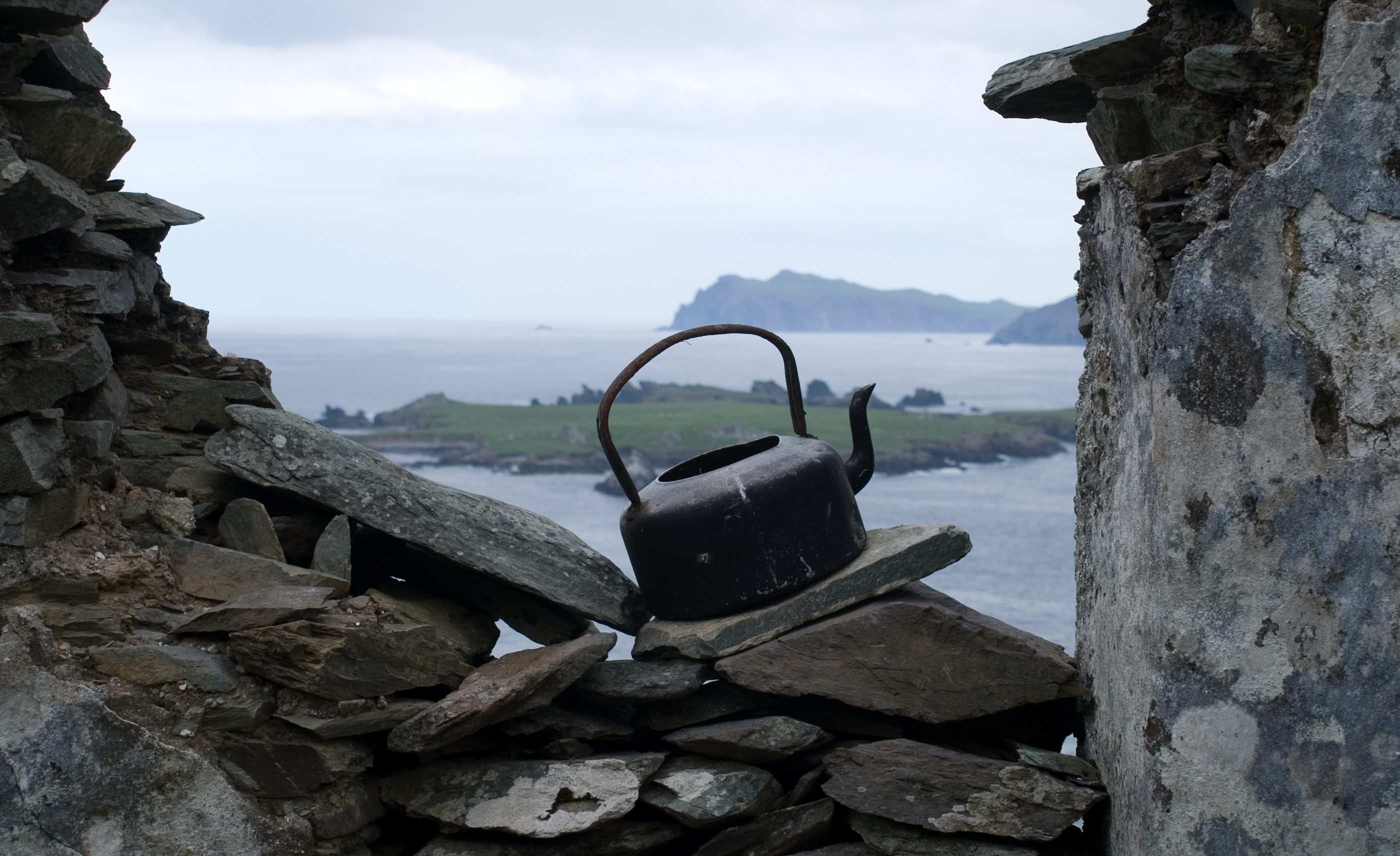
From a non-conference on virtual worlds in Limerick – to the experience of reconnecting with nature, wildness and remoteness at the edge of Europe …

Last week I had the privilege of once again spending time on the Great Blasket Island, off the Dingle peninsular, Co Kerry Ireland.

This is always a highlight of our annual holiday in Ventry. The marine and bird life never ceases to amaze, this year ticking seals, basking sharks, minke whale, dolphin, gannets, puffins and much much more. The beach on the island is in my mind one of the best beaches in the world, and on a hot suny day the white bright sand can take you to the Caribbean. It really does feel like the end of the land out here, with the walk out over the highest point to the end of the island one of the most dramatic walks anywhere.

The island lies approximately 2 km from the mainland at Dunmore Head, and extends 6 km to the southwest, rising to 292 metres at its highest point (Croaghmore). Despite its close proximity to the mainland, visitors to the Dingle coast can often not see the island through the notorious sea mist.

The island was inhabited until 1953, when the Irish government decided that it could no longer guarantee the safety of the remaining population. It was the home of three noted Irish writers: Tomás Ó Criomhthain, Peig Sayers and Muiris Ó Súilleabháin. Their works were all written in Irish, and have all been translated into English, as well as other languages. The homes of Tomás Ó Criomhthain and Muiris Ó Súilleabháin are now in ruins but the house in which Sayers once lived has been restored, and used to form part of the hostel which previously functioned on the island.

Until 1953, the inhabitants of Great Blasket Island formed the most westerly settlement in Europe. The small fishing community (even at its peak the population was hardly more than 150) mostly lived in primitive cottages perched on the relatively sheltered north-east shore.

Over the ten years or so I have visited the island, the dispute on ownership and planning to restore and create tourist facilities has ebbed and flowed. Initially it seemed the vision was for a World Heritage listing which would mean no construction or restoration. Looking at planning minutes it seems the vision is now a somewhat less grand Irish National Historic Park which it would seem allow some facilities to be built.

This year though I was amazed to see, even upset to see, what was a poorly managed (ie untidy material storage) construction site to restore / extend self catering hostel. In stark comparison to the solid construction of existing buildings, made of solid and local stone, breeze blocks had been flown in, packs split and not restacked, timbers not stacked, (artificial?) slates from Northern Ireland awaited on pallets.

Earlier regulations would not allow any vehicles on to the island in an effort to preserve the pristine nature, now yellow diesel construction plant lay where it had been last used. Concrete and mortar spoils from the mixer hardened on the ground.

What a fantastic opportunity for alternative construction practices and designs – wasted. The creation of an alternative construction technology and education center here would have been a wonderful message, showing we can work within a sense of connectivity to nature and heritage. Instead we have taken the easy route and failed.

Read the account of Tomás Ó Criomhthain’s experiences

The roof of his home was made of a thatch of rushes or reeds and his sisters would climb up to collect eggs from under the hens nesting on top. One amusing episode in An tOileánach describes a neighbour’s family at supper when, to their bewilderment and consternation, young chickens began raining, one by one, onto the table and splashing into a mug of milk. “For God’s sake,” cried the woman of the house, “where are they coming from?” One of the children spied a hole scratched in the roof by a mother hen.

Ó Criomhthain lived in a cottage or stone cabin with a hearth at the kitchen end and sleeping quarters at the other. A feature of island life was the keeping of animals in kitchens at night, including cows, asses, sheep, dogs, cats and hens.

The Blasket Community was in its way sustainable and resilient until moved from the land by the Irish Government, reading the literature really strikes a note of resourcefulness, of reusing and of recycling:

The islanders’ sometimes meagre existence was often supplemented by gifts from the sea when shipwrecks occurred. Timber, copper and brass were salvaged, as well as cargoes of food such as meal and wheat, which helped them to survive lean years. At one time tea was unknown on the island and when a cargo of the stuff floated ashore from a wreck it was used by one woman to dye her flannel petticoats (normally dyed with woad). She also used it to feed pigs.

(facts on Blasket taken from wikipedia)

rethinking construction still requires massive system change …


Collaborative working champion colleague Henry Loo posted the comment below in response to my recent posts on rethinking Egan.  This short response article is so spot on, going to the heart of the matter I have elevated it to a full post to give it more prominence.  Thanks Henry.

Egan didn’t emphasis one important pre-requisit to his message: to deliver the kind of vision he is talking about require a massive system change.

When we went to Japan last November, we saw how Takeneka, Shimizu and Kajima successfully translated the efficiencies that Egan was talking about in Rethinking Construction from manufacturing into construction. It was just like the book.
Their critical success factor was the ability to combine Design and Construction operation as seamlessly as possible.
In UK, we can’t possibly deliver that level of success because of the steep Consultancy/Contracting divide, and until such time that we can successfully come up with a breed of people under one organisation that can do both successfully together, we would never be able to deliver Egan. This goes straight to the heart of Lean Thinking because no matter how hard to try to squeeze out waste, the inherent system is not design to be efficient in the first instance (type 1 Muda is inhibiting efficiency!)
The car industry is efficient because it is output driven.

The construction industry is still inherently input driven – note when a client needs a building, rarely can he go directly to a prime contractor and gets everything under one roof; whereas that is exactly what you do in buying a car! note when a Japanese manufacturer needs a new plant, they go straight to Takenaka and Takeneka can wheel out in chapter and verse what a modern manufacturing plant would look like and reasonably accurately forecast productivity based on their research activities gathered worldwide.

Kajima spend over £200million on R&D last year, 4.5% of its annual turnover. They see R&D as their USP & innovation is where the future of their business lies. No innovation=no future. Little wonder why Egan’s vision is still less than half way?

Continue reading

3DCamp slides, invitation and links

Here are my 3Dcamp slides, which, had I not been thwarted by Limerick Munster match traffic would have presented, giving a background to second life activities. I was fortunate to participate in the plenary panel though, which was a great discussion of virtual worlds, of which I will put my notes up here asap.

Well done to organisers James Corbett and Gabriela Avram

The 3DCamp website can be found here

and a series of flickr images here

Invitation to Orientation day …

As mentioned in Limerick, we are holding an orientation day for our second life activities on the 28th June. Watch this space for times. (We hope to cover the UK and US Saturday afternoon time zones). So if you haven’t ventured into second life as yet – here is that opportunity and reason to do so. You will be greeted and shown around our projects and other interesting ‘builds’ within SL. We hope to engage a number of SL friends to show you around their (related) projects too. Maybe even end up with music and Guinness at the Blarney Stone!

Links

3DCamp was live blogged and live tweeted by Krishna De via Cover it Live on her excellent BizGrowth News blog. (thanks Krishna)

Developers accused of pursuing gadgetry instead of saving planet

The Guardian reported on Saturday on the CABE criticism of architects and developers who are, according to CABE ignoring the threat of climate change and failing to address concerns over sustainability, (Based on design reviews of more than 700 large construction projects over the last two years that concluded that fewer than 10 made sustainability a priority)

Thats less than 2% !! Why has it taken two years and 700 project reviews to highlight such failings?

“painfully slow, piecemeal approach to sustainability” and a focus on
superficial “green gadgets” is threatening efforts to build green towns
and cities.”There are some architects and developers who really get climate
change, but most don’t or choose not to. As a result we get a lot of
greenwash, such as green gadgets and microtechnology stuck on to
buildings, rather than a proper approach to sustainable design.”

I am intrigued as to the review criteria used by CABE and will report more here when I can track down and read the report.

SDRN news

Noticed the following of interest items on the Sustainable Development research network …

EAC Publication – ‘Personal Carbon Trading’
The Environmental Audit Committee has recently published a report which considers the concept of allocating individuals an allowance of marketable carbon credits, and urges the Government to lead and co-ordinate further research into personal carbon trading. This is based on the recognition that reductions in carbon emissions from business and industry will be meaningless unless accompanied by significant and equal reductions from households and individuals. Whilst acknowledging the implementation costs and the issue of dealing with vulnerable groups and a sceptical public, the Committee finds that personal carbon trading has the potential to be more engaging, more effective and more progressive than green taxation, provided it is carefully developed and sensitively implemented. The report stresses that any personal carbon trading scheme would need to be accompanied by a range of policies, educating and assisting individuals in making the necessary changes to their lifestyle. More…

Conference – ‘Sustainable Non-Dwellings: Regulations and Ratings’
10th July 2008: Jurys Gt Russell St Hotel, London
This one-day conference will bring together key representatives from government and industry for a day of discussion and solution-finding in response to the introduction of Energy Performance Certificates, the toughening-up of the BREEAM ratings system and the government announcement that all non-dwellings must be zero-carbon by 2019. Sessions will consider how current regulations fit together, how local authorities are using green building regulations as criteria for planning, the implications of the BREEAM update 2008, lessons to be learned and transferred from the Code for Sustainable Homes, and the likely real additional costs of implementing green building regulations. More…

LGA/EA/UKCIP Guide – ‘Be aware, be prepared, take action’
The Local Government Association have collaborated with the Environment Agency and the UK Climate Impacts Programme to produce a short guide to encourage local authorities to asses the risks posed by climate change and to ensure that adaptation strategies are planned into local government working. The report outlines the role of local authorities, the government drivers for adaptation, positive action to mainstream adaptation, five key stages to preparing an adaptation action plan, and sources of further information, together with a series of case studies of the impacts of climate change and the need for adaptation measures at the local level. More…

HT/DfT Conference – ‘Living Communities’
17th June 2008: Overseas House, London
The Institution of Highways and Transportation’s (IHT) Urban Design Panel and the Department for Transport (DfT) will be hosting this one-day conference to bring together representatives from senior government, industry and academia to discuss the work being undertaken on the urban street agenda. The day will offer attendees an insight into the outcomes of two key DfT projects – Mixed Priority Routes and Streetscape – and explore a number of topics, including: Strategic Objectives, Streetscape Local Transport Notes, Street Design and Place Making, and a number of case studies from the Mixed Priority Routes project. Contact  website

Conference – BWEA30
21st – 22nd October 2008: ExCel, London
BWEA’s 30th Anniversary Conference and Exhibition will bring together over 100 speakers, from Government ministers to industry leaders, to highlight the urgent need to invest in wind, wave and tidal power and the opportunities this will bring to the UK, and to address the remaining barriers facing the continued growth of the industry. Visit the website to sign up or for more information