Category Archives: carbon

Construction Localism – how do you compare against benchmark?

Construction ‘localism’ is currently high on the agenda. And set to grow in importance.

There is, rightly, much talk and focus on localism within construction projects and frameworks at the moment, based on the principle of keeping project spend local. And of course realising other benefits such as reduced travel and transport distances, reduced carbon emission, improved productivity and more.

But how do we compare and benchmark ‘localism’? How local is your project? As a client how can you know if your contractor is addressing your ‘localism’ requirements?

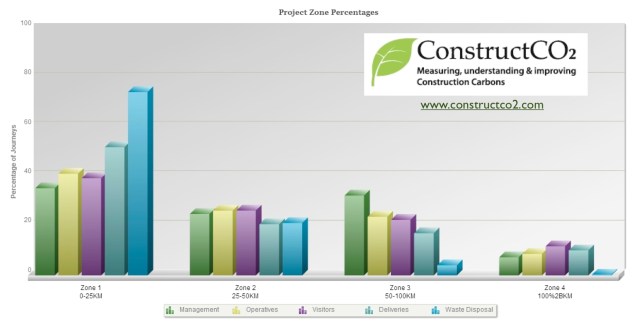
The benchmark being set through ConstructCO2 can provide a starting point. How do you compare? Do you know your project stats?

Construction Localism by Zone

Measuring and understanding your localism (and CO2) footprint must be a key measure, a KPI, as part of your sustainability and CSR programme. Going beyond the measuring it’s essential we monitor trends, make the comparisons, understand the causes and, take action.

bb7dff99a6e2e90c5e67b380cb0aac7b

It is one of the more important impact and influence areas your construction project has on sustainability and the environment.

For more on measuring your construction project carbons and project localism check out constructco2 or please do get in touch.

ISO14051: Turning waste to gold with ISO standard for environmental management accounting

With the proposed demise of Site Waste Management Plans SWMP under the ‘Greenest Government Ever’ red tape plans, could a new-ish ISO standard that puts costs to the impacts identified under ISO 14001 provide direction, guidance or framework for construction to measure and improve material and energy waste?

The standard, ISO 14051:2011, Environmental management — Material flow cost accounting — assists organizations to better understand the environmental and financial consequences of their material and energy use practices, so that they can identify opportunities for improvement.

The standard uses MFCA, Material flow cost accounting,  which is “applicable to any organisation that uses materials and energy, regardless of their products, services, size, structure, location, and existing management and accounting systems”

MFCA could be applied on a business wide basis across all projects, understanding material, energy and resource inputs, processing and outputs, as well as on a project basis adopting a SWMP format combined with a Carbon plan driven by ConstructCO2 could indeed turn waste into gold.

Background Reading:

Constructing Excellence SWMP position

ISO turn waste into gold  

Measure, Understand and Improve Construction Carbons www.constructco2.com

#GreenSkills a serious barrier

The RAE (Royal Academy of Engineering) have today published their report:

Heat: Degrees of Comfort, Options for heating home in a low carbon economy. 

There is no possibility that the UK can meet its 2050 target for CO2 emissions without a fundamental change to the way our homes are heated, according to a report published today (12 January) by the Royal Academy of Engineering. Even with the most modern gas boilers and state-of-the art insulation, we cannot continue to heat so many homes by natural gas and still achieve an 80% cut in emissions as laid down in the Climate Change Act 2008.

Plumbers unprepared for move to energy-efficient homes, report warns (from the Guardian 12/01/12)

In addition to the technical options and considerations, throughout the report there are a number of important and timely comments around the skills issue for installation, AND, for behavioural operation, as the following extracts show:

… skills shortages will be a serious barrier to decarbonising heating unless addressed effectively

… behavioural aspects are very important. Studies in the UK and overseas tend
to reveal a variation of typically 3:1 between the upper and lower tails of the
energy use (between the 5% and 95% cases in the distribution) in technically
similar dwellings occupied by people from demographically similar
backgrounds. To make radical changes, it will therefore be essential to engage the occupiers.

… the lack of inter-discplinary work:

(A Cautionary Tale Case study): The initial problem they faced was finding a single contractor who would take responsibility for the whole installation including the GSHP, ground coils, underloor heating and the integration of the new system with their existing heating and DHW installations. Eventually, despite having contacted the Low Carbon Partnership and the Energy Savings Trust, they had to place separate contracts with a heat pump installer, a groundwork contractor, a plumber and an electrician for different parts of the work.

The work went ahead and a 16kW heat pump, 150m of slinkies, a thermostore tank, solar collectors, two underfloor heating coils and room thermostats were installed.

When the system was operational the householder was shocked to find the electricity bill increased from £30 per month to £250. After 18 months of high electricity consumption and many visits by the different companies involved, it emerged that the heat pump had been wrongly connected so it was providing heat to the underfloor heating at the temperature required by the storage cylinder for DHW and, although the room thermostats were controlling the pumps on the underfloor heating manifold, they had not been interlocked with the heat pump which, in consequence, was running continuously at its maximum return temperature.

… often there was no single contractor responsible for the installation, which might involve a ground works contractor, a plumber, a heat pump installer and an electrician. As a result of there being no ‘design authority’ for the whole system, there was no single point of responsibility or any liability for the eventual performance of the installation

… there is clearly a need for many more engineers and technicians who understand the systems engineering that has to go into a heat pump installation and who can integrate the various energy systems in a customer’s house. The present provision in higher education and further education is well below what will be required. This could be a significant brake on the deployment of low-energy systems

“Our building performance studies show unmanageable complication is the enemy of good performance. So why are we making things more complicated in the name of sustainability?” – Bill Bordass,  The Usable Buildings Trust

and in conclusion:

17.4  Skills
The levels of applications engineering required to integrate a heat pump in a property along with local energy sources and other intelligent loads, such as chargers for electric cars, is much higher than is generally available in the trades that traditionally provide heating and related services to domestic consumers. A new type of energy use professional will be needed. Recruiting these will compete with the demands of new nuclear power, offshore wind and other energy industries that are already flagging-up staff shortages.

Skills shortage will potentially be a serious barrier to decarbonising heating unless addressed effectively.

Half of Multinationals to Choose Suppliers Based on CO2 Emissions

Why monitor construction carbons:  Shortly after writing a comment to a linkedin group on the importance of measuring and understanding construction carbons, through tools such as ConstructCO2, indications of increased focus on carbon performance popped up in a tweet (via Julie Urlaub @TaigaCompany ) regarding an Environmental Leader post that referenced Carbon Trust Report: Half of Multinationals to Choose Suppliers Based on CO2 Emissions 

According to the study, a full half of multinational companies plan to select suppliers based on carbon performance, and that 29% of suppliers are likely to lose their places on green supply chains if they do not have adequate performance records on carbon.

In the U.K., 56% of multinationals said that in the future they expect to drop suppliers based upon low carbon performance, with 74% of the U.K. respondents quoting shareholder pressure as a key driver for them in tackling carbon emissions.

And, although the report has a focus on multinationals, it is not irrelevant to the built environment

Next month Marshalls Plc, a supplier of hard landscaping, will be hosting a United Nations Global Compact Supplier event to educate first-tier suppliers on its approach to environmental issues.

As I posted to the Think Zero group on Linkedin, I still have to hear a good reason why we should not be measuring construction carbons.  Are you tracking your carbon performance – do you have the evidence?

Read more: Carbon performance offers major risk or reward

What is Green Deal: the hard, the soft, the CSR and the terminology.

Just what is Green Deal? Associated with my support for organisations developing strategies and implementation plans for ‘transition’ to eco refit or green deal work, the following documents are proving very useful indeed.

Getting Ready for Green Deal (Fairsnape and PBEnergy)  Is your organisation ready and equipped to work in green deals? Check against our top tips.  Time to green your board. It is absolutely essential that your Green Deal approaches are fully supported and sponsored by a board level director or equivalent. Green Deal has to be a key element of your CSR and Business strategy, not a bolt-on or suck and see approach.

What is the Green Deal and how will it work? (greenenergynet.com) Gives a general overview of what will be involved in Green Deal, who it is aimed at and useful terminology

Behaviour Change and Energy Use (Cabinet Office Behavioural Insights Team). Its not all hard technology and finance as this recent publication demonstrates. Energy reduction alongside Green Deal is one of behaviour change, nudge approaches and good CSR understandings.

This paper draws on evidence from behavioural economics and psychology to outline a new approach to enabling people, at home and at work, to reduce their energy consumption and reduce their bills in the process.

Behaviourally based changes that reduce emissions have major advantages. First, the benefits can be very fast, unlike major infrastructure changes that can take years, or even decades – a 1% gain today is worth more than a 1% gain tomorrow. Second, they can be highly cost-effective. Third, they can provide savings and other benefits directly to citizens

Green skills ‘essential’ to carbon-conscious building industryRecent Guardian Sustainable Business article.

Green Deal Terminology

Improver – The household, business or community that carries out energy saving measures through the Green Deal.

Green Deal Provider – This is the organisation funding the Green Deal. They could be your utility supplier or commercial companies, charities or social landlords.

Accredited Advisor – This is the person who recommends energy saving measures that could be carried out on an improver’s property. The advisor would document the energy saving measures on an Energy Performance Certificate which he would pass on to the Green Deal Provider and Improver.

Accredited Installer – Approved contractor who carries out measures recommended by the accredited advisor. The Green Deal provider could be the Accredited Installer but could also contract this work out. Whoever the Accredited Installer is the contractual agreement is always between the Improver and the Green Deal Provider.

The Green Deal Plan – The Green Deal Provider offers the Improver a Green Deal Plan. This includes arranging an accredited advisor and installer. It also includes the financial and contractual agreement between the Green Deal Provider and Improver.

The Golden Rule – The financial savings derived from the Green Deal energy saving measures recommended by the accredited advisor must be equal to or more than the cost of implementing the energy saving measures and the repayments must not be longer than the expected life span of the measure.

For more on Green Deal awareness of support 

Towards low carbon construction IGT Report: Government Response

Snippets from todays launch of the Governments Response to the  industry’s Innovation Growth Team Report:

Business Minister Mark Prisk said:

“An efficient, effective and profitable construction industry is at the heart of any growing economy.

“Meeting the UK’s commitment to reducing carbon will affect every aspect of the built environment and has the potential to provide the construction industry with a 40 year programme of work creating great opportunities for growth in the sector.

“Through this joint Government and industry action plan we are making a clear commitment to the low carbon transition which will create the certainty needed for construction companies to invest in essential new skills, processes and products.”

Climate Change and Energy Minister Greg Barker said:

“Improving the energy efficiency of the nation’s buildings is a win-win response to tackling emissions and spiralling fuel costs.

“The Government’s Green Deal will radically transform the energy efficiency of our homes and businesses, and presents a massive opportunity for Britain’s construction industry.

Government Chief Construction Advisor Paul Morrell said:

“I am delighted that the Government has taken on board so many of the recommendations from the IGT report which was developed with expertise from across industry.

“To ensure that construction rises to the low carbon challenge we need to continue this new level of cooperation so I am also pleased that a joint Government and industry board has been set up to ensure implementation of this plan.”

Influence of Construction 

A copy of the Government’s response to the Low Carbon Construction Innovation and Growth Team Report can be found at: http://www.bis.gov.uk/constructionigt


Info from the News Distribution Centre


ConstructCO2 now records zero carbon travel

ConstructCO2, our construction carbon calculator now measures ‘zero’ carbon travel to and from job sites.

Recording and increasing the travel from managers, visitors and operatives who get to site under their own steam (eg walking and cycling) or via car sharing is an important element in reducing construction impact on the environment, travel miles and the associated carbon emissions

It is also an important KPI that measures the projects performance against any green travel or car share plans.

The Zero travel KPI is expressed as a percentage of all travel or can be broken down to percentage of zero carbon travel for managers, visitors or operatives.

It is very very early days as yet, but it looks as through zero carbon travel is below 1% of all people travel. More later when we have more data.

Natural Mossland Carbon Capture Scheme – putting a ‘natural’ cost to carbon?

Not to be confused with carbon offsetting.

If we are serious about moving to low and zero carbon construction then this Mosslands conservation project looks like a good approach to capturing all those tricky CO2 emissions from your site or building that cannot be eliminated through good carbon reduction and energy management.

At £30 a tonne/CO2, to capture construction activity CO2 would mean, that for each £million construction spend we would be paying £30,000. (Based on the constructco2 CO2 indicator)

A natural cost on carbon?

The brochure contains some very interesting facts and figures as why peatland and mossland are essential as carbon sinks, more so than trees, and why we need to stop extraction.

NaturalCarbonCaptureBrochure.pdf Download this file     Or view on my posterous blog 

Cost of Carbon: “What was a carrot will now become a stick”

So are we prepared yet for the tranistion to a low carbon economy in the built environment?

Accouncements this week from the UK Government regarding targets for carbon reduction will affect all aspects of energy use, conservation and management. With the built environment contributing to 40% of CO2 emissions the imapct on design, material production, tranport construction and more will be very significant.

Facilities Management and the way we use buildings will most likely be the sector of the built environment to be profoundly affected. Whether the FM sector can rise to the occasion is another question, and one now being debated in FM forums, circles and events. See my thoughts on CSR Wire Talkback   

Indications from the recent Facilities Show in Birmingham (my own questioning of the exhibitors) suggests carbon measurement is just not on many FM providers agenda as yet

Can we be ready for such a dramatic tranistion, which as Derek Deighton explained is a 13 times reduction – a huge undertaking. And its not as if we havent had time to prepare in the last decade or so. Indeed as John Elkington highlighted ‘since Brundtland in 1987 we are still jollying along and still delighting in green or sustainable innovations’ 

What lies ahead in relation to the tranistion for businesses to a low carbon economy has been wonderfully summed up and explained in the May edition of  the Director in the Green Path to Growth article by Alison Coleman:

The UK has pledged to make deep cuts in carbon emissions by 2050. But as new sustainability rules bite, what are the duties of businesses? …

Britain is committed to massive carbon cuts, and whether businesses subscribe to green principles or not, they will be expected to play a key role. The Climate Change Act 2008 set a target for reducing greenhouse gas emissions to 80 per cent below 1990 levels by 2050, which assumes energy efficiency savings of around two per cent per annum for the next 40 years. That’s a big ask.

Although many companies are implementing green operating policies and achieving environmental management standards, the business contribution to the target is being driven by myriad carbon-related sustainability rules. Yet many organisations have yet to understand the cost of compliance

and as to the cost of carbon? …

Tony Rooke, sustainability practice leader at IT services provider Logica, says: “What was a carrot will now become a stick, and with the carbon price set at £12 per tonne of carbon emitted, it could add up to eight per cent to an organisation’s energy costs. What it will do is encourage them to minimise that impact by monitoring energy consumption more closely, and redoubling their efforts to reduce it and avoid waste.

it of course makes good sense:

Alan McGill, a partner in the environmental reporting practice at PricewaterhouseCoopers. “Forget the green agenda and just apply the commercial principles. There are lots of companies looking at operational opportunities to take carbon out and bring benefits to the business.”

People get ready, there’s a CO2  train a comin’ You don’t need no baggage, you just get on board”  With apologies to Curtis Mayfield

I have often said the built environment is a fascinating and great sector to be involved with – and now as we realise the carbon train is a-coming and we see its time to get on board, the journey could get a lot more interesting!

Thoughts?

Biodiversity – the new carbon?

In response to recent questions on twitter: will biodiversity emerge from its environmental protection guise to become the new carbon, the driver for sustainability? New standards for the built environment are being discussed that will, I guess roll up sustainability thinking, environmental management with ethical sourcing, taking impact assessments to local, national and international levels, and possibly redefining ‘resilience’.

To be meaningful though we need to re-gain that connection with nature, with our environment, to understand we are part of the earth system, not apart from it.

(the following appeared on the Guardian Sustainable Business site recently)

Biodiversity is the new carbon in environmental circles, but can you really measure, manage or cost it as easily as you can carbon?

It was October 2006 when Nicholas Stern published his review on the economics of climate changefor the government. At the time, top climate change economist professor Michael Grubb hailed the report, suggesting that it “finally closes a chasm that has existed for 15 years between the precautionary concerns of scientists, and the cost-benefit views of many economists”. Four years on and many are pinning their hopes on the TEEBreport having the same impact on biodiversity.

Dubbed the new carbon, biodiversity just had its own international year of recognition with the UN, culminating in the Convention on Biodiversity in Nagoya, Japan. The summit placed the issues in the spotlight but there remains a feeling that an obsession with carbon emissions has distracted businesses and policy makers from equally important environmental challenges, such as the health of the world’s ecosystems.

It’s easy to see why awareness, acceptance and action on climate change have eased their way into the boardroom more readily than biodiversity. Global policy may be stalling, but businesses understand the concept of carbon measurement and footprinting; there’s also evidence emerging that cutting carbon brings financial benefits. A recent UK government report found some companies were investing £50k in carbon measurements and reporting, but saving £200k as a result. Not a bad return.

Carbon is relatively easy to measure, of course. Thanks to Lord Stern’s report, policy makers were also able to put a price on not dealing with the issue. Regulation is now snowballing, at least on a regional and national scale, and the pressure on businesses to cut emissions continues to increase.

However, attention is now turning to biodiversity. Research and reports have emerged showing the grave state of the world’s biodiversity. http://www.guardian.co.uk/sustainable-business/biodiversity-footprint-new-carbon-measurement-management

Article continues here.