Category Archives: comment

Inventing the Eco-Industrial Age … with ‘Bio’ the new Data.

unnamedThat ‘Bio’ is set to be the new data, and a further development for BIM (Building Information Management) to align with biomimicry and the circular economy was reinforced in a Wired interview with Janice Beynus inspirational insights into the near future manufacturing at Interface.

What excites you about where technology is taking humankind?

I’m excited by the fact that we are probably the first generation to actually be able to gather biological intelligence and distribute it to the people because of the Internet. Our understanding of how nature works is just increasing exponentially. Now we have a way to gather it and to actually make it available to people.

Our experiment is AskNature.org to try to get that biological intelligence out. That’s exciting to me—understanding how nature works, and then possibly being able to emulate it.

You’ve said that “heat, beat, and treat”—heating up materials, beating them with high pressure, and treating them with chemicals—is the de facto slogan for our current industrial age. What should be the slogan for the next era in manufacturing?

I think manufacturing will be local, safe, and cyclical. (… but at the moment) We’re talking about an industrial process, where you wear hard hats and eye guards. We’re a long way to go before it’s local raw material, safely produced, (with non toxic products) and then recycled at the end of its life—put back into the printer, if you will, as the raw materials for the next product.

We’ve got a long way to go.

Changes to ISO 14001: 2015 identified.

calgary treesThe latest milestone in the ISO 14001 revision process was reached on 2 July 2015 with the issue of ISO/FDIS 14001. This document is the final draft before the publication of the standard (scheduled for September 2015).

The convention at ISO is that only editorial changes to the text are permitted between the issue of the FDIS and final publication of the standard, therefore we can be reasonably sure that FDIS 14001 contains the requirements of the revised version of ISO 14001.

NEW IN ISO 14001

The FDIS 14001 adopts the High Level Structure specified in ISO Annex SL, which is now the required framework for all new and revised management system standards.The ISO team responsible for the revision process (subcommittee ISO/TC 207/SC1) has identified the following emerging changes as a result of their revision. (Comments in italics are mine)

Strategic environmental management

There is a new requirement to comprehend the context of the organisation determining external and internal issues pertinent to the organisation and the environment, with actions to address them within the Environmental Management System (EMS).

14001 now embeds environmental and sustainability thinking into the high level strategy, vision and policy planning aspects of an organisation and project

Leadership

A new clause has been added with particular responsibilities for top management to express their leadership and commitment to environmental management. Top management may assign this responsibility to others but retain accountability.

14001 calls for increased accountability for the leadership (CSE, MD) of an organisation or project to ensure ongoing commitment and engagement  with environment and sustainability activities in the organisation.

Protecting the environment

Environmental policy shall incorporate a commitment to the ‘protection of the environment’. There is no definition about ‘protection’ that includes ‘prevention of pollution’ and ‘other’ commitments, such as sustainable resource use, climate change mitigation and adaptation, protection of biodiversity and ecosystems, etc.

The 14001 change from protection to prevention is significant, requiring a proactive approach and can be seen to move closer to a restorative thinking towards the environment

Environmental performance

The key focus is on improving performance related to the management of environmental aspects. The organisation shall decide on criteria to evaluate its environmental performance, using correct indicators.

Again a significant and proactive change: from monitoring to improving performance

Lifecycle thinking

Organisations will need to extend its control and influence to the environmental impacts from raw material acquisition/generation to end-of-life treatment. This does not imply a requirement to do a life cycle assessment (LCA), just thinking carefully about the stages of product/service that can be controlled or influenced.

There will be much debate on this 14001 change, but indicates a proactive approach to design and specification that takes into account material and building(?) environmental impact through to end of life, encouraging more design for re-use, deconstruction plans and circular economy thinking

Communication

Emphasis on internal and external communication, and equal treatment of both has been added. The decision to communicate externally is retained by the organisation whilst taking into account its compliance obligations.

Welcomed 14001 improvement for the digital and social media age of communications and transparency

Documentation

The term ‘documented information’, is used instead of ‘documents’ and ‘records’. The organisation has the flexibility to conclude when ‘procedures’ are required. Any format (paper, cloud, etc.) would be valid.

Again a welcomed improvement in the digital and social media age of documentation and data management

ISO 14001:2004 TRANSITION

Organisations that are already certified to ISO 14001:2004 will have three years from formal publication of ISO 14001:2015 in which to transfer to the new version of this standard. Based on the current publication schedule, this transition period would end in September 2018.

Source: http://www.industrytoday.co.uk/energy_and_environment/iso-140012015-update-fdis-14001-issued/36699

Related previous iSite blog posts:

14001 Support

Why did I seek to put GreenBIM into Room 101?

Why did I seek to put Green BIM into Room 101 ? Did I not tweet only this week that Green BIM is one of the more important developments in the built environment?

greenBIM 101

The label, or hashtag for GreenBIM is so riddled with issues, I was only able to skim during the 2 mins allowed in the ThinkBIM / Green Vision Room 101 session, and in fact is pre-occupying a lot of thought and space in my forthcoming RIBA book.

However, in 5 bullet points … here goes.

  • BIM (and digital construction) is the most powerful of improvement and collaborative programmes for decades, if not in the history of construction – all BIM should be green – all BIM should be pushing the boundaries and doing more good, not happy just to maintain a business as usual, a sustainability status quo or be incrementally less bad.
  • Every BIM is a core enabler in achieving Construction Vision 2025 through sustainability and carbon targets – requiring net positive approaches. Construction 2025 is not just for GreenBIM’s.
  • One of the fast emerging sectors within the world of sustainability, with a predicted market value in the billions, is the circular economy – every BIM, not just GreenBIM’s should be addressing this concept. In particular, where one building becomes the food, the material farm, for the next building. Am I in danger of creating a new hashtag and meme here: #CEBIM _ Circular Economy BIM anyone?
  • Looking through (BIM) product data sheets we see products and chemicals that are scientifically proven carcinogenic – the formaldehyde, the PVC’s, the styrene – all BIM’s should address these issues on health and wellbeing grounds, not just GreenBIM. It is estimated to take 8 hours per material on Red List transparency to determine exact ingredients – and ensure no redlist prohibited materials, at present this doesn’t make material or product specification through BIM a viable option for LBC, Well Building standard or indeed LEED4 where the Red List thinking is applied
  • Green Vision has embraced Living Building Challenge – where, for accredited projects like the Bullit Centre there are no energy performance gaps – this is what a BIM should achieve on every building, green or not, and fast. Lets seek a net-positive performance gap. This is Construction Vision 2025!

Conclusion: My reason for putting GreenBIM into 101 is more out of frustration than annoyance. We would all agree that all BIM’s should be GreenBIMs, so do we need another label, perhaps, perhaps not, but what we do need to do is to take the agenda from ‘GreenBIM’ sessions to all other BIM events, initiates, software, projects, and make every BIM Green.

I also blogged on this very issue back in 2013 – Do we really need ‘Green BIM’?

It was encouraging to see the Circular Economy feature in a number of presentations at the Green BIM event. For more on circular economy and BIM see my take here: RegenerativeBIM … moving the GreenBIM debate

And, by coincidence or serendipity, I had presented to and participated within a panel debate at Runshaw College on Circular Economy the day before:

The Papal Encyclical relevance to the Built Environment sector

Todays launch of the Papal Encyclical has much relevance for Built Environment sector on sustainability, the relationship of buildings with nature, on waste, energy, health, biophilia and even touching on BIM, (TechnoScience).

There is also a nice resonance with language from standards such as the Living Building Challenge, and other ecological restorative approaches to new perspectives on sustainability.

In particular Paragraph 150 (see below) should become a touchstone for modern, restorative, sustainable design.

It’s a hefty document, but here below are the salient sections relating to the built environment:

26. Investments have also been made … in methods of construction and renovating buildings which improve their energy efficiency. But these good practices are still far from widespread

44. Nowadays, for example, we are conscious of the disproportionate and unruly growth of many cities, which have become unhealthy to live in, not only because of pollution caused by toxic emissions but also as a result of urban chaos, poor transportation, and visual pollution and noise. Many cities are huge, inefficient structures, excessively wasteful of energy and water. Neighbourhoods, even those recently built, are congested, chaotic and lacking in sufficient green space. We were not meant to be inundated by cement, asphalt, glass and metal, and deprived of physical contact with nature.

58. In some countries, there are positive examples of environmental improvement: rivers, polluted for decades, have been cleaned up; native woodlands have been restored; landscapes have been beautified thanks to environmental renewal projects; beautiful buildings have been erected; advances have been made in the production of non-polluting energy and in the improvement of public transportation. These achievements do not solve global problems, but they do show that men and women are still capable of intervening positively.

103. Technoscience, when well directed, can produce important means of improving the quality of human life, from useful domestic appliances to great transportation systems, bridges, buildings and public spaces. It can also produce art and enable men and women immersed in the material world to “leap” into the world of beauty. Who can deny the beauty of an aircraft or a skyscraper?

143. Together with the patrimony of nature, there is also an historic, artistic and cultural patrimony which is likewise under threat. This patrimony is a part of the shared identity of each place and a foundation upon which to build a habitable city. It is not a matter of tearing down and building new cities, supposedly more respectful of the environment yet not always more attractive to live in. Rather, there is a need to incorporate the history, culture and architecture of each place, thus preserving its original identity. Ecology, then, also involves protecting the cultural treasures of humanity in the broadest sense. More specifically, it calls for greater attention to local cultures when studying environmental problems, favouring a dialogue between scientific-technical language and the language of the people. Culture is more than what we have inherited from the past; it is also, and above all, a living, dynamic and participatory present reality, which cannot be excluded as we rethink the relationship between human beings and the environment.

149. The extreme poverty experienced in areas lacking harmony, open spaces or potential for integration, can lead to incidents of brutality and to exploitation by criminal organizations. In the unstable neighbourhoods of mega-cities, the daily experience of overcrowding and social anonymity can create a sense of uprootedness which spawns antisocial behaviour and violence. Nonetheless, I wish to insist that love always proves more powerful. Many people in these conditions are able to weave bonds of belonging and togetherness which convert overcrowding into an experience of community in which the walls of the ego are torn down and the barriers of selfishness overcome. This experience of a communitarian salvation often generates creative ideas for the improvement of a building or a neighbourhood

150. Given the interrelationship between living space and human behaviour, those who design buildings, neighbourhoods, public spaces and cities, ought to draw on the various disciplines which help us to understand people’s thought processes, symbolic language and ways of acting. It is not enough to seek the beauty of design. More precious still is the service we offer to another kind of beauty: people’s quality of life, their adaptation to the environment, encounter and mutual assistance. Here too, we see how important it is that urban planning always take into consideration the views of those who will live in these areas.

180. There are no uniform recipes, because each country or region has its own problems and limitations. It is also true that political realism may call for transitional measures and technologies, so long as these are accompanied by the gradual framing and acceptance of binding commitments. At the same time, on the national and local levels, much still needs to be done, such as promoting ways of conserving energy. These would include favouring forms of industrial production with maximum energy efficiency and diminished use of raw materials, removing from the market products which are less energy efficient or more polluting, improving transport systems, and encouraging the construction and repair of buildings aimed at reducing their energy consumption and levels of pollution.

232. Not everyone is called to engage directly in political life. Society is also enriched by a countless array of organizations which work to promote the common good and to defend the environment, whether natural or urban. Some, for example, show concern for a public place (a building, a fountain, an abandoned monument, a landscape, a square), and strive to protect, restore, improve or beautify it as something belonging to everyone.

WELL Building Institute launches pilot programs for new sectors.

Buildings should be developed with people’s health and wellness at the centre of design.

Untitled 5In a recent Press Release IWBI (International Well Building Institute) is calling for organisations to participate in its next stage of development and to pilot the Well Building Standard.  Invites are called for from the retail, multifamily residential, education, restaurant and commercial kitchen sectors.

IWBI Founder Paul Scialla  said “The pilot programs will help us spur innovation and bring us even closer to fully integrating WELL into all sectors of the built environment.”

“The WELL pilot programs will allow participants to be the first to engage at the cutting edge of the sustainability and healthy building movement. IWBI will collect information from participants and industry experts to further refine the standards prior to publication. Upon completion of the pilot program, each standard will move out of the pilot phase and become integrated into the core features of WELL.”

For information or to download the pilot standards, visit www.wellcertified.com/well. Once a project has officially applied to the pilot program through WELL Online, IWBI will contact the project team to arrange an initial evaluation of the project to ensure that it fits the specifications, and provide assistance throughout the pilot certification process.

The Well building standard has great alignment with the Living Building Challenge and was featured at our recent Green Vision / Living Building Challenge Health, Happiness and Mindfulness event in May with myself and  Vicki Lockhart, (@vicki572) Arup (WELL AP) See Healthy Buildings to Healthy Minds – joining the dots at Green Vision

More: The WELL pilot programs will allow participants to be the first to engage at the cutting edge of the sustainability and healthy building movement. IWBI will collect information from participants and industry experts to further refine the standards prior to publication. Upon completion of the pilot program, each standard will move out of the pilot phase and become integrated into the core features of WELL.

WELL is the world’s first building standard focused exclusively on human health and wellness. It marries best practices in design and construction with evidence-based medical and scientific research – harnessing the built environment as a vehicle to support human health and wellbeing.

WELL is grounded in a body of medical research that explores the connection between the buildings where we spend more than 90 percent of our time, and the health and wellness impacts on us as occupants.

The WELL Building Standard is the culmination of seven years of research, in partnership with leading scientists, doctors, architects and wellness thought leaders. Pilot programs are now available for projects in the following categories:

  1. Retail: Retail applies to locations where consumers can view and purchase merchandise onsite, and where staff are employed to assist in the sale of products. The Retail pilot standard is applicable to owner- and tenant-occupied projects, and to those in both stand-alone buildings and those integrated into larger structures.
  2. Multifamily Residential: Multifamily Residential applies specifically to projects with at least five dwelling units in a single building with common structural elements. Projects that qualify include apartments, condominiums, townhouses, and other residential complexes within all market thresholds – affordable housing, market-rate and luxury.
  3. Education: Educational Facilities applies to projects where dedicated staff is employed for instructional purposes, and students may be of any age. Courses may cover any range of topics, and facilities may be typified by fully scheduled days or distinct classes in which students enroll at will.
  4. Restaurant: Restaurants applies to locations where a consumer can purchase food and dine onsite, including indoor or outdoor seating. The establishment may be either self-serve or include wait staff that tend to consumers. The Restaurant pilot standard does not include take-out only establishments or establishments whose primary source of revenue derives from the sale of alcoholic beverages. Further, the Restaurant pilot standard only applies to dining spaces—it does not cover kitchens in which food is prepared.
  5. Commercial Kitchen: Commercial Kitchens applies to locations where cooks prepare food for other building users. It is not applicable to office kitchenettes or home kitchens. In general, spaces subject to local health inspection are likely to use this Pilot Addendum. Commercial Kitchen is always paired with another standard, such as Restaurant or Education.

All pilot programs were developed as an adaptation of WELL v1.0. Using v1.0 as a baseline, relevant features from v1.0 were incorporated into each pilot, while features that only apply to commercial and institutional spaces were removed. Certain features were also adapted, so that their intent remains the same but the details are different. Prior to being finalized, all pilots will complete a thorough and transparent peer review process with scientific, practitioner and medical experts. During this process, expert feedback from leading researchers and industry practitioners will help refine each pilot for its final release.

Pilot projects are eligible to achieve Silver, Gold or Platinum level pilot certification, following the same method as WELL v1.0. Through IWBI’s collaboration with the Green Business Certification Inc. (GBCI), projects receive third-party certification by GBCI.

About the International WELL Building Institute™ The International WELL Building Institute™ (IWBI) is a public benefit corporation (B-Corp) whose mission is to improve human health and wellbeing through the built environment. B-Corps like IWBI are an emerging U.S. structure for corporations committed to balancing public benefits with profitability – harnessing the power of private capital for greater good.

IWBI administers the WELL Building Standard® (WELL) – a performance-based system for measuring, certifying, and monitoring features of buildings that impact the health and wellbeing of the people who live, work, and learn in them. Fulfilling the vision of IWBI Founder Paul Scialla, IWBI has a pioneering altruistic capitalism model that will address social responsibility and demonstrate a sustainable model for philanthropy.

IWBI has committed to direct 51 percent of net profits received from WELL Certification project fees toward charitable contributions and impact investment focused on health, wellness, and the built environment. IWBI was established by Delos in 2013 pursuant to a Clinton Global Initiative commitment to improve the way people live by developing spaces that enhance occupant health and quality of life by sharing the WELL Building Standard globally. WELLcertified.com

About the WELL Building Standard® The WELL Building Standard® (WELL) is a performance-based system for measuring, certifying, and monitoring features of the built environment that impact the health and wellbeing of the people who live, work, and learn in the buildings.

WELL focuses on seven categories of building performance: air, water, nourishment, light, fitness, comfort, and mind. Pioneered by Delos, the WELL Building Standard is grounded in evidence-based medical research that demonstrates the connection between the buildings where we spend more than 90 percent of our time and health and wellness impacts on us as occupants.

The WELL Building Standard is administered by the International WELL Building Institute™ and third-party certified by Green Business Certification Inc. (GBCI). WELLcertified.com ### Press Contact: Taryn Holowka taryn.holowka@wellcertified.com 202.828.1144

REVEALed: a new initiative to showcase and compare the world’s most energy efficient buildings.

REVEALREVEAL – a new building energy performance nutrition label and benchmarking scheme to showcase and compare the world’s most energy efficient buildings. 
Reveal is the latest programme from the International Living Futures Institute (the Institute behind the Living Building Challenge, Living Product Challenge, Declare and JUST) to provide visible and benchmark-able energy data based on real, measurable data. Reveal is aimed at certified Living Buildings, net zero buildings, LEED buildings, BREEAM buildings, Passivehouse projects – or indeed any project with accurate measured energy data. It should be of great interest to the facilities Management and Property sectors

REVEAL taps into performance based reporting – an integral part of the Living Building Challenge and Net Positive Certification to provide a new platform for projects to showcase how efficient they are relative to other buildings.

Evidence for the Reveal using the EUI – Energy Use Intensity index – would be validated from utility provider data and audited by ILFI. Reveal Labels are date stamped and will be renewed on a two-year basis to essentially become ‘nutrition’ labels for building energy performance.

Organisations can use their label on their websites and marketing materials to tout their achievement in being one of the world’s most efficient buildings – and see how their project stacks up to other exemplary projects.

Energy Use Intensity (EUI) indicator: In the absence of a standard or benchmark it is difficult to benchmark energy uses between buildings. Simply measuring the amount of energy used per a chosen time period does not take into account building size, configuration or type of use. The use of an Energy Use Intensity (EUI) indicator provides a means to normalise the way that energy use is compared between various types of buildings, and evaluate the means of reducing overall energy consumption.

When using EUI, energy use is expressed as a function of a building’s total area or “footprint”. For Reveal, as is common in the US, EUI is expressed in energy used per square foot of building footprint per year. It is calculated by dividing the total gross energy consumed in a one-year period (kilowatt-hours or kilo-British Thermal Units) by the total gross square footage of the building ie KbTu/sqft/year  In the UK and elsewhere this would be KWh/m2/year. See Calculating a Building’s EUI

The International Living Future Institute (ILFI) will begin issuing the new energy label, called “Reveal,” in late 2015 according to Eric Corey Freed, vice president for global outreach at ILFI.

10th June – A Busy Built Environment Day

This Wednesday, 10th June, is going to a busy built environment learning and sharing day: Check out these great events:

If you are in Leeds, Yorkshire or the North of England:

UK_collaborative_logoOur Living Building Challenge UK Collaboration Materials Workshop explores the materials petal, at Squire Patton Boggs, Leeds from 2.30 – 5

Introduction to the Materials Petal (LBC Presentation) Martin Brown
Materials Handbook Working Session
Experiences of tracking Red List Materials (Alex Whitcroft)

Contact LSI GreenVision e.a.schofield@leedsbeckett.ac.uk  for more information.

If you are on the internet:

Untitled

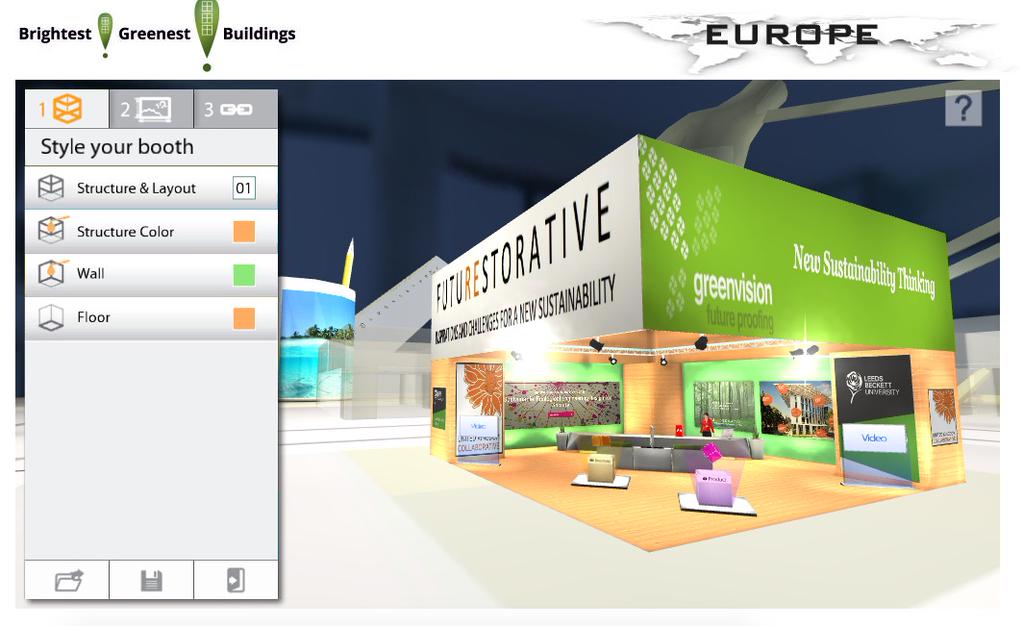
CGlkNIhUAAEei4eBrightest Greenest Buildings: The free-to-attend carbon neutral virtual exhibition dedicated to Europe’s most successful and greenest building projects and green building solutions opens on June 10th. We will have a presence – thats the UK Living Building Challenge UK, Fairsnape, #FutuREstorative and LSI Green Vision, along with many other great green building advocates and supporters.

There is an inspiring and free seminar Schedule of Events running through out the day, not to be missed!

If you are on twitter:

WORLD-FM-DAY-LOGO_2015_translations2-1World FM Day On June 10, @IFMA will host two Twitter chats that pose hot-topic questions addressing aspects of this year’s World FM Day theme, “Building Resilience for the Future,” using the hashtag #WorldFMDay.
8-9 a.m. CDT: Chat on resilience (risk mitigation, business continuity, agility/change management)
2-3 p.m. CDT: Chat on the future of FM (succession planning, tech/industry innovations, etc.) (There are also a myriad of other WorldFMDay events taking place on the 10th)

What does good ‘Facilities Management Sustainability’ look like? And why aren’t we doing it now?

I was honoured to be invited to the EuroFM ReseCGb8As1WsAA4i1varch Symposium as a guest of EuroFM, held at the recently completed Technology Innovation Centre at Strathclyde University in Glasgow.
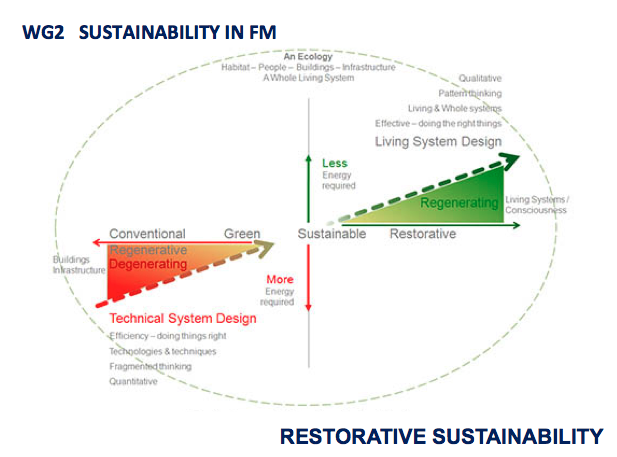
As promised, here are my thoughts from the day, and further links to the issues I raised during the day, in conversation or in the panel presentation/debate:

  • We do not have luxury to continue being incrementally less bad, and with the built environment’s 40% negative impact, the facilities Management sector, (led by the research community) has a huge opportunity and responsibility to flip to being more good.
  • We have been talking about Sustainable FM for at least a couple of decades, but still we haven’t made any real progress. The environmental impact of how we manage facilities is huge,FM Restorative Sustainability but remains something we struggle to fully understand, to measure and to address.
  • It was good to see Restorative Sustainability language within Keith Alexander’s opening presentation – laying down a challenge to the sector to adopt different thinking for sustainable FM
  • However it was disappointing to see FM research updates or proposals that start from a very dated perspective. Starting from Brundtland’s definition is last decades thinking – and has an odd message, perhaps giving licence to do nothing …. far better to adopt Yvon Chouinard’s (Patagonia) approach – ‘ Sustainability means we give back more than we take” – Restorative or Net Positive FM!
  • I did question the “in depth studies into sustainable building schemes” that have not picked up on the relatively new thinking standards such as Living Building Challenge, Well Building Standard, Cradle to Cradle, Circular Economy and so on. FM research has to be credible and leading edge for practice to listen and adopt.
  • Research proposals presented missed the huge opportunities for FM to engage with the wider sustainability agendas, in particular on people and health issues. (Note: the days theme being People Make FM)
  • Indeed the claim that FM contributes to the health and wellbeing of people needs to be backed up with evidence. Anecdotally, it is possible that FM ( and the wider built environment) could be putting people’s health at risk – through continued inclusion of toxic materials in buildings, (PVC? Formaldehyde glues?), a lack of biophilic thinking, promoting lifts over stairways, standing desks, poor air quality, lighting quality and so on. It is on these ‘health’ issues that the Well Building Standard should be a fundamental part of the sustainable FM agenda.
  • I did note that on the tour of the 3 month old BREEAM Excellent TIC Building, prior to the symposium, many of the FM delegates commented on the ‘new building smell’ – unfortunately now an indicator that chemicals may have been used in the finishes and adhesives.CGa3mDhWgAAPrZI
  • It was good to see the work in development on Smart Cities and Internet of Things from Prof Keith Jones at Ruskin University, showing the collaborative joined up research necessary to address complex (as in complexity theory) and wicked problems of sustainable smart cities.
  • Research to Practice was the theme for the end of day panel session where access to research by FM practice was discussed. I still wonder why research is blind to social media? As an example there were only two of us tweeting (myself @fairsnape and Iain @IainMurray) – but still our tweets reached approx 20k accounts, all researchers, would I am sure, like to have seen their research message reach 20k accounts.
  • It was, as ever, a real delight to introduce Living Building Challenge thinking and the Bullitt Centre to the EuroFM Research to Practice panel session. This is where sustainable EuroFM Sustainability FM thinking needs to be, driving a wedge into the future, demonstrating what is possible, not wrestling with a dated definition of sustainability.
  • the World FM Day on 10th June celebrates Building Resilience for the Future as an online debate throughout the day – a great opportunity for the FM Research community to engage and share their work.
  • Also on the 10th June the Brightest Greenest Buildings Europe virtual expo opens – again a free to attend event giving an opportunity to learn, share and engage with others across Europe.UK_collaborative_logo
  • And, also on 10th June, (a busy day!) our Living Building Challenge UK Collaborative meets at Leeds Beckett to explore the issue of healthy and materials.

If any of the above comments seem a little negative and critical, forgive me, but the intention is to be constructively so, and after all, one of the Living Building Challenge advocacy messages is to ‘stir the pot’, … o challenge current thinking.

Related Links:

Living Building Challenge

Well Building Standard (see also Vicki Lockhart Well Building presentation here)

Bullitt Centre  @bullittcentre  and (see also my interview with Denis Hayes)

Bullitt Centre added value report: Optimizing Urban Ecosystem Services: The Bullitt Center Case Study

Bullitt Centre – From Roots to Canopy

Cradle to Cradle

Circular Economy – Circulate

Responsible Business – Yvon Chouinard

Research and Social Media: Rethinking Sustainability Research: Eight Global Challenges and  my presentation to UCLan CSD 

Restorative Sustainability: Future Restorative

Living Building Challenge UK follow @livingbldgUK

Brightest Greenest Buildings EU  – the EU Virtual Expo for Built Environment (opens 10th June)

World FM Day – 10th June – Building Resilience for the Future

Wildwood, A Journey Through Trees

Roger Deakin’s article in this weeks Guardian Review starts off with one of the best illustrations of biophilia and connection with nature I have read in a while …

I wonder if the swallows that nest in the chimney of my Suffolk farmhouse have the faintest idea how profoundly they affect my emotions. When they first arrive from the south in spring, and I hear the thrumming of their wingbeats amplified to a boom by the hollow brickwork, my heart leaps. They seem to bless the house with the spirit of the south; the promise of summer. Swallows have such a strong homing instinct that it is quite possible this same family of birds, by now an ancient dynasty, has been returning here to nest for the 450 summers since the chimney was built.

When the household swallows fly away to Africa, I get restless. I suppose I envy them. I certainly miss standing by the fireplace at night, eavesdropping on their dormitory conversations in the mud nests above. Swallows never fail to stir the nomad in me, too.

Do read the rest of the article Follow the swallows: Roger Deakin’s days hitchhiking to the sun, it is a great read, a rights of passage of schoolboy french, heading south, hitchhiking delights of the 2CV or Citroen DS, the goddess of the French road. It rekindles in me my my own memories of hitch hiking down through France, sleeping on Corsican beaches, grape picking and climbing around the Mediterranean.

1344371Roger Deakin is one of our great nature writers (and ‘an icon’ of the environmentalist movement) and I would certainly recommend Wildwood, A Journey through Trees, not least for the description of a living building – his home at Walnut Tree Farm, … “evolved rather than designed … riding the earths constant movement … The proportions of each room and of the house as a whole were predicated on the natural proportions of the trees available”

So what was / is Climate Week Paris and how relevant to the built environment?

You couldn’t have missed the #CWParis hashtag and tweets from the Business Climate Summit in twitter streams over the past few days. The Climate Week Paris business meeting hosted by The Climate Group was scheduled six months before Paris hosts the UN conference where almost 200 countries are set to seal a (yet another) global climate change pact.

Key events included a Business & Climate Summit and Climate Finance Day, with world’s leading companies and policymakers brought together to demonstrate that low carbon makes good business, and good environmental sense

There were calls from many company executives at Paris urging governments to introduce more carbon pricing systems, such as a carbon tax or emissions trading schemes.

Relevance to built environment

With the Built Environment contributing the (rule of thumb) 40% of Carbon emissions, and a huge influence on business operation the sector had a presence through advocacy organisations and businesses with large built environment assets, but from reports seen and feeds followed, there was a very low presence from built environment providers – if any!

A high level session on transition to a ‘Low Carbon Built Environment’ (with a panel led by Christiana Figueres @CFigueres, Executive Secretary of the UN Framework Convention on Climate Change (UNFCCC) and chaired by Sandrine Dixson-Declève, Director of Cambridge Institute for Sustainability Leadership) discussed how “architect, town planners and engineers, collaborating with the construction, real-estate, materials & technology and financial communities, could showcase solutions for the built environment that can be deployed in Europe and inspire worldwide action”

One of the main points addressed was the lack of visibility suffered by the construction sector, as topics like energy efficiency and net positive standards are often seen as highly-technical and not understood by the general public.

Key to meeting the global goal of decarbonisation by 2050 is seen as the transition of new and existing buildings to EU Net Energy Standards . The EU Standard Requires “Member States shall ensure that by 31 December 2020 all new buildings are nearly zero-energy buildings; and after 31 December 2018, new buildings occupied and owned by public authorities are nearly zero-energy buildings”

Marks and Spencer (M&S) announced that they joined RE100, a global initiative for major companies committing to 100% renewable power, through their Plan A programme to lower carbon emissions from their activities and building operations.

The World Green Build Council promoted and launched its BuildUpon report during Climate Week Paris, aiming to create a building renovation revolution in Europe. See the Imagine a Built Environment that Enables a High Quality of Life for All  report

The BuildUpon report includes two notable actions,

  • identifying and engaging with ‘Unusual Suspects’, those not as yet engaged in the low carbon built environment dialogue.
  • A proposed open source wiki for information, the RenoWiki, a comprehensive summary of renovation initiatives across the 13 project EU countries, “to bring clarity on how national renovation strategies can strategically build upon the current landscape and how identified solutions might be scaled-up across other countries”

And, as reported in the Guardian Article “in an unprecedented alliance, 25 global news publishers have agreed to share climate change content to raise awareness in the runup to the next UN summit and agreed to scrap licensing fees for climate change content so that members of the alliance can freely republish articles.”

A call then to the Built Environment news publishers to do similar, to share climate change content and bring that content out from behind paywalls?

(I am grateful for informative tweets, sharing news and links from Climate Week Paris from friend , @WeMeanBusiness, @GuardianSustBiz, @SDDecleve @ClimateGroup and others in Paris)