Category Archives: design

European monsoon

Just as I read in the Guardian about European monsoons, Gridworks colleague Pam over in Illinois blogs on her Public Works site about dealing with water quantity and a one in 500 year event.

Questions to be asked of our storm drainage perhaps?

Leo Hickman:

But discuss it we must, because talk of a “European monsoon” is increasing, not just due to this summer’s frequent cycle of deluges but last summer’s washout, too. Is a recognisable trend now occurring, whereby the prevailing westerly winds from the Atlantic, which weaken at the end of spring, pick up again at the beginning of June and bring with them wave after wave of rain-laden depressions that can last into July

Public Works Blog

We need to start questioning the (water quantity) standards under which we design – do they need to be updated to address any climate changes?

Developers accused of pursuing gadgetry instead of saving planet

The Guardian reported on Saturday on the CABE criticism of architects and developers who are, according to CABE ignoring the threat of climate change and failing to address concerns over sustainability, (Based on design reviews of more than 700 large construction projects over the last two years that concluded that fewer than 10 made sustainability a priority)

Thats less than 2% !! Why has it taken two years and 700 project reviews to highlight such failings?

“painfully slow, piecemeal approach to sustainability” and a focus on
superficial “green gadgets” is threatening efforts to build green towns
and cities.”There are some architects and developers who really get climate
change, but most don’t or choose not to. As a result we get a lot of
greenwash, such as green gadgets and microtechnology stuck on to
buildings, rather than a proper approach to sustainable design.”

I am intrigued as to the review criteria used by CABE and will report more here when I can track down and read the report.

new online construction carbon calculator

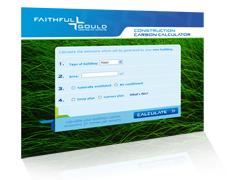
A pre-design carbon calculator has been launched in a bid to boost the green credentials of the construction industry. The free online tool will allow the industry to evaluate sustainable options at the earliest stages of construction and covers various building sectors. Developed by Faithful+Gould, the tool will ensure costs associated with carbon saving techniques are properly budgeted for at the very start of a project.

There is also a more detailed Excel version for download

more information at Faithful+Gould,

isite will use and review shortly.

zeroHouse

A search over a coffee, starting from Pam’s link (here) led me to zeroHouse.

Now this may be hitting a lot of boxes on the zero list, may be an architects vision or dream, but to call eco (as in ‘eco’ =’home’) and a place to live?

Does this primary school Lego construction have a soul – ie a spiritual dimension. Is it at all aligned to nature – it actually looks as though it has flown in to the location and cant wait to be off again. And just imagine a society, a neighbourhood or development of these. Or even, gulp, an eco-city.

And on the current theme here of usability – has anyone lived in one of these I wonder and feedback comments to designers, or indeed feedforward experiences to the next iterative design.

Saying all that this would be a good design to have within the Second Life International Eco Code Park so visitors can move around, experience its ‘feel’ if only virtually and leave comments on their ‘experience’ (click here to enter into the Park)

are green buildings usable?

It seems we are becoming awash with green buildings, eco homes and eco towns.

There are some great sites out there with green architecture eye candy (check out Mad Architecture for example).

We have some major and significant conferences and events on the horizon – from the international Eco City 2008, Green Build 2008 and West Coast Green, here in the UK Think 08, and more locally the Elevate Exemplar event in September and the Lancs Best Practice Club July event.  All very different and important to their target audiences.

Even in Second Life there are great green and sustainable ‘built environment’ demonstration and education projects

And yet in all the design, conferences, events and working groups I see very little about the usability of green buildings – what is it like to work, live and play in them?  What does the comfort level  within (and around) green building do for health, for productivity and for well being?  What is it really like to be a citizen of a eco-city such as Auroville?

Once again I am convinced its not the building – green or other wise – but the way we use buildings that is paramount importance on the sustainability agenda – as Prof Keith Alexander down at the Center for Facilities Management comments – its about building consumption – not production. 

Time to turn the telescope around?  Is the green / sustainability movement in the built environment stuck in the building production with eye candy design, at the expense of the usability of the buildings?

As a Friday comment – I am throwing down a challenge for comments and evidence – are  Green Buildings usable?

I invite guest posts here and links to sites that discuss this issue.

Low impact eco village

From the eco cities of the world to plans for a low impact eco-village in Wales.

Lammas, in its bid to get planning permission has put together a comprehensive and absorbing website. Well worth checking out.

from the Lammas website: 

The Houses

Low-impact architecture uses a combination of recycled and natural materials. The project is essentially a self-build affair. The first phase will see the construction of five detached dwellings and one terrace of four dwellings. There will be a combination of building styles including straw bale, earth sheltered, timber frame and cob. The houses will feature the latest environmental technologies and design techniques. The dwellings will blend into the landscape. Indeed they will be largely made from elements of the landscape (for example turf roofs, cob walls, timber cladding).


Worlds greenest city and eco home?

Is the German city of Freiburg, the  worlds greenest Eco City? Is the Passiv Haus the most effective and efficient Eco-Home? If so why are we not learning for eco-homes and eco-towns in the UK ?

Also, more on Eco Cities at Eco City 2008

a real school for the future – without eco-bling

Education Guardian reports today on the development of Acharacle School on the Ardnamurchan peninsula in Scotland.  The report by Tariq Tahir, should make ‘essential ‘ reading for those involved in school design, construction and in community assets. In addition the school childrens blog ‘they are building outside our class‘ illustrates how construction can be a real educational benefit.  One to RSS and watch develop.

And with no eco-bling, no greenwash, this is sustainable development…

The design, illustrating a sustainable future, for two or three generations is based on the use of mass-timber.  Architect Howard Liddel from Gaia comments … “the modern school does what it says on the tin but what it has on the tin is a skull and crossbones, and these are toxic fumes. Modern buildings have huge amounts of formaldehyde coming out of the floor coverings, seat coverings, the walls run with condensation.”

“What this project is doing is ticking a lot of boxes in a very subtle manner. There’s no covering the building in ‘eco-bling’ – the gimmicks people put on to make buildings green. It’s really quite liberating for an architect.”

He promised that the new building would provide a much healthier working environment for the staff and 50-odd pupils. “We have an immense problem with toxic materials in buildings – we have 55,000 chemicals we use in building and only 3% of them have been tested for their effects on humans.

“The timber is very good at dealing with indoor moisture passively. In other words, you don’t need a ventilation system when you’ve actually got a material that’s dealing with the moisture. Continue reading

is the code for sustainable homes working

Building Design asks the question is the code working and carries two viewpoints. Andy von Bradsky sees it as credible tool that will evolve and allow us to lead the field in zero carbon futures, whereas Mark Brinkley sees it as a graveyard of intentions.

The article finishes with a what do you think prompt…

I couldn’t resist replying, and include my post to that page below

Code level 6 is, as I have mentioned more than once, the wrong tool for the wrong job.

Why?

It doesn’t pick up on the wider sustainable communities issues, the triple bottom line and CSR issues that contribute to sustainable homes/developments, ie the eco-home within the context of an eco-place.

More importantly it does not address the construction process as Mark illustrates, allowing business as usual for the builders, other than integrating or assembly new bits of building kit. (I was not surprised to hear that the Hanham Hall project will not be monitoring or attempting to improve the carbon footprint of the construction process)

I also question whether we (the UK) are indeed leading the field in zero carbon futures. Are we not just waiting to be led by legislation, and then complaining when its too hard, too expensive, too different ? (as illustrated by bidders pulling out of the next eco-challenge project at Peterborough). I sense elsewhere they are just getting on and doing it – because it makes good sense, commercially, for image, and for the planet.

Time for a re-think on this one. But then thats what targets are for – to learn and improve.

Postscript:

Jonathan Poritt’s view point on this is well worth a read – as he says, Continue reading

Code level 6 too easy ? – go to level 7 or beyond

Following on from earlier posts (whats wrong) on this site where I raised the question that Level 6 of the Code for Sustainable homes was seemingly too low a standard – as Barratts and Eddie Shah, and others, already claim they can achieve it , apparently without doing to much different, it is encouraging to see Bill Dunster pushing the goal posts further.

‘Anybody can build to Level Six,’ says Bill

Bill Dunster claims his RuralZED house, which will be shown at the Ecobuild exhibition (26-28 February at Earls Court), meets the unprecedented (and non-existent – he invented the term) Level Seven of the Code for Sustainable Homes, with a wind turbine producing energy to make up for the embodied energy in the materials and construction of the structure. more info at AJ

Level 6 and now Level 7 must remain stretch targets – targets to stretch our rethinking, our innovations and our urgency in addressing sustainability issues. To say we can achieve them today is plain greenwash. (Greenwash sin number 1, 2 3, or 6? )

And, on a similar issue will we see a higher level BREEAM assessment to continue to stretch our sector? After all if BREEAM Excellent doesn’t achieve the targets we need to reach nationally or globally then indeed we do need higher, tougher standards.

As Dr Jo Williams, in the latest edition of Journal of Environmental Planning and Management shows, the current government strategy is unlikely to drive the required increase in technological, infrastructural, service and knowledge capacity needed to deliver zero-carbon homes. If it is going to meet its carbon targets the government should make the current “code 6-star rating” (ie zero-carbon standard) mandatory for all new housing, and invest in the technology, infrastructure and knowledge needed to support its delivery… Without which we will head to an environmental disaster. (Guardian report – where are the green houses)

Or – the will (hearts and minds) and motivation to do so without legislation and standards – ie just getting on and doing it as in the spirit of Contraction and Convergence for example – but thats another post.