Category Archives: sustainability

a transition view of the uk transition housing plan

A welcomed and important perspective on the UK Low Carbon Transition Plan was posted by Rob Hopkins on the Transition blog:
lowcarbonplancover

After many months of Ed Milliband putting himself out there are a Secretary of State for Energy and Climate Change that actually gets climate change, finally his big Plan, the UK Low Carbon Transition Plan was unveiled on Wednesday, in a speech in the House of Commons that name checked Transition Towns and which is the boldest national vision for a low carbon society yet seen.  Many others have since pitched in with their thoughts, I thought it might be useful here to offer an analysis from a Transition perspective.  In his speech, Milliband said “we know from the Transition Towns movement the power of community action to motivate people..”, clearly an outcome of his attendance as a ‘Keynote Listener’ at the Transition Network conference in May. So how does the Plan measure up, and does it actually advance what Transition initiatives and the wider relocalisation movement are doing?

On Housing (of particular interest here) Rob Comments:
tpcommThe Plan restates 2016 of the date by which all new housing will be zero carbon, which is entirely laudable, although Wales has actually managed to introduce this 5 years earlier, by 2011.  It might have provided a good push to this had it been brought forward to, say, 2014. Much of this part of the report is as you would imagine, but it does contain the intriguing statement that “the Government is investing up to £6 million to construct 60 more low carbon affordable homes built with innovative, highly insulating, renewable materials”.

Does this mean that there is now £6 million for hands-on research into straw bale, hemp construction, earth plasters and so on?

Or does ‘highly insulating, renewable materials’ refer to Kingspan and other industrial oil-derived building materials?

At the moment ‘zero carbon homes’ refers only to a building’s performance once built, not the embodied energy of the materials it contains.

The role of local and natural materials in strengthening local economies is key.

My Comment: it is these points that need a wider, open and urgent debate as raised in a previous blog item here. If zero carbon is the solution what was the question? and are we defining zero carbon with enough insight?

Rob scores the Plan as follows:

Addressing Peak Oil:  1 out of 10.

Energy: 7 out of 10.

Transport 4 out of 10

Housing: 6 out of 10

Community involvement: 2 out of 10

Food and Farming: 1 out of 10

and Overall : 6 out of 10


on passivhaus challenges

Su Butcher  has posted an excellent and very useful comment on PassivHaus  being about saving energy over on her blog, Just Practicing.  I did comment there in brief but here is a more detailed response.

Relationship with Code 6 and Carbon Definition  As was reported from the Zero Hub consultation Passiv Haus is the aspirational target of the UK zero carbon definition, not only for domestic but for a wider scope of building.  

Challenges  The PassivHaus challenges are not just within in design. (With all the eco-kit, materials, knowledge and lessons from PassivHaus in use out there, the ‘design’ of passivhaus is now arguably just a process to repeat)

Challenges lie, in my view, in three areas:

Construction. Construction of PassivHaus will require a far higher level of quality and fit than we are used to (at least in the UK) .  Research at Leeds Met is showing that the retro investigation and remedial work to fix or improve on failed air tightness tests can be prohibitively expensive and may well become commonplace.

I am excited and impressed that one of my clients, a Lancashire house building contractor are building /eco- refurbing one of their own properties to learn and understand the new issues involved in PassivHaus  (they are also doing the same to CSH6  + I hope to get a case study together soon)

End Users – the challenge here is to engage with the hearts and minds of potential PassivHaus dwellers. Ask anyone (esp with a family) if they would want to live in a PH and most often the response would be no.  And that is on the house ‘image’ – there is also the life style of living in a sealed box with minimal user ventilation that needs addressing.  This may apply to all modern eco-homes in what Greer refers to unforgivingly vertical houses not being designed for practical family life. (And does anyone else have the Peter Seger song Little Boxes playing in the mind when looking at / reviewing / visiting modern new eco homes?)

Existing Stock – Here the challenge is to move the PassivHaus  debate and design considerations away from new build home to PassivHaus eco renewal, and away from just homes to commercial, industrial and public buildings. 

using twitter in the built environment?

Next week, the 12 – 15th May, sees a series of built environment ‘events’ in the UK:

All of these will use twitter as a ‘backchannel’ to enable off line chat, discussion or commentary on the events.  Each of the events has a twitter hashtag   ( #be2campnorth   #sustnow and  #FACshow09 )

The use of twitter will also allow those not able to attend  to keep in touch with real time happenings within the events, and also enable input into sessions from more than just those attending.  All increasing the scope, reach and impact of the events

I did consider putting together a top 10 reasons and benefits of tweeting, why construction and facilities management should twitter, why managers should let their staff twitter and indeed why managers themselves should!.  

However, far better to get a collaborative list from built environment people who use twitter and realise its value (you know who you are!) 

So in preparation for the potentially unprecedented flurry of twitter use next week what are your reasons to use twitter? (add to comments below and I will compile)

HIP blog and tweets

Prompted by a tweet from Paul this morning I have been reading back through the excellent informative posts on his HipConsultant Blog

In addition, since the end of 2008 HIP-Consultant.co.uk has been on twitter to

  • Update followers with articles published both on our blog and at Ezines.
  • Update about news from HIP-Consultant.co.uk
  • Detail related UK Property News of interest and followers hopefully will appreciate.
  • Find and network with others within our niche.
  • It is also being discussed that we could possibly use Twitter to advertise vacancies for DEAs to supply EPC(s) within the UK.

Could twitter be the end of emails asks Paul. Follow on twitter @hipconsultant 

 Some of the recent posts worth a scan include:

be2camp north shapes up

www-constInterested in the Built Environment?  Not sure about Web 2.0, social media, blogs, Twitter and the like?

Then Be2camp North is the event for you.

Following on from the world’s first Web 2.0 construction event, in London in October 2008, Be2camp North in Liverpool on 15 May brings together people interested in how Web 2.0 can help industry professionals create a more sustainable built environment. From using social media for marketing to GIS, BIM and virtual worlds, Be2camp will stimulate and challenge how you use the web. Find out more at http://www.be2camp.comJust looking at the potential scope and range of topics for the up coming be2camp north event in Liverpool on the 15th May.

be2camp

The topics and themes for the day are shaping up as follows?  Where else will you be able to get the following for ‘free’ ?

Register Here

Topics:

Ada Lovelace Day – Women and technology (Suw Charman-Anderson – via Skype)

Geographical information

  • Geographical information and urban design (Rollo Home)
  • Earth Exchange, map mashups for construction (Alex Albon)
  • Geo-caching – talk and game (Martin Brown and others)

Second Life + other Virtual Worlds

  • Wikitecture – a Second life view from USA (Keystone Bouchard)
  • Pivote – Second Life emergency training (Dave @ Daden)
  • Maybe a Second Life contribution from Leeds? (Angrybeth)
  • SL Pennine Lancs (elevate) visualisation (Jeff Smithson)
  • Sustainability Now 2009: lessons from the latest virtual exhibition (Phil Clark / UBM?).

Ubiquitous computing

  • Arduino session (Amon Katz)
  • The internet of things – Adrian McEwen

BIM

Other topics

  • Web 2.0 and construction PR and marketing (Paul Wilkinson)
  • Social media guide for AEC people: out of beta (Pam Broviak)
  • Online communities: the Constructing Excellence collaborative working champions (Martin Brown / Paul Wilkinson)
  • Bazaart: Street art and urban design (Daniel Gilbert)
  • Possible Passiv Haus link with San Fransisco
  • CWC recession survival guide launch?
  • Kalexo: new levels of interaction in construction collaboration (TBC – possibly input from California)

What would you like to see?  Please use the be2camp discussion forums feature to:

  • volunteer to speak on an existing topic/idea
  • suggest additional or alternative speakers
  • suggest additional or alternative topics
  • nominate speakers where nobody is currently listed
  • volunteer a presentation, a story or anecdote of your own

Background:

The Be2camp concept started as a Twitter conversation between Martin Brown and Paul Wilkinson, following Martin’s attendance at Barcamp-type events, suggesting we do ‘something’ for the (UK) built environment. This discussion was picked by Jodie Miners in Australia, through Twitter, and through conversations within Second Life with Pam Broviakfrom Illinois, USA. The timing of Be2camp 2008 was fixed to coincide with Jodie’s visit to the UK, while Pam helped coordinate Be2camp’s Second Life activities. So now you know who to contact, praise or blame!

sustainability now champion

susnow10-160px4

Phil Clarke at Building Mag @zerochamp has asked me to be a  champion for the forthcoming Building magazine’s Sustainability Now virtual event taking place 13 and 14 May.

Still awaiting details, but I will be online in the discussion lounge on the 14th May and look forward to chatting with you there (and hopefuly drinking virtual champagne with Mel and others?) 


I will be in great company with fellow green bloggers:

  • Lucy Pedler, an architect founder of the influential body The Green Register, which has a membership of 600 influential sustainable professionals
  • Principal at green consultancy Inbuilt and green blogger Mel Starrs, who writes at Elemental
  • One of the sector’s most popular figures on Twitter, blogger Su Butcher – a practice manager at architect Barefoot & Gilles who blogs at Just Practising.

A detailed agenda for the event should be available next week. In the meantime here’s a bit of a snapshot of the type of content at the show:

  •  Live seminar on refurbishing existing houses with the Energy Saving Trust
  • Discussions on issues such as PassivHaus design, the zero carbon definition and the CRC
  • Videos from Ecobuild 
  • Some content from Bioregional on their views on sustainable legislation and updates from their projects
  • A survey on BREEAM 2008 

More here 

To take part in the online event sign up here  Its Free ! with the benefits you’d get from major conferences without the travel and from your home / office computer.

CBI low-carbon economy roadmap to 2020

For the first time the UK’s leading business group has set out its vision for a low-carbon economy in a series of climate change roadmaps.  The roadmaps, called ‘Going the Distance’, set out a timetable of action to ensure carbon emissions targets are met, and the measures that will be needed to put the UK in pole position in the development of low-carbon technologies.

Comment: the roadmap could appear to be protecting industry (only a 6% reduction) and focuses heavily on nuclear and carbon capture (but not until 2013), sees the Severn Barrage as the way forward and wants a government led, rather than industry led  initiative.  (what happened to market led economies?)

CBI are proposing the following contributions per sector from 2006 

Industry 6%

Buildings 43%

Transport 29%

Energy 39%

(not sure how much the roadmap avoids double counting, particularly with energy reductions) 


In the buildings roadmap the CBI wants to see:
• Smart meters fitted in homes and businesses so users can see how much power they are using.
• Incentives to encourage consumers to buy more efficient washing machines, fridges and freezers.
• Loft insulation installed in three million homes.
• Agreement on a realistic definition of ‘zero-carbon’ for new homes and business premises.

  Download: Going the distance: the low-carbon buildings roadmap 

Forty percent of the UK’s carbon emissions come from energy consumed in buildings.1 To meet the UK’s 2020 CO₂ target, the CBI believes carbon savings of 43MtCO₂ should come from buildings, equivalent to a 20%reduction from 2006 levels.

Nearly two thirds of these savings can come from energy efficiency measures that will save money as well as carbon, while remaining savings will need to come from renewable and low carbon heat and micro-generation and zero-carbon new buildings. Progress made in decarbonising the UK’s electricity supply will also drive emissions reduction

Related:

Route to Zero

Carbon Consultation Confusion (update)

There are a number of papers and proposals out for consultation at the moment, one just closed and another still to come.  So as a guide (and really looking for correction here if anyone can add to):

Code for Sustainable Buildings Consultation closed – expected feedback from UKGBC at Eco-Build

Zero Carbon Definition for Housing and Non Domestic – consultation closes 18 March (see my post defining zero carbon – more clarifications (for homes at least))  Doesnt include non domestic definition.

Heat and Energy Saving Strategy – sets out emissions from existing buildings to be approaching zero by 2050 – consultation opened yesterday 

Zero Carbon Definition for Non Domestic Buildings – expected later this year but anticipated to follow the principles in the Defintion for Homes.

*Update:  today National Energy Action (NEA) released their own strategy document entitled “National Energy Efficiency Strategy”. To view this document please Click Here.  According to the paper, this Strategy should establish a Code for Sustainable Existing Homes 

Confused?  It is not clear how these will ‘mash’ together, and indeed that is part of consultation, for example how will the Zero Carbon Definition (for Homes) relate to the Code for Sustainable Homes (in particular CSH6) – will it endorse or replace the CSH definition?

Whatever, this is an important aspect of the future of design, build and fm in the UK. The government are to be congratulated on being open on consultation – it is down to us to respond, make our points known …. for forever hold our peace and as Casey put it bitch in the pub.


For more informed views on LZC (low zero carbon) see Carbon limted blog posts

defining zero carbon – more clarifications (for homes at least)

On Wednesday I sat in on a Zero Carbon Hub consultation event relating to the defining-zero-carbon-homes-presentation2zero carbon definition  for buildings. I did manage to send some tweets via twitter during the session, and here, I have pulled these together to give a view on the consultation paper.

The event was not quite what I was expecting, as confusingly although the document out or consultation is entitled Definition of Zero Carbon Homes and Non Domestic Buildings, it doesn’t, Neil Jefferson head of the Hub informed us, cover Non Domestics – a separate consultation is expected soon.

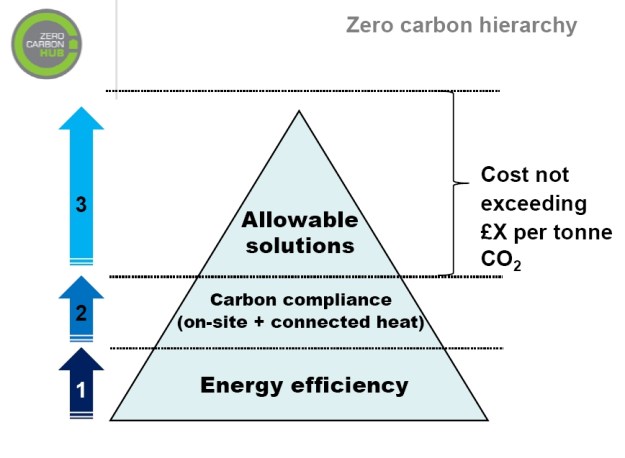
Key to the proposal and principles are three elements expressed in the pyramid:

zero-carbon-hier

There is so much thinking, science , technology and even politics behind this hierarchy that isn’t (imho) expressed in the paper, but was covered in the slides from the session, handed out on USB drive and from here : defining-zero-carbon-homes-presentation2

Some interesting thoughts:

As to the rate of homes being built to CSH 6 (zero carbon) the following profile helps to explain the anticipated progress to 100% post 2016:

of-homes-to-zero-carbon

The aspirational target is a UK version of the German PassivHaus concept.  (as Denise Chevin mentions in Building Its principles are simple – the best way to go low carbon is to build a well-insulated, airtight envelope that is nice to live in. It also comes with a copper-bottomed pedigree, with thousands of completed buildings over its 17-year history.)

Nearly 50% present at event were developers and contractor and saw the on site achieving of standards as most demanding aspect of zero carbon. (Cost and quality) 

Will allowable solutions be just another complex carbon off-setting scheme? Could offsite allowances mean business as usual for designers / developers / builders ?  although 2/3 of those present thought that offsite renewables should n0t be included within carbon compliance.

New build house projects to (could?) decarbonise existing housing stock – this is an exciting new idea but received low interest in terms of potential (votes) from those present 

And as to who should monitor and police zero carbon?  Given three options ( Local Planning Authority/ Building Control Bodies/New form of accredited body) those present opted for c, New form of accredited body.

musing on a carbon 1:5:200

Reading many items and articles on the carbon issues that the built environment faces in the coming years, I have jotted a number of random thoughts in google notebook, which may one day be useful ‘spin’ for example:

…almost every building uses more energy than design calculations …… technology alone is not enough …… design 20%, people 80% … attitudes and behaviour towards energy use need to change …….. it is our responsibility to make sure that the building users understand what they need to do to meet the carbon objectives set at the design stage…… people just change the lightbulbs and appliances as soon as they move in ……. eco bling in buildings is too complex for fm’s so they switch it off and open the window..

And then, describing the 1:5:200 concept to someone today, it clicked, maybe it is the  1:5:200 thinking that joins these snippets together and is a new paradigm required in relation to sustainability and carbon management.

Maybe, if  the impact of construction is set to 1, then could the impact or influence of fm be 5 and the impact of building users 200? (in this thinking the influence of design is 0.1)

(and of course, as with the cost 1:5:200, these are indicative magnitudes to illustrate relationships between construction fm and buildings in use, not absolute figures)

Comments welcome ….