Category Archives: technology

built environment events … coming soon

News of up and coming events which in some way isite / fairsnape are involved or participating in. Information and contact links are included below but please feel free to leave comments or contact here for more information, or indeed for help on accessing the online events

(V indicates the event has virtual or online access elements, saving your travel and environmental footprint.)

Saturday 28th June. V

Open and Orientation day on the Public Works Island in Second Life. Your chance to pop into second life and see what all the fuss is about, get a guided tour around interesting construction activities, view environmental and education projects, talk to second life users and see how second life can help with your collaboration projects and meetings.

Details: Open Day register through the Public Works Group Web site,

July 1/2 V

Sustainability Now, Building‘s online conference organised by ZeroChampion blogger Phil Clark, is to take place from 8am to 8pm on the 1 and 2 July. From your home or office computer, visit this unique FREE online event and have the opportunity to Network with like-minded professionals; Hear from industry thought leaders; Visit the exhibition, and take part in Q&A sessions.

A series of live online seminar topics are planned  including “EPCs – Surviving Them Now and Assessing their Impact” and “The Cost of the Code for Sustainable Homes”.

Details: Sustainability Now virtual conference

July 10th

Best Practice Procurement and Support. A Lancashire Best Practice drop-in event hosted by UCLAN, (University of Central Lancashire)  in Preston. Find out the ‘best practice’ issues your customers are looking for in procurement and seek assistance from the ‘best practice’ support organisations. There will also be a series of mini presentations throughout the day and a chance to network and chat.

Details: Latest event news here

July 16th

Route to Zero improvement module as part of the Elevate Constructing the Future programme.  An early evening event to learn about starting out on a route towards low or zero carbon future for your organisation

Details: Route to Zero . Register through Constructing the Future here

October (date to be fixed but between 10-17) V

be2camp. A planned event to discuss and explore the use of web 2.0 technologies and applications for built environment activities.  The event is being organised on non-conference and bar-camp ideas, which means you can get involved in designing the event, speaking at the event, or providing support and sponsorship. This event is already attracting much interest in the UK, the USA and Australia.

Detailsbe2camp wiki, blogs

October 29th / 30th V

Elevate’s Constructing The Future national sustainability conference.  Details to follow but get the date into your diary now.

Note that it is planned to host a Best Practice Club Question Time Event on the evening of October 29th

Details: background competition contact for more info
Watch this space for more events and updates

interseasonal heat transfer

Pams second post on snow and ice clearance over at Public Works blog, reminded me of two items I had collected into my google notebook for future isite posts.

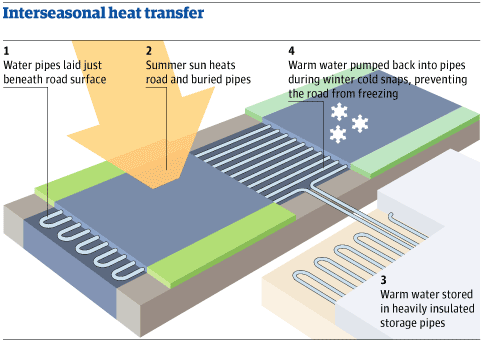
The GuardianReported in the Guardian Friday last Under Road heaters may beat snow and ice , the Highways Agency plans to install pipes underneath a section of road to gather solar energy in summer and recirculate it in winter. Experts hope the scheme could be a way to treat the roads which are the first to freeze.

The scheme, known as interseasonal heat transfer, or IHT, will lay a network of plastic pipes filled with water just below the road surface. In summer, when road temperatures can reach 40C, the water is warmed and pumped to pipes insulated with polystyrene. In winter, when sensors detect the temperature at 2C, warm water is pumped back under the road to heat the ground and prevent ice forming.

Also a Guardian mp3 audio item to download Which discusses the technology and approach to using IHT on UK roads.

Too cool for schools – featuring a pièce de résistance of the building as the construction of the world’s first IHT system underneath the playground. IHT will take heat from the sunshine that falls on the tarmac playground, then stores it and releases it in the winter to heat the school.

Modern online communities are the new co-operatives.

The recent speech by Tom Watson MP, Minister for Transformational Governance, Power of Information,  can be found here and is a fascinating overview and history of information management – well worth a read.

The Grid Works

SLengineer has changed its name to Grid Works with its latest issue to reflect the magazine’s goal of documenting and reporting how companies and people are using online services and tools to support and enhance their work in engineering and science related fields. Available as pdf here

in this issue:

Walking into the Map – David Rumsey shares his extensive map collection with residents of Second Life

TEEX Bridge Tour –  the Texas Engineering Extension brings real life bridge maintenance training to Second Life

Cement Company LSmidth builds a virtual cement plant as an aid for real life recruitment

and how Implenia, Switzerland’s largest construction and building services provider, conceived and developed the virtual worlds communication interface (VWCI)— a tool for monitoring common building automation systems

This is an excellent communication example of how Second Life can be and is relevant to RL businesses, education and general learning / sharing improvements, and pleased that I (and isite) have been co-opted ‘on to the staff’ for future issues of the GridWorks, hopefully bringing an international, well UK view.  Watch this space.

wanted … eco home builder

I have for a while now been exploring Second Life’s contribution to the built environment – on themes of collaboration, education and usability.

One of these ideas is to create a UK Level 6 Eco Home within second life to use as an educational device. A meeting a month or so ago with Pam Broviak (Public Works Director for the City of LaSalle, Illinois) has led to a collaborative project forming an International Eco-Code Park within Second Life. The Public Work island already contains a US Code House, demonstrating how such virtual builds can be used effectively.

Read more over on Pam’s Public Works blog

The island also contains a brilliant bridge tour built by TEEX enabling you to view all risks and hazards of concrete bridge construction. Read a review in the latest, hot of the press, copy of GridWorks

So a plot of land has been cleared, signs put in place, across the street from the US Code House to build a UK level 6 eco home. Perhaps a Dunster (level 7) home or Hanham Hall home? (Location on Public Works)

We are now seeking support from designers and SL builders to help on this exciting project. If you are a SL builder, educator or would like to fund and support this project please do get in touch. (or IM Brand Woodin or Pam Renoir from within Second Life)

When complete, or indeed even in construction, the international eco-code park will enable educational tours and visits from colleges and universities, on site workshops and discussions along with the show casing of real world eco solutions and material. It is even anticipated the homes could be used to give building code assessors more awareness and depth to training – as the existing TEEX bridge and Code house do already.

If you do not have a Second Life – join up through our dedicated Public Work registration site – you will arrive in Second Life at the Public Works Island and meet other built environment professionals there who will assist with any questions.  We look forward to seeing you there.

10 Downing St on Twitter

It took a colleague over in Chicago to point out that Gordon is now twittering – is this for real?  One of my predictions for 2008 was an increase in such technology – I was thinking of the built environment – not main stream politics though.

And his call sign …. 10 Downing Street

a real school for the future – without eco-bling

Education Guardian reports today on the development of Acharacle School on the Ardnamurchan peninsula in Scotland.  The report by Tariq Tahir, should make ‘essential ‘ reading for those involved in school design, construction and in community assets. In addition the school childrens blog ‘they are building outside our class‘ illustrates how construction can be a real educational benefit.  One to RSS and watch develop.

And with no eco-bling, no greenwash, this is sustainable development…

The design, illustrating a sustainable future, for two or three generations is based on the use of mass-timber.  Architect Howard Liddel from Gaia comments … “the modern school does what it says on the tin but what it has on the tin is a skull and crossbones, and these are toxic fumes. Modern buildings have huge amounts of formaldehyde coming out of the floor coverings, seat coverings, the walls run with condensation.”

“What this project is doing is ticking a lot of boxes in a very subtle manner. There’s no covering the building in ‘eco-bling’ – the gimmicks people put on to make buildings green. It’s really quite liberating for an architect.”

He promised that the new building would provide a much healthier working environment for the staff and 50-odd pupils. “We have an immense problem with toxic materials in buildings – we have 55,000 chemicals we use in building and only 3% of them have been tested for their effects on humans.

“The timber is very good at dealing with indoor moisture passively. In other words, you don’t need a ventilation system when you’ve actually got a material that’s dealing with the moisture. Continue reading

efficien-cities

Its clean and its efficient and its possible  – its efficiencity – whilst the government dither on policy Greenpeace have produced an attractive and informative animation to show just what is possible in our towns and cities.  It is a animated and illustrated portal to many of the initiatives and emerging technologies in the built environment

It is statistics such as by the time we use electricity in our homes and offices, we’ve lost nearly 80 per cent of the usable energy inside the fossil fuels we burn that demonstrates the urgency of rethinking our approaches, and as this site demonstrates – this rethinking is happening in real world communities and projects around the UK

Manage best in class innovation – free webcast

Learning from and sharing with other sectors is important to overall improvement. Colleagues at the Benchmarking Institute have highlighted the following Managing Best in Class Innovation web cast scheduled for Jan 24th , hosted through the Automotive News, but the overview is important to all sectors, including the built environment:

Innovation is important for all businesses and especially vital for those in the manufacturing industry. Successful businesses do not just conceive ideas, they empower their people with the right technology and resources to develop, refine and convert those concepts into opportunities. Join Automotive News for a complimentary webinar presented by Microsoft. This discussion will expose how today’s innovators are:

# Leveraging social networking and enterprise search to enhance the innovation process

# Instilling structure and process to minimize the ad-hoc nature of innovation

# Leveraging rich collaboration and communication technologies to connect internal communities as well as external partners and customers

# Empowering people to contribute and discover new ideas

Register at Managing Best in Class Innovation web cast

New coal fired power station gets go ahead

The news that Medway Council have given the green light to a coal fired power station at Kingsnorth in Kent seems at complete odds with the current informed thinking on energy, on coal and on the current ‘mood’ or zeitgeist towards sustainability. It also appears as a developing country decision – not one taken by a nation attempting to be a leader in sustainability and carbon targets.  Building Guardian

The decision can be seen in many ways as a damning comment on the built industry in not moving fast enough to address the energy issue within buildings and facilities.

76 % of the energy from this new power plant will be consumed by buildings. By reducing building energy use of new and renovated buildings by a minimum of 50%, we negate the need for new coal plants. (source)

How can the government and local authorities push forward with zero carbon homes to Code 6, zero carbon schools, zero carbon non-domestic buildings, insist on reductions through Merton Rule approaches, and demand organisations reduce their carbon emissions … when in one action we turn the carbon emissions clock back 30 years ( This will be the first plant to be built in 30 years)

And many of these targets come in to place before the new plant comes on stream.

Perhaps the Kent council and others should read the work from the excellent and influential Architecture 2030, who, in the USA are directly and indirectly influencing cities and states to cancel or shelve coal fire plants in favour of a green build approach .

Emissions from the new plant will blow the UK’s targets and commitments for carbon reductions out of the water.  The notion of cleaned coal is an oxymoron, with environmentalists and scientists diasgreeing over the viability of any capture / claeaning / sequestration technology. It will take years and seems a high gamble to rely on a technology in the future.

In a time when we need positive actions and messages to prevent green fatigue – this will send a dangerous message – that it is ok to invest in traditional planet threatening energy sources whilst playing lip service to renewables and alternatives investment.

A very ominous start to 2008.