Tag Archives: circular economy

The next chapter of construction business?

Construction business has moved a long way from Milton’s ‘the only purpose of business is business’ with many seeking to adopt more of a socially responsible approach, sometimes through choice, more often through client driven procurement requirements. But can businesses rooted in capitalism really morph into something that drives a more responsible sector, one that embraces a collaborative, sharing, responsible economy?

John Friedman @JohnFriedman writing in Huffington Post ‘The Next Chapter of Capitalism‘ thinks so,

In boardrooms and executive suites around the world, business leaders – those people who are truly leading and not just managing their companies – are writing a new chapter of capitalism.

The new chapter seeks to preserve (and expand) the gains in quality of life, longevity, health and well-being and prosperity that are the best results of this economic system while working to ensure that those benefits are universally shared and they do not come at the expense of the Earth’s vast – but finite – natural resources.

The next chapter of capitalism is where the performance of the private sector is in harmony with the progress of society.

The test for the ‘next chapter in capitalism’ will be when social metrics such as CSR, Community Engagement, Sharing, Responsible and Restorative Sustainability, gain a place on the construction board room agenda equal to or over riding the historic cost and profit metrics.

And, as John Friedman questions who will write this next question in capitalism, so we should ask who will write the next chapter in construction business.

EcoBuild launch a vision for a Built Environment future …

Ecobuild, in association with Building has published ‘Future of the Built Environment’ as part of the launch for EcoBuild 2015.  The white paper, a collection of thought pieces from leading industry players, assesses the future of the sector, painting a very useful picture for a not-so-far into the future built environment.

It is set of future scenarios, encompassing beauty, circular economy, health, equity and eco systems. And in this respect closer to the regenerative sustainability philosophy of Living Building Challenge and the Well Building Standard than it is of current, more energy performance focused BREEAM and Regulations.

Jane Henley, Chief Executive Officer, World Green Building Council sees the next chapter for green building as one of health, wellbeing and productivity, arguing that business may be less interested in the mechanical and energy issues of a building than they are on how investing in better indoor environments will lead to better returns on their greatest asset: people

Rick Willmott, Chief Executive, Willmott Dixon sees a contracting future as one of climate adaption, carbon targets and collaborative construction with a leadership that ‘digs deeper’. The circular economy will be key, offering industry tremendous opportunities. Willmott cites the rising energy costs and depletion of finite natural resources that will lead to a mushrooming market for recycled materials, and a move to designing buildings with deconstruction in mind from the outset.

Munish Datta, Head of Plan A & Facilities Management, Marks & Spencer sees the future being about beautiful buildings, “We spend 90% of our time in buildings so why shouldn’t they be beautiful”, delivered from an industry that is holistic,where every role, from developers to facilities management, is incentivised to design, build, operate and re-use buildings for their life.

Paul King, Chief Executive Officer, UK Green Building Council sees that there is a great deal a new government, of whatever hue, can do to create the conditions in which a sustainable built environment industry can thrive. It can save more money than it needs to spend, it can set clear and consistent policy direction, and it can lead by example. “Frankly, to do anything else would be to squander an opportunity for growth the UK simply cannot afford”

Sarah Richardson, Editor, Building, sees the sector on the cusp of a radical transformation, with a growing sense that new technologies are not just an optional extras but key to delivering necessary efficiencies. However, to realise any transformation, a shift in the demographic of the sector itself is required, to attract a broader mix of talent that can imagine a future free from the constraints of the past.

Peter Caplehorn, Deputy CEO, Construction Products Association sees a key challenge for the industry being to get out of buildings the performance we design into them

Ike Ijeh, Architectural Critic, Building and Building Design describes  a future sustainable environment as one which has established a holistic vision for integrated urban development where every aspect of the city is specifically planned and designed to maximise social, economic and environmental benefits for its inhabitants while at the same time minimising its ecological footprint. The city itself no longer relies on an ecosystem, it becomes one.

Recommended reading for all in the sector, the EcoBuild paper can be downloaded from here

Living Building Challenge 3.0 Released

International Living Future Institute refines and upgrades the building certification program to raise the bar even higher for restorative design. 

PORTLAND, Ore. — May 22, 2014 —The International Living Future Institute™ today
released the next iteration of the Living Building Challenge.

Widely considered the built environment’s most rigorous performance standard,
Living Building Challenge, the 3.0 version represents an important step forward in the
program’s evolution, with several new innovative elements as well as important
refinements.

“These changes reflect the many discussions and compelling feedback provided by
Living Building Challenge project teams pursuing certification,” says Amanda
Sturgeon, the International Living Future Institute’s Vice President in charge of the
Living Building Challenge. “We believe the 3.0 version of the program helps advance
our goal to rapidly diminish the gap between current limits and the end-game positive
solutions we seek in the built environment and beyond.”

On initial reading, I am (perhaps not surprisingly) impressed with the more headline improvements, reinforcing that there is more to built environment sustainability than just the building.

  • The Site Petal renamed the Place Petal, reflecting deeply held belief in viewing each project location as a place with unique and important  characteristics.
  • A more clearly defined Equity Petal, which integrates with JUST™. This is encouraging, not only reflecting the current interest in Equity issues as a key component of sustainability, but embedding within the standard.
  • The Car Free Living imperative becomes Human Powered Living, including “Advocacy in the community to facilitate the uptake of human powered transportation”
  • Water and Energy is simplified, for water ‘net zero water’ redefining water as a precious resource’ and for energy ‘net zero energy’. One hundred and five percent of the project’s energy needs must be supplied by on-site renewable energy on a net annual basis, without the use of on-site combustion. Profoundly simple, profoundly challenging.
  • Happiness is added to the Health imperative, this is a great move, taking the sector responsibility beyond just healthy buildings. A built environment salutogenesis – focus on what makes people happy and healthy – rather than the causes of ill health or sick building syndrome.
  • Appropriate Sourcing strengthened to Living Economy Sourcing in respect of location for materials and services.
  • I am not so sure about renaming of Conservation and Reuse as Net Zero Waste.  A strength of the 2.0 imperative was that is was not called Waste, moving the focus upstream to deal with causes of waste.  The strengthening of circular economy, cradle to cradle thinking is to be to welcomed with the requirement to find ways to integrate waste back into either an industrial loop or natural nutrient loop.
  • Imperative 18 is a big focus on the JUST programme, requiring at least one  project team members must have a JUST Label for their organisation. But why is the contractor not one of those required to do so is surprising. It is more likely that the contractor will have the least just practices, thinking for example of diversity within construction organisations and unacceptable labour practices on football stadium in Qatar. An opportunity missed?
  • Another opportunity missed may be in the education imperative. One of the most powerful means of communicating and sharing sustainability lessons and advances is through social media. It’s great that every project should have an educational website, but also real-time sharing through blogs and (eg) twitter could be a very powerful advocacy platform.

More observations and insights to follow, but once again the Living Building Challenge raises the bar, but there is more to come …

In response to the growing need for sustainability solutions that move across industries and scales and better address the social and environmental crises humanity now faces, the International Living Future Institute™ has created the Living Future Challenge ™.

Based on the elegant and profound architecture of the Living Building Challenge, utilising nature as the ultimate end-game metric for success, the Living Future Challenge will extend to all aspects of society as various programs are launched over the next few years: Living Buildings, Living Communities, Living Products, Living Food, Living Enterprises, Living Lifestyles. 

Living Building Challenge 3.0 can be found here.

Further Reading and Blogs

Living Future “unConference” Sets New Model of Shared Resources by @PaladinoandCo

What You Need to Know About the Living Building Challenge 3.0 by @KatieWeeks

Biomimetics and Biophilia – the new sustainable construction?

There is a new language and lexicon emerging within the world of built environment sustainability, from circular economy to biophilia,  indicating a maturing of construction’s approach, moving from better waste management to circular economy thinking, from biodiversity management to biophilia.

I participated in a brilliant tweetchat yesterday evening, under the hashtag of #CityofLife, hosted by Melissa Sterry (http://melissasterry.com) and others with some very knowledgeable contributors from Northern Europe and elsewhere, exploring the concepts of Biomimetics in buildings and cities. There will be a transcript soon and more debates, so watch this #CityofLife space.

It did strike me though, whilst being comfortable with these new terms in sustainability, many readers and subscribers to this blog may not be, so here is a quick primer.

Biomimetics –  learning from nature as models for building design and construction. See Building a Bionic City (Intriguingly George Mokhtar (@GeorgeMokhtar) tweeted  yesterday before the chat “biomimetics, basically the reason I started using 3D models” proving, maybe, a foundation link with BIM?)

Biomimcry, imitation of nature for the purpose of solving complex problems. Perhaps the best source of information can be found at Biomimicry38  and the Janine Benyus  Biomimicry TED talk

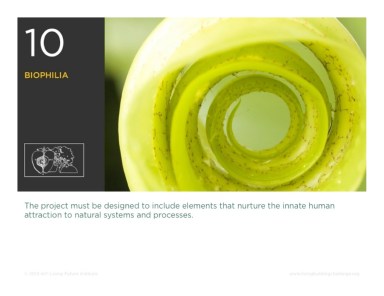
Biophillia, exploring the intrinsic bond between humans and nature, most commonly from a health and well being perspective of building users and occupants.

lbc biophillia

Biophllic thinking is core philosophy for the Living Building Challenge  and suggests the adoption of Richard Kellert’s Six Biophilic Design Elements, (roughly 70 design attributes,  from egg-shaped buildings a historical connection to place)

Suggested reading:

E.O. Wilson, Biophilia 1984 (There is a very useful primer on Ecology, based around E.O Wilson work, within the iBooks (ipad) series from the Open University, with texts, videos and workbooks)

Last Child in the Woods: Richard Louv

Building for Life: Richard Kellert

Case Study Cities: Melissa Sterry, Sustain Magazine

Suggested people to follow on twitter

@melissasterry @thefuturemakers @StefanoSerafi11

@amandasturgeon  @livingbuilding @livingbldgUK

@JanineBenyus @RichLouv @biomimicry_uk @AskNatureTweets

Other Links:

Bios – Flipboard Magazine 

Biophilia in the Real World

Biophilic Design Solutions and Effect

Sustain – my flipboard magazine 

Are you pedalling on Square Wheels?

Have we wasted a good crisis?

In an earlier blog post I used the expression of pedalling squares to illustrate how progress and development in sustainability is often a clunky and inefficient activity.

Within construction we have some great new round wheels available to us that will improve our business, our services to clients and image, for eg BIM, Social Media, Circular Economy and Restorative Sustainability to name a few. These nice new shiny round wheels are necessary in a construction organisations baggage – we need to use them in PQQ, PR and interviews to demonstrate a sense of being tuned into current industry improvement programmes

Many organisations have started to do a wheel change – some encouraged through the never waste a good crisis thinking – seeing the lean times as time for investment in the future, some through Innovation Vouchers or other funded support.

Think about starting 2014 with a more efficient approach by understanding how organisations – often your competitors – are implementing new wheels.  Find out more.

Related:

Sustainability: in equilibrium … or pedalling squares?

A TQM for the social media, digital age?

Do we really need ‘Green BIM’?

My understanding of BIM is that it is another important step on the built environments journey of improvement, integrated approaches and increased collaborative working. I find it rather disappointing then to see concepts of Green BIM or Sustainable BIM emerging.

If we are serious about holistic improvement then we should see sustainability and green issues baked in to BIM – not as a bolt on. BIM changes everything commented John Lorimer in our PPP event and Collaborative Working document earlier in the year. It must also change our thinking on sustainability as a core improvement issue.

BIM could force direction and set the pace on  wider sustainability and circular economy issues – so for example when selecting materials from BIM libraries into a model procurement decisions can be made on:  Transparency of product composition detailing the chemicals and ingredients, the ability to filter red list compliant materials, check the responsible sourcing issues relating to the product/manufacturer (think BES 6001 or JUST)

BIM, as an industry improvement tool, will fail if it permits the design of buildings that incorporate toxic materials (either in production, construction handling or in use) or socially unjust practices in manufacture or construction. Think Qatar World Cup football stadium design and construction.  Although BIM designed we are now, as an afterthought applying a sustainability and responsibility sticking plaster.

PAS1192 Part 3 (BIM in operational phase) is out for consultation at the moment. The proposed standard focuses on hard FM- asset management and not people orientated soft FM. There is the danger we will not address the health issues of occupants within BIM development and particularly through material selection and management. Health only gets one mention in the proposed standard, and associated with Safety – under risk – there because we always use the word health when we use the word safety – without really thinking through the huge consequences. The draft doesn’t mention the word sustainability at all. (Note see The NBS article on the proposed standard here for more detail)

Just this week the USGBC released LEED v4 at GreenBuild 2013 – significant and controversial in that it includes health transparency issues in material and product selection. As this is the direction sustainable and resposnible construction is heading (think Google HQ and the Red List, think Living Building Challenge)  it is only a matter of time before BREEAM addresses the issue.

This blog has been written as background thinking to supporting the Midge Hole UK Living Building Challenge design phase and my BIM Changes everything presentation to the Lancs Best Practice BIM event on 27th Nov, and supporting my Time to Heal the Future thinking.

Untitled

Have we picked the low hanging fruit of Sustainable Construction?

low hanging fruitThe mid 90’s saw my first involvement with sustainable construction, as Business Improvement Manager, setting up strategy and awareness programmes for Mowlem Construction, driven it should be noted to address client bid requirements in PFI and Prime Contracting.

At that time Brundtland’s definition from 1987 was fresh and it made good sense to include it in strategies and as a definition.

In hindsight, one of the problems of this approach is that it reinforced the thinking of that time, that environmental management, and by default sustainable construction belonged firmly and squarely within the Health and Safety departments.  A misconception that many organisations still subscribe to, or struggle to move away from.

But, since then, sustainability thinking has moved on from environmental management as H&S add on, to a wider view of sustainability that includes social and business responsibility, ethical procurement and localism and is now heading for a challenging future greener and deeper agenda

It is encouraging to note the move away from what I have referred to as ‘accommodationalist‘ thinking – ie doing only what we are required to do by law, no more no less. In fact this  thinking is now being challenged by the Governments red tape initiative, proposing to remove certain sustainability related legislation

Over the last 7 years I have been supporting organisations map out and chart progress on their ‘Route to Zero‘, identifying actions necessary today, tomorrow and most likely into the future. We may be in the position of being able to say we have picked off the low hanging fruit from the sustainability tree.

Most construction companies now have a sustainability policy and project approaches that are ISO 14001 accredited, to deal with better management of waste,  recording transport construction miles, employing locally and so on.

But now the real work begins, reaching higher into the greener, more dense canopies of the tree, with a new, emerging set of challenging actions that will take us closer to our zero impact ambitions.

Amongst these new challenges we can see:

  • Collaborative and circular economy thinking. For example what if every building improved with age, improved in its function, its resilience, its performance.  Became more ‘durable‘?  Contracts would not only need to cover the design and construction of buildings, but a new form of collaboration between provider and user that included continuous improvement criteria.  Such Circular Economy thinking would force new collaborations across the supply chain, across discipline and with clients.
  • Convergence of data, information rich ICT environments, an Internet of Things linked to metering sensors that will provide real time feedback on performance of the buildings and of the construction process, driving improved and sustainable resource utilisation. Getting us closer to zero waste and  zero carbon emissions.
  • Responsible specification and procurement, that is not only local but considers ethical and most importantly the health impact of building product ingredients. (see the Healthy Product Declaration Standard)
  • Challenging standards, that bring new deep green philosophies and certifications for buildings and facilities, as we see with the Living Building Challenge
  • The inclusion of costing nature within construction projects. ‘Cheap’ buildings may only be cheap because the real social, environmental costs have been externalised for someone else, often society and the public purse to deal with. Time to bring those externalised costs back into the project costs?
  • A mindful built environment sector, or one that has mindfulness, ie ‘in the moment’ awareness of the impact the design, the construction, the maintenance, use and deconstruction of the building will have upon the environment and nature. Mindfulness is a huge and complex topic but an important sustainability concept we will hear far much more of in 2013.

The first Green Vision tweetchat for 2013 will explore some of these issues on the 28th January at 8pm using the hashtag #GVisChat, asking the question are we getting closer to ‘Zero’?

If you would like to know more on how the Fairsnape Route to Zero mapping and charting programme can help your business, please do make contact

Update – Presentation on this theme 

The world may not be ending today, but does the construction industry continue to waste as though there is no tomorrow?

OLYMPUS DIGITAL CAMERAOK, not all construction and indeed we have many exemplar, near-zero-waste construction projects , yet the industry continues to be wasteful, locked into a Take, Make, Waste attitude that contributes 40% of all waste.


The last few weeks of Green Vision activity have highlighted the emerging circular economy, cradle to cradle, living building, healthy product philosophies that will move us away from our cornucopian approach.

The push for 2013 must be to ‘rethink the way we make things’ and aim for more near-zero- waste projects. (near-zero-waste as meaning waste generated on a project, not the percentage of waste diverted from landfill)

Related posts:

Cradle to Cradle Tweetchat Storify

3 R’s for rethinking built environment sustainability

Is Our Green Build Compass Broken?

3 R’s for rethinking built environment sustainability

OLYMPUS DIGITAL CAMERA

Its over ten years since rethinking construction became the driving force for improving the construction industry. Back then, in 1998, sustainability wasn’t on the agenda for many construction organisations, and didnt feature in Egans influential report.

Now at the close of 2012, it is of course one of the key challenges for construction.

But is it now just a ‘must do, tick box’ matter, rather than a real agenda for improving, reducing costs and reducing our impact?

Earth2.0 Hub in an excellent blog post ( The Future of Business – inspired by and in harmony with nature.) provides a framework and the language of 3 R’s for future businesses working in harmony with the earth .  And its a framework we should learn from, borrow, adopt or adapt  at project and business level in rethinking built environment sustainability; Re-Design, Re-Connect and Re-Kindle.

Re-Design. Not only design of buildings, but to re-design the way we build. No longer are transactional efforts (reducing waste, conserving energy and recycling) enough.

How?: Take a look at Cradle to Cradle thinking, Circular Economy, Designing out toxic materialsDesigning out Landfill

Re-Connect. Time to rethink our relationship with nature. However just including nature as a natural capital to be costed is not meaningful approach. We need a relationship that is deeper, that is deep green thinking.

How?: take a look at Living Building Challenge – what if every building, like a flower, contributed to its environment. Or the One Planet Living ten principles

Re-Kindle. Time to rekindle the sustainability debate – moving away from the negative, harassment to doing less bad, to encouraging a move towards a positive new world of doing more good,  better. Resilience.

How?: Learning and benchmarking from other industries and sectors, for example Patagonia, or closer to the built environment, Interface Flooring

This blog, since 2005, has had as a tagline built environment improvement and its connectivity to the natural world . Since then, it has been a core philosophy within fairsnape.

cropped-pc210049flip.jpg

Since 2005 we have organised and facilitated benchmarkwalks, discussing sustainability issues , across and within sectors, whilst walking in the natural environment. Rather than in the conference of training room. You would be amazed how diffierent, how green, sustainability discussions when conducted in the great outdoors. Try it !

Cradle to Cradle, Circular Economy, Healthy Products Standard, Designing Out Landfill , Interface UK, and the UK Living Building Challenge all featured in our #GVis2012. Green Vision Conference in Leeds on the 12 Dec 2012.

>>> See Green Vision event material, links, blogs and more here  <<<<

<<< Read the Cradle to Cradle tweetchat transcript here <<<

The Living Building Challenge UK Collaborative will be ‘launched’ at this event on the 12th.

And, Cradle to Cradle is the book-topic for our Dec #GVisChat tweetchat on Dec 10th at 8pm.

Built to Last – Designing Out Landfill

There has been an increase in circular economy thinking and the built environment recently, and no doubt we will see much more in the coming weeks and months.  It forms a core element behind the Green Vision half day conference in Leeds on the 12th Dec.

Whilst researching back ground information on “Designing Out Landfill” for a client I was struck by these useful paragraphs from Sophie Thomas  co-director of design at the RSA and published in a Guardian Sustainable Business article in September 2012

Built to last

Design sits at the heart of the challenge to create a circular economy. Approximately 80% of a product’s environmental impact is “locked in” at the design stage, so understanding production cycles and reconfiguring them for maximum effectiveness is key. We cannot simply substitute one material for another without understanding the consequences.

Designing in this way is complex. Gone are the days of “sustainable” or “eco” design, when a simple change of material to a recycled alternative would give a project environmental credibility. This system calls for investigation into materials at a molecular scale. It demands true co-creation, with all stakeholders involved in the lifecycle of a particular product. Finally, it requires a new logistical approach to capturing and recirculating materials.

This effort needs to be led by businesses. At the moment, it is rare to see a company setting a design brief that includes requirements to recover material. Now, however, the business model is changing and the economic imperative for recovery is growing stronger.

So…

How well is design, construction and facilities management prepared for such ‘deep green’ thinking to waste elimination?