Tag Archives: construction

Quartz: healthy product datasets for BIM?

When we know what our buildings are made of, we can make informed choices by selecting materials that are healthier for occupants and have a lesser impact on our environment*

This blog regularly covers the intersection between sustainable, healthy products (for example the Living Building Challenge Red List) and BIM. Indeed the selection of materials and products based on biological health, as well as environmental impact and functional performance within ‘sustainable construction’ should be a no brainer.

We are not so good at using data in construction, and although this is improving as BIM becomes more established, there remains a gap in useful product health data sheets that carry material or product ingredients. Projects that use a rigorous material schedule such as the ILFI Red List often find themselves unpacking designs and material specification in order to understand product recipes and seek safe alternatives.

The Quartz Common Products Database, a collaborative initiative from Flux, HBN, thinkstep and Google was launched at VERGE 2015 at the end of October.  Quartz is an open database of composition, health hazard and environmental impact data for building products. It looks a promising contribution to a greater understanding of material health impacts and, being open source, paves the way for inclusion and alignment with BIM’s and the Product Data Sheets currently being compiled by CIBSE, NBS and others.

“Quartz aims to bridge the gaps between information, knowledge, and action, leading to less toxic, lower-impact building materials”

The Quartz database (www.quartzproject.org) will provide a collection of product profiles for commonly used building materials. Specifically:
● Quartz is a free and open dataset, integrating both LCA and health-hazard data into a single information source using widely accepted and consistent methodologies, such as Pharos Project/GreenScreen hazard screening, TRACI 2.1, and ISO14044.
● Data is vendor-neutral and covers 100 building products across a range of categories, such as concrete, drywall and insulation. Products are compared by composition, health impacts, and environmental impacts.
● Data is licensed under Creative Commons BY 4.0, meaning there is no restriction on the use, redistribution, or modification of the data. This openness will enable the AEC community and the general public to become more educated about the potential
impacts of materials in buildings and communities, and to put this data to creative and productive use.
● Through consistent language and metrics, stakeholders will be empowered to have productive dialogue with building products manufacturers, driving the industry towards increased sustainability  (From Quartz Press Release)

Health profile

Quartz Health Profile for polyvinyl chloride membrane, prohibited by ILFI Living Building Challenge Red List but in common use in construction.

Here in the UK this could be seen as timely launch, with the Considerate Constructors Scheme promoting a Construction Occupational cancer awareness campaign on sites. A welcomed campaign and one that should start with product specification using data such as Quartz to remove such toxic materials from construction.

“Sites need to proactively eliminate harmful substances, when this isn’t achievable working methods and equipment must be substituted for safer alternatives (CCS)”

By focusing only on construction site, we are not learning from the past, and it is the same thinking as we were a few decades ago when the focus was on ‘safe’ handling of asbestos.

In todays climate of CSR, (Corporate Social Responsibility), where Do No Harm is a common-place construction value, specifying, procuring and installing products that cause ill health in production, in installation and in use should be deemed as socially irresponsible.

Note – a very useful guide to Nine Green Product databased for Architects, Specifiers and Consumers was published to Architect Magazine on Nov 10th 

In 2015 we should have a much more mature approach to health – not to be content with one that seeks only to reduce impact on health but an approach that seeks to improve health, through biophilic material inclusion and a salutogenic approach.

*from http://quartzproject.org/

Integrating environmental management with business strategy. ISO14001:2015 published: Key revisions outlined.

At last, the long awaited next edition of ISO 14001:2015, integrating environmental management with business strategy has been published and available here

ISO-14001-–-5-ways-the-revised-ISO-14001-is-even-better-ENNEW IN ISO 14001 (updated from my blog post 13 July 2015)

ISO 14001:2015 adopts the High Level Structure which is now the required framework for all new and revised management system standards. (We will see the same structure in the new ISO 9001 and other ISO’s )

Strategic environmental management

There is a new requirement to comprehend the context of the organisation determining external and internal issues pertinent to the organisation and the environment, with actions to address them within the Environmental Management System (EMS).

14001 now embeds environmental and sustainability thinking into the high level strategy, vision and policy planning aspects of an organisation and project

Leadership

A new clause has been added with particular responsibilities for top management to express their leadership and commitment to environmental management. Top management may assign this responsibility to others but retain accountability.

14001 calls for increased accountability for the leadership (CSE, MD) of an organisation or project to ensure ongoing commitment and engagement  with environment and sustainability activities in the organisation.

Protecting the environment

Environmental policy shall incorporate a commitment to the ‘protection of the environment’. There is no definition about ‘protection’ that includes ‘prevention of pollution’ and ‘other’ commitments, such as sustainable resource use, climate change mitigation and adaptation, protection of biodiversity and ecosystems, etc.

The 14001 change from protection to prevention is significant, requiring a proactive approach and can be seen to move closer to a restorative thinking towards the environment

Environmental performance

There is a shift in emphasis with regard to continual improvement, from improving the management system to improving environmental performance. The key focus is on improving performance related to the management of environmental aspects. The organisation shall decide on criteria to evaluate its environmental performance, using correct indicators.

Again a significant and proactive change: from monitoring to improving performance

Lifecycle thinking

Organisations will need to extend its control and influence to the environmental impacts from raw material acquisition/generation to end-of-life treatment. This does not imply a requirement to do a life cycle assessment (LCA), just thinking carefully about the stages of product/service that can be controlled or influenced.

There will be much debate on this 14001 change, but indicates a proactive approach to design and specification that takes into account material and building(?) environmental impact through to end of life, encouraging more design for re-use, deconstruction plans and circular economy thinking

Outsourced processes

Organisations need to control or influence outsourced processes.

Will, at last bring contracted-out elements of a project fully into ISO 14001 environmental management, and will undoubtedly see an increase, and reinforcing of 14001 as a contract and subcontract requirement.

Communication

Emphasis on internal and external communication, and equal treatment of both has been added. The decision to communicate externally is retained by the organisation whilst taking into account its compliance obligations.

Welcomed 14001 improvement for the digital and social media age of communications and transparency

Documentation

The term ‘documented information’, is used instead of ‘documents’ and ‘records’. The organisation has the flexibility to conclude when ‘procedures’ are required. Any format (paper, cloud, etc.) would be valid.

Again a welcomed improvement in the digital and social media age of documentation and data management

ISO 14001:2004 TRANSITION

Organisations that are already certified to ISO 14001:2004 will have three years from formal publication of ISO 14001:2015 in which to transfer to the new version of this standard. Based on the current publication schedule, this transition period would end in September 2018.

Working in collaboration with a number of organisation on EMS and 14001 improvement, we have commenced future proofing systems and environmental approaches to address ISO 14001:2015 and in doing so improve integration between sustainability approaches, organisation strategy and governance. Get in touch to find out how this could help your environment management take the next step forward.

Whats new?

14001 Support

Modern Slavery Bill: transforming construction CSR and supply chain management.

No responsible organisation in construction would want any association with modern day construction slavery, forced employment, child or migrant exploitation as we read increasingly often in the mainstream news, for example Qatar construction or closer to home with construction gangmaster organisations. Hence the Modern Slavery Bill should be welcomed by the built environment sector.

Included within the Modern Slavery Bill introduced on 31 August 2015 (coming into affect on 31 October 2015) is a clause that has significance for most construction organisations – the Transparency in Supply Chains (TISC) clause.

We have introduced a transparency in supply chains clause to the Modern Slavery Bill. This will require businesses above a certain size threshold to disclose each year what they have done to ensure that there is no modern slavery in their supply chains and own business. This will be a truly world-leading measure. There are similar transparency requirements in California, but they only apply to businesses producing goods for sale, whereas this disclosure will apply regardless of what it supplies, whether goods or services.
Minister for Modern Slavery and Organised Crime, Karen Bradley

What does the Bill and Transparency Clause mean for construction:

Chris Blythe, CE CIOB in Foreword to the CIOB Dark Side of Construction publication: The dark side – the systematic exploitation of millions of vulnerable migrants – is rarely acknowledged, even by the clients and multinationals that commission and create our shiny new cities. Our sector is rife with human rights abuses. Bonded labour, delayed wages, abysmal working and living conditions, withholding of passports and limitations of movement are all forms of modern slavery.

The scope of the TISC clause will cover construction products companies importing goods or components to the UK, as well as contractors and consultancies operating in the home markets and/or overseas.

The Modern Slavery Bill (with its Transparency in Supply Chains clause) will transform and elevate construction CSR and Supply Chain Management as important legislative responsibility processes.

Organisations with a turnover of £36 million will have to:

  • publish a “slavery and human trafficking statement” setting out the steps it has taken to ensure that slavery and human trafficking is not taking place in its supply chains and within its own business.
  • From October 2016, to publicly share their policies and strategies to tackle modern slavery in their supply chains.

Guidance on what might be included in such a statement:

  • Companies’ due diligence processes relating to slavery and human trafficking in their supply chains;
  • Reporting on the parts of companies’ supply chains where there is a risk of slavery and trafficking taking place, and how to assess and manage such a risk;
  • Reporting on staff training on slavery and human trafficking;
  • Reporting on companies’ effectiveness in ensuring that slavery and trafficking are not taking place in their businesses or supply chains.

“Implications of non-compliance with this reporting obligation in such a morally compelling context could leave a large dent in an otherwise sterling company reputation” Victoria Ball, projects & construction associate at law firm Trowers & Hamlins

“It will involve a deep dive into the supply chain to understand what’s really going on many tiers down – getting visibility of the many layers to truly see the conditions of workers at the bottom of the chain. The message to companies is clear – it is no longer an option to stay below the radar, refuse to take responsibility for problems in your supply chain and hope you won’t get exposed.”Cindy Berman, head of knowledge & learning ETI

What is not so clear is where the responsibility under the Bill rests for SME’s below the threshold that have organisations above the threshold within their supply chains. Most construction organisations procuring goods and services from large product distributors or manufacturers.

Actions construction and built environment organisations should take?

  • Embed Modern Slavery into CSR policies and statements, where, arguably there should be a statement anyway if base on a recognised CSR structures(eg ISO 26001, Global Reporting Initiative (GRI), JUST, Global Compact or the Human Rights Charter)
  • Understand the concept of Transparency in Supply Chains (TISC)
  • Include questions statements in supplier procurement processes. (And probably best to do so for all suppliers who are close to or over the threshold)
  • Develop a PQQ and Project Bid standard text.
  • Understand what an annual“slavery and human trafficking statement” for your organisation could look like

And of course, these good practices should be adopted even if below the £36million turnover threshold as a matter of social responsible construction.

Sources:

Related iSite blogs:

JUST: a social justice label for construction …

Constructing CSR iTransparency 

Understanding CSR in Construction

The Brightest Greenest Buildings Europe 2015

Untitled2

Brightest! Greenest! Buildings EUROPE Opens 10th June 2015 at 10am CET

The free-to-attend carbon neutral virtual exhibition dedicated to Europe’s most successful and greenest building projects and green building solutions opens on June 10th. 

Following on from the success of last years ExpoC21, (Sustainability Made Cool – my blog review here) the format for this year, under the title of Brightest! Greenest! Buildings, is very different.

UntitledThe Expo will run over a number of months with an evolving focus and a great Schedule of Events.

The launch of Brightest! Greenest! Buildings EUROPE 2015 on 10 June 2015  includes presentations by Delta Development Group, C.F. Møller, The Carbon Trust, MIPIM’s Innovation Forum, OVG Real Estate, Europe’s Green Building Councils, BUILD UPON: Co-Creating Europe’s National Renovation Strategies, launch of baseEUcities, and many more!

Brightest! Greenest! Buildings EUROPE 2015, as a virtual exhibition has been designed and organised an international team to promote the greenest building projects and associated solutions in Europe. Our exhibition and conference will reach 50+ countries in the European market in a very efficient manner. Last year, we had the participation of over 1500 of the greenest and most successful real estate investors, project developers, designers, green building consultants and rating tool assessors and other services as well as and technologies, products, and materials providers.

Organized under the patronage of the European Commission, Brightest! Greenest! Buildings EUROPE 2015 is very low cost for exhibitors, free for attendees, eliminates travel time and the associated carbon emissions, and benefits from the support Green Building Councils across Europe as well as other expert organisations. From our current partnerships and future efforts, we believe we will easily reach our target of 10000 high quality attendees and strong media coverage during the 12 month exhibition period.

Our introduction brochure and website – www.BrightestGreenestBuildings.eu – provides all the information about the event, the great organizing team, and the promotional plan and highlights from last year’s event. Booth features are described in the “Why Exhibit” section. Exhibitors can also configure their virtual booths in just a couple of hours using their existing promotional material.

We invite you to take a demonstration tour with our team of the virtual trade fair platform to see first hand how this works. Tours are scheduled at 3:30pm (Central European Time) on Tuesdays and Wednesdays and at 10:30am on Fridays. Please note, the deadline to register to exhibit for the 10 June launch event is 29 May 2015.

UK_collaborative_logoAs in 2014, the UK Living Building Challenge Collaborative will have a presence at Brightest! Greenest! Buildings EUROPE 2015, join us on the 10th June and throughout the exhibition!

Related: Why EXPOC21 is a vital event for the built environment

Ecological Handprints: Construction materials that do more good not just less harm

One of the more interesting and potentially industry game changing announcements coming out from the ILFI 2015 conference in Seattle last week was the launch of The Living Product Challenge (LPC).

Initially introduced at the LF 2014 conference with more detail released this year along with more on the concept of the “Ecological Handprint” (not a new concept, but one that is set to gain more parlance now adopted by the ILFI)

The LPC challenges manufacturing organisations to make products with a positive “handprint” i.e. encouraging products that are net-positive and transparent throughout the entire life cycle. (Ecological Handprints will measure the positive impact that a product causes across its life cycle, such as harvesting more water and generating more energy than was required to make the product)

There could be reservations with a requirement for LPC accredited organisations to hold  other ILFI standards such as Just and Declare, seeming a little incestuous perhaps. However sticking to the LBC approach of philosophy first, advocacy second and accreditation third, lets focus on the philosophy and advocacy to improve the sector, and address certification issues later. Living Product Challenge is looking to operate in an increasingly crowded healthy material transparency and green directory arena, yet the absolute-ness of the criteria, (you do or you don’t) will undoubtedly differentiate.

Buildings that consists solely of products and technologies that themselves do more good than harm, across environmental, social and economic spectrums, in manufacture, construction and in use is a very powerful statement for a regenerative future.

And its an approach of course that responsible organisations within the built environment should be adopting. And here are a whole new set of questions to ask; before designers specify materials; when contractors procure products and as facilities management upgrade/replace products.

The philsophy:

Re-imagine the design and construction of products to function as elegantly and efficiently as anything found in the natural world.

Products are informed by biomimicry and biophilia; manufactured by processes powered only by renewable energy and within the water balance of the places they are made.

Products improve our quality of life and bring joy through their beauty and functionality.

Imagine a Living Product whose very existence builds soil; creates habitat; nourishes the human spirit; and provides inspiration for personal, political and economic change.

Like the Living Building Challenge (LBC), the LPC consists of 20 specific “Imperatives” under seven “Petal” categories. All 20 requirements are needed for full LPC certification, or Imperative and Petal certification options . Many of the imperatives will be familiar to those already au fait with the Living Building Challenge, with a few new additions and definations, for example:

Positive Handprint: The manufacturer must demonstrate that the product gives more than it takes over its entire life cycle,

Net-Positive Waste: Water use and release from manufacturing the product must work in harmony with the natural water flows of the site and its surroundings.

Net Positive Material Health: The product must be safe for human exposure during manufacturing, use and end-of-use.

Human Thriving: The product must contribute to an active, healthy lifestyle and be designed to nurture the innate human/nature connection.

Product Fit to Use: Durability, warranty, and useful lifespan must have a direct relationship to environmental impact and embodied energy.

Equitable Product Access: Products sold to consumers must be affordable to the people who manufacture them, and products used in buildings must not unduly impair the affordability of those buildings.

The Living Product Challenge ‘brochure’ pdf can be downloaded from here. The UK LBC Collaborative will be getting to grips with the LPC over the coming weeks, with a view to providing more information and introduction sessions later in the year.

Sources #LF15 Tweets,  https://living-future.org

Twitter for Sustainable Business

17062008118“I didn’t know twitter could be used for business, I thought it was just for complaining and moaning on poor service” A comment from a recent chat on a construction site illustrates the level of understanding of twitter and social media within the sector.

OK, it is maybe more daunting to start using twitter today than it was four or so years ago when I wrote in the Guardian “Why Construction Should Engage with Social Media”, but the reasons and rationale for doing so remain the same, but now perhaps with more urgency.

I am often asked where to find the best source for up to date information and thinking on sustainability in the built environment, in design, in construction and in facilities management . My response is the same as in 2011, i.e. “There is probably no better, and certainly no more accessible, tool for keeping abreast with sustainability thinking, development, papers, case studies and failures than twitter”

We were reminded by Martha Lane Fox, in her Dimbleby Lecture this week of Aaron Swartz’s comment “It is not OK not to understand the internet anymore” and too right, its akin to not understanding or wanting to engage with email or the telephone or the radio or …

So just where would we start today? 

I liken twitter and social media to the radio, it’s live, it’s full of great comments and content, but also non stop and full of unwanted content or ‘noise’. Therefore one of the modern skills we have developed is filtering out noise from that we are really interested in – we use programme schedules, our beloved wireless sets to tune in and occasionally use the off switch. In twitter we can do this through lists, through hashtags and with suitable applications (think apps such as tweetdeck as your digital wireless) Not only is this now an essential life and business skill, for directors, managers and others in the built environment, its sadly not one included in the sector’s education and training.

There are great social media training courses out there – but many are the equivalent of the Letter Writing Courses that many us would have attended pre-email days. Informative and entertaining with many wow tips, but the content was soon eclipsed and rarely applied, which is why I continue to recommend and deliver one to one coaching over time.

Following hashtags such as #GreenBIM, #UKBIMCrew #CSRchat #sustldrconv will bring up to date thinking, links and help direct to your twitter stream. Start building your lists for great content and insight, check out the top 500 lists curated by Jim McClelland, for example: Built Environment SustainabilityGreen Infrastructure or BIMAnd keep your twitter ear open for curated lists: for example: 30 CSR Pro’s to follow in 2015 or the EcoBuild 2015 Influencers list

“Resistance to twitter is futile” as my colleague Andrea Learned wrote in her Linkedin article recently. You will start using it sometime soon, your competitors are most likely using it today, your staff are, and the most informed on built environment sustainability issues certainly are.

Not knowing the construction industry carbon footprint is not acceptable.

Minimising and reducing carbon in construction has been a central plank of industry sustainability strategies for a good many years. It is therefore embarrassing for the industry, as Construction Manager reports, that we don’t still don’t have an industry handle on or indeed understand construction carbon figures.

An earlier Sustainability Strategy for Construction set a 2012 target of 15% reduction from the 2008 figure of 48T of CO2 / £million spend which should give us about 42 T / £m at 2012 with targets for further reductions by 2020 and 2050 in line with UK reduction targets.

Although … Peter Hansford “The strategy is to achieve a 50% cut in construction sector emissions from 1990 levels by 2025, and the GCB (Green Construction Board) is tasked with making it happen”

Indications are that, dispute a focus on sustainability, with just about every organisation in construction self-claiming to be sustainable,  construction emissions actually rose by 13% over the period 2008 – 2012.

As a major emitter of CO2, (when adding in transport and travel) the construction has a socially responsibility to address and reduce.

The fact that as an industry we don’t really know is down right unacceptable.

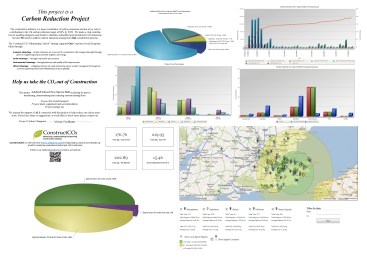
Our ConstructCO2 tool shows an average of 97.5kg / £k based on all construction types. As we gain more data (currently 300 projects) we can break this down into more meaningful targets, but since the first project on ConstructCO2 our benchmark has not fallen below 90kg/£K. (As an industry we should be below 40kg/£K)

When we founded ConstructCO2, we set out to keep it simple to record and used the strap line of Monitor, Understand and then Reduce.  Having monitored for a number of years we now understand the causes of construction carbon

Ashford School CCO2 A2 Poster

and can take steps to reduce through proactive planning.

Reducing Construction Carbon - Infographic


Why then, as industry we do not understand or monitor Construction CO2?

  • Cash in King, Carbon is Queen was a rallying call from Construction Advisor Paul Morrell – but very few rallied.
  • BREEAM hasn’t followed through – with just the requirement to record travel, transport and energy use, but not to reduce, monitor over time or collate. As an industry we have a mass of disparate spreadsheets across the country containing probably all the data we need.
  • Recording data at site level is deemed too time consuming, put into the too busy to do box by contractors, excepting of course the enlighten contractors using ConstructCO2 who see the benefits of doing so – or their clients are telling them to do so.
  • In the main, clients are not requiring projects to record and act on carbon emissions as a project key performance indicators.
  • Reducing carbon at site entails a collaborative approach from all on construction method, specification, procurement, planning, sub contractor management and so on. We simply don’t collaborate on reducing CO2.

Benefits of Monitoring CO2 (as reported by ConstructCO2 users)

  • Every kg of CO2 reduced equates to x£ not spent
  • Reducing CO2 from material and waste transport improves the local spend
  • Reducing mileage CO2 from personnel travel reduces driving time stress on operative & managers, improves productivity and time on site. Car sharing also reduces the fuel cost of operatives and managers.
  • Understanding the carbon issues enables more informed procurement, selection and logistics management

As Shaun McCarthy, Director of the Sustainability Supply Chain School said on twitter, its not Rocket Science,

Indications are that the GCB and WRAP UK will take up the mantle of managing data on construction carbons. Lets hope they talk to ConstructCO2, understand our lessons learnt and keep it simple but effective.

The next chapter of construction business?

Construction business has moved a long way from Milton’s ‘the only purpose of business is business’ with many seeking to adopt more of a socially responsible approach, sometimes through choice, more often through client driven procurement requirements. But can businesses rooted in capitalism really morph into something that drives a more responsible sector, one that embraces a collaborative, sharing, responsible economy?

John Friedman @JohnFriedman writing in Huffington Post ‘The Next Chapter of Capitalism‘ thinks so,

In boardrooms and executive suites around the world, business leaders – those people who are truly leading and not just managing their companies – are writing a new chapter of capitalism.

The new chapter seeks to preserve (and expand) the gains in quality of life, longevity, health and well-being and prosperity that are the best results of this economic system while working to ensure that those benefits are universally shared and they do not come at the expense of the Earth’s vast – but finite – natural resources.

The next chapter of capitalism is where the performance of the private sector is in harmony with the progress of society.

The test for the ‘next chapter in capitalism’ will be when social metrics such as CSR, Community Engagement, Sharing, Responsible and Restorative Sustainability, gain a place on the construction board room agenda equal to or over riding the historic cost and profit metrics.

And, as John Friedman questions who will write this next question in capitalism, so we should ask who will write the next chapter in construction business.

Lean BIM: Six reasons why construction needs to embrace BIM alongside Lean Thinking

Combining Lean Construction thinking (in the shape of Last Planner approaches) and BIM (Building Information Management) on construction projects can enable big reductions on time, cost, waste and stress, and in doing so improve profits, capability, staff wellbeing and reputation.

My recent ‘Lean BIM’ lecture at Leeds Beckett, explored and discussed with case studies, how achieving the 30% construction strategy cost saving target is within reach.

Lean thinking and last planner approaches should be seen as collaborative working preparation for BIM. Both share similar aims – ‘producing  the right product at the right time in the right quantity for the customer and to produce exactly what you need and nothing more’.

Here are 6 of the many compelling reasons for adopting ‘Lean BIM’ …

  1. BIM in conjunction with lean construction (ie Last Planner approaches) can get construction activity closer to the Honda expression of “everything we do … goes into everything we do” (Currently only 40-60% of what we do in construction goes into what we do, ie what we get paid for or hand over to our customers).
  2. BIM, like lean construction thinking forces us to focus on the end game first, understanding client value and pulling that value through design and construction.
  3. BIM, like Last Planner will reduce firefighting and stress on project management team.
  4. BIM will drive lean and predictable programming and material sequencing.
  5. BIM will streamline the supply value stream for materials, enabling just in time supply, adding value and reducing unnecessary costs.
  6. BIM will greatly assist in improving information flow and communications, between project partners and supply chain. Techniques such as the TQM / Toyota ‘5 whys‘ repeatedly shows communication as the root cause of many if not all costly problem

However,  embracing  both BIM and Lean has a number of essential pre-requisites, for example

  1. BIM and Lean construction both need construction leadership at organisation and at project level.
  2. Contractor core processes (eg design and construction) need to be shaped around Lean Thinking and BIM requirements.
  3. BIM Is a people collaboration mindset. Even on BIM projects, approaches such as last planner are essential to ensure people (the last planner) involvement in project short-term planning and improvement, and
  4. Early contractor and supply chain involvement with strong collaborative culture must be in place.

“The construction aspects of projects is the easy bit – “a doddle”  … The harder, more complex bit is the collaborative working ‘glue’ that surrounds the design, build and operation of the facility, whether BIM is used or not” John Lorimer (In PPP Publication)

Sustainability through Diversity

On the 14th october I presented the above pecha kucha to Be2Camp Be2campOxon event on Ada Lovelace Day, taking the perspective of a young Ada, looking to a career in construction, in sustainability, in IT, in BIM, and the challenges she may face. Not only a glass ceiling but perhaps a triple glazed ceiling.

Initial thinking was triggered by the excellent Nilofer Merchant article in TIME You Are the Industry. You Must Be the Change, pointing out to Satya Nadella, Microsoft that it is not good enough to call for change in the (IT) sector – but that those in power, like Satya Nadella, should affect change.

And so it is in the built environment, particularly construction, where it is no longer acceptable for industry leaders, industry groups and strategy authors to record the fact we have a gender and diversity problem – but time to do something about it and affect change.