Tag Archives: FutuREstorative

BioClimatic Design: Book Review

Sustainability and eco design are now common place in todays built environment, yet how appropriate is our level of understanding and relationship with natural and bioclimatic conditions necessary to address climate change?

9780691169736-us-300Design for Climate, Bioclimatic Approach to Architecture Regionalism by Victor Olgyay originally published in 1962/3 has been recently updated with new essays and insights on climate change and design.

Today, even though we may have far greater understanding of climatology and potential solutions, we still strive to understand how built environment design will influence the drive to cap global warming to 1.5 deg c. The core teachings and messages in Design for Climate remain just as relevant, and indeed perhaps far more so.

The original book is populated with wonderful pen-drawn climatic and bioclimatic charts and illustrations that pull the reader in to discover more. Sadly, much of the data, charts and methodologies included within the book would now be included within BIM environmental modules, even on smart phones, based on algorithms, and possibly applied without in-depth knowledge of for example sun path diagrams and insolation affects.

I say sadly, as we have perhaps lost that connection and innate understanding of the natural climatic conditions pertaining to the individual places in which we build.

Considering that the original edition would have been conceived, researched and produced without the use of computers and the internet, the meteorology, climatology and biological data incorporated into Design for Climate are outstanding.

There are a number of areas in the book, both within the original text and in the new prefaces that resonate with where I am in my sustainability research, practice and thinking for FutuREstorative.

For example there is a resonance with the Living Building Challenge philosophy, and of the flower metaphor for buildings rooted in place, harvesting all energy and water whilst being adapted to climate and site. Words which would not have been out of place within Olgyays text and charts.

Within the new preface, Victor W Olgyay describes how the very local bioclimatic conditions at Limone, Lake Garda, have given rise to very specific architecture, something that Living Building Challenge students on the annual Regeneration design competition, held nearby in Dro, take into account as they prepare designs for local municipal buildings along Living Building Challenge principles.

1962 also saw the publication of Silent Spring, in an era of environmental awakening, of pollution awareness and of the impact or relationship of buildings with the climate, which ushered in the modern environmental protest movement.

picture-13

Earth Day Catalogue

Through the text and the images, even the paper quality, I was reminded of another near-contemporary text, towards the end of that decade, the Earth Day Catalogue and its mantra of that time, still relevant today, to Stay Hungry Stay Foolish.

Further there is a striking continuity which caught my eye, Victor Olygay passed away on the first earth day in 1970. Part of the organisation team on that day was Denis Hayes, who, 40 years later would apply the essence of Design with Climate, translated through the Place and the other Living Building Challenge imperatives on the built environments green flagship at the Bullitt Centre.

Design for Climate includes a number of concepts that now seem way ahead of its time (or rather concepts not fully understood or adopted by practice) re-emphasised in the new Scannable Documentessays. For example, the concept of interlocking fields for climate balance – suggesting that architecture design should be in balance with biology, technology and climatology. Something which is very close to the current thinking of integrating digital technologies (BIM) with bio-data, nature and climatology within todays restorative sustainable design and build.

Core to Design for Climate text is the concept of comfort, again a concept central to todays sustainable building design, for example within passive house thinking. Olgyay quotes a Dr Cannon “the development of a nearly thermostable state in our buildings should be regarded as one of the most valuable advances in the evolution of buildings” An outcome we have lost sight of perhaps in our search for ever more energy efficient buildings under the label of sustainability, but now being addressed through a balancing wellbeing and healthy building agenda

I was somewhat surprised to note that demand for Design for Climate has outstripped supply, most likely as being an AIA recommended text for architect studies. Indeed if that is the case then why are we not seeing more buildings fully bioclimatic focused? Maybe this new and updated version will correct that, bringing understanding of bioclimatic design principles to a new generation.

In one of the new essays, (The Roots of BioClimatic Design) John Reynolds comments “while the teachings of these are still rippling out there are many corners of our built environment that cry for their application”


I am grateful toMolly Miller via Princeton Press. to forwarding a copy of Design For Climate for review here and within FutuREstorative


Circular Economy and the Built Environment

KONICA MINOLTA DIGITAL CAMERA

Updated: Ready for a Circular Economy?

This coming week sees a number of circular economy events, for example Green Vision 10th Feb  (#GVis2016) in Bradford and ConstructCE 12 Feb (#cethinking) in London. Also see the Build Well 2016 Feb 10/11 event in the USA.  If you are at all interested in learning more about Circular Economy and its current popularity in construction, get along to at least one for these, and, engage via their twitter streams

This blog has mentioned and covered concepts of Circular Economy, Cradle to Cradle and related themes on many occasions, including the 2008 Constructing Excellence Lancashire Waste is Stupid event and presentation for that asked the question when did the construction Take Make Dump become acceptable, and why it remains so.

Whilst we see an increase in interest and a hunger to understand, an occasional interface with mainstream sustainability (as represented by BREEAM) and with BIM (GreenBIM), circular economy thinking struggles to gain any real traction within the built environment.

Research shows that the circular economy could be worth up to £29billion to the UK economy. It remains unclear how much of this would be construction related, but is this another area we can apply the rule of thumb 40% factor to, making a significant impact on the sector?

The Living Building Challenge provides a great framework for circular economy thinking, requiring for example, Conservation Plans not just Site Waste Management Plans, and pulls on the DfD (Design for Disassembly or Design for Deconstruction) principles as a guide for material selection and management within Living Building Challenge projects.

And it is DfD principles that will form the core of my talk at the Green Vision circular economy with examples from recent visits in the UK, Europe, Canada and the US.

Circular Economy and DfD principles present great opportunities and challenges for todays design and construction within the world of BIM. Can we for example design buildings with materials and components that have a secondary designed life after the first? and, how can we incorporate materials and components that are already insitu within existing buildings? The Alliander company ‘new’ HQ building in the Netherlands demonstrates it is possible, using concepts such as Material Passports to incorporate 80% raw materials from existing buildings and have designed re-use potential for 80% of the new building.

However, if we are serious in designing and constructing buildings with circular economy thinking, with a planned lifetimes reaching to 250 years, as for example in the case of Bullitt Centre, is it acceptable or responsible to specify or include unhealthy or toxic chemicals or materials?  We would be potentially locking risks into many years of use and potentially many future buildings. A good place to start is to ensure the buildings are LBC Red List compliant. The Bullitt Centre has demonstrated toxic material free buildings are possible in six-storey, city centre commercial buildings.

The era of just harm reduction should really be history, and, in an age of responsible construction, the Precautionary Principle (to do no harm where evidence of health or ecological risk exists), should be forefront in design. And if unhealthy or toxic materials are really unavoidable, then project Deconstruction Plan’s must detail the designed replacement rationale and methodology as soon as healthy alternatives become available.

FR_Visuals_FINAL

Circular thinking and DFD are explored within my upcoming RIBA publication FutuRestorative as inspirations and challenges for a new sustainability in the built environment.

Event Links:

Green Vision 10th Feb   Hashtag #GVIs2016 @lsigreenvision

CE Thinking 12 Feb  Hashtag #CEthinking @constructCE 

Build Well 2016 Feb 10/11 @BuildWELL_EBNet

2016 Built Environment Challenges

KONICA MINOLTA DIGITAL CAMERA

One: 2016 is the year Building Information Management in the UK becomes mandated for public sector projects. Our ongoing challenge is increasing the scope and application, across all the built environment sectors and organisations, moving us towards a digital and data driven industry.

Two: The 2015 Paris Agreement sets ambitious intent to cap global warming to 1.5deg C. Current built environment sustainability strategies and approaches are based around a 2deg cap, with targets too low or too slow. Our challenge is to enable the built environment to play it part, for which we will need all the restorative sustainability tools we have at our disposal. We need to flip our 40% negative impact, but can no longer seek to be near zero or net positive but need to push towards being demonstrably ‘very positive’.

ThreeHealth is the new GreenBuild. We have seen a big increase in health and wellbeing awareness with biophilia now firmly within the sector’s lexicon. Our challenge is to ensure health and wellbeing is a key driver in design, in materials, in the construction process and within building operations.

Four: our biggest opportunity is to now create the conditions that allow for leadership in integrated and collaborative thinking, combining the innovative approaches and development from the BIM, Restorative Sustainability and Healthy Buildings agendas.

FR_Visuals_FINAL


These challenges are explored in depth in forthcoming RIBA Book:
FutuREstorative

Avoiding PVC health hazards through substitute materials.

Aside from building materials that present obvious and accepted hazards to health (asbestos, leadpaint etc) it is PVC that generates the most discussion when exploring the Materials RedList imperative in Living Building Challenge training or workshop sessions. To design and construction buildings that are PVC free seems impossible to many, but LBC projects are doing just that through viable alternatives.
PVC imageThe Perkins+Will white paper, Healthy Environments, Whats New (and Whats Not) with PVC published last week (16th Nov) reviewed why PVC is on their ‘precautionary list’ in light of recent advances in PVC chemistry and manufacture. The white paper, a collaboration with the Healthy Building Network, to promote health in the built environment, concluded that despite advances in production, PVC should remain on their precautionary list.

Influential materials rating systems, including the Living Building Challenge building certification and Cradle to Cradle product certifications recommend avoiding PVC. Influential building owners such as Kaiser Permanente and Google have adopted PVC avoidance policies. Perkins+Will, an international architecture practice with about 1,000 architects, included PVC in its Precautionary List as a substance for which to seek alternatives.

“Exposure to a single PVC fire can cause permanent respiratory disease… Due to its intrinsic hazards, we support efforts to identify and use alternative building materials that do not pose as much risk as PVC to fire fighters, building occupants or communities.”  Richard M Duffy, International Association of Fire Fighters139

This does not mean that Perkins+Will has eliminated the specification of all PVC-based products. Instead, in keeping with the precautionary principle, when evidence indicates a relevant adverse finding as it relates to human health or negative environmental impact, Perkins+Will seeks to, where possible and appropriate, present alternatives to building owners for their consideration. The goal is to empower design teams to make informed decisions, recognising that this is an issue where scientific certainty is elusive.

Perkins+Will includes PVC on the Precautionary List because it presents hazards to people and the environment, beginning with its synthesis and continuing through its manufacture into products, use, and additional significant hazards during its disposal or recycling.

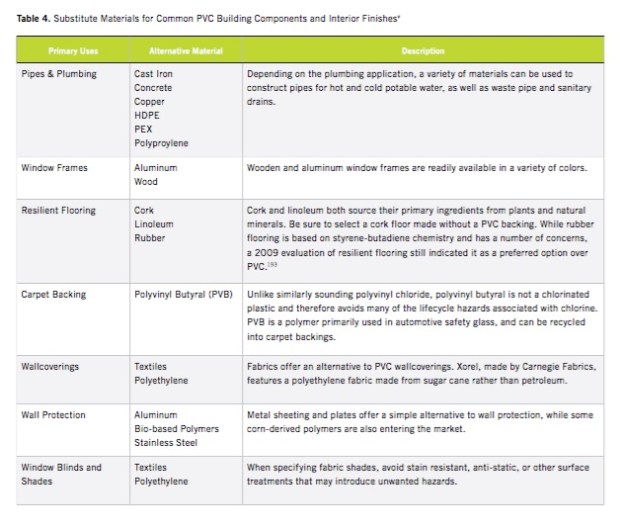
The white paper includes detailed analysis on the Health Hazards Associated With PVC and Hazardous Emissions from PVC, but the section on Avoiding PVC hazards through substitute materials will be of great help for those seeking PVC free constructions.

Avoiding PVC hazards through substitute materials

Mobilising the Construction Sector for Climate Action

We now know that buildings and the built environment are a key factor to our climate change problem, whilst at the same time, a vital part of climate change solutions.

2015 is seen by many as the turning point in the fight against climate change. In December, France hosts the 21st “Conference of the Parties”, or COP21, with a goal of reaching a binding agreement to limit global warning to between 1.5degC to 2degC.

Without significant action by the built environment sector, this target can not be met

December 2015 


The built environment sector’s crucial role in mitigating climate change is finally being recognised. For the first time in the history of climate negotiations, A ‘Buildings Day’ will be held December 3 at the COP21 UN conference on climate change in Paris.

  • Helping to put the buildings and construction sector on the below 2 °C path
  • Aligning existing initiatives, commitments and programmes to achieve greater scale and increase the pace of efficiency actions
  • Catalysing stronger collaboration and targeting sectoral and cross sectoral climate action and solutions for all

17062008118

Now then, is the time for every built environment organisation; funder; client; designer; constructor; and maintainer, to revisit and to recommit to sustainability goals that will not only seek to limit global warming through reducing carbon and other greenhouse gas emissions, but also seek to be net positive.

More than 30 per cent of global greenhouse gas emissions are buildings related, with emissions from buildings set to double by 2050 if we continue business as usual. Not addressing climate change will increase the risks and vulnerability of countries, regions and local communities. The forecast rapid urbanisation, without action will accelerate impacts.

Yet:

  • The built environment sector offers one of the most cost-effective and economically beneficial paths for reducing energy demand and associated emissions while at the same time supporting adaptation and resilience to climate change.
  • Many low-energy, renewable and deep renovation solutions are available. Proven policy, finance and technology actions exist.
  • The economic, health, and social benefits of sustainable buildings are significant. Buildings provide shelter, places to live, work, learn and socialise, directly affecting our daily lives. Providing more than 50 per cent of global wealth, and one of the largest employers at local level, the sector also offers a path to poverty alleviation.
  • Buildings are long-term ventures. Today’s new buildings are tomorrow’s existing stock. Failure to act now would lock in growth in GHG emissions for decades.

Better Build Green is the World Green Building Council’s new campaign which focuses on the UN climate change negotiations – COP21 in Paris. The campaign aims to show the world that green buildings offer one of the best and most cost-effective ways to tackle climate change and help keep global temperature rises within the two degrees limit. The message is simple: not only had we better build green if we are to reach a two-degree world tomorrow, but we are better off today if we do.

Sources:

UN Environment Programme Buildings Day 

Friends of Europe

Better Build Green

The New Economy – Why Buildings Matter in Fights Against Climate Change

Fairsnape iSite: Beyond Sustainability

Base EU Cities – In The Presence of Greatness

post.inddI was fortunate to attend the conference session of BaseEUcities in Brussels late last month. Sandrine Dixson Decleve (chair BaseEUCities advisory board, and Director CISL)  introduced the day as being in ‘the presence of greatness’, and undoubtedly that was to be the case, not only from the speakers and panelists but in discussions throughout the networking sessions.

File 03-11-2015, 08 42 57Keynote for the morning was Jeremy Rifkin economic, social theorist and author (the Third Industrial Revolution and recently the Zero Marginal Cost Society amongst many). According to The “European Energy Review” “Perhaps no other author or thinker has had more influence on the EU’s ambitious climate and energy policy”

Key to Rifkin’s keynote is the emergence and then convergence of innovation in three key areas – communications, energy, and transportation. This led to the fist industrial revolution in the UK, driven by coal, printing and the railways, the second industrial revolution was based on centralised power, cheap oil, telecommunications and the combustion engine ….. and now we heading into a third industrial revolution as we see the internet, IOT and virtual collaboration converging with a shift in energy production, ownership and conservation along radical innovations in transportation – not only vehicle but digital transportation of materials. (think Amazon and iTunes)

Rifkin’s delivery at BaseEUCities was just under an hour of linked thoughts, without aids or slides, and this is his skill, to connect and articulate a number of seemingly disconnected concepts into economic theories.

“The digital economy will revolutionise every commercial sector, disrupt the workings of virtually every industry, bring with it unprecedented new economic opportunities, put millions of people back to work, democratise economic life and create a more sustainable low-carbon society to mitigate climate change”  Rifkin in Huffington Post

At a private conference dinner the evening before, where Rifkin also spoke, Jorgen Randers, (a distinguished Norwegian economist and author of 2052 A Global Forecast for the Next 40 years, a much acclaimed sustainability publication) wasn’t too happy with Rifkin’s delivery, comparing it to building blocks being throw at you, rather than carefully constructed into a solid wall of economic theory. Frank Schwallba-Hoth (Founder of Green Party, Germany) responded that whilst you may or may not agree with Rifkin, his delivery, thinking and conclusions were to be admired.

And I agree, it is necessary to move away from a limiting cause and effect approach, the world isn’t like that anymore, if it ever was. We need more of Rikfin’s style, more complexity theory thinking – of fractuals thinking  and emergence from simple rules.

File 03-11-2015, 09 25 48

Graeme Moxton Sec Gen Club of Rome, added to the debate at the conference, arguing for political change and leadership for redistribution of wealth, energy and that greening is not negative for GDP growth but vital.

John Elkington, the final speaker for the day, summed up the days debates identifying three themes,  a New Normal, Corporations are key to Cities and a move from Incremental to Exponential Solutions

Listening to and participating in the days debates (in particularly listening to and reading extracts from Rifkin) you cannot help but think of the emergence of BIM, (Building Information Management) and how it is now transforming the AEC (Architecture, Engineering and Construction) sector.

Is BIM innovative and contributing to and shaping the third industrial revolution? or is it a consequence of the convergence of digital communications, new energy thinking and innovations in transportation? Which ever way it is, is BIM taking us towards a Rifkin future of Zero Marginal Costs?

Once we have, for eg, standard digital construction models, when each building is an energy production unit and we are 3D printing with local materials, the price of construction will tumble close to zero marginal cost, determined by the market, not by the cost of production. As has, music, books and other commodities following suit..

File 03-11-2015, 09 25 17And it isn’t all positive news. Rifkin talked of the dangers in externalising the nervous system of human race through Internet of Things , Alexander Der Croo Deputy Prime Minister of Belgium, who kicked off the conference, championing the digital era, warned that the IoT has a 1984 dark side we must all guard against.

And the sustainability dimension? After two industrial revolutions and now seemingly unsolvable climate change, our eco systems just cannot keep up with our interference, and as Rifkin commented “there is no guarantee for our species” – making the ending of using fossil fuel and emergence of restorative and regenerative sustainability so utterly vital.

……

For more on the BaseEUCities events see

#EUCities hashtagged feeds

BaseEUCities: the Conference storify

BaseEUCities: the Parallel sessions storify

BaseEUCities virtual exhibition continues for a few more weeks at http://virtualbasecities.com/

Why did I seek to put GreenBIM into Room 101?

Why did I seek to put Green BIM into Room 101 ? Did I not tweet only this week that Green BIM is one of the more important developments in the built environment?

greenBIM 101

The label, or hashtag for GreenBIM is so riddled with issues, I was only able to skim during the 2 mins allowed in the ThinkBIM / Green Vision Room 101 session, and in fact is pre-occupying a lot of thought and space in my forthcoming RIBA book.

However, in 5 bullet points … here goes.

  • BIM (and digital construction) is the most powerful of improvement and collaborative programmes for decades, if not in the history of construction – all BIM should be green – all BIM should be pushing the boundaries and doing more good, not happy just to maintain a business as usual, a sustainability status quo or be incrementally less bad.
  • Every BIM is a core enabler in achieving Construction Vision 2025 through sustainability and carbon targets – requiring net positive approaches. Construction 2025 is not just for GreenBIM’s.
  • One of the fast emerging sectors within the world of sustainability, with a predicted market value in the billions, is the circular economy – every BIM, not just GreenBIM’s should be addressing this concept. In particular, where one building becomes the food, the material farm, for the next building. Am I in danger of creating a new hashtag and meme here: #CEBIM _ Circular Economy BIM anyone?
  • Looking through (BIM) product data sheets we see products and chemicals that are scientifically proven carcinogenic – the formaldehyde, the PVC’s, the styrene – all BIM’s should address these issues on health and wellbeing grounds, not just GreenBIM. It is estimated to take 8 hours per material on Red List transparency to determine exact ingredients – and ensure no redlist prohibited materials, at present this doesn’t make material or product specification through BIM a viable option for LBC, Well Building standard or indeed LEED4 where the Red List thinking is applied
  • Green Vision has embraced Living Building Challenge – where, for accredited projects like the Bullit Centre there are no energy performance gaps – this is what a BIM should achieve on every building, green or not, and fast. Lets seek a net-positive performance gap. This is Construction Vision 2025!

Conclusion: My reason for putting GreenBIM into 101 is more out of frustration than annoyance. We would all agree that all BIM’s should be GreenBIMs, so do we need another label, perhaps, perhaps not, but what we do need to do is to take the agenda from ‘GreenBIM’ sessions to all other BIM events, initiates, software, projects, and make every BIM Green.

I also blogged on this very issue back in 2013 – Do we really need ‘Green BIM’?

It was encouraging to see the Circular Economy feature in a number of presentations at the Green BIM event. For more on circular economy and BIM see my take here: RegenerativeBIM … moving the GreenBIM debate

And, by coincidence or serendipity, I had presented to and participated within a panel debate at Runshaw College on Circular Economy the day before:

What does good ‘Facilities Management Sustainability’ look like? And why aren’t we doing it now?

I was honoured to be invited to the EuroFM ReseCGb8As1WsAA4i1varch Symposium as a guest of EuroFM, held at the recently completed Technology Innovation Centre at Strathclyde University in Glasgow.
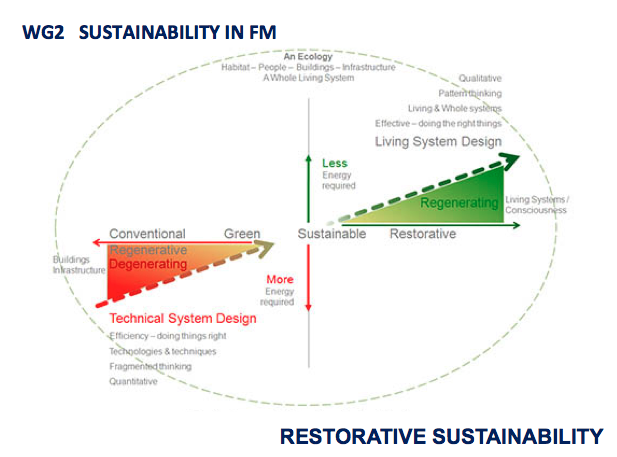

As promised, here are my thoughts from the day, and further links to the issues I raised during the day, in conversation or in the panel presentation/debate:

  • We do not have luxury to continue being incrementally less bad, and with the built environment’s 40% negative impact, the facilities Management sector, (led by the research community) has a huge opportunity and responsibility to flip to being more good.
  • We have been talking about Sustainable FM for at least a couple of decades, but still we haven’t made any real progress. The environmental impact of how we manage facilities is huge,FM Restorative Sustainability but remains something we struggle to fully understand, to measure and to address.
  • It was good to see Restorative Sustainability language within Keith Alexander’s opening presentation – laying down a challenge to the sector to adopt different thinking for sustainable FM
  • However it was disappointing to see FM research updates or proposals that start from a very dated perspective. Starting from Brundtland’s definition is last decades thinking – and has an odd message, perhaps giving licence to do nothing …. far better to adopt Yvon Chouinard’s (Patagonia) approach – ‘ Sustainability means we give back more than we take” – Restorative or Net Positive FM!
  • I did question the “in depth studies into sustainable building schemes” that have not picked up on the relatively new thinking standards such as Living Building Challenge, Well Building Standard, Cradle to Cradle, Circular Economy and so on. FM research has to be credible and leading edge for practice to listen and adopt.
  • Research proposals presented missed the huge opportunities for FM to engage with the wider sustainability agendas, in particular on people and health issues. (Note: the days theme being People Make FM)
  • Indeed the claim that FM contributes to the health and wellbeing of people needs to be backed up with evidence. Anecdotally, it is possible that FM ( and the wider built environment) could be putting people’s health at risk – through continued inclusion of toxic materials in buildings, (PVC? Formaldehyde glues?), a lack of biophilic thinking, promoting lifts over stairways, standing desks, poor air quality, lighting quality and so on. It is on these ‘health’ issues that the Well Building Standard should be a fundamental part of the sustainable FM agenda.
  • I did note that on the tour of the 3 month old BREEAM Excellent TIC Building, prior to the symposium, many of the FM delegates commented on the ‘new building smell’ – unfortunately now an indicator that chemicals may have been used in the finishes and adhesives.CGa3mDhWgAAPrZI
  • It was good to see the work in development on Smart Cities and Internet of Things from Prof Keith Jones at Ruskin University, showing the collaborative joined up research necessary to address complex (as in complexity theory) and wicked problems of sustainable smart cities.
  • Research to Practice was the theme for the end of day panel session where access to research by FM practice was discussed. I still wonder why research is blind to social media? As an example there were only two of us tweeting (myself @fairsnape and Iain @IainMurray) – but still our tweets reached approx 20k accounts, all researchers, would I am sure, like to have seen their research message reach 20k accounts.
  • It was, as ever, a real delight to introduce Living Building Challenge thinking and the Bullitt Centre to the EuroFM Research to Practice panel session. This is where sustainable EuroFM Sustainability FM thinking needs to be, driving a wedge into the future, demonstrating what is possible, not wrestling with a dated definition of sustainability.
  • the World FM Day on 10th June celebrates Building Resilience for the Future as an online debate throughout the day – a great opportunity for the FM Research community to engage and share their work.
  • Also on the 10th June the Brightest Greenest Buildings Europe virtual expo opens – again a free to attend event giving an opportunity to learn, share and engage with others across Europe.UK_collaborative_logo
  • And, also on 10th June, (a busy day!) our Living Building Challenge UK Collaborative meets at Leeds Beckett to explore the issue of healthy and materials.

If any of the above comments seem a little negative and critical, forgive me, but the intention is to be constructively so, and after all, one of the Living Building Challenge advocacy messages is to ‘stir the pot’, … o challenge current thinking.

Related Links:

Living Building Challenge

Well Building Standard (see also Vicki Lockhart Well Building presentation here)

Bullitt Centre  @bullittcentre  and (see also my interview with Denis Hayes)

Bullitt Centre added value report: Optimizing Urban Ecosystem Services: The Bullitt Center Case Study

Bullitt Centre – From Roots to Canopy

Cradle to Cradle

Circular Economy – Circulate

Responsible Business – Yvon Chouinard

Research and Social Media: Rethinking Sustainability Research: Eight Global Challenges and  my presentation to UCLan CSD 

Restorative Sustainability: Future Restorative

Living Building Challenge UK follow @livingbldgUK

Brightest Greenest Buildings EU  – the EU Virtual Expo for Built Environment (opens 10th June)

World FM Day – 10th June – Building Resilience for the Future

Tesla’s Powerwall: a game changer for BIM and Built Environment Sustainability?

Following the announcement from Elon Musk, we have seen energy and sustainability commentators proclaiming the new Tesla PowerWall a game changer for energy management, and for good reasons, moving from centralised energy to local energy management.tesla-demand

Tesla estimate that with only 9 million Powerwall devices, carbon targets to address climate change can be achieved and that’s not such a big number given the number of cars in the world. What happens when every home, office, building has a Powerwall (or similar: there will be others) enabling local energy management, connected to the internet of course.

The Information Age Is Over. Welcome to the Infrastructure Age.

The Powerwall has also be heralded as an example of the emerging ’world view’ age, we are leaving the Age of Information to enter an Age of Infrastructure. An age that will focus on the way not only energy but how information is managed, transported and communicated, constantly and in real time – the Infrastructure of Information.

Imagine future Building Information Management models that up date instantly and constantly based on incoming data feeds from building’s internet of things , from weather, from other BIM’s building user data and so on

The age of Infrastructure, in which the internet of things is a key element will mash up physical and cyber spaces. Will BIM’s also start to blur the boundary between physical and web space, making Augmented Reality the tip of an iceberg. Building Infrastructure Management anyone?

But of course there is the security aspect:

There are the inevitable dangers that come with infusing physical space with all the vulnerabilities of cyberspace. People will hack your building; they’ll inject malicious code into delivery drones; stealing your phone might become the same thing as stealing your car.

Whilst this could well give us near perfect buildings and facilities, it could also take us one step closer to the Blade Runner vision of cities and buildings that is the antithesis of the environment, restorative sustainability thinking movement, and a danger “We’ll still be mining unsustainably to support our glorious batteries and photovoltaics and smart dance clubs”

It is shaping up to be an incredible fast paced journey ahead for the built environment and even more reason for sustainability watchdogs, and for educational focus.

Sources/Credits:

Tesla’s new Powerwall battery could be world-changing

Tesla Powerwall: Game-changing batteries for homes and businesses, starting at $3,000

The Information Age Is Over. Welcome to the Infrastructure Age.

The Internet of Things (IoT)— an integrated fabric of devices, data, connections, processes, and people.

On #tweetchats and future #sustldrconv conversations …

By Martin Brown and Andrea Learned

It has been huge fun co-hosting the sustainability leadership conversation since back in early 2013. This labor of love has introduced us to new ideas, leaders and friends, both in social media and in real life. However with emerging additional commitments (Martin with his forthcoming FutuREstorative book, Andrea in her new We Mean Business role) we have decided to scale back.

slc

What ambitiously started as monthly chats, then dropped to every two months or so. We now propose to drop to 3 or less per year, likely with Martin taking the lead and Andrea an occasional guest host.

Having given time freely to run the conversation series for a few years now, we have huge respect for others who run regular successful chats on twitter. They are time consuming and don’t happen overnight. Guests and topic are sought, questions and anticipated responses discussed, promotion and invites managed, in addition to the hosting and post chat transcripts … it all takes more time than the casual tweet-chat observer might realize.

Tweet chat hosts are by no means simply hosts. Instead, they need to be fairly knowledgeable in the topic and to know their way around, have experience in and be well known on across social media. They need to have developed a trusted reputation within their topic’s community, and thus, be able to persuade a fair number of people to take an hour from an already busy day to learn in an often very new-to-them way.

Through #sustldrconv we feel we have established a brand for sustainability conversations. We’ve held very successful conversations, connected many twitter users through excellent guests, and shared great content (see some of our Storify accounts). Perhaps most important to us, we know from feedback that we’ve moved the needle on sustainability awareness for many.

Keen to not lose that influence or brand, sustldrconv will continue, but on a less rigid footing, holding chats to meet demand, related to our own work or research and related themes. That said, the experience and skill we have developed should not go to waste. For example Martin will continue to be “for hire” as Tweetchat consultant and Andrea will be using her strengths, perhaps more behind the scenes, with her work the rest of this year.

In addition we would not be adverse for our great friends, guests and contributors to the series so far to ‘guest’ host future #sustldrconv from. If that interests you, please so get in touch.

Social media technology is changing fast. Martin has often commented that the tweet chat is the new benchmarking. No longer do we need to travel and spend to understand what others are doing. There is so much initial fact-finding that can be done from our offices or homes, with little more than an hour’s chat investment. It will be interesting to see how the tweet chat element of twitter develops or is eclipsed by new applications. (Will this year’s SXSW-emergent social media app Meerkat or twitters own Periscope replace some twitter sharing?)

We thank you for your interest in, and support of, #SustLdrConv these past years. We have enjoyed learning with you, and have felt so rewarded by perhaps getting even a handful of you more interested in the power of Twitter and sustainability.

Martin and Andrea