Tag Archives: Living Building Challenge

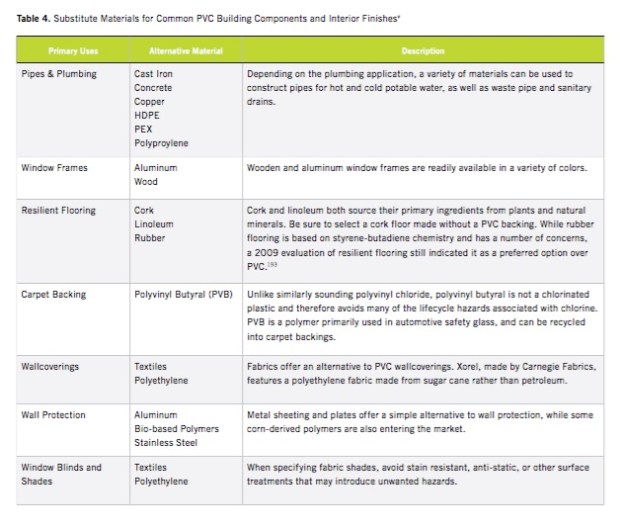
Avoiding PVC health hazards through substitute materials.

Aside from building materials that present obvious and accepted hazards to health (asbestos, leadpaint etc) it is PVC that generates the most discussion when exploring the Materials RedList imperative in Living Building Challenge training or workshop sessions. To design and construction buildings that are PVC free seems impossible to many, but LBC projects are doing just that through viable alternatives.
PVC imageThe Perkins+Will white paper, Healthy Environments, Whats New (and Whats Not) with PVC published last week (16th Nov) reviewed why PVC is on their ‘precautionary list’ in light of recent advances in PVC chemistry and manufacture. The white paper, a collaboration with the Healthy Building Network, to promote health in the built environment, concluded that despite advances in production, PVC should remain on their precautionary list.

Influential materials rating systems, including the Living Building Challenge building certification and Cradle to Cradle product certifications recommend avoiding PVC. Influential building owners such as Kaiser Permanente and Google have adopted PVC avoidance policies. Perkins+Will, an international architecture practice with about 1,000 architects, included PVC in its Precautionary List as a substance for which to seek alternatives.

“Exposure to a single PVC fire can cause permanent respiratory disease… Due to its intrinsic hazards, we support efforts to identify and use alternative building materials that do not pose as much risk as PVC to fire fighters, building occupants or communities.”  Richard M Duffy, International Association of Fire Fighters139

This does not mean that Perkins+Will has eliminated the specification of all PVC-based products. Instead, in keeping with the precautionary principle, when evidence indicates a relevant adverse finding as it relates to human health or negative environmental impact, Perkins+Will seeks to, where possible and appropriate, present alternatives to building owners for their consideration. The goal is to empower design teams to make informed decisions, recognising that this is an issue where scientific certainty is elusive.

Perkins+Will includes PVC on the Precautionary List because it presents hazards to people and the environment, beginning with its synthesis and continuing through its manufacture into products, use, and additional significant hazards during its disposal or recycling.

The white paper includes detailed analysis on the Health Hazards Associated With PVC and Hazardous Emissions from PVC, but the section on Avoiding PVC hazards through substitute materials will be of great help for those seeking PVC free constructions.

Avoiding PVC hazards through substitute materials

Quartz: healthy product datasets for BIM?

When we know what our buildings are made of, we can make informed choices by selecting materials that are healthier for occupants and have a lesser impact on our environment*

This blog regularly covers the intersection between sustainable, healthy products (for example the Living Building Challenge Red List) and BIM. Indeed the selection of materials and products based on biological health, as well as environmental impact and functional performance within ‘sustainable construction’ should be a no brainer.

We are not so good at using data in construction, and although this is improving as BIM becomes more established, there remains a gap in useful product health data sheets that carry material or product ingredients. Projects that use a rigorous material schedule such as the ILFI Red List often find themselves unpacking designs and material specification in order to understand product recipes and seek safe alternatives.

The Quartz Common Products Database, a collaborative initiative from Flux, HBN, thinkstep and Google was launched at VERGE 2015 at the end of October.  Quartz is an open database of composition, health hazard and environmental impact data for building products. It looks a promising contribution to a greater understanding of material health impacts and, being open source, paves the way for inclusion and alignment with BIM’s and the Product Data Sheets currently being compiled by CIBSE, NBS and others.

“Quartz aims to bridge the gaps between information, knowledge, and action, leading to less toxic, lower-impact building materials”

The Quartz database (www.quartzproject.org) will provide a collection of product profiles for commonly used building materials. Specifically:
● Quartz is a free and open dataset, integrating both LCA and health-hazard data into a single information source using widely accepted and consistent methodologies, such as Pharos Project/GreenScreen hazard screening, TRACI 2.1, and ISO14044.
● Data is vendor-neutral and covers 100 building products across a range of categories, such as concrete, drywall and insulation. Products are compared by composition, health impacts, and environmental impacts.
● Data is licensed under Creative Commons BY 4.0, meaning there is no restriction on the use, redistribution, or modification of the data. This openness will enable the AEC community and the general public to become more educated about the potential
impacts of materials in buildings and communities, and to put this data to creative and productive use.
● Through consistent language and metrics, stakeholders will be empowered to have productive dialogue with building products manufacturers, driving the industry towards increased sustainability  (From Quartz Press Release)

Health profile

Quartz Health Profile for polyvinyl chloride membrane, prohibited by ILFI Living Building Challenge Red List but in common use in construction.

Here in the UK this could be seen as timely launch, with the Considerate Constructors Scheme promoting a Construction Occupational cancer awareness campaign on sites. A welcomed campaign and one that should start with product specification using data such as Quartz to remove such toxic materials from construction.

“Sites need to proactively eliminate harmful substances, when this isn’t achievable working methods and equipment must be substituted for safer alternatives (CCS)”

By focusing only on construction site, we are not learning from the past, and it is the same thinking as we were a few decades ago when the focus was on ‘safe’ handling of asbestos.

In todays climate of CSR, (Corporate Social Responsibility), where Do No Harm is a common-place construction value, specifying, procuring and installing products that cause ill health in production, in installation and in use should be deemed as socially irresponsible.

Note – a very useful guide to Nine Green Product databased for Architects, Specifiers and Consumers was published to Architect Magazine on Nov 10th 

In 2015 we should have a much more mature approach to health – not to be content with one that seeks only to reduce impact on health but an approach that seeks to improve health, through biophilic material inclusion and a salutogenic approach.

*from http://quartzproject.org/

Beyond sustainability: Buildings are a climate change problem … and also part of the solution.

Buildings are a climate change problem … and also part of the solution. With buildings responsible for an estimated 40% of all carbon emissions and having a huge influence of lifestyle, commerce and industry carbon reduction efforts, we can now longer afford to incrementally be less bad. And this year, 2015, being a significant year for climate change action, with the COP21 in Paris in December and the imminent release of the UN Sustainable Development Goals, it is time to recognise the role of buildings as a climate change solution.

https---img.evbuc.com-https%3A%2F%2Fcdn.evbuc.com%2Fimages%2F15507896%2F145406037897%2F1%2Foriginal

Beyond Sustainability, as you may have seen in the media, via social media or by invite, is our significant event in London on the 5th Oct. The event highlight will be Jason McLennan’s (CEO International Living Futures Institute) first UK keynote, which promises to be an inspiring call to do more good, as being less bad is not just enough anymore

The event will also include an overview of Living Building Challenge and Well Building Standard activity in the UK from Martin Brown, Fairsnape, and Ann Marie Aguilar, Arup Associates.  Hattie Hartman (Sustainability Editor at AJ) will chair a panel debate, featuring regenerative and well being sustainability activity in the UK from a range of presenters.  In addition John Alker UKGBC will introduce the UKGBC’s new campaign ‘Better Places for People‘ 

There will, of course, be opportunity for Q and A panel debates with speakers.

Please take this as your invite to attend. The event will held appropriately, in the wonderful Royal College of Physicians building on Regents Park. More details and how you can you can still register here.

Jason F. McLennan Keynote speaker:

Considered one of the most influential individuals in the green building movement today and the recipient of prestigious Buckminster Fuller Prize (the planet’s top prize for socially responsible design), Jason F. McLennan’s work has made a pivotal impact on the shape and direction of green building in the United States and Canada and he is a much sought after designer, presenter and consultant on a wide variety of green building and sustainability topics around the world.

It is time to move on from theTriple Bottom Line …

It is time to move on from theTriple Bottom Line …

We have become very familiar with the Triple Bottom Line approach for Sustainability and Corporate Social Responsibility, ie Environment, Society and Economic. It forms the basis of many environmental and sustainability visions, policy statements, and development initiatives.

In the business arena, this is the acknowledged responsible ‘bottom line’ of meeting economic goals (usually profit) whilst also meeting environmental (impact) and social (community) goals in carrying out business activities. The triple bottom line approach provides a practical framework for the development of policies and strategies to drive institutional change.

roots coyo triple bottom line

Triple Bottom Line as drawn by COYO students

And of course we are now familiar with the well used triple bottom line venn diagram. If like me you loved Venn Diagrams at school, then its a real pleasure to see such vital and complex issues such s sustainability expressed as three interwoven circles. The Triple Bottom Line has also been represented as a three legged stool or as three columns.

As mentioned previously on this blog, this triple bottom line thinking can be traced back to Patrick Geddes who, now recognised as the Grandfather of Town and Country Planning coined the triptych Place, Folk and Work. Its current concept however is credited to John Elkington in his 1998 book Cannibals with Forks:Triple Bottom Line of 21st Century Business.

Whilst we can easily identify Geddes’ Place as being the Environment circle, (note, interestingly the Living Building Challenge renamed its Site Petal as Place for version 3), the Work aspect is readily identified as the Economy circle, there is an uneasy fit with people or folk within the Society circle. Are staff part of society, and where do the governance arrangements of a business (including vital for sustainability ISO 9001 related quality and organisational arrangements / controls) fit into the sustainability three circles?

Quad Bottom Line

Quadruple Bottom Line introduces Governance as the fourth ‘Petal’

The Quadruple Bottom Line introduces Governance as the fourth bottom line, or perhaps better, as Culture

Governance, or Culture is defined here as including both the formal business, administrative and ‘control’ processes of an organisation, as well as the informal networks, traditions and cultural and behavioural norms which act as enablers or disablers of sustainable development.

Sustainability governance therefore could include those organisational items that are increasingly seen as the vital enablers for sustainable development – many of which are embedded within the modern sustainability building programmes such as the Living Building Challenge, JUST, or Well Building Standard, including:
Diversity
Equity
Fairpay
Education
Collaborative Working
Working Places
Biophilia
Health and Wellbeing
Happiness
Communications and social media

This new, fourth leaf on the sustainability venn diagram, raises both important questions and huge opportunities for advancing sustainability development, and could usher in a new generation of sustainability thinking.

For example, what are the ‘governance’ issues of construction site facilities, welfare and administration that enable sustainable construction … more

Extract from forthcoming FutuREstotative

WELL Building Institute launches pilot programs for new sectors.

Buildings should be developed with people’s health and wellness at the centre of design.

Untitled 5In a recent Press Release IWBI (International Well Building Institute) is calling for organisations to participate in its next stage of development and to pilot the Well Building Standard.  Invites are called for from the retail, multifamily residential, education, restaurant and commercial kitchen sectors.

IWBI Founder Paul Scialla  said “The pilot programs will help us spur innovation and bring us even closer to fully integrating WELL into all sectors of the built environment.”

“The WELL pilot programs will allow participants to be the first to engage at the cutting edge of the sustainability and healthy building movement. IWBI will collect information from participants and industry experts to further refine the standards prior to publication. Upon completion of the pilot program, each standard will move out of the pilot phase and become integrated into the core features of WELL.”

For information or to download the pilot standards, visit www.wellcertified.com/well. Once a project has officially applied to the pilot program through WELL Online, IWBI will contact the project team to arrange an initial evaluation of the project to ensure that it fits the specifications, and provide assistance throughout the pilot certification process.

The Well building standard has great alignment with the Living Building Challenge and was featured at our recent Green Vision / Living Building Challenge Health, Happiness and Mindfulness event in May with myself and  Vicki Lockhart, (@vicki572) Arup (WELL AP) See Healthy Buildings to Healthy Minds – joining the dots at Green Vision

More: The WELL pilot programs will allow participants to be the first to engage at the cutting edge of the sustainability and healthy building movement. IWBI will collect information from participants and industry experts to further refine the standards prior to publication. Upon completion of the pilot program, each standard will move out of the pilot phase and become integrated into the core features of WELL.

WELL is the world’s first building standard focused exclusively on human health and wellness. It marries best practices in design and construction with evidence-based medical and scientific research – harnessing the built environment as a vehicle to support human health and wellbeing.

WELL is grounded in a body of medical research that explores the connection between the buildings where we spend more than 90 percent of our time, and the health and wellness impacts on us as occupants.

The WELL Building Standard is the culmination of seven years of research, in partnership with leading scientists, doctors, architects and wellness thought leaders. Pilot programs are now available for projects in the following categories:

  1. Retail: Retail applies to locations where consumers can view and purchase merchandise onsite, and where staff are employed to assist in the sale of products. The Retail pilot standard is applicable to owner- and tenant-occupied projects, and to those in both stand-alone buildings and those integrated into larger structures.
  2. Multifamily Residential: Multifamily Residential applies specifically to projects with at least five dwelling units in a single building with common structural elements. Projects that qualify include apartments, condominiums, townhouses, and other residential complexes within all market thresholds – affordable housing, market-rate and luxury.
  3. Education: Educational Facilities applies to projects where dedicated staff is employed for instructional purposes, and students may be of any age. Courses may cover any range of topics, and facilities may be typified by fully scheduled days or distinct classes in which students enroll at will.
  4. Restaurant: Restaurants applies to locations where a consumer can purchase food and dine onsite, including indoor or outdoor seating. The establishment may be either self-serve or include wait staff that tend to consumers. The Restaurant pilot standard does not include take-out only establishments or establishments whose primary source of revenue derives from the sale of alcoholic beverages. Further, the Restaurant pilot standard only applies to dining spaces—it does not cover kitchens in which food is prepared.
  5. Commercial Kitchen: Commercial Kitchens applies to locations where cooks prepare food for other building users. It is not applicable to office kitchenettes or home kitchens. In general, spaces subject to local health inspection are likely to use this Pilot Addendum. Commercial Kitchen is always paired with another standard, such as Restaurant or Education.

All pilot programs were developed as an adaptation of WELL v1.0. Using v1.0 as a baseline, relevant features from v1.0 were incorporated into each pilot, while features that only apply to commercial and institutional spaces were removed. Certain features were also adapted, so that their intent remains the same but the details are different. Prior to being finalized, all pilots will complete a thorough and transparent peer review process with scientific, practitioner and medical experts. During this process, expert feedback from leading researchers and industry practitioners will help refine each pilot for its final release.

Pilot projects are eligible to achieve Silver, Gold or Platinum level pilot certification, following the same method as WELL v1.0. Through IWBI’s collaboration with the Green Business Certification Inc. (GBCI), projects receive third-party certification by GBCI.

About the International WELL Building Institute™ The International WELL Building Institute™ (IWBI) is a public benefit corporation (B-Corp) whose mission is to improve human health and wellbeing through the built environment. B-Corps like IWBI are an emerging U.S. structure for corporations committed to balancing public benefits with profitability – harnessing the power of private capital for greater good.

IWBI administers the WELL Building Standard® (WELL) – a performance-based system for measuring, certifying, and monitoring features of buildings that impact the health and wellbeing of the people who live, work, and learn in them. Fulfilling the vision of IWBI Founder Paul Scialla, IWBI has a pioneering altruistic capitalism model that will address social responsibility and demonstrate a sustainable model for philanthropy.

IWBI has committed to direct 51 percent of net profits received from WELL Certification project fees toward charitable contributions and impact investment focused on health, wellness, and the built environment. IWBI was established by Delos in 2013 pursuant to a Clinton Global Initiative commitment to improve the way people live by developing spaces that enhance occupant health and quality of life by sharing the WELL Building Standard globally. WELLcertified.com

About the WELL Building Standard® The WELL Building Standard® (WELL) is a performance-based system for measuring, certifying, and monitoring features of the built environment that impact the health and wellbeing of the people who live, work, and learn in the buildings.

WELL focuses on seven categories of building performance: air, water, nourishment, light, fitness, comfort, and mind. Pioneered by Delos, the WELL Building Standard is grounded in evidence-based medical research that demonstrates the connection between the buildings where we spend more than 90 percent of our time and health and wellness impacts on us as occupants.

The WELL Building Standard is administered by the International WELL Building Institute™ and third-party certified by Green Business Certification Inc. (GBCI). WELLcertified.com ### Press Contact: Taryn Holowka taryn.holowka@wellcertified.com 202.828.1144

REVEALed: a new initiative to showcase and compare the world’s most energy efficient buildings.

REVEALREVEAL – a new building energy performance nutrition label and benchmarking scheme to showcase and compare the world’s most energy efficient buildings. 
Reveal is the latest programme from the International Living Futures Institute (the Institute behind the Living Building Challenge, Living Product Challenge, Declare and JUST) to provide visible and benchmark-able energy data based on real, measurable data. Reveal is aimed at certified Living Buildings, net zero buildings, LEED buildings, BREEAM buildings, Passivehouse projects – or indeed any project with accurate measured energy data. It should be of great interest to the facilities Management and Property sectors

REVEAL taps into performance based reporting – an integral part of the Living Building Challenge and Net Positive Certification to provide a new platform for projects to showcase how efficient they are relative to other buildings.

Evidence for the Reveal using the EUI – Energy Use Intensity index – would be validated from utility provider data and audited by ILFI. Reveal Labels are date stamped and will be renewed on a two-year basis to essentially become ‘nutrition’ labels for building energy performance.

Organisations can use their label on their websites and marketing materials to tout their achievement in being one of the world’s most efficient buildings – and see how their project stacks up to other exemplary projects.

Energy Use Intensity (EUI) indicator: In the absence of a standard or benchmark it is difficult to benchmark energy uses between buildings. Simply measuring the amount of energy used per a chosen time period does not take into account building size, configuration or type of use. The use of an Energy Use Intensity (EUI) indicator provides a means to normalise the way that energy use is compared between various types of buildings, and evaluate the means of reducing overall energy consumption.

When using EUI, energy use is expressed as a function of a building’s total area or “footprint”. For Reveal, as is common in the US, EUI is expressed in energy used per square foot of building footprint per year. It is calculated by dividing the total gross energy consumed in a one-year period (kilowatt-hours or kilo-British Thermal Units) by the total gross square footage of the building ie KbTu/sqft/year  In the UK and elsewhere this would be KWh/m2/year. See Calculating a Building’s EUI

The International Living Future Institute (ILFI) will begin issuing the new energy label, called “Reveal,” in late 2015 according to Eric Corey Freed, vice president for global outreach at ILFI.

10th June – A Busy Built Environment Day

This Wednesday, 10th June, is going to a busy built environment learning and sharing day: Check out these great events:

If you are in Leeds, Yorkshire or the North of England:

UK_collaborative_logoOur Living Building Challenge UK Collaboration Materials Workshop explores the materials petal, at Squire Patton Boggs, Leeds from 2.30 – 5

Introduction to the Materials Petal (LBC Presentation) Martin Brown
Materials Handbook Working Session
Experiences of tracking Red List Materials (Alex Whitcroft)

Contact LSI GreenVision e.a.schofield@leedsbeckett.ac.uk  for more information.

If you are on the internet:

Untitled

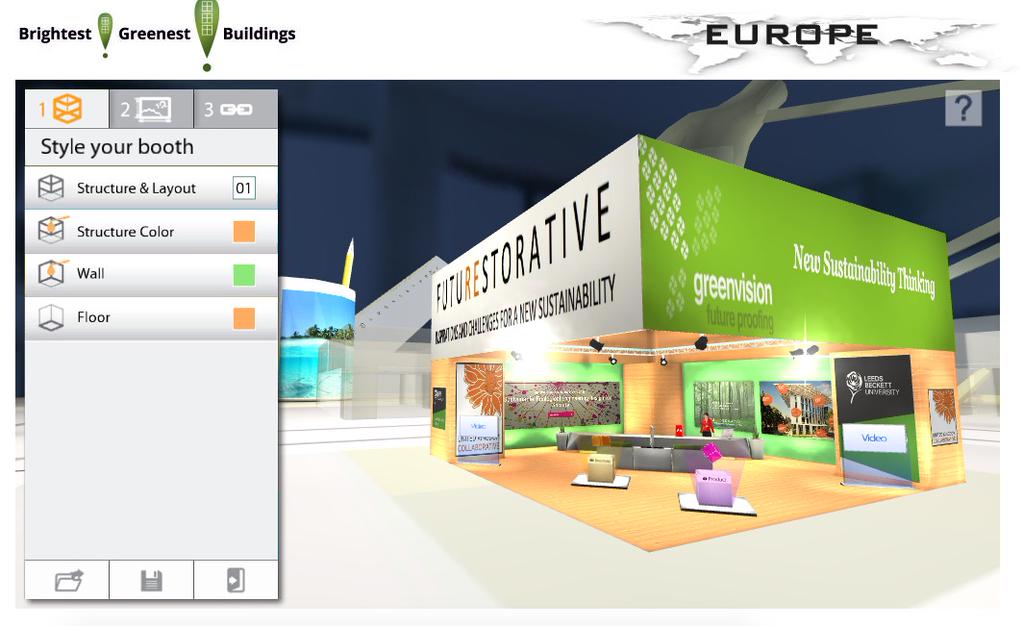
CGlkNIhUAAEei4eBrightest Greenest Buildings: The free-to-attend carbon neutral virtual exhibition dedicated to Europe’s most successful and greenest building projects and green building solutions opens on June 10th. We will have a presence – thats the UK Living Building Challenge UK, Fairsnape, #FutuREstorative and LSI Green Vision, along with many other great green building advocates and supporters.

There is an inspiring and free seminar Schedule of Events running through out the day, not to be missed!

If you are on twitter:

WORLD-FM-DAY-LOGO_2015_translations2-1World FM Day On June 10, @IFMA will host two Twitter chats that pose hot-topic questions addressing aspects of this year’s World FM Day theme, “Building Resilience for the Future,” using the hashtag #WorldFMDay.
8-9 a.m. CDT: Chat on resilience (risk mitigation, business continuity, agility/change management)
2-3 p.m. CDT: Chat on the future of FM (succession planning, tech/industry innovations, etc.) (There are also a myriad of other WorldFMDay events taking place on the 10th)

What does good ‘Facilities Management Sustainability’ look like? And why aren’t we doing it now?

I was honoured to be invited to the EuroFM ReseCGb8As1WsAA4i1varch Symposium as a guest of EuroFM, held at the recently completed Technology Innovation Centre at Strathclyde University in Glasgow.
As promised, here are my thoughts from the day, and further links to the issues I raised during the day, in conversation or in the panel presentation/debate:

  • We do not have luxury to continue being incrementally less bad, and with the built environment’s 40% negative impact, the facilities Management sector, (led by the research community) has a huge opportunity and responsibility to flip to being more good.
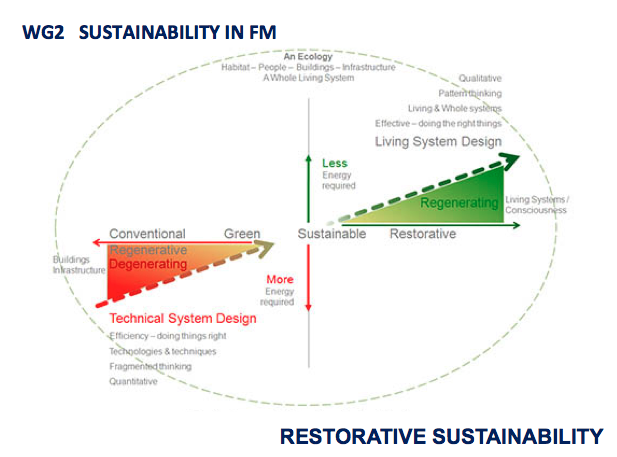
  • We have been talking about Sustainable FM for at least a couple of decades, but still we haven’t made any real progress. The environmental impact of how we manage facilities is huge,FM Restorative Sustainability but remains something we struggle to fully understand, to measure and to address.
  • It was good to see Restorative Sustainability language within Keith Alexander’s opening presentation – laying down a challenge to the sector to adopt different thinking for sustainable FM
  • However it was disappointing to see FM research updates or proposals that start from a very dated perspective. Starting from Brundtland’s definition is last decades thinking – and has an odd message, perhaps giving licence to do nothing …. far better to adopt Yvon Chouinard’s (Patagonia) approach – ‘ Sustainability means we give back more than we take” – Restorative or Net Positive FM!
  • I did question the “in depth studies into sustainable building schemes” that have not picked up on the relatively new thinking standards such as Living Building Challenge, Well Building Standard, Cradle to Cradle, Circular Economy and so on. FM research has to be credible and leading edge for practice to listen and adopt.
  • Research proposals presented missed the huge opportunities for FM to engage with the wider sustainability agendas, in particular on people and health issues. (Note: the days theme being People Make FM)
  • Indeed the claim that FM contributes to the health and wellbeing of people needs to be backed up with evidence. Anecdotally, it is possible that FM ( and the wider built environment) could be putting people’s health at risk – through continued inclusion of toxic materials in buildings, (PVC? Formaldehyde glues?), a lack of biophilic thinking, promoting lifts over stairways, standing desks, poor air quality, lighting quality and so on. It is on these ‘health’ issues that the Well Building Standard should be a fundamental part of the sustainable FM agenda.
  • I did note that on the tour of the 3 month old BREEAM Excellent TIC Building, prior to the symposium, many of the FM delegates commented on the ‘new building smell’ – unfortunately now an indicator that chemicals may have been used in the finishes and adhesives.CGa3mDhWgAAPrZI
  • It was good to see the work in development on Smart Cities and Internet of Things from Prof Keith Jones at Ruskin University, showing the collaborative joined up research necessary to address complex (as in complexity theory) and wicked problems of sustainable smart cities.
  • Research to Practice was the theme for the end of day panel session where access to research by FM practice was discussed. I still wonder why research is blind to social media? As an example there were only two of us tweeting (myself @fairsnape and Iain @IainMurray) – but still our tweets reached approx 20k accounts, all researchers, would I am sure, like to have seen their research message reach 20k accounts.
  • It was, as ever, a real delight to introduce Living Building Challenge thinking and the Bullitt Centre to the EuroFM Research to Practice panel session. This is where sustainable EuroFM Sustainability FM thinking needs to be, driving a wedge into the future, demonstrating what is possible, not wrestling with a dated definition of sustainability.
  • the World FM Day on 10th June celebrates Building Resilience for the Future as an online debate throughout the day – a great opportunity for the FM Research community to engage and share their work.
  • Also on the 10th June the Brightest Greenest Buildings Europe virtual expo opens – again a free to attend event giving an opportunity to learn, share and engage with others across Europe.UK_collaborative_logo
  • And, also on 10th June, (a busy day!) our Living Building Challenge UK Collaborative meets at Leeds Beckett to explore the issue of healthy and materials.

If any of the above comments seem a little negative and critical, forgive me, but the intention is to be constructively so, and after all, one of the Living Building Challenge advocacy messages is to ‘stir the pot’, … o challenge current thinking.

Related Links:

Living Building Challenge

Well Building Standard (see also Vicki Lockhart Well Building presentation here)

Bullitt Centre  @bullittcentre  and (see also my interview with Denis Hayes)

Bullitt Centre added value report: Optimizing Urban Ecosystem Services: The Bullitt Center Case Study

Bullitt Centre – From Roots to Canopy

Cradle to Cradle

Circular Economy – Circulate

Responsible Business – Yvon Chouinard

Research and Social Media: Rethinking Sustainability Research: Eight Global Challenges and  my presentation to UCLan CSD 

Restorative Sustainability: Future Restorative

Living Building Challenge UK follow @livingbldgUK

Brightest Greenest Buildings EU  – the EU Virtual Expo for Built Environment (opens 10th June)

World FM Day – 10th June – Building Resilience for the Future

RegenerativeBIM … moving the GreenBIM debate

green bimBuilding Information Management offers huge benefits to Sustainability and to GreenBuild, but needs to move from GreenBIM to RestorativeBIM

Bringing together the two most important themes of todays built environment, Sustainability and BIM, the ThinkBIM and Green Vision programmes at Leeds Beckett are setting the agenda for GreenBIM.

However we need to guard against GreenBIM falling into a trap of being Sustainability and BIM as usual, but to move GreenBIM into the visionary, Regenerative Sustainability arena, as adopted by Green Vision through their association with the Living Building Challenge.

Rethinking BIM for the Ecological Age

It does seems a waste that all the creative and innovative thinking and energy being put into BIM should only incrementally improve built environment sustainability, and that we will be a little less bad next year, a bit more less bad by 2018

Aligning the innovation of BIM and the forward thinking of Regenerative Sustainability provides an immense opportunity that could and should powerfully push the overall built environment agenda forward. And, through the intelligence of a RegenerativeBIM, ensure that each element, not just the building, contributes in a net-positive manner, doing more good, not just doing incrementally less bad.

Where GreenBIM is today and where Green BIM needs to be, RegenerativeBIM.

Where GreenBIM is today and where Green BIM needs to be, RegenerativeBIM.

Imagine then if every building, indeed every ‘facility’ was designed, constructed and operated through a RegenerativeBIM, that;

> is designed and constructed specifically in relation to its ‘place’, positively impacting and benefiting its immediate environment.

> becomes a provider of water, cleaning all that falls on the building and providing clean water to adjacent facilities.

> generates more energy than required and contributes the net positive difference to nearby homes, community buildings.

> contains no harmful materials. There should be no place in a GreenBIM for materials on Red Lists. An intelligent RestorativeBIM could not allow materials or products such as PVC, formaldehyde, or SPF’s. Every Product Data Sheet would include the elements of the Living Product Challenge, with every product having a net-positive Handprint

>  are based on biophilic and biomimic principles. RegenerativeBIM would constantly ask the question, How would nature approach this?

> focus on a positive, salutogenetic health principle – on making people healthy, not as present on the negative stopping people getting less ill. (Big difference!)

> cleans the air, emitting better quality than intaking.

> delights and encourages creativity …

> intelligently and digitally inspires and educate the next …. BIM.

Such an approach is not only possible but arguably the responsible approach we must take. An approach that in a short time could be the accepted way of designing, constructing and maintaining buildings.

OLYMPUS DIGITAL CAMERA

These ideas will be explored further in upcoming ‘GreenBIM’ events hosted through Green Vision, ThinkBIM and CE Yorkshire.

Watch this space.

Ecological Handprints: Construction materials that do more good not just less harm

One of the more interesting and potentially industry game changing announcements coming out from the ILFI 2015 conference in Seattle last week was the launch of The Living Product Challenge (LPC).

Initially introduced at the LF 2014 conference with more detail released this year along with more on the concept of the “Ecological Handprint” (not a new concept, but one that is set to gain more parlance now adopted by the ILFI)

The LPC challenges manufacturing organisations to make products with a positive “handprint” i.e. encouraging products that are net-positive and transparent throughout the entire life cycle. (Ecological Handprints will measure the positive impact that a product causes across its life cycle, such as harvesting more water and generating more energy than was required to make the product)

There could be reservations with a requirement for LPC accredited organisations to hold  other ILFI standards such as Just and Declare, seeming a little incestuous perhaps. However sticking to the LBC approach of philosophy first, advocacy second and accreditation third, lets focus on the philosophy and advocacy to improve the sector, and address certification issues later. Living Product Challenge is looking to operate in an increasingly crowded healthy material transparency and green directory arena, yet the absolute-ness of the criteria, (you do or you don’t) will undoubtedly differentiate.

Buildings that consists solely of products and technologies that themselves do more good than harm, across environmental, social and economic spectrums, in manufacture, construction and in use is a very powerful statement for a regenerative future.

And its an approach of course that responsible organisations within the built environment should be adopting. And here are a whole new set of questions to ask; before designers specify materials; when contractors procure products and as facilities management upgrade/replace products.

The philsophy:

Re-imagine the design and construction of products to function as elegantly and efficiently as anything found in the natural world.

Products are informed by biomimicry and biophilia; manufactured by processes powered only by renewable energy and within the water balance of the places they are made.

Products improve our quality of life and bring joy through their beauty and functionality.

Imagine a Living Product whose very existence builds soil; creates habitat; nourishes the human spirit; and provides inspiration for personal, political and economic change.

Like the Living Building Challenge (LBC), the LPC consists of 20 specific “Imperatives” under seven “Petal” categories. All 20 requirements are needed for full LPC certification, or Imperative and Petal certification options . Many of the imperatives will be familiar to those already au fait with the Living Building Challenge, with a few new additions and definations, for example:

Positive Handprint: The manufacturer must demonstrate that the product gives more than it takes over its entire life cycle,

Net-Positive Waste: Water use and release from manufacturing the product must work in harmony with the natural water flows of the site and its surroundings.

Net Positive Material Health: The product must be safe for human exposure during manufacturing, use and end-of-use.

Human Thriving: The product must contribute to an active, healthy lifestyle and be designed to nurture the innate human/nature connection.

Product Fit to Use: Durability, warranty, and useful lifespan must have a direct relationship to environmental impact and embodied energy.

Equitable Product Access: Products sold to consumers must be affordable to the people who manufacture them, and products used in buildings must not unduly impair the affordability of those buildings.

The Living Product Challenge ‘brochure’ pdf can be downloaded from here. The UK LBC Collaborative will be getting to grips with the LPC over the coming weeks, with a view to providing more information and introduction sessions later in the year.

Sources #LF15 Tweets,  https://living-future.org