Tag Archives: sustainability

Innovation and inspiration in sustainability

This free ebook from Guardian Sustainability Business contains excellent, innovative and inspiring case studies that should be read by directors, senior and Untitledsustainability managers across construction.
“At a time when multiple social, environmental and economic challenges face the world, instances of true leadership and innovation can be game changing and offer a much-needed light in the dark.

However, ensuring these examples of excellence are shared, embraced and learnt from can often be a tricky feat when the business landscape is so innately complex”

Built Environment related case studies include:

  • BAM Nuttall: peer-led training unlock wealth of hidden talents
  • British Land: chain reaction in building design
  • Skanska: working with rivals for the greater good
  • Interface: net gains for poor coastal communities
  • M&S: proud to be the biggest – and the greenest
  • URS: how to build a big building with a small footprint
  • The Co-operative: landmark HQ designed with environment in mind
  • Kebony: hardwood alternative that’s soft on the environment
  • Royal Mail: LED lights the way to energy savings
  • Hastoe Group: lays the blueprint for sustainable communities

However …

“If a company wants to see a future then 80% of what it will have to learn will be from outside its own industry.” (Gary Hamel)

… real inspiration and innovation for those of us in construction and the built environment will come from learning from those outside of the sector, on themes of communications, carbon, employee engagement, biodiversity and more.
fairsnape: innovating and improving

Construction CSR – A Clients View

At the launch of the British Land Corporate Responsibility Report 2013,  Head of Planning and Corporate Responsibility, Adrian Penfold, gave people the chance to quiz him on our approach to corporate responsibility and on our plans for the future.

Here are Adrian’s responses to the questions we received via Twitter@BritishLandCR (original wording kept for all questions, including abbreviations).

Of course, I was particularly interested in my question:

Adrian, What do you see as key drivers for Corp Responsibility in built environ. over next 5 yrs? By Martin Brown @fairsnape

At a corporate level, we have identified three key drivers for corporate responsibility in general over the next five years:

  • Resource shortages and unpredictable climate patterns posing ever-greater risks to wellbeing and economic stability in developed and developing nations.
  • Public concern about how businesses operate leading people to ask questions about the role of business in shifting to more sustainable models of consumption and supporting wider societal needs.
  • Local, national and global issues stemming from low economic growth, challenges in accessing employment and skills shortages.

For the built environment, I think regulation will play an important part, particularly Minimum Energy Performance Standards and Building Regulations. But I believe the real changes are coming through in the attitudes of our customers. In our recent experience, Marks & Spencer and UBS are for example both very challenging in the environmental criteria that they require, particularly on new buildings. We welcome this, as we are well positioned to work with them in this area, and we expect to see more of this kind of requirement from other businesses.

Do read the whole article for similar comments on the built environment current challenges of wellbeing, energy, co2, green leases and green deal.

In addition to the comments this is another brilliant example illustrating the maturity of twitter in the built environment / corporate social responsibility sector, and why it should be a key tool for construction boards strategy planning.

Plans A and B – changing the sustainability debate?

Yesterday may well be remembered as a significant milestone in the world of sustainability with two major events: Marks and Spencers celebrated their Plan A with Al Gore and others, meanwhile Richard Branson was part of a global team that launched Plan B.

And there was  much relevance for the built environment and construction sectors, on carbon, supply chain management, social responsibility and on the urgency to change, away from business as usual. Now.

It was also a significant milestone for social media – in particular twitter, with so much of the events being shared, enabling many around the world, like me, to listen in, share key messages and comment. (Hashtags #PlanB and #PlanA2013 – see Storify links below))

If ever there was a reason for built environment organisations committed to sustainability to have a presence on twitter – it was yesterday.

Despite some of the contradictory language – “Plan A because there is no Plan B” and “We need a Plan B because Plan A isn’t working” – the two should definitely be seen as complimentary.

Many, like myself have seen and blogged on the complimentary messages from the two events, for example the UKGBC opinion article The day the debate changed: Plan A or Plan B and the article by Eddie 

There was so much information and comment shared during the day, I have captured the tweets on to storify for later reading and digesting. The storify records are raw tweets so I can go back and read, but please read and be inspired. As I re-read them I will tidy up to curate a better stori-fy.

Plan A : raw tweets from Marks and Spencers Plan A Conference 2013

Plan B – raw tweets from the launch of Plan B – a global conversation and new sustainable business era

A sustainable, purpose-driven Green Deal?

sb13live-logoThere is a real buzz emerging from Sustainable Brands annual conference in San Diego focusing on the progress purpose-driven brands are having in moving the sustainability agenda. The strap line theme for this years event is from Revolution to Renaissance, and explores the positive sustainability shifts currently taking place where business and society meet.

The event has wide coverage via Livestream feed and a vibrant twitter stream at #SB13con

‘Research shows that brands have failed to align themselves with changes in society’  

From the event, there are significant articles from Jo Confino at Guardian Sustainable Business (one of the event platinum sponsors), in particular – Consumers believe brands can have positive impact but are failing to do so and Can brands help unlock the power of citizens to change the world? and well worth a read. 

Tuning into #SB13, following the livestream coverage, sharing tweets thoughts with others and reading the Guardian articles, it strikes me the UK Green Deal programme is a prime platform where purpose driven material and equipment suppliers could make a huge impact. Could green deal product suppliers move away from  traditional supply and sales driven profit routes and focus on a purpose of reducing fuel poverty, improving wellbeing and influencing the greendeal consumer?

Could the Kingfisher group be the first to move into this space and pioneer a ‘net positive’ and purpose-driven approach to Green Deal? Nick Folland, the company’s group corporate affairs director thinks so:

The Kingfisher of the future could be as much about helping people make, mend and repair things than selling them kit. “We’re going to go out into communities and teach these things, and [help them be] more self-sustaining.”

Kingfisher’s plan to put ‘net positive’ into practice

One of the notable themes from SB13 is the need for product brands to connect, collaborate and scale fast,  filling the sustainability gaps that governments at present can not.

What a different green deal we could have!

Related: More than just a Green Deal presentation via martin brown

A tipping point for sustainability

Could this be one of the key important concept diagrams for sustainability and environmental impact?

Snapseed‘Restorative sustainability’ in one simple graphic.

This brilliant  slide came to my attention via a @melanieloftus tweeted picture  taken during Jason McLennan’s presentation, Mind the Gap at the Living Futures conference, positioning Living Building Challenge beyond LEED. 

Reflecting on this simple model, we can visualise the impact of our current built environment sustainability approaches – are they just doing less bad, or really doing more good and making a restorative, positive contribution?

And importantly we can visualise that tipping point for sustainability, from less bad to more good.

The urgency for reconsidering ‘sustainability’ was emphasised in the recent report State of the World 2013: Is Sustainability Still Possible? The term sustainable has become essentially sustainababble, at best indicating a practice or product slightly less damaging than the conventional alternative.

Is it time to abandon the sustainability concept altogether, or can we find an accurate way to measure sustainability?

The Living Building Challenge, as a philosophy, an advocacy and assessment scheme has real significance. It enables us to cross the sustainability rubicon, setting a vision for a future built environment and encouraging owners, designers, constructors, operators and users to track towards it. As commented on the opening of the Bullitt Centre in Seattle a LBC accreditation hopeful, such approaches are driving a wedge into the future so others can see whats possible.

I feel honoured to be a Living Building UK Ambassador, spreading the message of the Challenge as fresh sustainability thinking into the UK built environment agenda.

For more information and planned events for the Challenge in the UK , check out our presentation to Green Build Expo, visit the Living Building website,  follow us on @UK_LBC on twitter or say hi via email. (We even have a facebook page to like!)

Related Post: Have we picked the low hanging fruit of Sustainable Construction?

Sustainable futures require collective power of unconventional partnerships

mandelbrot

Early today I came across this excellent quote* from Hannah Jones, Nike’s global head of sustainability and innovation:

“We believe that the innovations required to create the future won’t come from a single source. Not from science. Not from technology. Not from governments. Not from business. But from all of us. We must harness the collective power of unconventional partnerships to dramatically redefine the way we thrive in the future.”

Just the thinking and attitude we need for a ‘sustainable’ built environment, based on unconventional collaborative working, driving our conversations towards a future that is sustainable on economic, social and environmental value levels. In the way we operate, address our impacts and importantly in the products and services we deliver.

*Quote contained in the Guardian Sust Biz article Can systems experts create scale and speed in sustainability?

Built Environment Earthday Inspiration

Today, April 22nd is Earthday.

Earth Day is an annual day on which events are held worldwide to demonstrate support for environmental protection. Earth Day is observed on April 22 each year. The April 22 date was designated as International Mother Earth Day by a consensus resolution adopted by the United Nations in 2009. Earth Day is now coordinated globally by the Earth Day Network and is celebrated in more than 192 countries every year.

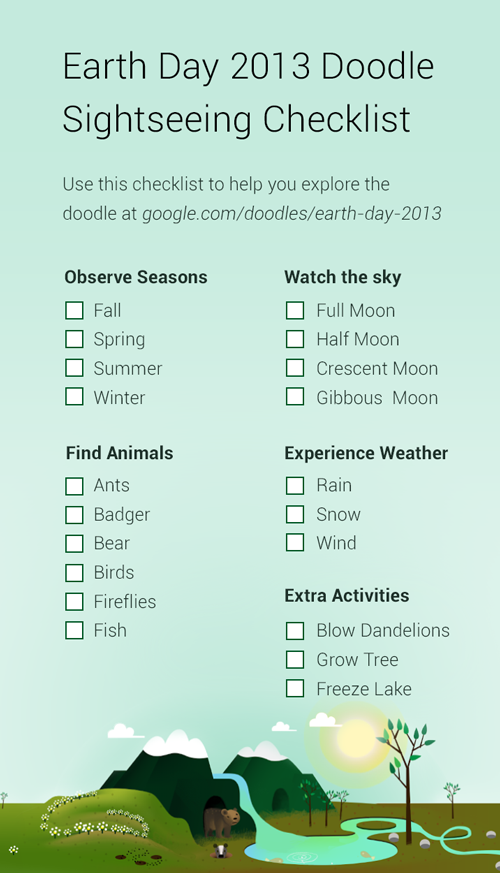
Google once again is celebrating with an interactive doodle. gearth

“Today we are celebrating Earth Day with an interactive doodle that captures a slice of nature’s subtle wonders,” wrote Doodler Leon Hong. “We hope you enjoy discovering animals, controlling the weather, and observing the seasons. Use the sightseeing checklist  to make sure you do not miss anything!” (end of blog below)

But for Built Environment inspiration on Earth Day – take a look at the video on the philosophy behind the Bullitt Centre in Seattle – “driving a wedge into the future of buildings”, officially opening today and now home to the Living Building Challenge.

Seattle’s Bullitt Center: The World’s Greenest Office Building from EarthFix on Vimeo.

An inspiration for the UK Built Environment. The UK Collaborative was launched on the 3rd April (see Introduction here) Find out more and keep in touch with Living Building Challenge UK via @UK_LBC

……

earth-day-2013-doodle-sightseeing-checklist

Green Deal Guidance for the Property Industry

UntitledThe Department of Energy and Climate Change has published The Green Deal: Guidance for the Property Industry in Great Britain aimed at property practitioners dealing with domestic or non-domestic properties

The Green Deal is designed to help householders and businesses increase the energy efficiency of properties and therefore reduce greenhouse gas emissions across Great Britain.

This guidance covers aspects of the Green Deal that will be of interest to the property industry, and it applies to both domestic and non-domestic properties. It is accompanied with some illustrations on how the Green Deal interacts with various property transactions. 

This guidance will be of interest to people selling, letting (social or private rented  sector) or transferring a property other than through sale or letting, as well as those advising them. This guidance also contains some information which may be relevant to those wishing to make alterations to a Green Deal improved domestic or non domestic property

Green Deal Strategic Support
Related Green Deal articles
My latest GD presentation: Revisited: More than just a Green Deal from martin brown
See also earlier More than just a Green Deal presentations

A low carbon diet for construction boards

benchmark

Question for you:who on your board is really championing sustainability and the low carbon agenda?

Board members, as Lucy Marcus reminded us at construcTALKs, need to balance continuity with change, to embrace the changes in technology.

From my experience in (small-medium) construction organizations, boards are too focused on looking back at performance, rather than forward; and when looking forward, tend to do so with the risk-eye of past problems. And sustainability is often only discussed when necessary, as part of an ISO 14001 project or incident issue. Too often, as 14001 sits with Health and Safety, sustainability takes a back seat. Rarely do construction boards view sustainability as a critical strategic, opportunity issue, rather than simply one to be dealt with at project level.

Yet the world is moving forward, and increasingly so towards a low carbon environment and economy. Only those with proven performance and attitude of low carbon approaches may well survive—all the more reason to have board members champion change. Non-execs tend to provide the independent financial and governance role, but increasingly they should drive the organization towards change.

Perhaps it’s because construction boards are slow to embrace the communication power social media can bring that they remain out of touch. I do wonder whether we had the same issue when other, now well-established, means of communication emerged; did we resist telephones, faxes, conference calls and emails as we seem to be doing with social media?

If construction boards were more diverse and embraced a wider range of views and outlooks, through board composition and social media awareness, the transition to a low carbon construction economy would be more successful.

Construction boards really do need to embrace social media potential, not just as a tool for others in the organization, but for the board itself, tuning into discussions and commentaries on emerging standards and legislation and sharing what is working or not. The likes of Twitter, Linkedin groups, blogs, forums and news aggregators are abundantly rich with low carbon and sustainable construction information.

This is all vital client, competitor and industry intelligence that enables boards to move their organization forward – and, through embracing social media in this manner, become role models for its mature use.

To quote from Lucy, boards need to be both Grounded and Stargazers.Are construction boards so grounded they go underground? Or do they at least from time to time stand on a hill and gaze the stars to wonder, then to understand what is out there?

This post originally appeared on CSRWire in April 2011 and savedhere from now defunct Posterous blog 

From Greendeal to Mindfulness in Sustainability

My More than Just a Green Deal keynote to the Merseyside Construction Conference March 13th 2013, making the case to see Green Deal as part of the Green Build and Sustainability agenda, and the need for doing the right green thing every time.