Author Archives: martin brown

BIM: More than just an information model

Last month I was delighted to present and explore ‘BIM, Building Information Modelling’ with Yorkshire CIBSE members.

I wanted to reinforce a few BIM issues, in particular that

  • BIM is just not about buildings – but facilities
  • BIM is about collaborating and continues the collaborative working journey started way back in Building Down Barriers, Rethinking Construction and others since.
  • BIM needs people collaborating to be a success

and that BIM is more than just an information model.

Here is Simon Owens, (@CalibreSimon excellent commentary from the evening:

The evening started with an introduction from Jim Marner of the B&ES expressing the belief that there is something of a “genetic  flaw” that leads the industry to perpetuate problems, 80% of which he believes could be resolved at pre-contract stage and mainly relate to design and procurement. Jim went on to say that he sees BIM as being an opportunity to create a new model leading to more projects being completed with a greater level of success than previously.

Having laid the foundations for the discussion to follow Paul gave an overview and then went on to talk about the challenge of the 2016 BIM target and how SES had embraced it to prepare for that deadline and gain advantage. What they have found is that for advantage to be realised, general understanding of BIM, cost of implementation and construction industry methodology would need to be addressed.

Paul discussed how poor models would be of limited value and that issues regarding the transfer of data between Architects, Modellers and other disciplines can hinder the cornerstone of BIM; that of being able to use information more than once and smooth out procurement processes.

Lee then discussed the technology side of BIM within SES and how they use AutoCAD as a basic package with Revit for Stage E moving on to AutoDesk Fabrication (formerly FABMep+ and CADmep+ as separate packages, now merged), their own system to quantify costs before NavisWorks for 3D visualization, clash detection, coordination, presentations and bringing models in from other packages.

The idea is that core information comes in at one end and is progressed through the system until the final result is produced and he demonstrated the value of using information more than once by extracting design data for a module and importing it in to their cost system. He then showed how the system could provide a list of the constituent parts, costs and labour for that module. While very impressive, Lee was keen to point out that to reach the stage of being able to make it look that easy had taken several years and many hours of development.

Paul raised the following discussion points as part of his rounding off:
– The industry appears keen to embrace BIM and its expected benefits, but there are still factors holding it back such as knowledge and questions of achieving return on investment.
– Who are the BIM Heroes and where are they coming from?
– Whether the industry as a whole is ready for the necessary culture change as opposed to merely buying the appropriate packages/technology.
– There are still inefficiencies within project procurement which BIM may not be able to fully help address.

As a final statement he talked about the need to blur the boundaries between the various stages of building and the different parties involved to achieve the necessary degree of collaborative working needed for all to benefit.

This final statement led very nicely on to Martin’s presentation Copy of Martins presentation here where he started with a definition of BIM as follows:

“The total and virtual modelling of all aspects of a facility prior to construction, during construction and in use.”

Martin stressed the word facility as he believes that clients do not commission buildings, but places which have to fulfil a purpose. He then compared the 13 month build period of the Empire State Building at the rate of 1 story a day with a maximum of 3400 people on site and one contractor with Ropemaker Place which took 3 years, had a maximum of 500 people on site and 140 contractors. What happened to progression? Complexity of building, process and organisational complexity as well as inefficient production were given as reasons; things that Jim referred to at the start, that SES has been developing BIM to minimise and something which Martin believes can be avoided through collaboration.

The origins of BIM go further back than most people think with its roots being in “Building Down Barriers” (pre-dating Egan) and Richard Saxon’s “Be Valuable”, a book he recommends reading. Richard Saxon is now the UK Governments BIM Ambassador who has introduced regional people to promote BIM at a more local level.

Martin asked whether technology was ruling the roost, or enabling the process; the clear thing is, he stated, if BIM is to lead to a 20% cost reduction by 2016, but is costing the industry more now, it is going in the wrong direction and only has a short while to make up ground, a concern of Paul’s when there are just over 3 years to go.

Taking communication as the root issue of many problems Martin described how email was used as a “splatter gun” while an effective BIM process will see all information relating to a scheme in a central point, ordered and accessible to all involved.

This is indeed a step change for the industry and he feels that the education system is teaching students about the old way; failing to show their students about the culture that the industry is adopting for the future.

So how to move forward?
– Get all parties involved, especially the smaller players
– Be comfortable with paperless sharing
– Be comfortable using social media sharing and its place in BIM

To make the point Martin likened taking social media away from young people to telling the previous generation that they waste too much time talking on their mobile ‘phone.

As a partial answer to where are the BIM heroes, he suggested that they are the people who are using Minecraft, Second Life etc. to design virtual worlds could well be those people given suitable understanding of construction.

With his presentation drawing to a close Martin talked briefly about Honda how “everything they do, goes in to everything they do” and the development of their culture, mind set and working practices to eliminate waste.

As a final comment, Martin highlighted the thought that we’ve tried solving the problem with technology, found it didn’t work and needed to go back to collaboration and then design the technology to facilitate that.

For further thoughts there is a Tweetchat about BIM using #TBim as a hashtag on the 29th Nov at 8pm – for details about what one is click here

There is also the thinkBIM network which holds regular meetings and discussions around BIM and its development. For further information visit:

http://ckehub.org/thinkbim

It is also worth looking out for BIM Storms click here for details

Please do get in touch by email, twitter (@fairsnape) or leave a comment below if you wish to discuss any of the BIM issues raised here.
Ash disease and the built environment

There has been a huge amount of coverage in the media, and indeed across social media on Ash dieback disease, but little as yet related to the built environment, and the role we may have played in the spread of the disease or the potential impact it may, no will, have on the built environment.

Despite the UK Government (DEFRA) slow response, not to mention odd instructions to wash boots dogs and children after visits to the countryside, the causes of Ash Dieback seems to be emerging as:

  • Climate Change
  • Bio Security, or lack of
  • Demand for instant landscaping

The built environment is accountable for around 40% of climate change issues (waste, transport, carbon, energy etc) but its the increase in demand for instant green that may be our biggest contribution.  Odd isn’t it that efforts to plant trees and plants to provide green landscapes and green roofs in response to CO2 and biodiversity issues may have opened the door to yet bigger problems.

There is of course a great example of complexity theory at play here, we can no longer rely on cause effect thinking, but need to consider wider, biodiversity consequences. As Muir is quoted as saying ” when we tug at one part of nature we tug at the whole of nature”

  • We face a tidal wave of diseases with over 30 damaging pathogens identified poised, ready to threaten UK trees and plants. See Guardian article.
  • We face movement and transport restriction on timbers from Ash, Scots Pine and other plants, both in landscaping and use in construction, finishes and furniture.
  • We need to rethink, and fast

20121104-160816.jpg

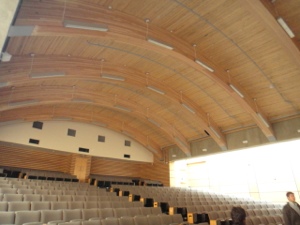
I am reminded of my visit to UBC CIRS building in Vancouver last year and the gorgeous timbers in the atrium and main hall, timbers ‘salvaged’ from local forests affected by pine beetle disease and closely monitored by the Living Building Challenge.

As we launch Living Building in the UK with a UK collaborative, it may well be that the certification of future green buildings in the UK is through standards such as the Living Building Challenge, that give hard earned recognition to buildings and facilities that, like plants, contribute to making the world a better place.

The CIRS Building was recently profiled in our CKE Green Vision series with a presentation from Max Richter at Perkin+Will.

Green Vision is a key driver in launching Living Building thinking into the UK. Look out for more announcements at the next Green Vision conference event on the 12th Dec in Leeds and across the web. (Hashtag #GVis2012)

For more information on the Living Building collaborative in the UK, leave a comment, get in touch or pop over to our Living Building UK Collaborative page on Facebook and say hello.

Construction Carbon Cost and Risk Management

Having effective scenario planning in place within a construction business is essential to developing effective forward looking strategies that protect the business into the future and provide resilience against change.

One of our current uncertainties is related to the price of carbon, and how once the price of carbon has been fixed, how that will impact your business and project costs. It is now only a matter of time before carbon costing becomes established as an indicator and ‘repayment’ cost for your environmental impact

As with the increase cost of waste management over the last decade or so, cost of carbon will, most likely be a supply risk and cost.

The concept of shadow pricing is not new, (based on the lifetime damage costs associated with greenhouse gas emissions)  Applying a shadow cost to your carbon emissions now will enable you to action plan and reduce carbons, reducing exposure to future costs  hitting your business.

A good place to start is through measuring and understanding your project construction carbons with Constructco2 and then applying a carbon cost of £10 per tonne.  If you haven’t measured your construction carbons as yet (why not?) then use the ConstructCO2 benchmark of 96.7 Kg/£K project spend.

How would that cost affect your business? How would you manage projects with this additional cost, and importantly what actions would you take to reduce your project emissions?

Perhaps we should be asking the question will you start?

Many of the contractors, clients and subcontractors we support through constructco2 are seeing cost and bidding benefits. (More)

Useful Background Reading:

Based on recent Huffington Post article  The Benefits of Carbon Shadow Pricing Tyler Elm and Jim Harris

DECC: Carbon Valuation

BIM Survey – More Contractors than Architects using #BIM


A recent, still to be published survey shows some very interesting BIM usage stats:


  • The percentage of companies using BIM  is now 71%, which is a jump when comparing previous statistics, with 17% in 2007 and 49% in 2009.
  • More contractors (74%) are using BIM than architects (70%) for the first time.
  • 49% of BIM users have five or more years experience using it.
  • Almost 40% of BIM users are heavily committed to using BIM, doing over 60% of their work in BIM.

This new research conducted by McGraw-Hill Construction shows that there is a rapid increase of Building Information Modeling (BIM) usage by architects, engineers, contractors and owners in, you may have guessed –  North America.

But for us here in the UK, I find this interesting:

  • With increased use, will BIM prove to be more attractive, and deliver more benefits to contractors than architects?
  • With our current push on BIM with the 2016 target for level 2 BIM, could we see usage in the UK at a similar 71% level?
  • By time we do get to 2016, we will have a good stock of experience of BIM users, ie those adopting BIM or BIM approaches now!
  • As we move more to documentation systems and working in collaborative spaces, working predominantly within BIM’s could be the way we will work within AEC sector in the very near future

PQQ Specification PAS 91 now to include BIM

I have blogged a number of times on PAS 91, the Publicly Available Specification for PQQ’s, (eg here) and on BIM, Building Information Management, (eg here – What is BIM)

But … until now separately …

It is encouraging to note then that Construction Manager published news that the new version of PAS 91 will include BIM, asking bidders on their experience of using Building Information Modelling.

Although PAS91 has maybe not had the take up anticipated, its influence on other PQQ’s is noticeable. Hence the inclusion of BIM into the PAS can only reinforce the importance and the need to act on BIM, from both clients and contractors.

A consultation on the draft version of the updated PAS91 has just concluded. The drafting committee convened by the British Standards Institute, which  authored the original form, will study the comments and issue a final version before Christmas, according to Brian Such, project manager at BSI Standard Solutions.

The draft asks about an organisation’s understanding, capability and willingness in BIM, said Such. “In the last two years interest in building information modelling has grown rapidly – and it felt appropriate and helpful to expand in this direction.”

The government has mandated BIM on all public projects from 2016. (See the Government Construction Strategy)

Proposed new version of PAS 91:

Required

•  Supplier identity, key roles and contact information

•  Financial information

•  Business and professional standing

•  Health and safety policy and capability

Optional

•  Equal opportunity and diversity policy and capability

•  Environmental management policy and capability

•  Quality management policy and capability

•  Building Information Modelling

Notes:
 
I am currently assisting a number of contractors in developing a BIM preparation strategy, based on collaborative working principles and approaches.
 
I recently co-authored a NFB Guide to PAS91:2010 which will be updated following issue of Revision 2
 
If you would like to know more, or receive an outline of a preparation strategy please do get in touch via email or twitter
 
A copy of PAS91:2010 can be downloaded from the BSI site

Sustainability: Closing the Circle

Barry Commoner, scientist-activist, whose ability to identify and explain complex ecological crises and advocate radical solutions made him a pillar of the environmental movement, died last week. Source

Commoner whose seminal 1971 book, “The Closing Circle: Man, Nature and Technology,” argued for the connectedness of humans and the natural world.

Commoner was particularly known for boiling down his philosophy to four simple principles as he wrote in “The Closing Circle.”

Four simple rules that still have huge relevance today in the world of built environment sustainability and resilience:

  1. Everything is connected to everything else.
  2. Everything must go somewhere.
  3. Nature knows best.
  4. There is no such thing as a free lunch

Simple Rules:
Through facilitated workshops, we can help you explore a ‘simple rules’ approach to dramatically improving effectiveness of your processes and procedures, increase buy in whilst reducing red tape bureaucracy.
Behind seemingly complex issues there are simple rules. The concept of Simple Rules is a key principle within complexity and emergence thinking. The oft cited simple rules being those for flocking birds. 
This blog series will explore application of simple rules to sustainability and the built environment. Based on the premise: if we were to discard all strategies , policies, processes, procedures, work instructions and checklists, what simple rules would emerge or would we need.

Simple Rules: Addressing Sustainability

Addressing climate change, environmental harm and sustainability can seem far to difficult and complex to tackle, so often we dont, or we do so with approaches that are masked by process and checklist.

Daniel Goleman, in Ecological Intelligence gives us three simple, yet remarkably comprehensive rules for reducing impact:

1. Know your impacts

2. Favour improvement

3. Share what you learn

Imagine the power of everyone in your organisation fully understanding the environmental impact of what they do, favouring improvement to address (over doing nothing) and continually sharing with colleagues, supply chain, clients and the wider industry.

In respect for sharing, social media has enabled unparalleled learning and sharing for sustainable improvement, something the built environment is just awakening to.

Does your organisation have Ecological Intelligence and a set of simple rules for reducing environmental impact?

Simple Rules:
Through facilitated workshops, we can help you explore a ‘simple rules’ approach to dramatically improving effectiveness of your processes and procedures, increase buy in whilst reducing red tape bureaucracy.
Behind seemingly complex issues there are simple rules. The concept of Simple Rules is a key principle within complexity and emergence thinking. The oft cited simple rules being those for flocking birds. 
 This blog series will explore application of simple rules to sustainability and the built environment. Based on the premise: if we were to discard all strategies , policies, processes, procedures, work instructions and checklists, what simple rules would emerge or would we need.
Next: Simple Rules for Business Improvement
 

Now is the future of construction

All too often I hear construction talk of how things will be better and back to normal when we emerge from the current tough environment, with a strategy of retrenching, waiting and picking up again in good times just around the corner.

Wrong – this is the future, right now, and only those who adapt and embrace change will find a better working environment, and turn the corner to find those good times. As Einstein said, doing the same thing over and over again hoping for better results is just plain insanity.

I was reminded at yesterdays Constructing Excellence Collaborative Working Champions meeting that the Never Waste a Good Crisis  – Challenge to the UK Construction Industry is now three years old – and the message is still as viable and important as ever.

Embracing change across so many facets of business today is vital for future success, but particularly in the sustainability and responsibility arena. As Michael Townsend wrote only yesterday on the Guardian Sustainable Business blog, companies that prosper in future will be the ones that take action on sustainability now, and asks the question:

Should construction companies remain engaged in the net depletion of resources, or move towards becoming a zero-adverse impact facilities business within the circular economy?

Understanding change and adapting for the future is a big ask for many organisations within the built environment, and we have yet to see breakthrough case studies. However, many are now embarking on the first step of increasing awareness of change, and through the Fairsnape Route to Zero approach starting to map out a strategy.

Celebrating social media in the built environment

Only two days left to our Be2Awards, 2012 Social Media awards event in London at the Building Centre,  kicking off at 1.30pm.  As with our 2011 awards, the event, part of Social Media London Week, will be an inspiring combination of TEDx style talks and a celebration of what is good in the world of built environment social media.

Recognition will be paid to the crowd-sourced winners from 12 categories, from best use of twitter, best sustainability blog, best use of media, and many many more. The Be2Talks presentations will cover BIM, Bikes, Social Hiking, Coffee, Green Deal and more.

The event will use the #be2awards  hashtag and will be live streamed, live blogged and tweeted. Check out our event page for more information.

Can there really be a better place to be on a wet Wednesday afternoon in London? Spaces still available here.

By the way, if you havent voted yet, you have under 12 hours left – so take a look at the excellent short-listings and be inspired as how social media is being used today.

And, if you are looking to make a day of social media in London – check out the Guardians Social Media for Sustainability event, taking place just up the road on the morning of the be2awards, with enough time to grab a drink and sandwiches you head over to the Building Center!

Be2Talks Presenters:

Richard Saxon CBE – “Growth through BIM”

Richard SaxonRichard Saxon is an architect and urban designer. He now works as a client adviser after a career at BDP (chairman 1996-2002), the RIBA (Vice-President 2002-8) and Be, Collaborating for the Built Environment (chairman, 1999-2005). He was made a CBE in 2001 for services to architecture and construction. He is on the board of the Construction Industry Council, is currently advising BIS on the growth potential of BIM and was recently appointed the CIC’s “BIM Ambassador”.

Carlton Reid – ”Cycling, the built environment and social media”

Carlton ReidCarlton Reid (@carltonreid) has been writing about bicycles and travel for 20 years. He has written for many cycling and travel magazines and UK newspapers including The Guardian and The Independent, and is the author of several books on travel and cycling. He is executive editor of BikeBiz.com, editor of Bikehub.co.ukQuickrelease.tv and iPayRoadTax.com. Author of the acclaimed Bike to Work Book, his latest project is Roads were not built for Cars. Carlton will present our Be2Bike Keynote on the growing application and importance of social media in the world of cycling.

Phil Sorrell – ”Geo-blogging”

Phil SorrellPhil Sorrell is the creator of Social Hiking – Share Your Adventure, a website for sharing outdoor adventures live using social media and GPS tracking. He is an experienced web developer, writes a blog about the outdoors and fundraises for Multiple Sclerosis charities. @daylightgambler

Liz Male – ”Why repair, maintenance and improvement is vital”

Liz MaleLiz Male (@LizMale) will talk about the rise of the RMI (repair, maintenance and improvement) sector – its new-found political, social, economic and environmental importance, and the opportunities and risks this creates for UK businesses in the built environment, including those linked to the imminent Green Deal initiative.

Liz is Chairman of TrustMark, a not-for-profit organisation licensed by Government and supported by consumer protection groups which helps people find reputable local tradesmen to do work on their homes. She is also a PR consultant with specialism in sustainability in the built environment.

Mark Stodgell – ”BIM, blogs, bikes and Pozzoni Architects”

Mark StodgellMark Stodgell was an early adopter of building information modelling and of social media, having used Twitter (he’s@Stodgeblog) and LinkedIn to raise the profile of Pozzoni in the BIM world. He will talk about how the technologies complement each other.

Mark works at Manchester-based architects’ practice Pozzoni Architects, and started using the internet to find about orienteering in Finland. In his spare time, he is a member of Great Britain’s mountain bike orienteering team.

Nick Katz – ”Honest Buildings”

Hear about Honest Buildings: a real estate network connecting professionals to new business opportunities and information for over 700,000 buildings across the US, and now with an office in London.

Honest Buildings was founded in 2011. Nick Katz (on Twitter, he’s @NicholasKatz), formerly at UK Green Building Council and then senior sustainability advisor for Colliers International, is associate director leading UK market development for Honest Buildings.  Nick believes that, through sharing information freely and showcasing great building projects delivered the world over, the bar for building performance will be raised globally.

BeAward Categories:


BE2 are the social media advocates behind the Be2camp movement. Since 2008, Be2camp has been championing the use of social media Web 2.0 in the Built Environment (hence Be2).

Since the first Be2camp unconference in London in October 2008, Be2camp people have organised more than 30 events focused on promoting collaboration and co-operation within a better, more sustainable built environment. Key topics have included education, building information modelling, property and real estate, facilities management, the Green Deal, marketing, and river basin management (among other things).

Founded by four practitioners (two in the UK, one in Australia and one in the US), the Be2camp online community is now nearly 700 strong with members around the world.