Author Archives: martin brown

Half of Multinationals to Choose Suppliers Based on CO2 Emissions

Why monitor construction carbons:  Shortly after writing a comment to a linkedin group on the importance of measuring and understanding construction carbons, through tools such as ConstructCO2, indications of increased focus on carbon performance popped up in a tweet (via Julie Urlaub @TaigaCompany ) regarding an Environmental Leader post that referenced Carbon Trust Report: Half of Multinationals to Choose Suppliers Based on CO2 Emissions 

According to the study, a full half of multinational companies plan to select suppliers based on carbon performance, and that 29% of suppliers are likely to lose their places on green supply chains if they do not have adequate performance records on carbon.

In the U.K., 56% of multinationals said that in the future they expect to drop suppliers based upon low carbon performance, with 74% of the U.K. respondents quoting shareholder pressure as a key driver for them in tackling carbon emissions.

And, although the report has a focus on multinationals, it is not irrelevant to the built environment

Next month Marshalls Plc, a supplier of hard landscaping, will be hosting a United Nations Global Compact Supplier event to educate first-tier suppliers on its approach to environmental issues.

As I posted to the Think Zero group on Linkedin, I still have to hear a good reason why we should not be measuring construction carbons.  Are you tracking your carbon performance – do you have the evidence?

Read more: Carbon performance offers major risk or reward

Green Deal Update Sources

Slowly green deal details are emerging.  A number of people and organisations have asked me for good reliable Green Deal update sources.  Across the web the situation still seems very patchy and I guess will remain so until we have further news from the government on the Energy Bill and release of PAS 2030 for consultation for example.

UPDATE: PAS 2030 Issued for Consultation

However, here is my list of sources as a starter for 10.  If you have any to add (that are informative rather than outright service/product/training ‘sell’) please add to comments and I will incorporate.

DECC Green Deal 

DECC Green Deal Advisory Forums

Energy Savings Trust Green Deal 

Green Deal Guide Green Deal Guide

Microgeneration MCS Certificate Scheme

Asset Skills – Green Skills

The Guardian Sustainable Business Built Environment Hub

Social Media (Blogs, Forums and Twitter):

Green Deal Linkedin Forum

Fairsnape (this blog)  eg: CSR – the hard, the soft and the CSR

Great Green Deal (PB Energy Solutions Blog)

Green Deal Twitter List (curated by me @fairsnape)

Green Deal News Weekly (Twitter  based Paper.li) (curated by me @fairsnape)

Green Deal Providers (Blog)

Future Fit Blog 

Passive House Whistler (and bears!)

I was delighted to be able to visit the Austrian Passive House in the Lost Lake area of Whistler during our recent RV travels through British Columbia.

The house was recently gifted to Whistler from the Austrian Olympic Team and provides club room for mountain biking and nordic skiing clubs.

It was designed as a family house for 5 and used as the HQ for the Austrian olympic committees, teams and press during the 2010 winter games.

Claimed to be the greenest building at Whistler, the Austrian Passive House was designed in Austria but built by local contractors using imported materials (incl timbers?) from Austria. ‘Legacy’ crops up on all the web search, that the building outlive the Olympics and provide demonstration of passiv haus concepts, using less than a tenth of energy an equivalent local Canadian house would use. It was the first (and only?) Passiv Haus accredited building in Canada

The Austrian House dominates a key entry point to the Lost Lakes area that provides stunningly smooth singletrack biking (and I guess XC skiing in winter). I couldnt shake the apprehension however of cycling around a singletrack bend into a bear. We had seen plenty of bears on our travels, including at Whistler, and the fresh bear scat, along with the ripening berries, a favourite bear treat in a food-stressed area, added to the apprehension.

Links:

Austrian passive house   The Greenest House at the Games 

Whistler Bears : Bear death toll continues to rise

Construction Video

Construction in Crisis? BIM the solution?

Construction in crisis? buildings too complex? communication of knowledge rapidly changing? (Thoughts from the road)

Whilst I have long being a supporter of the need for the aims of BIM, it has been as seeing BIM as a technoloy to enable and enhance, better, improve collaborative working, not in a means to itself. In fact many agree collaboration in a digital age is or should be 80% people 20% technology.

In other blog posts here I have mentioned my thoughts on how BIM should in fact be FIM, Facilities Information Modelling, as the models set out or should set out the way the facilities will be used, managed, improved, adapted over time etc, not just the building. Ie the people aspects of building use. ( a recent example from a building designed on CAD, not quite BIM, being a student quiet zone for thinking and meditation littered with in the face fire exit signs and a large red fire panic button)

That BIM is being seen with both fear and salvation is interesting but not surprising, it will after all change the way the built environment sector works, and importantly works together and collaborates.

And yet BIM is perhaps just as the word processor is to creative writing, it may enable the articulation but not the creativity.

For BIM to be effective the people issues and desire for collaborative working need to be in place, to be well grounded and to be effective. To leap straight into BIM can be as ineffective as trying to write a creative masterpiece just because we have a new tool or piece of software available in the toolbox

Admist all the noise, news and promotion of BIM as a technology its therefore refreshing to read Randy Deutsch brilliant, BIM and Integrated Design, but perhaps his short but powerful summary that not only sums the book, but provides light on issues facing design, construction and fm. (extract below but view the article here: http://ow.ly/1vVNMJ)

(Update: Randy has reminded me You can read the first chapter here. Or buy a copy discounted online at Amazon, at your local bookstore or from the publisher.)


Q: How would you summarize your book in a single sentence?

A: The focus throughout this book is on people and the strategies they use to manage and cope with the transition to the new digital technology and the collaborative work process it enables as they initially adopt and then take the technology and process to a higher plane.

Q: Why do we need a book like this now?

A: There’s a crisis not only in the economy but in the profession. Buildings are becoming more and more complex and the way we communicate knowledge to one another is changing. At the same time the construction world is going through enormous changes, so is our environment.

We’ll only be able to tackle today’s complex problems through collaboration, and that takes work and a prepared mindset. You have to be disciplined, can’t just show up and wing it. Your teams’ efforts have to be coordinated and integrated. I noticed that there is a gap in learning along these lines in the profession and industry and this book seeks to fill it.

Q: There are a number of books that cover the subject of BIM. How is this one different?

A: Most books on BIM cover the technology or business case while this one focuses on the process that enables the highest and best use of the technology. BIM and Integrated Design focuses on the people side of the change equation, addressing BIM as a social and firm culture process and does so in four distinctive ways:

it addresses people problems, human issues, issues of communication and collaboration, firm-culture issues, issues of motivation and workflow related to working in BIM;

it explores the most commonly encountered obstacles to successful collaboration, as well as the challenges this technology and process create for individuals and organizations in their labor toward a comprehensive, successful BIM adoption and implementation;

it describes the social impacts and implications of working in BIM on individuals and firms, and how to overcome real and perceived barriers to its use; and

it discusses challenges to BIM collaboration including interoperability, workflow, firm culture, education, technological challenges, working in teams, communication, trust, BIM etiquette, one model versus multiple models, cost, and issues concerning responsibility, insurance, and liability.

Twitter Building Down Barriers

A few tweets caught my eye on Friday between two SELCA (SE Lancs Construction Association) members, nothing really remarkable in content, but what was interesting was the exchange was between  joinery and bricklaying contractors, @rlmbrickwork and @tmjcontractors. As was mentioned, such conversations just wouldn’t happen on site.

That got me thinking, I have long maintained that organisations cannot really collaborate (few are designed to collaborate), hence the need and importance of last planner approaches, but that its people across organisations that collaborate, and of course that social media can only foster and enable more person to person connectivity.

And real collaboration.

So thoughts mused on how twitter can be used to enhance the last planner approach, enabling real time sharing of progress and issues between subcontractors. eg

@joiner: will the 2nd floor be ready for us on Tues as planned?

@plumber: @joiner first fix complete on for you to start in tues morning. Spoke with @electrics who will be done too. Good to go 

 @joiner; great thanks, will have a couple of guys there

 @contractor: delivery of plasterboard expected for 10am, loading out to level 2 for you

 @joiner @contractor ok, we can help offload ?

Dreaming or Potential? I know many SME contractors who dismissed the idea of any weekly last planner type sessions with subcontractors a few years back, but now see them as essential to construction project management. Maybe in a few years twitter will be a key project tool …. ?  (After all if  social media can be used to organise flashmobs, even dare I say riots, then surely we can use it to coordinate construction projects?)

Last Planner: There are many definitions of Last Planner in the context of lean construction, but essentially its about collaborative working, planning, scheduling and progress reviews with trade supervisors – the last planners – to reduce costs and delays, waste in its widest sense and add value. Often run as a series of weekly or daily planning and progress sessions on site.

Twitter Building Down Barriers: By the way the title above is purposely taken fromBuilding Down Barriers, a 1997 (just pre Egan) action research initaive to remove barriers between construction players that has shaped much of todays Modern Methods of Construction Management thinking.

Construction supply chain footprints

Our construction carbon tool, Constructco2, through its ability to monitor a projects supply footprint is throwing up some interesting issues:

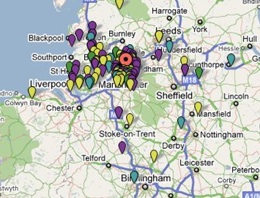
Take a look at a project footprint that has a focus on localism – ie in keeping material, supplier, management and even waste transportation as close as possible to the project:

And then one that doesn’t (which is actually less in construction value):

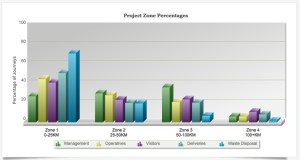
Across the 80 or so projects on the site we can start to see the travel pattern for materials, people and waste, and how close to the project …

All this starts to position Constructco2 as a possible valuable CSR tool and indicator, monitoring impact of projects on local communities, and starting to raise issues of procurement, appropriate sourcing / specification as well as good on site project management housekeeping

These notes are extracted from my recent ConstructCO2 presentation that is available to view on slideshare. 

For more on information please get in touch or visit Constructco2,and follow links.

Green Deal Bulletin July 2011

Green Deal Update news received from DECC.

Does this mask the slowing down of Green Deal preparation or announcement for Green Deal in October 2012?  The consultation with the industry and public is a key milestone, yet this remains ‘the Autumn‘ rather than a specific date.

Green Deal Bulletin July 2011

“We’re now expecting that we get Royal Assent for the Energy Bill, including the primary legislation for the Green Deal and Energy Company Obligation, early in the autumn. I do not expect this will make any change to our plan to bring in the Green Deal in October 2012. It also remains our intention to consult on secondary regulations in the autumn, and I encourage you to write to us during this process with your views”.

Greg Barker, DECC Minister

Moving forward on legislation and consultation

The legislation setting out the framework for the Green Deal and Energy Company Obligation (ECO) has continued its passage through Parliament and has now completed the Committee stage, which saw line by line scrutiny of the Energy Bill and Green Deal. All parties agreed they wanted to see the Green Deal be a success, although naturally there was a range of views about how exactly this should be achieved.

The next stage is Third Reading and Report, then into the Lords and finally Royal Assent. Following this, we intend to consult with you in the autumn on a range of secondary legislation which will set out the detail of how the Green Deal and ECO will operate.

Listening to stakeholders

The Minister of State, Gregory Barker has met with a range of stakeholders to discuss progress and next steps. These have included senior representatives from the likely new entrants to the Green Deal market – including Kingfisher, Birmingham City Council, Travis Perkins, Carillion and Marks and Spencer.

The Minister also met with a range of senior representatives from the Social Housing Sector, and enjoyed the opportunity for open dialogue on the opportunities presented by the Green Deal.

Protecting Consumers

It’s vital that consumers have confidence in the Green Deal. Over the summer we will further develop our approach with the Energy Ombudsman Service, the Financial Ombudsman Service, Ofgem and the Office of Fair Trading (OFT) to ensure the consumer protection framework is robust and sufficient to protect all consumers.

Developing Green Deal Finance

We are in the process of commissioning expert advice on assessing the fraud risk in the Green Deal and ECO. We launched an invitation to tender for assessing this risk at the end of July and plan to have consultants appointed by the end of summer with a report requested during the autumn. This will be used for guidance for commercial parties, helping us to ensure we are on the right lines and provide financial assurance to interested parties.

Green Deal, the ECO and the Prime Minister

In July the Secretary of State presented the Green Deal and ECO policy to senior Ministerial colleagues, including the Prime Minister, Deputy Prime Minister, Chief Secretary to the Treasury and engaged in a discussion about progress to date and next steps. The session also heard from external stakeholders.


Great Green Deal Re-Skilling?

Following on from the depressing news that Construction lacks green, key business and foresight skills, in particular 43% of employers dont feel they understand the implications of green issues, or ability to identify the training needs, are we facing a green deal barrier?

Need for New Skills

We read in the Low Carbon Plan from the Government, (“much re-skilling of the construction industry to deliver the planned targets of greenhouse gas reduction by at least 34% by 2020 and 80% by 2050″),  from the IGT Report of the need for green skills, we read that PAS 2030 and Green Deal codes of conduct will access sustainability skills, training and development. The FMB Cut the Carbon programme focuses on the need for new skills.

Will it turn out OK?

Rob Hopkins in his Transition Handbook, (see my blog back in 2008 time for built environment transition?) in a futures scenario talked about the Great Construction Reskilling, the NEF paper, How it all turned out ok celebrates how we recovered our lack of traditional skills, succeeded in addressing the localism issue and turned energy ineffective buildings into models of zero carbon. (again my blog: How it all turned out OK in 2050)

Who is defining …

But do we have an understanding of what green skills mean? Is it just an understanding of good sustainability awareness (eliminating waste, reducing carbon, buying local etc), Is it technical, natural materials (see the Transition Culture archive for reskilling) or is it something more deeper, profound.

Green Re-skilling starts at the board level…

Do we imply the reskilling is just for operatives, or wider to include supervisors, managers and (in my view essential) board directors and senior managers? Maybe this isn’t a training issue to be lodged with the HR team but one of crucial CSR strategy for organisation? (see A Low Carbon Diet For Construction Boards)

A question then …

What are construction boards, contractors, installers, training organisations, industry bodies doing, plan to do, or indeed have done to understand and address sustainability skills.

Construction lacks green, key business and foresight skills

Construction lacks essential skills. A recent poll of 1,450 construction employers, conducted by Construction Industry Training Board and Sector Skills Council, CITB-ConstructionSkills, skills gaps such as understanding the implications of green issues (43%), identifying potential new business (39%) and not having sufficient IT skills (43%) were all areas picked out by industry managers and supervisors as lacking in their organisations.

In addition, a third (32%) of employers said that keeping up to date with the latest innovations, products and techniques was an important concern for their business. A further 32% also stated that their management team’s ability to identify the training needs of staff was an area that needed improvement.

Begs the question what have we been doing in the world of construction improvement over the last two decades since these skills were identified in seminal reports, eg Egan , Latham and others.

Importantly it also demonstrates a lack of awareness and vision at board, owner or senior management levels to identify, acknowledge and prepare for emerging trends, particularly in the sustainability, IT and social media arena.

Links:

A Low Carbon Diet For Construction Boards (CSRWire post by Martin Brown)

Future Proofing the Boardroom – Part One: Grounding and Stargazing (CSRWire post by Lucy Marcus)

Link to CITB 

What is Green Deal: the hard, the soft, the CSR and the terminology.

Just what is Green Deal? Associated with my support for organisations developing strategies and implementation plans for ‘transition’ to eco refit or green deal work, the following documents are proving very useful indeed.

Getting Ready for Green Deal (Fairsnape and PBEnergy)  Is your organisation ready and equipped to work in green deals? Check against our top tips.  Time to green your board. It is absolutely essential that your Green Deal approaches are fully supported and sponsored by a board level director or equivalent. Green Deal has to be a key element of your CSR and Business strategy, not a bolt-on or suck and see approach.

What is the Green Deal and how will it work? (greenenergynet.com) Gives a general overview of what will be involved in Green Deal, who it is aimed at and useful terminology

Behaviour Change and Energy Use (Cabinet Office Behavioural Insights Team). Its not all hard technology and finance as this recent publication demonstrates. Energy reduction alongside Green Deal is one of behaviour change, nudge approaches and good CSR understandings.

This paper draws on evidence from behavioural economics and psychology to outline a new approach to enabling people, at home and at work, to reduce their energy consumption and reduce their bills in the process.

Behaviourally based changes that reduce emissions have major advantages. First, the benefits can be very fast, unlike major infrastructure changes that can take years, or even decades – a 1% gain today is worth more than a 1% gain tomorrow. Second, they can be highly cost-effective. Third, they can provide savings and other benefits directly to citizens

Green skills ‘essential’ to carbon-conscious building industryRecent Guardian Sustainable Business article.

Green Deal Terminology

Improver – The household, business or community that carries out energy saving measures through the Green Deal.

Green Deal Provider – This is the organisation funding the Green Deal. They could be your utility supplier or commercial companies, charities or social landlords.

Accredited Advisor – This is the person who recommends energy saving measures that could be carried out on an improver’s property. The advisor would document the energy saving measures on an Energy Performance Certificate which he would pass on to the Green Deal Provider and Improver.

Accredited Installer – Approved contractor who carries out measures recommended by the accredited advisor. The Green Deal provider could be the Accredited Installer but could also contract this work out. Whoever the Accredited Installer is the contractual agreement is always between the Improver and the Green Deal Provider.

The Green Deal Plan – The Green Deal Provider offers the Improver a Green Deal Plan. This includes arranging an accredited advisor and installer. It also includes the financial and contractual agreement between the Green Deal Provider and Improver.

The Golden Rule – The financial savings derived from the Green Deal energy saving measures recommended by the accredited advisor must be equal to or more than the cost of implementing the energy saving measures and the repayments must not be longer than the expected life span of the measure.

For more on Green Deal awareness of support