Category Archives: comment

ConstructCO2 wins social media award at #Be2Awards

photo

Delighted that ConstructCO2 picked up a social media Be2Award  yesterday for the best ‘internet of things’, location-based or mobile app.

“Runner-up a few years back, ConstructCO2 has now moved on considerably. It has matured its monitoring of Construction Carbons at project, offices and company levels. It is now operating globally with projects in the UK, Europe, Americas, Far East and Australia.

However, the significant development this year is on the localism theme and the ability to monitor construction spend throughout the supply chain, based on project and supply chain locations, on set radials from the project.

Securing a Be2 means we successfully gained the recognition and endorsement of a substantial online community.”

The Be2Award trophy is made from recyled glass by Bottle Alley Glass in Yorkshire (websiteFacebook orTwitterwho sponsored the awards.

The best ‘internet of things’, location-based or mobile app was sponsored by Tekla 

Construction21EXPO – the first virtual tradeshow for Green Buildings for the whole of EUROPE!

Construction21EXPO.eu EUROPE - logo

The “business case” for green buildings is understood by many of Europe’s leading project developers. Now we need to quickly enable design, construction and management teams to deliver the expected results for green new construction and renovation projects.

Construction21EXPO will bring together, in a cost efficient manner, green building investors, designers, solution providers and the many other important stakeholders in a two day virtual expo; saving money and eliminating travel time and associated carbon emissions with physical meetings.

UK_collaborative_logoWe are delighted that the UK LBC COLLABORATIVE* is a key UK  partner in this exciting project that is  supported by Green Building Councils and Construction21 Chapters across Europe as well as many other expert organizations.

As such we can offer additional discounts on the Exhibitor fees, but be sure to obtain a discount code from us prior to registering.

Watch the promotional video here  and download the Construction21EXPO_ Introduction for more information,  and do not hesitate to contact the EXPO team listed in the introduction document with any questions.

The UK LBC COLLABORATIVE is driving Living Building Challenge awareness in the UK and is hosted by the Leeds Sustainability Institute, Green Vision, Fairsnape, CKE and Be2camp

Grey to Green sustainability – revisited

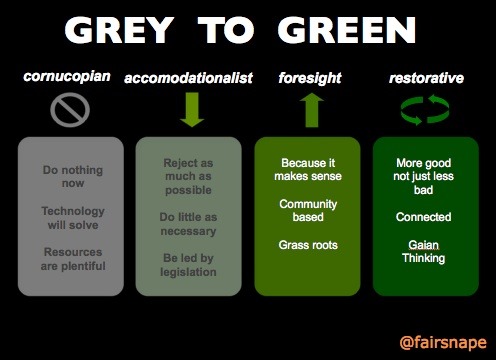
Grey to GreenWhere are you on the Grey to Green spectrum is a question I often ask at sustainability and CSR sessions with clients or in workshops.

Cornucopian Thinking: The glass that will always refills itself no matter what we do. Indeed the natural and financial environment will turn full circle and everything will be ok again. In fact we need do nothing different now as some emerging technology (carbon capture perhaps?) will make all of our problems go away. And if our customers and staff don’t like the way we operate, then, well, there are always the competition to turn to.

Accommodationalist Thinking: To accommodate the minimum, often to stay within the law, comply with ISO standards and satisfy the minimum requirements of our customers and staff. A key to this pattern of thinking is where sustainability and CSR sits within the organisation. Sitting alongside Health and Safety functions (for convenience) then it will always remain a bolt-on, which makes it difficult to move to a role that has a voice at a board level.

Foresight Thinking: Thinking based on the premise sustainability makes good business sense. Moving beyond the minimum and starting to embed CSR within the organisation. CSR and sustainability, as a function, sits at the centre of the organisation, often a dedicated CSR post with a voice at board level. Business impact understanding goes beyond the environmental and includes assessments on, for example, diversity or equality impact.

Restorative Thinking: Stems from the realisation of a greater holistic good as the driver for CSR approaches, alongside a recognition of connection with nature or the planet. There is a growing number of businesses in this thinking, epitomised for example by the 1% for the Planet group of organisations. In fact, I often give a copy of or recommend reading Yvon Chouinard’s Let My People Go Surfing to those I work with.

The Living Building Challenge, the most rigorous of green building certification schemes is firmly based on restorative thinking, doing more good – not just doing less bad.

There is a growing body of evidence linking good CSR and sustainability thinking to good business sense, but perhaps no one has summed this up so brilliantly and simply as Yvon Chouinard stated at Patagonia: “every time we do the right thing for the planet we make a profit.”

Tipping the Point

Somewhere along this grey to green spectrum there is a tipping point, where the switch from minimising the bad to maximising the good kicks in. I’d like to think of this as salutogenesis for sustainability and CSR. (Salutogenesis is an emerging and important school of thought within health care and increasingly within social well being that makes the switch from a focus on what makes us ill to a focus on what makes us stay healthy.)

In need of ideas on moving your business sustainability from grey to green?  Join in on the conversation on Twitter, subscribe to this blog (see right  hand column) or get in touch

(We can also help with Innovation Voucher funding to support your sustainability innovation ideas!)

Mindfulness for Construction Success

KONICA MINOLTA DIGITAL CAMERAMindfulness is fast gathering pace as a set of daily practices to manage stress, worry or to enhance daily living ‘in the present moment’. Organisations, large and small, including those in the construction sector are starting to explore how mindfulness can help with well being, sustainability and yes, improved organisational success. (For examples see articles listed below)

If you have read or heard about mindfulness and would like to come on a course to learn the techniques with others, then Anne Parker is running a course in Blackpool Lancashire. on the 5th October and 2nd November. The course will show you the techniques,  background information and then review your experiences and build on your practices further.

Perhaps you don’t know anything about Mindfulness at all and you would like to find out what it is all about then this is also for you. The content will allow for lots of questions and comments as well as being practical and highly participative.

More information is available from Anne Parker or view the event flyer here.

Anne will be presenting at the Be2Talks in London on the 25th Sept.

Articles:

Mindfulness: The Key to Long-term Business Success?

Upgrading the brains of global leaders 

Global technology CEOs seek out wisdom of zen master Thich Nhat Hanh

Award nominations for fairsnape projects

benchmarkI am rather in awe and delighted that a number of the social media and sustainability advocacy projects I am supporting have been nominated for Be2camp social media awards.

This fairsnape blog, started way back in 2005 as Excelsus and from 2007 as iSite, has been nominated for Best sustainability or built environment blog along with some excellent co-nominees!

The @fairsnape twitter account has been nominated for Best AEC use of Twitter

Green Vision -the brilliant deep green programme as part of Leeds Met and the Leeds Sustainability Institute is nominated for the Best AEC community, network or application

The Sustainability Leadership Conversation (#sustldrconv) initiative kicked off by Andrea Learned and myself earlier this year has been nominated as Best virtual or hybrid event

ConstructCO2 – the online construction carbon and geo-spend tool has been nominated for the Best ‘internet of things’, location-based or mobile app

and the excellent ThinkBIM  programme, web supported through be2camp with Paul Wilkinson and myself has also been nominated for the Best virtual or hybrid event

Please do take a few minutes to check out the nominations for this years awards and vote for those that inspire (hopefully those listed above!!)

(As social media advocates at be2camp we encourage the active online involvement of supporters, we didn’t follow  approach of many awards programmes – no decisions made by judges or panels in private here, the nomination and voting process for be2awards is crowd sourced across social media and is totally transparent and independent )

Where Greendeal should be …

08062008085

At many of the Green Deal workshops, roundtable discussions and presentations (eg More than Just a GreenDeal) I have led over the last year or so , I have challenged thinking with the question, how did we get to 2013 without a clear strategy in improving the efficiency of our existing buildings?

Its as though we waited for Green Deal then set about finding solutions. I know there has been masses of research and development in this area – but no clear agreed solution or strategy.

Many of the solutions are presenting themselves as technology or renewable solutions, rather than behavioural approaches. Have we put energy consumption behavioural science in the ‘too difficult’ or ‘not enough profit’  box?  The hottest new thing in energy efficiency may not be solar panels, wind turbines or eco bling — but computers. ( See Big data analytics and smart meters are allowing utilities to use more renewable power while reducing energy waste)

Encouraging then to see the Guardian Sustainability Business report “The power of behavioural design: looking beyond nudging” describing the powerful integration of big data, behaviour insight and mobile technology in pursuit of reducing energy consumption in homes and buildings.

The American energy software company, Opower, uses a powerful combination of big data and behavioural design to make consumers use less energy

The ambition of the collaborative project between Warwick Business School and Honeywell Building Solutions is to reduce the energy consumption of organisations by applying a combination of relevant technology and behavioural design

And this is just where Green Deal thinking needs to be thinking, on a hierarchy of behaviour, fabric and renewables – not the other way around as we appear to be at the moment – and quickly.

Constructing social media leadership …

OLYMPUS DIGITAL CAMERAOver the last year or so we have seen growth and a big change in attitudes to social media, with perhaps in twitter particular, now an accepted element in today’s communication mix.

Those who a few years back were adamantly against social media have now joined, often with a fanfare of “we’ve arrived, we’re innovative” (look at us!) and with some organisations once totally anti social media now proclaiming expertise in helping others.

Back in 2012 I wrote in the Guardian (Why the construction sector should engage with social media) that one of the barriers to social media take up, and hence by default a barrier to collaborative working communications,  BIM, learning and sharing  and general construction improvement is the reluctance of directors and senior managers to recognise, embrace or enable social media. Of course there are as ever some great exceptions to this,  But all too often directors have tinkered out of curiosity, and empty LinkedIn and twitter accounts set up now tell a different story … of organisations and directors who are poor communicators.

So why are built environment organisation leaders slow to embrace these communication platforms? Maybe its the:

Need to retain control – the beauty of social media is in its open sharing, we can never know who staff will reach, converse with, learn from, share with, collaborate with and how those we converse with will respond.

Lack of understanding Digital communications is expanding rapidly, beyond the understanding of many. Consequently many directors feel vulnerable in engaging with something they don’t understand, so stay away.

Fear of just being a fad. Without a clear vision of how social media will evolve, and how it can be used strategically to benefit an organisation, many directors are reluctant to invest in seemingly unchartered waters.

And all this is sad for a 21st century construction sector, where communications are so often the root cause of most of our problems, where most companies promote a vision of innovative, open, collaborative and where most directors sell themselves as enabling role models for innovation.

Social media presence is increasingly used as a good test of an organisations, and indeed the organisation’s leaders  claims within PQQ’s, Bids and PR material to be innovative, having effective internal and external communications.

Earlier this year we started Sustainability Leadership Conversations, powered by social media, to enable leaders of smaller built environment organisations to engage with the sustainability conversations that take place across across social media. Initially these are  monthly twitter conversations with leading individuals, but will expand to facilitate conversations between organisations, between UK and USA SME organisations. Join us and discuss on the 01 Oct  for our next sustainability leadership conversation by using and following the #SustLdrConv hashtag.

Having a strategy for social media in your organisation is essential, as it is with other initiatives, and should be the starting point for adopting social media approaches. To discuss support for getting your strategy underway, get in touch (Martin in UK, Andrea in USA)

If you are UK based, we can help you apply for Innovation Voucher funding to ensure your social media, digital communication and BIM journey sets off on the right footing. (Next application closes in October)

Amory Lovins, Restorative Sustainability, System Thinking … and BIM

I recently came across this great quote from Amory Lovins at the Rocky Mountain Institute (and used in a recent BIM Beyond Barriers report)

“As we shape our buildings and then our buildings shape our lives, we can choose to create abundance by design, not scarcity through inattention.

We can design radically efficient buildings that take nothing, waste nothing, do no harm, and create delight when entered, tranquility when occupied, and regret when departed—yet cost the same or less to build, cost almost nothing to run, and make people happier, healthier, and more productive.

 The key is integrative design that optimizes the building as a whole system, for multiple benefits, rather than its disjoint components for single benefits. Many similar benefits are available in existing buildings, as RMI’s RetroFit initiative aims to spread.

 And Building Information Modelling (BIM) is a powerful tool for spreading these results worldwide

Amory B. Lovins
Chairman and Chief Scientist
Rocky Mountain Institute

RetroFit-Challenge_logoRGB

EMPOWERING THE LARGER COMMERCIAL BUILDING INDUSTRY

Seventy-five percent of global electricity goes to buildings, and at least half of that is wasted. We want to reduce building energy use by 50 percent by 2050. We believe that building owners can lead the way to meeting this goal and significantly reducing global carbon emissions while improving their bottom line. During the Challenge, RMI is testing a number of approaches for accelerating building energy efficiency to result in more effective, and more implementable, portfolio energy strategies. Our portfolio partners will help lead other building owners in changing the way we all use energy. Lessons gleaned from the Challenge will inform RMI’s own publications and educational outreach, providing a foundation for larger scale implementation projects that demonstrate the vision of Reinventing Fire.

JUST: a social justice label for construction …

Taking built environment sustainability deeper into the responsibility agenda, the International Living Future Institute are launching (Oct 2013) a new and important transparency initiative for the built environment to sit along side the Living Building Challenge and Declare. Just will provide clients, specifiers and procurers with ‘a view of how participating organisations treat their employees and where they invest their profits’

Just will cover the important areas of gender and ethnic diversity, salary equity, gender pay equity, community involvement, responsible investing and more, taking it beyond other programmes in the built environment sector. (And arguably areas that the UK Considerate Constructors Scheme should be addressing?)

The Press Release from ILFI reads:

In today’s global economy, it’s difficult to know what your consumer dollars are really supporting. JUST gives you an insider’s view of how participating organisations treat their employees and where they invest their profits. JUST works seamlessly with the International Living Future Institute’s Declare™ materials label and the next iteration of the Living Building Challenge™ (Version 3.0 — coming spring 2014).

By providing participating companies with a clear, elegant and informative equity ‘nutrition-label’, JUST aims to transform the marketplace through transparency and open communication. It aligns with the Institute’s Declare™ materials label to provide a holistic picture of both the products a company produces and the human story behind those products.
To participate in this voluntary disclosure program, an organization must submit documentation that asks for in-depth information about twenty distinct aspects of workplace equity and justice.
We’ll be launching the JUST label and searchable database FALL 2013. Join us in this critical initiative!
.

Excellence in Sustainability Leadership

low hanging fruitSince TQM days, the EFQM has remained my go-to framework for understanding organisational approaches, practices and performance. Of the nine criteria,  Leadership has always presented a challenge to those leaders not directly engaged and driving the organisations policies and strategies:

How Leaders develop and facilitate the achievement of the vision and mission, develop values required for long term success and implement these via appropriate actions and behaviours, and are personally involved in ensuring that the organisation’s management systems are developed

In 2004, the EFQM Corporate Social Responsibility Framework  was developed, giving more definition to sustainability and social responsibility leadership.

Excellent leaders ensure the mission, vision, values and ethics of the organisation reflect a socially responsible culture which they role model and reinforce with the organisations people and relevant stakeholders

They are personally involved in ensuring the management system addresses current and future social, environmental and economic issues

Leaders ensure that any organisational change takes into account CSR and Sustainability commitments.

What do you think? Does this criteria still hold good 10 years on ?

In preparing this post, as part of our Sustainable Leadership Conversation initiative, Andrea Learned challenged me to mention a  leaders I see as demonstrating these excellence traits. A tough call, but outside of the built environment I would include Yvon Chouinard at Patagonia (See Responsible Business),  within the built environment I would include Ray Anderson at Interface. Yet in everyday construction we can see signs of such leadership, for example with those at Marks and Spencers (PlanA), Adrian Penfold at British Land (open sharing CSR ) and leaders in SME organisations, making change through real engagement, (such as Malcolm Clarke at Baxall Construction in Kent)

Who would you nominate as a sustainability leader?

Join us and discuss on the 30th July for the first sustainability leadership conversation by using and following the #SustLdrConv hashtag.