Category Archives: comment

social media in the workplace

Workplaces need social media. Martin Pickard @FMGuru posted a question on twitter this morning on (should we) use Social Media in the Workplace in preparation for a debate this week. These debates are happening across all sectors, particularly so within the built environment, but I find it odd that we are have these debates at all and wonder:

  • What do I tell my son who is learning how to use facebook and how to blog at school, with QR codes to promote school sports day results, that when he starts work he wont be allowed to use such skills?
  • Did we have these discussions when the telephone or fax was introduced. (Lets send a hand written note around, get people together to explore whether we should allow the telephone on to sites)
  • Or indeed when email was introduced. I work with construction contractors who still do not allow computers on site, emails are send to an info@ address, printed in the head office and taken to sites by the contracts manager. We laugh at this now, but are we doing the same on social media?

Lets think about social media as collaboration and communication. Do we really want to have a debate as to whether we need ‘communication’ in the work place? Or whether we want people to work together, to collaborate?

Increasingly we shore up our policies and employee guidelines preventing the use of social media rather then guidelines on responsible behaviour. Better to have a workforce of ambassadors across social media than a frustrated annoyed workforce who criticise or worse during their own time or in their lunch times?

If we start to use the expression of ‘Real Time Web’ rather than social media it opens the door to thinking about using it as a tool for learning, sharing, communicating and gathering the intelligence an organisation needs (market, client, comptetitors, innovations etc)

Google have enabled Real Time as part of their search options. Staff can now see who has tweeted, blogged or shared anything they search for. Should we hence prevent the use of Google.  We cannot stop the use of social media or real time web, are we (as employers, managers, directors etc) just trying to stick more and more fingers in the soon to break dam?

Reading the traits of successful collaborative leaders for a piece of work with an innovative construction organisation and I see time and time again that a collaborative leader, (to which most built environment leaders would profess to be) is one that is connected, internally and externally across many sectors, through, yes, social media as well as traditional media. (Blog post to come)

Increasingly I am working with organisations who are waking up to the use of social media applications to improve winning work potential, from gathering leads/market/client/competitor intelligence, to gathering evidence for PQQ’s (from eg project blogs) to collaborative writing of responses and much more. (Follow me on @fairsnape for more on this)

Related links:

Using social media can help boards be better on sustainability. (CSRWire Talkback Blogpost)

Why FM needs to go social (a @be2camp FMX Article with @EEPaul)

Top 10: uses of social media to win work (check back after 23rd June after my session with Lancs Construction Best Practice Club)

The future is influence? my thoughts from #commschat

I listened in and contributed to a great twitter @commschat debate yesterday evening. The main focus of the chat was around the importance of influence and the place of Peerindex with @azeem.

Part of the commschat transcipt can be found here

Whilst the chat seemed aimed more at PR professionals (which I confess, I am not) a lot of the more technical comments passed me by, but one or two gems started me thinking, or rather confirmed some of my thinking on the importance of influence Particularly as social media use becomes more main stream in the built environment. Here then are my thoughts.

One take away was the concept of ‘Peer Influence Leaders’ which I now see as increasingly important in PR and indeed in social media generally.

A while ago I supported a Macmillan group in the Midlands on awareness of the use of social media in their fund raising activities. I suggested they look for the top 50 influential tweeters within their area and start following, start conversations, pick up on the twitter buzz and link their funding activities accordingly.

Until recently it has been difficult to determine just who are the top (twitter) influencers are in the built environment (construction, design, FM etc But with the curation of the tCntop100 lists for construction and architects we are starting to get an understanding.

OK we may not fully understanding the scoring or alogorithms yet, and the movement in the rankings (that would have kept Fluff Alan Freeman happy for many pop pickers) suggests influence is a fluid, transient thing. Indeed as mentioned yesterday it has to be earnt and sustained.

Now if construction, design, and FM organisations and or their PR companies look to get a good message, new product, award, sustainable achievement into the industry then by engaging with the say top 50 for that discipline, who in turn are more likely to retweet, mention or comment onward to their peers would make brilliant sense. Conversely are those not engaging with these influences are missing an increasingly important element of PR

In a chat with Paul Wilkinson @EEPaul, earlier today on this subject, Paul mentioned the concept of ‘Amplifiers’ ie those whose influence is such that they can amplify messages. I like this concept, and when coupled with a maven ….

This of course could bring additional pressure to those on the (tCn top100) lists who would not want to be used as PR publicity retweeters, and reinforces the need for engaging, building trust and relationships.

And, one comment at #commschat  that I am still thinking through from @EbA :

 @fairsnape: Excellent point @EbA: @azeem where does emotional intelligence come in? If at all #CommsChat

Thoughts and comments very welcomed …

feedbackfeedforward for a FM led built environment sector.

Back in 2004/5 I chaired a Constructing Excellence working group, aBeCFM, an collaborative exercise between BE (now Constructing Excellence) and CFM (Centre for Facilities Management) with a remit to explore the collaboration and integrated working across the built environment sectors of design, construction and facilities management.

Following an article in Modern Building Services “What if we bought everything in reverse order” and an associated twitter conversation, I have dusted down the recommendations from the abecfm working group below. They are as relevant today as then, maybe more so in light of the Governments Construction Strategy.

Central thinking was feedbackfeedforward that recognised FM’s unique position and role to feedback of facility knowledge to design / construction at the start of a project and to feedforward facility knowledge into the organisation for organisational improvement.

The feeding back and feeding forward of building in use data and facilities management knowledge is key in helping to close the loop between RIBA stages 7 and 1. (Which should never have been illustrated as a linear process)

  • FM to act as broker for collaborative and integrated process. Early involvement of FM must be a given 
  • Extend culture of collaboration throughout the facilities life cycle, from concept to destruction (Would probably call this Cradle to Cradle now!)
  • Increase awareness of design, construction and fm leverage through better understanding of 1:5:200 ratios 
  • Facilities Management to drive a built environment collaborative approach to sustainability.
  • Adopt a collaborative improvement framework for an integrated FM led sector (such as EQFM or Be Excellent)
  • Assess value for all stakeholders –more focus on value management. Include whole life value statements with all design proposals
  • Integrate processes to address complexity, particularly at interfaces and handover stages
  • Share knowledge for innovation and learning feedback/feedforward 
  • Address people and leadership issues necessary for the transition to an integrated and collaborative, FM led industry

Unfortunately the abecfm.com website that contained more detail and signposted to references and case studies has been removed. But hopefully we can track it down and give it the light of day once again.

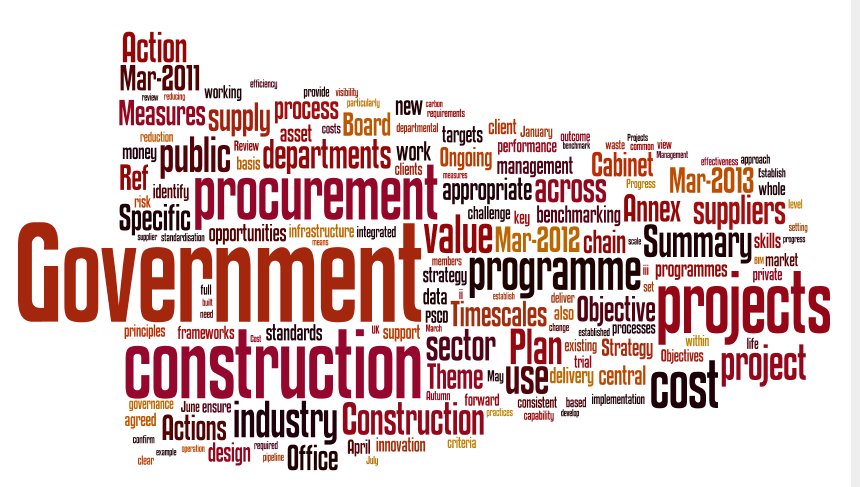
Government Construction Strategy – have we been here before?

The Government have recently published its Construction Strategy, aiming to address

… widespread acknowledgement across Government and within industry – backed by recent studies – that the UK does not get full value from public sector construction; and that it has failed to exploit the potential for public procurement of construction and infrastructure projects to drive growth.

This strategy changes that. It calls for a profound change in the relationship between public authorities and the construction industry to ensure the Government consistently gets a good deal and the country gets the social and economic infrastructure it needs for the long-term.

However, on a first few readings of the paper I find it un-inspiring and not representative of the current era for the built environment. With the possible exception of a luke warm, suck it and see approach to BIM there is very little in the strategy that we havent seen before in strategies, white papers and policy documents.  A wasted opportunity?

In an era of joined up thinking, collaborative and integrated working it would have been good to see this a built environment strategy, rather than continue the silo thinking of treating construction as a stand alone.

It is therefore disappointing to see that facilities management would appear to have been downgraded to asset management, and although the paper recognises the importance of a whole life thinking approach, it is a view from a building as an asset, a product,  rather than a facility that enables business.

Post-handover defects are a regular feature of construction projects, leading to the cost of remediation (and frequently the higher cost of resolving disputes). Even when there are no latent defects, it is still rare to find that a built asset performs exactly in accordance with its design criteria (and particularly in terms of energy efficiency, for example).

Integration of the design and construction of an asset with the operation phase should lead to improved asset performance. This has been demonstrated in projects which have integrated design and construction with whole-life operation. The same alignment can be created by requiring those who design and construct buildings to prove their operational performance for a period of say three to five years. Proposals for this will be developed with the Government Property Unit to ensure alignment with subsequent arrangements for facilities management.

The 3 – 5 year proving period has been suggested and trialed before – back as I recall in the mid 1990’s as part of the Building Down Barriers programme. And way way back in 1934 Alfred Bosom was saying the same thing (” our production costs are some 30% higher than they should be due to bad building layout”)

The strategy rightly sees procurement as a barrier, but the approach is

To develop a range of overarching procurement strategies appropriate to the whole programme.

Hmmm, havent we been doing that since Latham ? We now have PAS91 which the strategy calls to be better embedded, but to develop even more ….?

And on sustainability

To deliver future carbon reductions in the Government estate through the procurement of new construction, for example by developing approaches to appraising construction projects on a whole life carbon basis including embodied carbon, and working with departments and industry to deliver existing and emerging Strategy for Sustainable Construction targets.

but for the detail action plan and targets we have to wait for the governments response to the IGT Low Carbon Construction Report

Not sure if it is a mistake or not, but note the approach to reducing carbon is through  the procurement of new construction – not all construction – ie is it omitting refurbishment of existing property?

I didn’t expect the strategy to be explicit on social media, but I would have liked to seen communications addressed. Communication, or lack of, are at the root of most of construction problems. As we are seeing the increased use of ICT, Web Technology and yes, Social Media, in other Government sectors it would have been good to see it put on the radar for construction.

Also missing from a forward looking strategy is the need to address diversity – not only in gender, but in age, abilities, ethnicity etc. Without diverse views, opinions and approaches we will continue with our mono-centric approach.  The Government can act as a real role model and driver for construction here. As Einstein said – we cannot fix today’s problems with the same kind of thinking that created them! 

Read the paper here: Government-Construction-Strategy


Blink: the importance for bid interviews and presentations

Currently re-reading Blink: The Power of Thinking Without Thinking in advance of a bidding interview and presentation workshop for contractors tomorrow(*)


According to Malcolm Gladwell,  decision and impressions may occur much faster than previously thought – think instantaneously or in two seconds.

The interview panel may then, without thinking, have made their first impressions as you walk in the room, before you start talking or presenting, yet we focus on content and presentation rather than team composition, team appearance and team impression.

Whenever we have to make sense of complicated situations or deal with lots of information quickly, we bring to bear all of our beliefs, attitudes, values, experiences, education and more on the situation. Then, we thin-slice the situation to comprehend it quickly. The implications of this concept have astonishing significance for our personal reactions to most situations.

We should of course be using this thinking and Gladwells research to advantage.

Malcolm Gladwell, author of the bestselling The Tipping Point explores the extraordinarily perceptive and deceptive power of the sub-conscious mind. Gladwell’s major claim is that decisions made very quickly can be every bit as good as a decision made cautiously and deliberately. What we are actually doing is what Gladwell calls ‘thin-slicing’. When we leap to a decision or have a hunch our unconscious is sifting through the situation in front of us looking for a pattern, throwing out the irrelevant information and zeroing in on what really matters. Our unconscious mind is so good at this that it often delivers a better answer than more deliberate and protracted ways of thinking. Much of this is utterly mysterious but some of the most astonishing and useful examples of thin-slicing can be learned.

(*) Contact me for information on bid interview and presentation skills support and workshop

Ten tips: building green for contractors on a budget

Ever-changing regulations surrounding environmental policy require contractors to re-examine business practices on a regular basis. Unfortunately, contractors are left to interpret a great deal of industry regulations on their own. Among these confounding regulations are those concerning environmental protection.

Guest blogger, Kirsten Bradleyworking to educate professionals and their lawyers about construction industry regulations in the USA has the following advice … and although USA focused, these tips make good sense elsewhere … 

Once contractors have worked their way through the legal jargon found in many environmental policies, they might feel overwhelmed about what exactly their responsibilities are. Fortunately, however, a number of services and products have been created to help eco-friendly contractors.

The National Association of Home Builders plans to roll out the first and only national ratings standard for remodeled homes this year. Contact them for more information on how green products will affect ratings. (In the UK we wait for the Green Deal installers’ Code of Practice and a Publicly Available Specification (PAS) for the retrofitting of energy efficiency measures in domestic and non-domestic buildings)

  • Taking advantage of tax credits and other applicable programs, contractors can offset some of the additional costs they might incur by using eco-efficient approaches to building.
  • Enroll in green building event, training seminars and/or certification programs. (For example, the U.S. Green Building Council backs the LEEDHomes Raters program Home Raters are qualified to assess the degree to which a home has been constructed according to accepted standards of environmental sustainability)
  • Educate yourselves. Sign up for REGREEN, a program that distributes information about how to build green on a smaller scale. The U.S. Green Building Council partnered with The American Society of Interior Designers Foundation to create REGREEN, the first countrywide green residential remodeling manual for existing homes
  • If you think your customers don’t know or care about green building initiatives, think again. A February 2011 poll of Angie’s List members found that 50% of respondents plan to include green building elements in their home this year, but first they want to learn more. Educate yourself so that you will be able to educate your customer and market your services better.
  • According to some estimates, existing homes account for 94% of buildings in the U.S. The average age of these homes is 30 years, which means they often have drafty doors and windows as well as poorly insulated walls, attics and crawl spaces. Additionally, these properties are responsible for 21% of the nation’s carbon emissions. Herein lies a huge profit opportunity for contractors who educate themselves on green remodeling and market themselves to the right crowd.
  • Look at purchasing a green performance bond for your projects in addition to required contractor license bonds . Clients prefer working with professional contractors who are licensed and bonded because they appreciate the extra layer of financial protection
  • For smaller projects, check out the Habitat for Humanity ReStore as a resource. ReStore resale outlets sell reusable and surplus building materials to the public at low costs. Merchandise at the restore is especially good for home remodeling projects
  • Draw up window plans that take full advantage of passive solar energy and help maintain proper indoor temperature. Contractors should always verify that all windows are strategically placed in beneficial locations. This is a great example of implementing inexpensive, eco-conscious design that has a real impact on sustainability.
  • The cost of renewable products like solar platforms decreases as the technology gains traction with the buying public. Installing new products in today’s construction projects will play a large role in increasing eco-friendly building and, in turn, drive down costs.
  • Consider that building a completely new structure using eco-friendly processes might be easier and cheaper than retro-fitting an existing structure that has inherent design flaws.

Contractors who take advantage of green building will not only save money over the long haul, but also promote health benefits from building structures without toxic, energy-wasting materials.

What do you do – do you have any tips for improving green build?

 Kirsten Bradley is working to educate professionals and their lawyers about construction industry regulations through SuretyBonds with a special interest in helping contractors access more green building resources. Follow Kirsten on twitter @suretybond

Sustainability in Built Environment dominates Guardian Sustainable Business Awards

Sustainability in the Built Environment dominates Guardian Sustainable Business Award winners:

At British Land – winner of the Guardian Sustainable Business built environment award:

As the relationship with Camden council shows, British Land takes its corporate responsibility seriously and this is reflected in the goals for Regent’s Place. From design to construction, the project team has been expected to apply the highest standards of ISO 14001 certified sustainability brief for developments. As a consequence, all the new office buildings have Breeam “excellent” sustainability ratings.

From fit-out to property maintenance the developer has worked with occupiers and on-site teams to use natural resources efficiently, with a waste guide and sustainability brief for management – leading to 8% less like-for-like energy use since April 2010.

When the masterplan is complete, the Regent’s Place estate will double in size, providing 2m sq ft of office, retail and residential space for 14,000 workers and residents. What an opportunity, then, for a showcase site with sustainability at its core.

At Sainsbury’s – winner of the Guardian Sustainable Business energy award:

Crayford Sainsbury’s biggest UK store … is a breakthrough project – the first time a UK supermarket has used the so-called geo-exchange system to tap natural geo-thermal energy trapped deep under the ground.

At the heart of the system is an advanced ground-source heat pump that is linked to boreholes that capture and store waste heat from the store. This is released, when needed, to provide heat and hot water for the store and on-demand cooling for refrigeration.

Most importantly, it has allowed the supermarket group to increase the size of the store with no increase in either energy use or carbon emissions. The expanded store has exactly the same footprint as the smaller store it replaces.

As such, Crayford provides a blueprint for the UK’s second biggest grocer as it plots its future store development. The system will be used on several new and redeveloped stores now being planned.

At Tescos: winner of the Guardian Sustainable Business carbon award:

An all-timber new look store in Ramsey, Cambridgeshire, is meanwhile creating a zero-carbon template for future store development at home and abroad.

A range of new technologies is being tested, including sun-pipe lighting, renewable combined heat and power (CHP), harvested rainwater to flush toilets and run carwashes, the first ever LED car park lighting system and on-site renewable energy production. Similar stores in the Czech Republic and Thailand will be built in the coming months.

Some 614 UK stores have also been fitted with electronic energy boards showing staff at all levels, and in real time, if their store is operating in an energy efficient way and suggesting ways to improve the results.

The Livingston distribution centre in Scotland will soon be equipped with a six megawatt CHP plant, while the California distribution centre has one of the largest roof-mounted solar installations in North America.

And

at InterfaceFLOR – winner of the Guardian Sustainable Business waste and recycling award:

In 1995 InterfaceFLOR, a carpet tile and commercial flooring company, launched mission zero, a promise to eliminate all of its negative environmental impacts by 2020.

Born from an “epiphany” that founder and chairman Ray Anderson had on reading Paul Hawken’s The Ecology of Commerce, the mission moved the company away from the “take, make, waste” cycle of manufacturing towards a more sustainable business model.

The path to mission zero is made up of seven clear and ambitious goals, ranging from eliminating waste and using wholly renewable energy to maximising recycling and using resource-efficient transport.

For InterfaceFLOR, eliminating waste meant eliminating the concept of waste, not just incrementally reducing it. Recycling is seen as a last resort and only considered in cases where waste cannot be prevented or reused in any way. It’s an approach the judges thought eminently replicable.

At Capgemini – short-listed for the Guardian Sustainable Business built environment award.

Capgemini has established a new approach for building energy efficient data centres. Rather than build from scratch, it has used an existing building ‘shell’ and populated it with prefabricated modules, similar to those used as mobile hospitals by the British army in Afghanistan.

This in itself minimises the environmental impact that would come with a new-build project and cuts development time from 18 months to just 22 weeks.

Merlin aims to achieve a step-change in every aspect – from the smart engineering of the building to the use of many innovative features, such as fresh-air cooling, battery-free uninterruptible power supply (UPS) and use of recyclable or reusable materials.

The key feature is the cooling system, which combines fresh air and pre-evaporative cooling. It is set up to ensure the tightest possible real-time control of temperature, humidity and air-flow at minimum energy cost.

Merlin includes new “flywheel technology” in its UPS system, with kinetic energy replacing high-carbon batteries.

Natural Mossland Carbon Capture Scheme – putting a ‘natural’ cost to carbon?

Not to be confused with carbon offsetting.

If we are serious about moving to low and zero carbon construction then this Mosslands conservation project looks like a good approach to capturing all those tricky CO2 emissions from your site or building that cannot be eliminated through good carbon reduction and energy management.

At £30 a tonne/CO2, to capture construction activity CO2 would mean, that for each £million construction spend we would be paying £30,000. (Based on the constructco2 CO2 indicator)

A natural cost on carbon?

The brochure contains some very interesting facts and figures as why peatland and mossland are essential as carbon sinks, more so than trees, and why we need to stop extraction.

NaturalCarbonCaptureBrochure.pdf Download this file     Or view on my posterous blog 

Cost of Carbon: “What was a carrot will now become a stick”

So are we prepared yet for the tranistion to a low carbon economy in the built environment?

Accouncements this week from the UK Government regarding targets for carbon reduction will affect all aspects of energy use, conservation and management. With the built environment contributing to 40% of CO2 emissions the imapct on design, material production, tranport construction and more will be very significant.

Facilities Management and the way we use buildings will most likely be the sector of the built environment to be profoundly affected. Whether the FM sector can rise to the occasion is another question, and one now being debated in FM forums, circles and events. See my thoughts on CSR Wire Talkback   

Indications from the recent Facilities Show in Birmingham (my own questioning of the exhibitors) suggests carbon measurement is just not on many FM providers agenda as yet

Can we be ready for such a dramatic tranistion, which as Derek Deighton explained is a 13 times reduction – a huge undertaking. And its not as if we havent had time to prepare in the last decade or so. Indeed as John Elkington highlighted ‘since Brundtland in 1987 we are still jollying along and still delighting in green or sustainable innovations’ 

What lies ahead in relation to the tranistion for businesses to a low carbon economy has been wonderfully summed up and explained in the May edition of  the Director in the Green Path to Growth article by Alison Coleman:

The UK has pledged to make deep cuts in carbon emissions by 2050. But as new sustainability rules bite, what are the duties of businesses? …

Britain is committed to massive carbon cuts, and whether businesses subscribe to green principles or not, they will be expected to play a key role. The Climate Change Act 2008 set a target for reducing greenhouse gas emissions to 80 per cent below 1990 levels by 2050, which assumes energy efficiency savings of around two per cent per annum for the next 40 years. That’s a big ask.

Although many companies are implementing green operating policies and achieving environmental management standards, the business contribution to the target is being driven by myriad carbon-related sustainability rules. Yet many organisations have yet to understand the cost of compliance

and as to the cost of carbon? …

Tony Rooke, sustainability practice leader at IT services provider Logica, says: “What was a carrot will now become a stick, and with the carbon price set at £12 per tonne of carbon emitted, it could add up to eight per cent to an organisation’s energy costs. What it will do is encourage them to minimise that impact by monitoring energy consumption more closely, and redoubling their efforts to reduce it and avoid waste.

it of course makes good sense:

Alan McGill, a partner in the environmental reporting practice at PricewaterhouseCoopers. “Forget the green agenda and just apply the commercial principles. There are lots of companies looking at operational opportunities to take carbon out and bring benefits to the business.”

People get ready, there’s a CO2  train a comin’ You don’t need no baggage, you just get on board”  With apologies to Curtis Mayfield

I have often said the built environment is a fascinating and great sector to be involved with – and now as we realise the carbon train is a-coming and we see its time to get on board, the journey could get a lot more interesting!

Thoughts?

Cautionary and Costly BIM Tale: Designers did not tell Contractors

This story in ENR would appear to have gone  viral across US BIM blogs and twitter in the last 24hrs, but there lessons here for the UK as we read yesterday in Building that BIM will be mandatory on Government projects within 5 years.

If ever there was a case to demonstrate how BIM is a people and communication tool, not solely a design, technical or digital one, this could be it. Collaborative working with all must be key to BIM. 

It also illustrates the need for the contractor to be aware of and more involved in BIM, and as has been suggested elsewhere – by Paul Morrell and others, perhaps contractors should drive the BIM process. (I think it should be driven by FM but thats another tale)

A lawsuit over construction of a life-sciences building at a major university stands as the first known claim related to the use of building information modeling by an architect. Furthermore, the claim and its settlement serve as a cautionary tale to others using BIM, says the insurer.

“The creators of BIM claim its use reduces risk, and indeed it can—like any other tool, if it is used right,” says Randy Lewis, vice president of loss prevention and client education at the Denver office of XL Insurance, which provides professional liability insurance to licensed design professionals. “If you don’t use BIM correctly, you can get into trouble.”

For the life-sciences building, the architect and its mechanical-electrical-plumbing engineer used BIM to fit the building’s MEP systems into the ceiling plenum. But the design team did not tell the contractor that the extremely tight fit, coordinated in the BIM, depended on a very specific installation sequence.

When the contractor was about 70% through assembly, it ran out of space in the plenum. “Everything fit in the model but not in reality,” says Lewis.

The contractor sued the owner, the owner sued the architect, and XL brought in the MEP engineer. “It was a very costly claim to negotiate,” says Lewis. XL did not litigate the claim because it would be difficult for any jury to comprehend.

Lewis declines to offer specifics on the project, other than to say the building is open. He also declines to name the players. As far as the settlement goes, he will only say there was a “pretty significant cost,” totaling millions of dollars, which was shared by the architect, the MEP engineer and the contractor.

The problem was poor communication. “The design team never discussed the installation sequence with the contractor, and the contractor wasn’t sophisticated enough” to understand the importance of assembling the components in a certain order, says Lewis.

Read More