Category Archives: comment

Healthy Buildings and Wellness: 12 Insights

Alison Nicholls, Associate Director, Constructing Excellence, put together the following, excellent summary of the recent Heathy Buildings and Wellness event held on the 31st January 2017.  The event was hosted Aecom at their Aldgate Tower offices, designed to meet the very latest standards in healthy buildings and wellness.

The business case behind healthy buildings and investing in standards such as WELL, BREEAM and the Living Building Challenge, as well as the demand for healthy buildings and the practicalities of delivery in both new and existing buildings and future implications for regulations and law were explored.

Here are the top things learnt during the workshop:

  1. Changing buildings is a great opportunity to instigate healthy changes
    Dave Cheshire from Aecom looked at how making making healthier choices easier for employees could help make them healthier, more productive and more resilient to stressful life and work events. Aecom are implementing solutions to encourage people to live well, both for their own staff and on client projects.
  2. Take the investment conversations up a level
    Dave’s top tip for making the business case was to take the conversation up a tier to those who have a more holistic view of the business investments. Engaging the Human Resources department at can help justify expenditure that might add cost to the capital budget but will save significant amounts over the long term occupation of the building.
  3. Circadian rhythms – mimicking nature
    As part of the British Antarctic Survey project Aecom looked at how intelligent lighting solutions could mimic natural daylight patterns in order to trigger the hormones that set our natural body clock. This is particularly important in a building where it’s pretty dark for six months of the year, however this learning can equally be applied to night workers or office buildings where natural light doesn’t penetrate deep into the building floor plates.
  4. People don’t always understand the risks
    Isabella Myers gave a public health perspective on the link between buildings and health and wellbeing. She flagged up the risks of delivering interventions when occupants were often resistant to changes and not necessarily convinced of the risks to their health from problems such as leaky boilers and fuel combustion. This can come in many forms including deaths from carbon monoxide and neuropsychiatric symptoms from long term exposure to toxins.
  5. Our strategies to save carbon may have made it worse
    Isabella reminded us that some of the strategies that have been employed to save energy and carbon dioxide have led to more airtight homes and buildings have caused the build-up of toxins that can impact people’s health.
  6. Healthy Buildings attract premium tenants
    Anita Mitchell Head of Sustainability for Lendlease Europe spoke about increasing market demand for healthy buildings. On a recent project in Sydney major clients in the financial services and blue-chip companies were demanding high levels of WELL Buildings Standard. Eventually this could lead to devaluing property that does not support health and wellbeing.
  7. Speculative developments can still be healthy
    The strategy to deliver WELL-Ready core and shell schemes enables tenants to implement their own health and wellbeing strategies in order to meet the WELL Building Standard.
  8. Health & Wellbeing cuts across the political divide
    Health and wellbeing impacts on social and economic sustainability, therefore both sides of the political divide can support the agenda, on the one hand it benefits society and on the other it delivers bottom-line economic benefits.
  9. Don’t forget the construction process
    Martin Brown from Fairsnape reminded us that whilst the end product needs to support wellbeing there is a requirement not to forget how the built environment is constructed, the toxicity of materials used and the people who build them. While we have made huge progress in terms of onsite health and safety, the industry has one of the highest mental health and suicide rates after agriculture.
  10. Biomimicry
    There is a lot we can learn from nature and how it functions in order to reproduce natural patterns and deliver healthier and better performing buildings. For example the Living Building Challenge certified Bullitt Centre in Seattle mimics the effect of a tree canopy to limit exposure to overheating and solar glare.
  11. Data can help
    By mapping physical data sets from BIM with biological datasets from the health sector and fitness trackers etc. a really rich picture of how buildings and the built environment are impacting on people’s health and wellbeing is emerging, and providing data for health improvement. There are lots of ways in which existing buildings can be improved to increase the health and wellbeing of the occupants. BRE is carrying out a research project on a real life Biophilic office refurbishment assessing the health and wellbeing of occupants before and after various interventions.
  12. WELL & BREEAM setting the standard
    BREEAM and WELL have been working together to establish common factors and areas of mutual recognition for elements of their respective standards. Chris Ward provided an overview of progress including an initial mapping exercise that has been published in a technical guidance document.This will lead to further collaborative work to ensure that health and wellbeing are an even more integral part of the BREEAM standard going forward.

The group will meet again in April to look at how innovative, healthy and sustainable materials are being specified and how that process can be improved to ensure that clients and specifiers increase their understanding and demand innovative products and materials.

The original constructing excellence post and presentations can be viewed here 

Related:

FutuREstorative – Working Towards a New Sustainability

WELL & BREEAM announce alignment for credits: more good or less bad?
Mindfulness, Biophilia and Salutogenesis: a powerful triptych for improving construction health and happiness


Lancashire Construction is Blooming

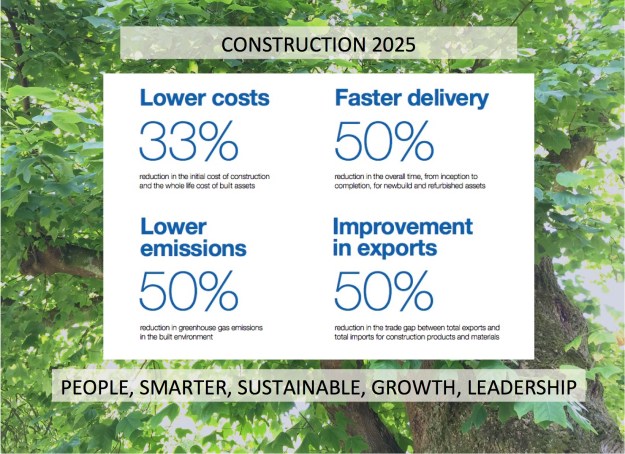
With the regions transformational City Deal now getting into swing there will be ‘blooming’ opportunities for those in the Lancashire built environment sector over the coming months and years. And Constructing Excellence, through its Lancashire and Regional Clubs is well placed to assist in the development and transfer of best practice knowledge and skills. These cover the core ingredients of successful built environment organisations – Productivity, BIM & Digital Construction, Sustainability and Continuous Improvement –  all geared to meeting the Construction 2025 Vision

construction-2025-headlines

Whilst you are here: Supporting the Lancashire Club: We are looking for new steering group members to steer and drive the club over the coming years, a period that will be a busy, challenging but rewarding one for built environment organisations within the region. if you are interested please get in touch with our Chair, Martin Brown, our Sec, Andrea Atherton or Regional Club Coordinator Zoe Brooke 

Our … speak to us at our next event on 23rd Feb in Lancaster 

We Are Lancashire – The Place For Growth

Lancashire, Preston and South Ribble’s transformational City Deal pitched to over 100 developers, agents and investors at half-day Place North West business conference last week.

Entitled “We Are Lancashire – The Place For Growth”, the event was organised by the City Deal Partnership (including Lancashire County Council, Preston City Council, South Ribble Council and the Homes & Communities Agency), Marketing Lancashire and the Lancashire LEP. It was run in partnership with leading property news and investment website Place North West, and hosted at the Preston headquarters of accountants RSM.

At the heart of the discussions was the impact and opportunities offered by the £434m City Deal programme. The City Deal is a key initiative of the Lancashire Enterprise Partnership’s strategic plan to create 50,000 new jobs over the next 10 years across the county.  The City Deal will help to create more than 20,000 new private sector jobs and see over 17,000 new homes built across Preston and South Ribble, as well as new school places, open green spaces and new health provision to cater for the growing population

  • Key themes which emerged throughout the sessions included how all of the Lancashire local authorities, both county and district, involved in City Deal were working closely together to ensure private investment can flourish. This included their pragmatic, joined-up approach to the planning process, and the substantial public sector support on offer to help private sector schemes get started, and completed, with a minimum of barriers.
  • Another important debate centred around the need to create a diverse mix of housing, and have different types of tenure, throughout Central Lancashire. This was to ensure families, young people, the elderly, students and recent graduates could all get access to affordable and desirable accommodation which suited their needs.
  • As well as providing suitable homes to encourage graduates to stay in the area, many of the speakers also touched on the need to retain graduate talent through a combination of suitable jobs in the region, and the creation of an attractive environment to live in. This included a need for an improved for an improved evening economy as well as strengthening its position as a visitor destination.
  • This led to a focus on the strengths and benefits of Central Lancashire’s existing regeneration and development schemes, and highlighted some of the major City Deal investments which have recently been announced.
  • These included Preston city-centre developments such as the new Harris Quarter cinema and leisure scheme, the potential for the re-development of an ‘HS2 ready’ Preston train station, the £200m UCLan masterplan, the regeneration of Winckley Square and the proposed Altus Grade A office project.
  • The major investment opportunities based around the Samlesbury Enterprise Zone site, which has now been designated as a specialist aerospace and advanced manufacturing hub as part of The Lancashire Advanced Manufacturing and Energy Cluster programme were discussed, including reference to the recently green-lighted Advanced Manufacturing Research Centre which will be based at Samlesbury.
  • The major mixed use logistics, retail and residential scheme at Cuerden, anchored by a new IKEA, was also held up as an example of how the City Deal is helping to unlock a series of complementary developments which are set to have a genuinely transformational effect on the Central Lancashire economy.

Threats and challenges to Lancashire’s growth were also debated, with issues like skill shortages, Brexit and Lancashire’s historic reputation for being a divided county all coming under discussion.

However, the general consensus from both private and public sector speakers was that Lancashire has made incredible progress over the last few years to speak with one voice showcasing its growing ambition and confidence, is looking to tackle the issue of vocational skills through a series of effective education and employer strategies, and is set to play a key role at the heart of the Northern Powerhouse initiative through a private-public partnership approach to stimulating economic growth.

More

Nomination for JDR Annual Industry Blogger Awards

green remodelingDelighted that this blog, Fairsnape iSite, that started its life in ten years ago in Jan 2007 has once again been recognised through nomination to the 8th Annual JDR Industry Blogger Awards. Watch this space as canvassing for votes starts in March.

From the JDR Blog Awards:

We are excited to announce the 8th Annual JDR Industry Blogger Awards, which recognise exceptional design and remodeling blogs. The Blogger Awards celebrate emerging and established blogs, avid followers, and active communities. In 2016, award participation continued to strengthen in reach and influence, with tight races in several categories. We eagerly anticipate an even livelier contest in our eighth year!

Our annual awards highlight the best bloggers in Architecture, Interior Design, Remodeling, Construction Business, Green, and Microblog categories.

Jackson Design and Remodeling has been a pioneer in the design and build remodeling industry for 27 years. Our company values innovation and excellence and we believe in discovering, embracing and promoting those values throughout the industry. The JDR Industry Blogger Awards bring additional recognition to the work of the best blogs in the business, while supporting our efforts to promote the professionalism of the remodeling industry, celebrate innovative communication and inspire our clients with the latest ideas in home design.

The blog that receives the most votes in a category will be the winner of that category. Each winner will receive a $500 cash prize and a 2017 JDR Industry Blogger Awards badge for display.

Awards Schedule:

  • Nominations Open: February 3rd, 2017
  • Nominations Closed: February 27th, 2017
  • Voting Open: March 6th, 2017
  • Voting Closed: April 24th, 2017
  • Winners Announced: April 28th, 2017

 Congratulations to last year’s winners:

Why we should all read the Edinburgh Schools report.

Every built environment organisation should read the independent investigative report into Edinburgh school collapse and closures. Specifically the 40 recommendations(1) made in the report, from procurement to information sharing to training and inspections. This is basic QA gone wrong throughout the project supply chain from client through to those constructing the schools.

c4suaejxaaaxmhh

This is not just a technical failure, or isolated issue, once again the root cause lies in cutting costs and lack of communication. Having robust quality management systems in place is essential but will only be effective with a responsible construction mind set and behaviours.

“This is not an area where corners or costs should ever be cut”

As Larry Flanagan, EIS General Secretary, said: “This report issues a stark warning – to Edinburgh, to local authorities and to all those responsible for the construction and maintenance of our schools – that they must take action to ensure that all buildings are well-designed, properly built and maintained to an extremely high standard. “This is not an area where corners or costs should ever be cut”

(1) THE LIST OF RECOMMENDATIONS … The 40 individual recommendations are listed under the following nine headings. 1. Procurement 2. Independent Certifier 3. Client’s Relationship with the Design Team 4. Information Sharing 5. Construction 6. Training and Recruitment 7. Building Standards 8. Sharing of Information 9. Recommendations for the City of Edinburgh Council 10 Further Inspections

The report can be read / downloaded here: Inquiry into Edinburgh Schools Feb 2017 Final

The following is a reblog from Construction Manager

A lack of proper scrutiny in construction work has been cited as the main reason for the debacle that forced 17 Edinburgh schools to close last year, according to the BBC.

The long-awaited independent investigative report criticised the construction company involved as well as City of Edinburgh Council and the partnership that managed the building contracts.

An inquiry was set up last year following the closure of the schools due to safety failures. Around 7,600 pupils were affected by the closures.

Leading architect and procurement specialist John Cole headed up the inquiry.

In his report, he said: “The fact that no injuries or fatalities to children resulted from the collapse of the gable wall at Oxgangs School was a matter of timing and luck.

“Approximately nine tonnes of masonry fell on an area where children could easily have been standing or passing through.

“One does not require much imagination to think of what the consequences might have been if it had happened an hour or so later.”

The 250-page report identified fundamental defects which led to the wall collapse:

  • not enough wall ties;
  • the wrong type of ties were used;
  • wall cavities were not uniform.

The report said: “It is the view of the inquiry that the primary cause of the collapse of the wall at Oxgangs school was poor quality construction in the building of the wall, which failed to achieve the required minimum embedment of 50mm for the wall ties, particularly in the outer leaf of the cavity wall. The poor quality relates to all three of the following aspects:

  • the direct laying of the bricks and the positioning of the wall ties;
  • the direct supervision of the laying of the bricks and the positioning of the wall ties;
  • the quality assurance processes used by the subcontractor and main contractor to confirm the quality of the construction of the walls.

“All three issues were ultimately the responsibility of the design and build contractor in charge of the site.”

The report said it was not the result of an isolated case of a rogue bricklayer.

It said the substandard bricklaying was either not inspected or was ignored, that an appropriate level of independent scrutiny was missing, and that having a clerk of works may have made a difference.

In his report Cole also questioned whether the drive for faster, lower-cost construction is to the detriment of quality and safety.

The 17 schools were originally built by Miller Construction which, together with Amey, was part of the Edinburgh Schools Partnership (ESP) consortium contract. In 2001 ESP won the £360m deal to design, build and maintain the 17 schools for 30 years. Miller Construction was acquired by Galliford Try in 2014.

City of Edinburgh Council said it was drawing up an action plan to ensure confidence in the safety of all its buildings.


Mindfulness, Biophilia and Salutogenesis: a powerful triptych for improving construction health and happiness

pexels-photo-94616Increasingly health is becoming a key aspect and driver for building design and maintenance. (See Next Wave of Design: Wellness-minded Spaces)

OF note, are seeing a BREEAM alignment with WELL, but as pointed out in FutuREstorative, and by others, this approach needs to equally apply to the construction process, to project working environments, including project office accommodation.

Mindfulness, Biophilia and Salutogenesis can provide a powerful triptych of approaches for construction health and happiness. But what are they, and how can they improve construction?

Mindfulness

The state of being present in the moment. Mindfulness can help in reducing stress and mind-wandering in addition to enhancing the sense of wellbeing and fulfilment from life and work. Mindfulness is growing in use within other sectors to address amongst other things wellbeing, productivity and safety.

(In collaboration with Anne Parker, we can provide tailored Mindfulness for Construction awareness and training sessions)

Biophilia

Our innate relationship with nature. Research is proving that connection or exposure to nature or natural patterns has a huge influence on our state of mind, our wellbeing, cognitive skills and our recovery times from illness. We should for example, be applying the 14 Patterns of Biophilic Design to construction workplaces as part of a healthy construction agenda

Salutogenesis

FutuREstorative introduces the concept of salutogenesis to the built environment. A medical concept that encourages focus on factors that improve & support health and then keeping people healthy, rather than the focus of just reducing the impact on health. Translated to the built environment this can mean focusing on design issues in buildings and workplaces where people go home healthier, feeling better and happier than when they arrived. As an example, the growing recognition that light (daylight and circadian light) can be a medicine, having positive, even healing benefits. Adopting a salutogenetic mindset to the construction process can also encourage us to consider and focus on potential health benefits of working in construction.

salutogenesis-slide

PreCycling: A gateway to the Construction Circular Economy

pexels-photo-93013

Precycling is a term I adopted within FutuREstorative to describe the decision making process when specifying, procuring, ordering and calling off materials. It is the thought process, not for only the avoidance of waste but in considering net-positive and secondary uses for a product at the end of its initial use.

Precycling is defined as ‘making purchasing decisions that will ultimately eliminate, delay, reduce the need to recycle or dispose of waste” and should be at the top of all waste hierarchies, as indeed it now is with some of the organisation whom I am supporting.

I have suggested elsewhere that product or material data sheets or passports within BIM should contain deconstruction, disassembly future use options within their attributes, hence enabling and informing precycling decisions.

“Precycling is one of the gateways into a construction circular economy” and assists in making the conversion from Site Waste Management Plans (that detail methods for reducing and better management of waste) to Material Conservation Plans (that detail methods for conserving resources)

Material Conservation Plans are a Living Building Challenge requirement under the Materials imperative. A framework for UK Project Material Conservation Plans is included within FutuREstorative

In January 2017 BRE published Material resource efficiency in construction: Supporting a circular economy (FB 85) which although still having a focus on Site Waste Management Plans assists in shifting waste thinking further up stream, noting that Material resource efficiency can be applied across a construction project’s life cycle, but with the greatest benefits at early, pre-construction stages

4_fb85_165px “There is increasing awareness that improved material resource efficiency will produce benefits across the construction industry such as cost savings, reduced environmental impact and an enhanced reputation. At a construction project level, resource efficiency can be implemented at all stages (design, procurement, construction, in use and end of life) using established tools and techniques.

This guide describes the material resource efficiency requirements in BREEAM. It provides the background, drivers, benefits and practical advice to assist clients, designers and contractors in achieving higher levels of material resource efficiency. It will also be useful to product manufacturers, suppliers and waste management companies”


22 Must Read Sustainability Books

FR_Visuals_FINALOne of my aims in writing FutuREstorative was to explore and encourage new thinking for sustainability in the built environment. In turn, inspiration for the book has, in part, come from a number of classic writers and books over the last half century or so, woven into FutuREstorative and into built environment sustainability potentials.

In addition to these books being powerful in shaping my thinking towards sustainability, they  often articulate alignment between nature, the outdoors, wildness and business sustainability.

The Bibliography in FutuREstorative gives a complete listing, but below are a sample 21 of the best, all worthy of making a great sustainable reading or gifts to inspire, as indeed would FutuREstorative!.  (Note the wonderful Icelandic tradition of giving books on Christmas Eve, simply as an additional gift to inspire)

Image 8.1a Book Shelf

Let my People go Surfing – Chouinard, Y.
Three books in one here, a biography, a mountain & surf adventure and a business sustainability philosophy. This is a must read for reluctant business CSR people.

Sand County Almanac – Leopold, A.
Recognised as the godfather of ecology, Sand County is the classic land ecology book. Classic quotes form Sand County include Thinking like a mountain and We reached the old wolf in time to watch a fierce green fire dying in her eyes. I realized then, and have known ever since, that there was something new to me in those eyes – something known only to her and to the mountain.

Silent Spring – Carson, R.
First published in three serializsed excerpts in the New Yorker in June of 1962,this is the book that in many ways triggered the 1960s environmental protest movement. Still as valid today as we deal with persistent chemicals within the built environment materials

Cradle to Cradle – Remaking the Way We Make Things – Braggart, M. and W. McDonough Groundbreaking for the circular economy thinking, challenging the way we make and dispose of things.

Ecology of Commerce – Hawken, P
An important text that aligned ecology and environmental concerns with mainstream business. “if you look at the science about what is happening on earth and aren’t pessimistic, you don’t understand data. But if you meet the people who are working to restore this earth and the lives of the poor and you aren’t optimistic, you haven’t got a pulse.”

Biophilia – Wilson, E.O
Part autobiographical and personal, Wilson’s introduction to the love and relationship with nature, that introduced us to the concept of biophilia. “Nature holds the key to our aesthetic, intellectual, cognitive and even wellbeing. …”

Transition Handbook – Hopkins, R.
The original handbook for the now-global Transition movement, addressing actions required in transitioning to a post peak-oil economy. “… by unleashing collective genius of those around us to creatively and proactively design our energy descent, we can build ways of living that are more connected, more enriching and that recognize the biological limits of our planet.”

Wildwood – A Journey through Trees – Deakin, R.
Living with trees, an autobiography from one of the UK’s foremost environmentalist writers. “To enter a wood is to pass into a different world in which we ourselves are transformed

Revolutionary Engineering – Miller, M.
How the international engineering firm Intergral approach restorative sustainability. Included are case studies from their Living Building Challenge projects. Intégral: Revolutionary Engineering is for trailblazers who care about advancing the building and construction industry toward greater occupant health and happiness, and stronger resilience and regenerative systems.

Design with Climate: BioClimatic Architecture 2015 update – Olgyay, V.
Reprint of a classic 1960s text that inspired and promoted architectural design based on biology and climate. I was not fully aware of this important work until researching for a commissioned review

Biomimicry in Architecture, 2nd Edition – Palwyn, M.,
Insights into the amazing world and future potentials of biomimicry within the built environment

Feral – Rewilding the Land, the Sea and Human Life. Monbiot, G.
Inspiration for restorative and regenerative environmentalism and conservatism through  Monbiot’s experience and passion on rewilding themes.

Tools for Grass Roots Activists. Gallagher, N. and L. Myers, P Brilliant collection of essays and tools from over two decades of the Patagonia invite-only Tools Conferences

Walden – Thoreau, H.D.
Recognised by many as being the classic work on environmental and conservation thinking. “We need the tonic of wildness…At the same time that we are earnest to explore and learn all things, we require that all things be mysterious and unexplorable, that land and sea be indefinitely wild, unsurveyed and unfathomed by us because unfathomable. We can never have enough of nature.”

Last Child in the Woods: Saving our Children from Nature-Deficit Disorder – Louv, R. 
Why we need biophilia in our and in our children’s everyday lives. “We have such a brief opportunity to pass on to our children our love for this Earth, and to tell our stories”

Confessions of a Radical Industrialist: How My Company and I Transformed Our Purpose, Sparked Innovation, and Grew Profits – By Respecting the Earth – Anderson, R.C. and R. White,
The guide that shaped and continues to inspire the values and ethos of Interface Inc. to take nothing from the earth that can’t be replaced by the earth

Landmarks – Macfarlane, R.
Why language and words are important to understanding our relationship with nature and landscapes. Certain books, like certain landscapes, stay with us even when we left them, changing not just our weathers but our climates.”

This Changes Everything: Capitalism vs. the Climate – Klein, N.
How capitalism and our economic structures are at the root cause of climate change.“So we are left with a stark choice: allow climate disruption to change everything about our world, or change pretty much everything about our economy to avoid that fate. But we need to be very clear: because of our decades of collective denial, no gradual, incremental options are now available to us.”

Responsible Business – Chouinard, Y. and V. Stanley
Background to the responsible business values and approaches at Patagonia. “At Patagonia, making a profit is not the goal because the Zen master would say profits happen ‘when you do everything else right.’”

Reinventing Fire – Lovins, A.
A route to a non fossil fuel future in four industries that includes the built environment. Reinventing Fire will require tapping, in particular, the two biggest motherlodes of energy, efficiency and the Sun.

Eden – Smit, T.
Background to the development and principles of the Eden Project in Cornwall, UK. “…. construction is a culture that depends on warfare and fault finding that is not compatible with collaborative partnerships …”

&

FutuREstorative: Working Towards a New Sustainability Brown, M.
Focuses on the emergence of a net positive and restorative sustainability, as a more rounded social, wellness, health and healthy buildings debate “We can and must reignite sustainability, set the sustainability soul on fire, make sustainability fun and exciting, and inspire a new generation – not only for a vision of sustainability that is regenerative but a vision that also acknowledges the damage of the past and makes amends, healing the future

 FutuREstorative : is available via RIBA Bookshops and other online book services!

WELL & BREEAM announce alignment for credits: more good or less bad?

UPDATE 01 Feb 2017

Credit Crosswalks: BRE and IWBI have released guidance to streamline joint certification of BREEAM and WELL

….

As mentioned and illustrated in FutuREstorative, we will see an alignment in building sustainability and performance standards over coming months and years. In the US we have seen an alignment between LEED and the Living Building Challenge on materials (Red List) and recently on energy and water.

On Monday 28th  Nov, we saw an announcement from The International WELL Building Institute and BRE for an agreement to pursue alignment between WELL and BREEAM will making it easier for projects pursuing both standards.

In practice this will mean documentation submitted for certain credits will be recognised by both WELL and BREEAM, saving project teams time and cost.

This will be a very interesting journey and further recognises the importance of health within building design, construction and use. WELL, like the Living Building Challenge is an excellent, robust but tough standard and one that cannot be attained without a different mind-set approach to buildings.

Key to that mindset is recognition of the impact of materials on health on construction workers and building users. An alignment or agreement between BREEAM and the LBC’s Red List would make great sense here.

It will be interesting to see how the differing philosophies between WELL (do more good) and BREEAM (do less bad) work together. Hopefully this further opens the door to a salutogenic approach to design – not just reducing ill-health but using buildings to improve health, for example, using light as medicine, as explored in FutuREstorative

salutogenesis-slide

Health – the next performance gap.

I will also be watching with interest if this agreement extends to the construction process, (ie. the BREEAM MAN credits) to improve the wellness and health of those involved in and affected by construction works. This is a health and wellness area that BREEAM, LEED, WELL and the Living Building Challenge do not readily address. Yet for those whose career is spent on construction sites, it is a key health and sustainability area, and one that benefits from biophilic design considerations, for example greenery in accommodation and living walls as project hoardings.

living-walls-construction-hoarding

Bright Green – the new Black (Friday)

That Green is the new Black is illustrated through sustainability focused alternatives to the commercialism of Black Friday.

100-planet-tcl-1404x778-c-defaultPatagonia whose sustainability vision entails using business to make change will be giving 100% of sales to 1% For The Planet this Black Friday. 

This year Patagonia will donate 100 percent of global Black Friday sales in our stores and on our website to grassroots organisations working in local communities to protect our air, water and soil for future generations. These are small groups, often underfunded and under the radar, who work on the front lines. The support we can give is more important now than ever

pexels-photo-94616REI and others under the hashtag banner of #optoutside will be closing stores, encouraging staff to spend time with family and friends – out of doors.
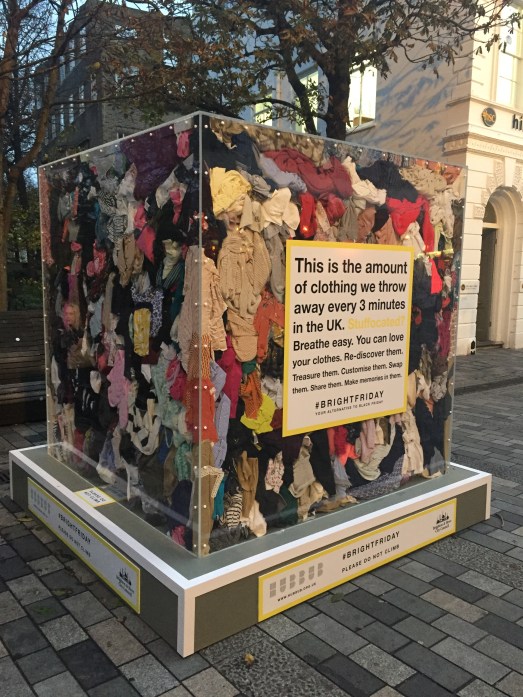
Here in the UK we have adopted the US Black Friday sales madness. In conversation with a local outdoor gear store, they felt they couldn’t make the stand as Patagonia and REI are doing as they would just loose out (online) sales to competition over the black Friday 2 week period. But there are signs we are adopting the green Friday thinking here in the UK.

As I write this blog on a business trip to Brighton, I am encouraged to see BrightFriday activities in place coordinated through alt fashion Hubbub.org. Their three simple guidelines to create a BrightFriday also serves as a great circular economy statement.

How to create your #BrightFriday this Black Friday

1. Resist the pressure of buying things you don’t want or even need. Remember, the best bargain is not buying stuff you didn’t want in the first place.

2. Rekindle love for what you already have.

3. Create memories rather than buying them by trying something you’ve always wanted to do.

img_3070


“This Changes Everything” Paris Agreement and the Built Environment

That the Paris Agreement has come into force today, 4th November 2016, some four years early, now ratified by the requisite number of nations, is a huge milestone and speaks volumes for the global recognition and consensus to reduce carbon emissions.

cop21 article 2 draft

Back in December in Paris, the built environment was recognised as a major contributor to the carbon problem as well as having a major role to play in a low carbon sustainable future. (See How significant was the first Buildings Day at COP21?)

Now, then, is the time to review our approaches to taking carbon out of the built environment, through design, through the operation of buildings and in the manufacture and construction processes.

Through ConstructCO2 we know that up to 70% of construction carbons are travel and transport related, and much of this through diesel fuelled vehicles, further adding to our air quality problems and stretched health services. Construction transport impact must now be a primary target for sustainable construction.

In the UK, our most recent industry target is within Construction 2025 Vision – to reduce emissions by 50% by 2025. Consider however that this was written when the consensus for carbon reduction was based on a 2 degree target for temperature increase. We are now looking at 1.5 degree as the emerging consensus, and that changes everything.

construction-2025-headlines

There is a sense of urgency here, and as I explored and commented within FutuREstorative ‘we no longer have the luxury of being only less bad’ but need to be doing more good, and in doing so heal the future.

less-bad-more-good-chart

In 2015 the UK Green Construction Board noted that ‘reducing built environment carbon emissions (50% from 1990 levels by 2025) is now out of reach with current practice’, and as Namoi Klein wrote in This Changes Everything (2015) “There are no non-radical approaches left before us in addressing climate change’

But we do have approaches, tools and initiatives to ensure that the built environment can contribute to a 1.5 degree future, again as explored in FutuREstorative and illustrated here in this infographic:

carbon-image

As we celebrate the Paris Agreement coming into force, lets also take the opportunity to look forward and start working collaboratively within the built environment towards a 1.5 degree future. And in doing so,to address the other hugely important aspects of the Paris Agreement, adopt the Sustainable Development Goals.

Chart_of_UN_Sustainable_Development_Goals