Category Archives: CSR

corporate social responsibility

Half of Multinationals to Choose Suppliers Based on CO2 Emissions

Why monitor construction carbons:  Shortly after writing a comment to a linkedin group on the importance of measuring and understanding construction carbons, through tools such as ConstructCO2, indications of increased focus on carbon performance popped up in a tweet (via Julie Urlaub @TaigaCompany ) regarding an Environmental Leader post that referenced Carbon Trust Report: Half of Multinationals to Choose Suppliers Based on CO2 Emissions 

According to the study, a full half of multinational companies plan to select suppliers based on carbon performance, and that 29% of suppliers are likely to lose their places on green supply chains if they do not have adequate performance records on carbon.

In the U.K., 56% of multinationals said that in the future they expect to drop suppliers based upon low carbon performance, with 74% of the U.K. respondents quoting shareholder pressure as a key driver for them in tackling carbon emissions.

And, although the report has a focus on multinationals, it is not irrelevant to the built environment

Next month Marshalls Plc, a supplier of hard landscaping, will be hosting a United Nations Global Compact Supplier event to educate first-tier suppliers on its approach to environmental issues.

As I posted to the Think Zero group on Linkedin, I still have to hear a good reason why we should not be measuring construction carbons.  Are you tracking your carbon performance – do you have the evidence?

Read more: Carbon performance offers major risk or reward

Construction supply chain footprints

Our construction carbon tool, Constructco2, through its ability to monitor a projects supply footprint is throwing up some interesting issues:

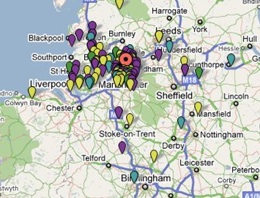
Take a look at a project footprint that has a focus on localism – ie in keeping material, supplier, management and even waste transportation as close as possible to the project:

And then one that doesn’t (which is actually less in construction value):

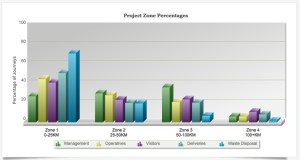
Across the 80 or so projects on the site we can start to see the travel pattern for materials, people and waste, and how close to the project …

All this starts to position Constructco2 as a possible valuable CSR tool and indicator, monitoring impact of projects on local communities, and starting to raise issues of procurement, appropriate sourcing / specification as well as good on site project management housekeeping

These notes are extracted from my recent ConstructCO2 presentation that is available to view on slideshare. 

For more on information please get in touch or visit Constructco2,and follow links.

Great Green Deal Re-Skilling?

Following on from the depressing news that Construction lacks green, key business and foresight skills, in particular 43% of employers dont feel they understand the implications of green issues, or ability to identify the training needs, are we facing a green deal barrier?

Need for New Skills

We read in the Low Carbon Plan from the Government, (“much re-skilling of the construction industry to deliver the planned targets of greenhouse gas reduction by at least 34% by 2020 and 80% by 2050″),  from the IGT Report of the need for green skills, we read that PAS 2030 and Green Deal codes of conduct will access sustainability skills, training and development. The FMB Cut the Carbon programme focuses on the need for new skills.

Will it turn out OK?

Rob Hopkins in his Transition Handbook, (see my blog back in 2008 time for built environment transition?) in a futures scenario talked about the Great Construction Reskilling, the NEF paper, How it all turned out ok celebrates how we recovered our lack of traditional skills, succeeded in addressing the localism issue and turned energy ineffective buildings into models of zero carbon. (again my blog: How it all turned out OK in 2050)

Who is defining …

But do we have an understanding of what green skills mean? Is it just an understanding of good sustainability awareness (eliminating waste, reducing carbon, buying local etc), Is it technical, natural materials (see the Transition Culture archive for reskilling) or is it something more deeper, profound.

Green Re-skilling starts at the board level…

Do we imply the reskilling is just for operatives, or wider to include supervisors, managers and (in my view essential) board directors and senior managers? Maybe this isn’t a training issue to be lodged with the HR team but one of crucial CSR strategy for organisation? (see A Low Carbon Diet For Construction Boards)

A question then …

What are construction boards, contractors, installers, training organisations, industry bodies doing, plan to do, or indeed have done to understand and address sustainability skills.

What is Green Deal: the hard, the soft, the CSR and the terminology.

Just what is Green Deal? Associated with my support for organisations developing strategies and implementation plans for ‘transition’ to eco refit or green deal work, the following documents are proving very useful indeed.

Getting Ready for Green Deal (Fairsnape and PBEnergy)  Is your organisation ready and equipped to work in green deals? Check against our top tips.  Time to green your board. It is absolutely essential that your Green Deal approaches are fully supported and sponsored by a board level director or equivalent. Green Deal has to be a key element of your CSR and Business strategy, not a bolt-on or suck and see approach.

What is the Green Deal and how will it work? (greenenergynet.com) Gives a general overview of what will be involved in Green Deal, who it is aimed at and useful terminology

Behaviour Change and Energy Use (Cabinet Office Behavioural Insights Team). Its not all hard technology and finance as this recent publication demonstrates. Energy reduction alongside Green Deal is one of behaviour change, nudge approaches and good CSR understandings.

This paper draws on evidence from behavioural economics and psychology to outline a new approach to enabling people, at home and at work, to reduce their energy consumption and reduce their bills in the process.

Behaviourally based changes that reduce emissions have major advantages. First, the benefits can be very fast, unlike major infrastructure changes that can take years, or even decades – a 1% gain today is worth more than a 1% gain tomorrow. Second, they can be highly cost-effective. Third, they can provide savings and other benefits directly to citizens

Green skills ‘essential’ to carbon-conscious building industryRecent Guardian Sustainable Business article.

Green Deal Terminology

Improver – The household, business or community that carries out energy saving measures through the Green Deal.

Green Deal Provider – This is the organisation funding the Green Deal. They could be your utility supplier or commercial companies, charities or social landlords.

Accredited Advisor – This is the person who recommends energy saving measures that could be carried out on an improver’s property. The advisor would document the energy saving measures on an Energy Performance Certificate which he would pass on to the Green Deal Provider and Improver.

Accredited Installer – Approved contractor who carries out measures recommended by the accredited advisor. The Green Deal provider could be the Accredited Installer but could also contract this work out. Whoever the Accredited Installer is the contractual agreement is always between the Improver and the Green Deal Provider.

The Green Deal Plan – The Green Deal Provider offers the Improver a Green Deal Plan. This includes arranging an accredited advisor and installer. It also includes the financial and contractual agreement between the Green Deal Provider and Improver.

The Golden Rule – The financial savings derived from the Green Deal energy saving measures recommended by the accredited advisor must be equal to or more than the cost of implementing the energy saving measures and the repayments must not be longer than the expected life span of the measure.

For more on Green Deal awareness of support 

Sustainability in Built Environment dominates Guardian Sustainable Business Awards

Sustainability in the Built Environment dominates Guardian Sustainable Business Award winners:

At British Land – winner of the Guardian Sustainable Business built environment award:

As the relationship with Camden council shows, British Land takes its corporate responsibility seriously and this is reflected in the goals for Regent’s Place. From design to construction, the project team has been expected to apply the highest standards of ISO 14001 certified sustainability brief for developments. As a consequence, all the new office buildings have Breeam “excellent” sustainability ratings.

From fit-out to property maintenance the developer has worked with occupiers and on-site teams to use natural resources efficiently, with a waste guide and sustainability brief for management – leading to 8% less like-for-like energy use since April 2010.

When the masterplan is complete, the Regent’s Place estate will double in size, providing 2m sq ft of office, retail and residential space for 14,000 workers and residents. What an opportunity, then, for a showcase site with sustainability at its core.

At Sainsbury’s – winner of the Guardian Sustainable Business energy award:

Crayford Sainsbury’s biggest UK store … is a breakthrough project – the first time a UK supermarket has used the so-called geo-exchange system to tap natural geo-thermal energy trapped deep under the ground.

At the heart of the system is an advanced ground-source heat pump that is linked to boreholes that capture and store waste heat from the store. This is released, when needed, to provide heat and hot water for the store and on-demand cooling for refrigeration.

Most importantly, it has allowed the supermarket group to increase the size of the store with no increase in either energy use or carbon emissions. The expanded store has exactly the same footprint as the smaller store it replaces.

As such, Crayford provides a blueprint for the UK’s second biggest grocer as it plots its future store development. The system will be used on several new and redeveloped stores now being planned.

At Tescos: winner of the Guardian Sustainable Business carbon award:

An all-timber new look store in Ramsey, Cambridgeshire, is meanwhile creating a zero-carbon template for future store development at home and abroad.

A range of new technologies is being tested, including sun-pipe lighting, renewable combined heat and power (CHP), harvested rainwater to flush toilets and run carwashes, the first ever LED car park lighting system and on-site renewable energy production. Similar stores in the Czech Republic and Thailand will be built in the coming months.

Some 614 UK stores have also been fitted with electronic energy boards showing staff at all levels, and in real time, if their store is operating in an energy efficient way and suggesting ways to improve the results.

The Livingston distribution centre in Scotland will soon be equipped with a six megawatt CHP plant, while the California distribution centre has one of the largest roof-mounted solar installations in North America.

And

at InterfaceFLOR – winner of the Guardian Sustainable Business waste and recycling award:

In 1995 InterfaceFLOR, a carpet tile and commercial flooring company, launched mission zero, a promise to eliminate all of its negative environmental impacts by 2020.

Born from an “epiphany” that founder and chairman Ray Anderson had on reading Paul Hawken’s The Ecology of Commerce, the mission moved the company away from the “take, make, waste” cycle of manufacturing towards a more sustainable business model.

The path to mission zero is made up of seven clear and ambitious goals, ranging from eliminating waste and using wholly renewable energy to maximising recycling and using resource-efficient transport.

For InterfaceFLOR, eliminating waste meant eliminating the concept of waste, not just incrementally reducing it. Recycling is seen as a last resort and only considered in cases where waste cannot be prevented or reused in any way. It’s an approach the judges thought eminently replicable.

At Capgemini – short-listed for the Guardian Sustainable Business built environment award.

Capgemini has established a new approach for building energy efficient data centres. Rather than build from scratch, it has used an existing building ‘shell’ and populated it with prefabricated modules, similar to those used as mobile hospitals by the British army in Afghanistan.

This in itself minimises the environmental impact that would come with a new-build project and cuts development time from 18 months to just 22 weeks.

Merlin aims to achieve a step-change in every aspect – from the smart engineering of the building to the use of many innovative features, such as fresh-air cooling, battery-free uninterruptible power supply (UPS) and use of recyclable or reusable materials.

The key feature is the cooling system, which combines fresh air and pre-evaporative cooling. It is set up to ensure the tightest possible real-time control of temperature, humidity and air-flow at minimum energy cost.

Merlin includes new “flywheel technology” in its UPS system, with kinetic energy replacing high-carbon batteries.

Sustainable Built Environment Business

The Guardian Sustainable Business web pages are proving a great resource for information, articles, debates and inspiration for sustainability as a strategic rather than just an operational level issue.

To reinforce the importance of the  built environment sector, the way we plan, design, construct and use buildings that is present in most aspects of business sustainability, the site now has a built environment specific ‘hub’ (and a Green ICT and Communications hub)

In addition following on my my article at CSRWire, (a low carb diet for construction boards) there is much the construction sector can learn here in moving sustainability to the board and to a strategic level.

This weeks round up from GSBi includes:

Why carbon reporting makes sense

It helps the environment, adds value to the business and brings long term benefits, says Paul Pritchard We reduced our UK carbon footprint to 31,600 tonnes in 2009 from 43,200 in 2006 – over 25%, and approximately saved over £1m. The savings have been helpful in getting the business to regard sustainability as something that could add value. Procurement is another important area of consideration and our recent contract with Kyocera for print management units is a prime example. Sustainability requirements were incorporated into the tender process from the start (beyond the “do you have an environmental policy” type questions) including quantifying energy and paper savings that formed a fundamental part in awarding the contract More …

Energy efficient buildings are vital to sustainability In the coming decades, our planet will be a very different place. By 2050, there will be an additional 3 billion people on Earth and 70% of the world’s population will be living in cities. While many things about the future remain unclear, one thing is certain: more people in urban areas means an increased demand for new buildings. And unless we change the incredibly inefficient nature of today’s buildings, it means an unprecedented increase in energy use. It’s a ticking time bomb. More …

The business case for valuing natural resources James Griffiths explores how a new ecosystems guide enables companies to make better business decisions Every company values its core business resources: its products, customers, and employees. But until now business has not been able to fully consider the value of a vital aspect for success – natural resources.That is why the World Business Council for Sustainable Development (WBCSD) created the Guide to Corporate Ecosystem Valuation (CEV), an innovative framework designed to enhance understanding of ecosystem services like freshwater, food, fibre and natural hazard protection. More …

Carbon Trust launches green guide for SMEs The Carbon Trust has launched a green guide to help small and medium-sized enterprises (SMEs) take advantage of the green goods and services industry The free ‘Green Your Business for Growth’ guide includes information on how businesses can find opportunities for green growth within their organisation and sector and how to develop a strategy to implement the changes. It also provides advice on how to reduce an SME’s environmental impact, including templates for energy and environment policies and a checklist to assess current sustainability. “We want to help Britain’s small firms to seize the opportunities presented by green growth through cutting costs or developing greener products and services,” said Ian Gibson, Carbon Trust director of delivery programmes. More …


UK’s first carbon neutral city

It was only a matter of time before the extension of eco homes, eco villages and eco towns was applied to eco cities in the UK, after all the rest of the world has eco-cities.

I should mention the great work being done at a community level over in Ashton Hayes – aiming to be England’s first carbon neutral village (which I believe is a great case study on Community based FM in practice)

But who would have thought Sterling would be the first city in the UK to be brave enough to go carbon neutral?

One to watch … Carbon Neutral Stirling

This raises a number of questions, mainly though, in my mind, what requirements will there be on sustainability and carbon management of construction and of facilities management of buildings in the citiy?

… on what makes a building green

Build the best product, cause no unnecessary harm, use business to inspire and

implement solutions to the environmental crisis.

Patagonia’s Mission Statement

I have mentioned Patagonia the outdoor clothing organisation a few times before on this blog, and recently searching for a model CSR policy or statement for a Masters course I am in part delivering, went back to their web site and Yvon Chouinard’s Let My People Go Surfing book.

More on Patagonia’s approach to building here and Patagonia’s environmental, CSR, approach here. And if you like environmentalism mixed with the great outdoors, mountains, clothing innovation and quality, along with a sprinkling of built environment comments – then check out the blog from staff, customers and friends at The Clean Line

can data centers power all homes …

How green is your data center? Stumbled upon an amazing post and comments over at The It Sanctuary

According to figures from IT market research company Forrester Research, a data centre with 2,500 servers – relatively small compared to many out there – will devour enough electricity over the course of one month to power 420,000 homes for a year. *

That’s bad news for the environment – and it also takes its toll on a company’s bottom line. Analysts at IT market analyst firm Gartner calculate that energy expenditure typically accounts for about 10 per cent of the IT budget, and is likely to rise to as much as 50 per cent over the next few years, as energy prices continue to soar.

As the comments on the post hint at – how well is IT covered within an organisations ISO 14001 scope, impact and assessment exercises? Or even within their CSR, Corporate Social Responsibility remits? With something like 60% of a buildings / organisations energy requirement being IT related, it needs to be a central theme.

But its the ability of data center energy to power homes that needs urgent investigation. If these numbers are correct thats a staggeringly high, unbelievably high, number of homes and would resolve the domestic electricity demand at a stroke. I will check the research and invite Forrester Research to comment here,

new CSR blog

Welcome to a new blog from Fabian Pattberg:  CorporateResponsibility.Net

Its purpose  is to provide the reader with a selection of news items that are informative and useful without the corporate spin of a normal press release. I have signed up to a lot of news services and website newsletters and will select the news items I feel are useful and provide an added value for the Corporate Responsibility interested reader.

and there is an RSS feed too!