Category Archives: sustainability

Is Building as Usual still a sustainable, responsible option?

Buildings represent a critical piece of any global low-carbon future.

Within the buildings sector, both residential and commercial, early movers towards efficiency can reap multiple benefits. These include more valuable, resilient buildings that offer better living and working conditions for owners and tenants, associated improvements in health and productivity, and higher occupancy rates.

Business Briefings on the Latest Climate Science is a highly readable series of briefings from CISL* at University of Cambridge, born of the belief that many sectors, including the building sector, could make more use of The Intergovernmental Panel on Climate Change (IPCC) Fifth Assessment Report (AR5)**, which is long and  highly technical, if it were distilled into an accurate, accessible, timely, relevant and readable summary.

The briefing can be downloaded here, and of particular interest is the warning of doing nothing, too little or too late that will severely impact and comprise future generations for decades, locking in many of problems we are seeking to eradicate.

  • The longevity of buildings presents the risk of energy performance ‘lock-in’ whereby today’s sluggish ambition confers a legacy of less than optimal buildings to future generations.
  • Avoiding lock-in requires the urgent adoption of state-of-the-art
    performance standards in all buildings.
  • Radical change within the building sector requires aggressive and sustained policies and actions across the design, construction, and operation of buildings and their equipment.
Building as Usual v Building for the Future Infographic

Building as Usual v Building for the Future Infographic

CISL, together with the Cambridge Judge Business School and the support of the European Climate Foundation  a series of documents synthesising the most pertinent findings of AR5 for specific economic and business sectors

** The Intergovernmental Panel on Climate Change (IPCC) Fifth Assessment Report (AR5) concluded that climate change is unequivocal, and that human activities, particularly emissions of carbon dioxide, are very likely to be the dominant cause.
Greening the Building Supply Chain

UNEP’s Sustainable Buildings and Climate Initiative (UNEP-SBCI) has, together with Skanska and other partners, assessed ways and means for ‘Greening the Building Supply Chain’, which constitutes the purpose of this new report. While there is increasing awareness and efforts to reduce energy consumption and greenhouse gas emissions from buildings, the work to realise reduced material use, water consumption and waste generation in the overall delivery of buildings and throughout the construction system have been less advanced. Source: Construction21 

chrome and glassThe report makes good background reading and guidance as we start to address the Sustainable Procurement requirements within the new ISO 14001:2015 Environmental Management Standard

And, not surprisingly the report cites BIM as a key intervention for greening the supply chain, to ‘facilitate green  life cycle decision making and supply chain collaboration early in the design process, improve construction and procurement processes, but also facility management, to maximize resource efficiency potential over the building life cycle’


Download the report here

Download the Action Framework here

Are you pedalling on Square Wheels?

Have we wasted a good crisis?

In an earlier blog post I used the expression of pedalling squares to illustrate how progress and development in sustainability is often a clunky and inefficient activity.

Within construction we have some great new round wheels available to us that will improve our business, our services to clients and image, for eg BIM, Social Media, Circular Economy and Restorative Sustainability to name a few. These nice new shiny round wheels are necessary in a construction organisations baggage – we need to use them in PQQ, PR and interviews to demonstrate a sense of being tuned into current industry improvement programmes

Many organisations have started to do a wheel change – some encouraged through the never waste a good crisis thinking – seeing the lean times as time for investment in the future, some through Innovation Vouchers or other funded support.

Think about starting 2014 with a more efficient approach by understanding how organisations – often your competitors – are implementing new wheels.  Find out more.

Related:

Sustainability: in equilibrium … or pedalling squares?

A TQM for the social media, digital age?

Towards a Responsible and Sustainability Construction Economy

Increasingly we hear more and more on emerging sustainable, responsible, collaborative economies. For example:

Patagonia, following on from Chouinard’s Responsible Business have launched their Responsible Economy initiative, and wisely, not having the answers shape the programme with the mission to start the debate – and ‘catch the wave‘.

Recently the TSSS and Earthshine launched an interesting and influential paper, BluePrints for a Sustainable Economy whose aim is to share a journey with people around the world, to help generate greater awareness of the issues and possibilities, to promote debate, to provide a sense of hope for what might be, and how we could all make the transition towards a more sustainable economy.

In the introduction to Towards New Innovative Collaborations  I wrote “Our built environment collaborative working journey is now venturing into new territories. The future for a responsible built environment will increase both  pressure and opportunities beyond collaboration and partnerships to co-collaborate and co-create hybrid projects, moving to open innovations that in turn stimulate further opportunities. 

So, what would a responsible, collaborative and sustainable economy for the construction sector look like?

Lets have the conversation.

How do we move from being the 40% negative sector to the 40% positive sector? How do we heal the future?

Untitled

“We can not call it a sustainable construction economy when we take more from nature than we give back”

We are seeing a number of excellent initiatives emerging, particularly in the area of restorative sustainability, converging on a sustainable construction economy – but what are the barriers, where are the leaders and drivers who will get us there?

This is just one of the topics planned in our Sustainability Leadership Conversations – join our Google+ community and participate in our twitter based conversations. The next conversation on Nov 5th with Eric Lowitt explores the Collaborative Economy.

Sustainability: in equilibrium … or pedalling squares?

cover

For me one of the best cycling reads of the year so far is Velo by Paul Fournel (review here) a collection of zen like thoughts on, well, all things cycling. And one I really do recommend for your summer readings.

From one of the brilliant posts, Circles:

To ride a bike is to make circles. You have to think about that when you pedal, as a little reminder the movement of the legs is circular,  you have to grant it this and turn the cranks roundly.

Cyclists have a sense of this.  As soon as the cadence falls and fatigue mounts they say they are peddling squares.

Cyclists have their own gyroscope, producing not only movement but equilibrium, the faster you turn your legs. the more harmonious this equilibrium becomes.

A cyclists equilibrium is a circular equilibrium

And so it is with sustainability, to keep moving forward, we need to keep circling think Edwards Deming Plan Do Check Act circle,

We need to keep pedalling, we need equilibrium,

The faster your progress, the greater your sustainability equilibrium, where all ‘competing influences are balanced’

Snapseed (1)

If you slow, become distracted or fatigue, sustainability efforts are no longer circular and become square, and if you stop you fall off …

Helping your sustainability stay circular

JUST: a social justice label for construction …

Taking built environment sustainability deeper into the responsibility agenda, the International Living Future Institute are launching (Oct 2013) a new and important transparency initiative for the built environment to sit along side the Living Building Challenge and Declare. Just will provide clients, specifiers and procurers with ‘a view of how participating organisations treat their employees and where they invest their profits’

Just will cover the important areas of gender and ethnic diversity, salary equity, gender pay equity, community involvement, responsible investing and more, taking it beyond other programmes in the built environment sector. (And arguably areas that the UK Considerate Constructors Scheme should be addressing?)

The Press Release from ILFI reads:

In today’s global economy, it’s difficult to know what your consumer dollars are really supporting. JUST gives you an insider’s view of how participating organisations treat their employees and where they invest their profits. JUST works seamlessly with the International Living Future Institute’s Declare™ materials label and the next iteration of the Living Building Challenge™ (Version 3.0 — coming spring 2014).

By providing participating companies with a clear, elegant and informative equity ‘nutrition-label’, JUST aims to transform the marketplace through transparency and open communication. It aligns with the Institute’s Declare™ materials label to provide a holistic picture of both the products a company produces and the human story behind those products.
To participate in this voluntary disclosure program, an organization must submit documentation that asks for in-depth information about twenty distinct aspects of workplace equity and justice.
We’ll be launching the JUST label and searchable database FALL 2013. Join us in this critical initiative!
.

Plans A and B – changing the sustainability debate?

Yesterday may well be remembered as a significant milestone in the world of sustainability with two major events: Marks and Spencers celebrated their Plan A with Al Gore and others, meanwhile Richard Branson was part of a global team that launched Plan B.

And there was  much relevance for the built environment and construction sectors, on carbon, supply chain management, social responsibility and on the urgency to change, away from business as usual. Now.

It was also a significant milestone for social media – in particular twitter, with so much of the events being shared, enabling many around the world, like me, to listen in, share key messages and comment. (Hashtags #PlanB and #PlanA2013 – see Storify links below))

If ever there was a reason for built environment organisations committed to sustainability to have a presence on twitter – it was yesterday.

Despite some of the contradictory language – “Plan A because there is no Plan B” and “We need a Plan B because Plan A isn’t working” – the two should definitely be seen as complimentary.

Many, like myself have seen and blogged on the complimentary messages from the two events, for example the UKGBC opinion article The day the debate changed: Plan A or Plan B and the article by Eddie 

There was so much information and comment shared during the day, I have captured the tweets on to storify for later reading and digesting. The storify records are raw tweets so I can go back and read, but please read and be inspired. As I re-read them I will tidy up to curate a better stori-fy.

Plan A : raw tweets from Marks and Spencers Plan A Conference 2013

Plan B – raw tweets from the launch of Plan B – a global conversation and new sustainable business era

Architects and Green Deal: greater ability to improve public health than medical professionals

‘Architects have a greater ability to improve public health than medical professionals’

A provocative statement  made by physician Dr. Claudia Miller, assistant dean at the University of Texas School of Medicine, at a recent  healthy building materials panel moderated and blogged by Kirk Teske on his Point of View blog.

The panel* made a unanimous call for cooperation and transparency from building product manufacturers … the type of collaborative action our industry needs to shift the building materials paradigm from translucent to transparent, and from toxic to healthy

Here in the UK we are seeing the Green Deal  gearing up, which, putting aside the programmes finance and operational uncertainty, has a huge potential to improve public health and NHS health costs. A benefit not addressed or recognised to date. (Particularly given the UK’s lowest ranking across European Countries for health and housing related issues)

How would Green Deal look, and what additional health benefits would it provide, if the scheme embodied Living Building Challenge’s Red List Materials? Seems a no brainer to me.

Likewise the recently announced PF2 Education Funding Agency programme for schools in relation to educational building occupant health.

Slide1

Google may be the influential game changer, globally they are opening 40,000 square feet of office space a week (including a new UK HQ in London).  And none of those workplaces will use any of the materials on the red list developed by the Living Building Challenge. Google’s decision stems from two principles, a focus on health and vitality of its employees and cost of healthcare

The UK Collaborative for Living Building Challenge was launched in April and is currently developing an UK overlay for the standard. Get in touch for more information.


Panel:
Dr. Claudia Miller, an assistant dean at the University of Texas School of Medicine,
Jason McClennan, founder creator of the Living Building Challenge and CEO of International Living Future Institute; 
Bill Walsh, executive director of the Healthy Building Network ,
Howard Williams, vice president at Construction Specialties, a global building materials supplier.

Green Vision for Social Media at Green Build Expo

logoBe2Camp returns to Greenbuild Expo in May with Green Vision.

This year’s session, taking place on 8th May at Manchester Central from 1pm, will be the most exciting  yet, with an amazing line-up of speakers (see below for programme).

GreenBuild Expo itself attracts over 4,000 built environment professionals and takes place on 8th and 9th May. It features over 100 free seminars and workshops on all aspects on sustainable buildings, from integrating renewable energy and BIM for beginners to skills for Green Deal and strategies for climate change adaptation. Speakers include UK Green Building Council, Energy Saving Trust, Warm Up North, Manchester City Council and many more. For free registration visit www.greenbuildexpo.co.uk.

Be2Green

The speakers will include some of the top presentations from Green Visions last three years’ programme, along with BE2 friends old and new. Join us for the whole afternoon, or one of the three great sessions we have planned.

1.00 Welcome

1.15 – 2.00 Green Knowledge – how social media can help us learn, share and advance green sustainability knowledge, including essential tips on promoting your green credentials and featuring ‘Integration is the name of the game’ Paul Toyne , Global Head of Sustainability WSP

2.15 – 3.00 Green Materials – transparency in green and healthy materials, featuring presentation from Kelly Grainger, Interface and Janet Beckett,Carbon Saver UK

3.15 – 4.00 Green Futures – what’s emerging in the world of green building, featuring ‘Green Towns’ Prof Angus McIntosh , Oxford Brooks University and a keynote live presentation from Amanda Sturgeon, VP Living Building Challenge, from the recently completed Bullitt Centre in Portland, called by many the greenest commercial building in the world. (Not one to miss)

Do you have something to share, Pecha Kucha style (thats 20 slides, each 20 seconds) that will fit one of the above sessions? We will keep one slot free for ‘on the day’ contribution But if you are interested please let the Greenbuild Expo organisers know in advance. (1st come, 1st served ….)

As in previous years, our afternoon session will be live streamed and web enabled allowing real global sharing from and into the event.

BE2 (Be2Camp) are Greenbuild Expo’’s social media partners, and a social media advocacy for built environment sustainability and collaborative working

Green Vision, part of the Leeds Sustainability Institute and Centre for Knowledge Exchange and committed to driving sustainable change for construction professionals

Built Environment Earthday Inspiration

Today, April 22nd is Earthday.

Earth Day is an annual day on which events are held worldwide to demonstrate support for environmental protection. Earth Day is observed on April 22 each year. The April 22 date was designated as International Mother Earth Day by a consensus resolution adopted by the United Nations in 2009. Earth Day is now coordinated globally by the Earth Day Network and is celebrated in more than 192 countries every year.

Google once again is celebrating with an interactive doodle. gearth

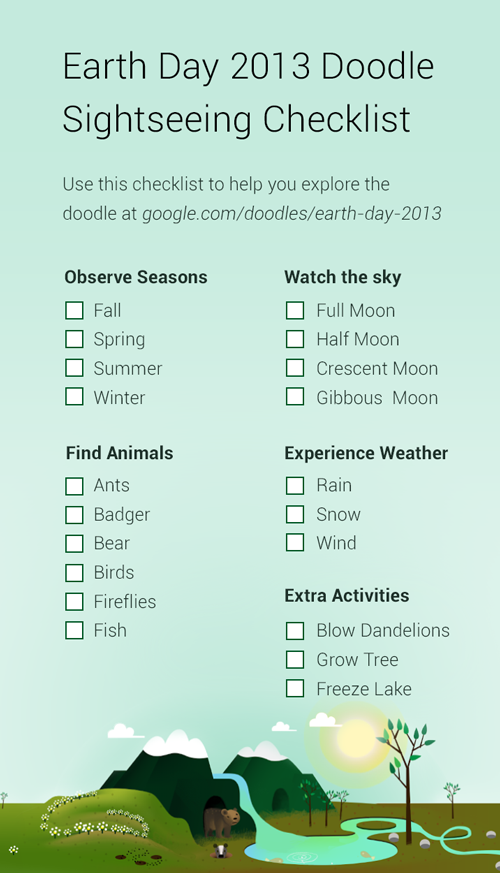
“Today we are celebrating Earth Day with an interactive doodle that captures a slice of nature’s subtle wonders,” wrote Doodler Leon Hong. “We hope you enjoy discovering animals, controlling the weather, and observing the seasons. Use the sightseeing checklist  to make sure you do not miss anything!” (end of blog below)

But for Built Environment inspiration on Earth Day – take a look at the video on the philosophy behind the Bullitt Centre in Seattle – “driving a wedge into the future of buildings”, officially opening today and now home to the Living Building Challenge.

Seattle’s Bullitt Center: The World’s Greenest Office Building from EarthFix on Vimeo.

An inspiration for the UK Built Environment. The UK Collaborative was launched on the 3rd April (see Introduction here) Find out more and keep in touch with Living Building Challenge UK via @UK_LBC

……

earth-day-2013-doodle-sightseeing-checklist