Category Archives: sustainability

Introducing the Living Building Challenge in the UK

It was a real treat to introduce the public lecture from Amanda Sturgeon as part of the UK Living Building Collaborative launch at the Interface showroom in London last night.
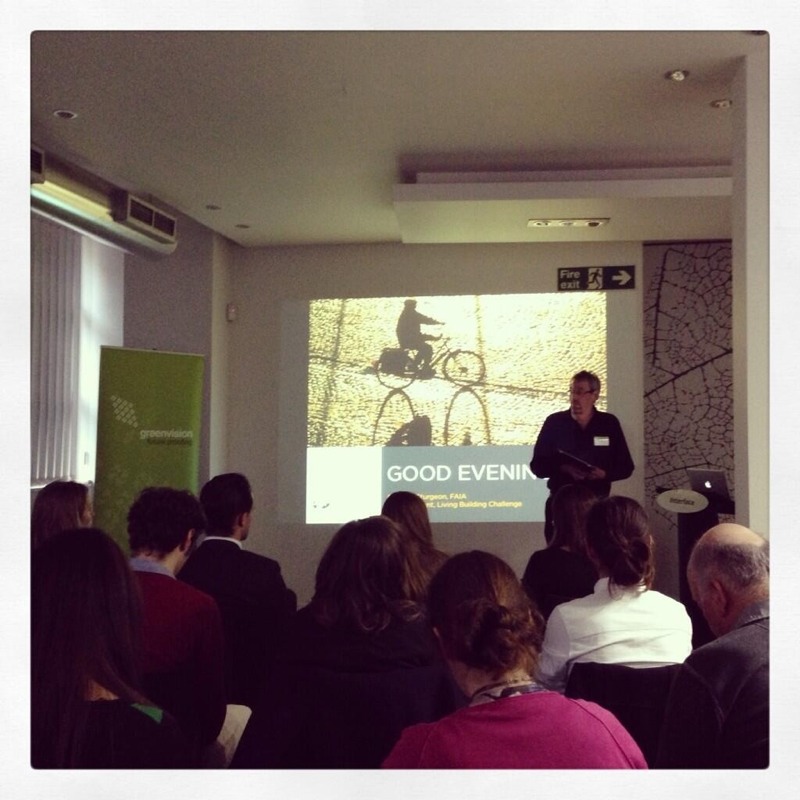

Here are my introduction notes …

Good evening and a warm welcome to Living Building Challenge UK

Firstly a huge thank you to Interface, Kelly Grainger for hosting this evening and Claire Bowles at Green Vision for making it happen, and of  course Amanda Sturgeon from Living Building.

I and a few others have waited a long time for this …

As you may have read in Hattie Hartmans AJ article, our awareness with Living Building started via twitter and through twitter dialogues during the Living Futures conference in Portland in 2011

Later that same year I was privileged to have a guided tour of the CIRS building in Vancouver, during the week before completion (The CIRS building is one of the few buildings scheduled for LBC certification) Since then we have received Living Building related remote presentations live into Green Vision and Be2camp events.

Over the last few months we, that’s myself and Claire at Green Vision, have held regular Skype chats with Amanda and others at LBC, to set up this UK Collaborative and this event, so it’s a real pleasure to welcome Amanda along this evening

But before introducing Amanda a word about the Living Building UK Collaborative. We are part of the Green Vision / Leeds Sustainability Institute with two main aims:

One of advocacy to increase awareness and understanding of the Living Building Challenge

Secondly to provide support to clients for living building design, construction and certification in line with the challenging Living Building principles.

If you want to know more about the collaborative, would like to get involved or indeed would like support on possible future Living Building projects here in the UK please do get in touch.

We cannot let this evening pass without mentioning Mel Starrs, and her advocacy for deep green thinking. Mel, in her last blog piece (an article which you must read) welcomed the idea of LBC in the UK as a standard worthy of the green credentials of leading clients.

Mel’s blog was read by Su Butcher.

I am sure you will agree – launching the LBC here in the UK is in fitting honour for Mels passion for sustainability, green building and challenging standards.

Amanda – Vice President Living Building Challenge

Amanda is an award winning architect recognised as a pioneering leader in the green building movement in the US northwest, a founding member of the Cascadia Green Building Council and is a visiting professor at the University of Washington

Amanda was awarded with better bricks Architect Award in 2008 and recently gained Fellowship of the AIA, the American Insitute of Architects

Amanda, welcome to London and the UK Collaborative

The event was well tweeted, to catch up on comments and pictures view the #lbcuk and #uklbc hashtags (don’t ask) and follow @UK_LBC.

Record of the evening now on Storify

There will be a Slideshare record very soon

Image Building Pieces

From Greendeal to Mindfulness in Sustainability

My More than Just a Green Deal keynote to the Merseyside Construction Conference March 13th 2013, making the case to see Green Deal as part of the Green Build and Sustainability agenda, and the need for doing the right green thing every time.

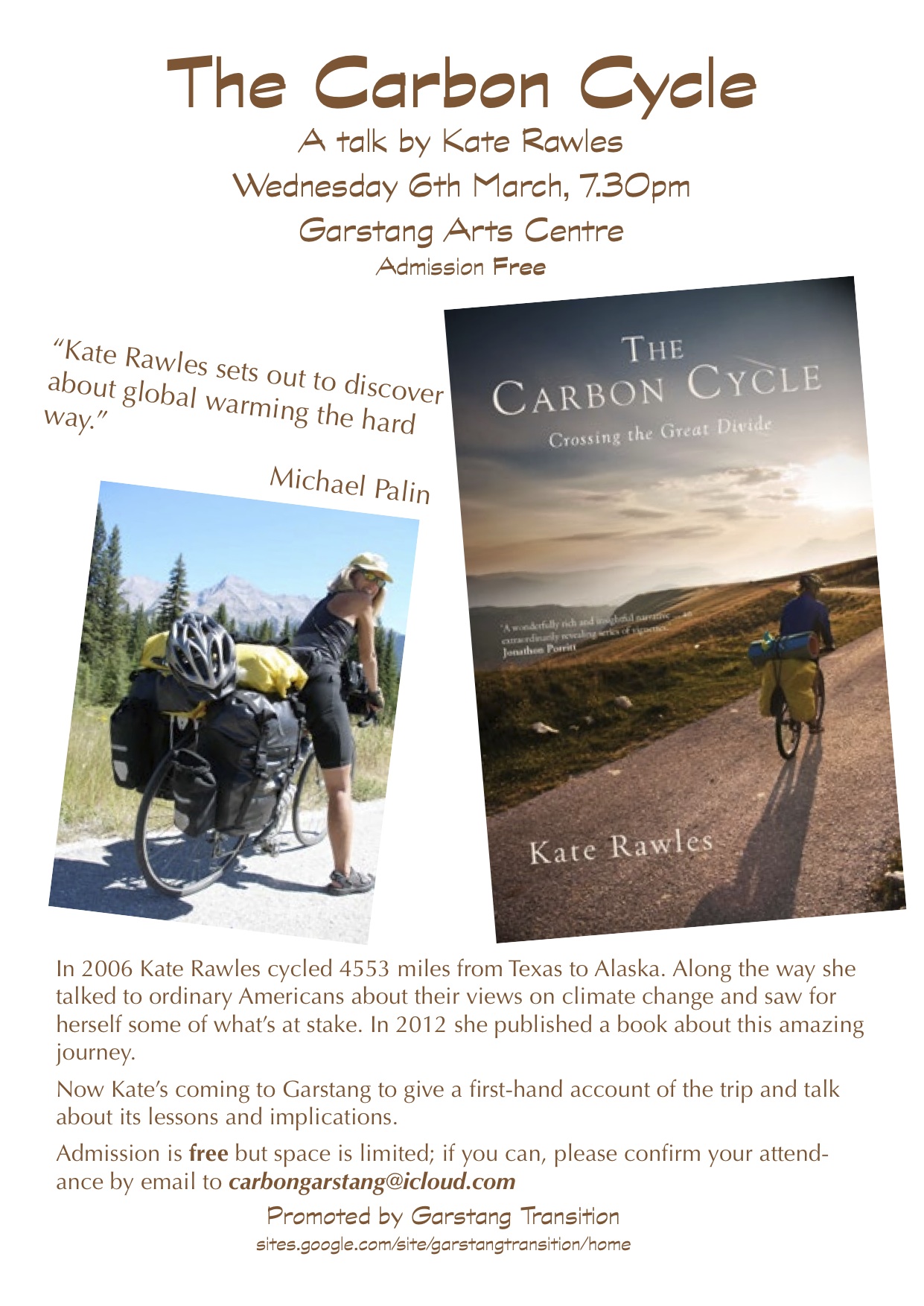
The Carbon Cycle: Transition Event

In 2006 Kate Rawles cycled 4553 miles from Texas to Alaska. Along the way she talked to ordinary Americans about their views on climate change and saw for herself some of what’s at stake.

In 2012 she published a book about her amazing journey. The Carbon Cycle

Now Kate’s coming to Garstang to give a first-hand account of the trip and talk about its lessons and implications. Admission is free but space is limited; if you can, please confirm your attendance by email to carbongarstang@icloud.com

Carbon Cycle Poster Web

Ecologically Rethinking Construction

Jonathan Dawson, head of economics at Schumacher College, writing on Guardian Sustainable Business asked “How do we redesign a new economic theory framed by ecological systems?”

OLYMPUS DIGITAL CAMERAA question we need to ask and start addressing within the built environment.

We are seeing a new vocabulary emerging with concepts such as biomimicry, zero or net energy, water and environmental impact, Living Buildings, biophillia, circular economy … and more … As the interest and importance of these concepts influence in the way we design, build and use buildings, do we need a new paradigm?  Some 15 years after Egan, do we need to again rethink construction to address these emergent sustainability themes. approaches and skills that once again the sector is lacking, engaging the economists, surveyors and accountants? As Jonathan Dawson comments:

Ecology offers the insight that the economy is best understood as a complex adaptive system, more a garden to be lovingly observed and tended than a machine to be regulated by mathematically calculable formulae.

A comment that makes a nice resonance with the Living Building Challenge philosophy

And of course a key element in this new thinking is the internet, web 2.0 and the power of social media.

Enabled by the growing power of information technology, whole new ways of doing business and organising society are emerging, whose strength lies not in economies of scale but in economies of co-operation and symbiosis

Over the weekend , via twitter I caught a slide via Rachel Armstrong illustrating the difference and need to move from 20th century Cartesian or Newtonian thinking into 21st complexity, emergent thinking …

screenshot.32

Jonathan Dawson: “This moment of history calls on us to rewrite the dictionary and create new stories, much as the generations following on from Copernicus did to reflect the new world-view that emerged from his astronomical insights”

Construction Localism – how do you compare against benchmark?

Construction ‘localism’ is currently high on the agenda. And set to grow in importance.

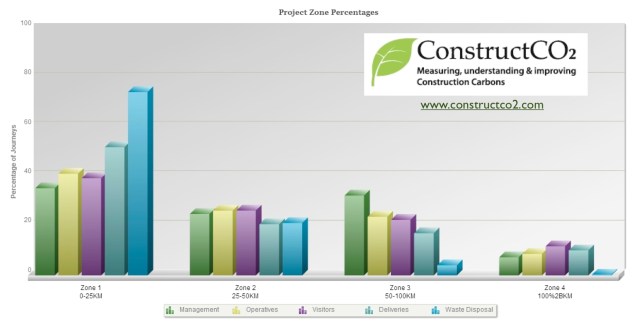
There is, rightly, much talk and focus on localism within construction projects and frameworks at the moment, based on the principle of keeping project spend local. And of course realising other benefits such as reduced travel and transport distances, reduced carbon emission, improved productivity and more.

But how do we compare and benchmark ‘localism’? How local is your project? As a client how can you know if your contractor is addressing your ‘localism’ requirements?

The benchmark being set through ConstructCO2 can provide a starting point. How do you compare? Do you know your project stats?

Construction Localism by Zone

Measuring and understanding your localism (and CO2) footprint must be a key measure, a KPI, as part of your sustainability and CSR programme. Going beyond the measuring it’s essential we monitor trends, make the comparisons, understand the causes and, take action.

bb7dff99a6e2e90c5e67b380cb0aac7b

It is one of the more important impact and influence areas your construction project has on sustainability and the environment.

For more on measuring your construction project carbons and project localism check out constructco2 or please do get in touch.

Sustainability beyond the low hanging fruit

My sustainability lecture to UCLAN SNBE and CSD 31/1/2013
Links referred to in presentation:
Please share your thoughts? Have we picked the low hanging options, what next for built environment sustainability?
For any clarifications or more information on the topics raised, or to keep in touch with UK developments on Living Building Challenge and HPD Standard, please get in touch (email or twitter) or subscribe to this blog

Are we so oblivious to the ways of nature?

“After 10 generations of industrial society, and with most people in the west removed from a world of soil and sweat, we are so oblivious to the ways of nature that we cannot bring ourselves properly to absorb its vital importance”

Mark Cocker author of Crow Country reviewing the excellent What Has Nature Ever Done For Us? by Tony Juniper “How environmentalists now put money at the centre of their argument”  (For example, read the book/review to understand why the total bill for India’s programme of removing its flock of vulture scavengers has been calculated at $34 billion)

Mark Cocker, based in Norfolk and written extensively on modern responses to nature.  Crow Country is a fascinating look at the life of crows, on the state of country life in Britain, and on the relationship between ourselves and nature.

Related: Re-Connecting – the 3R’s for rethinking built environment sustainability

So, what have we done for nature?

Having listened to Tony Jupiter’s “What has nature done for us” podcast talk at the RSA over the weekend, my son Tom brought this simply brilliant animation to my attention – “what have we done to nature” …

MAN from Steve Cutts on Vimeo.

Related:

The world may not be ending today, but does the construction industry continue to waste as though there is no tomorrow?

3 R’s for rethinking built environment sustainability

Sustainability: Closing the Circle: Barry Commoner

The world may not be ending today, but does the construction industry continue to waste as though there is no tomorrow?

OLYMPUS DIGITAL CAMERAOK, not all construction and indeed we have many exemplar, near-zero-waste construction projects , yet the industry continues to be wasteful, locked into a Take, Make, Waste attitude that contributes 40% of all waste.

The last few weeks of Green Vision activity have highlighted the emerging circular economy, cradle to cradle, living building, healthy product philosophies that will move us away from our cornucopian approach.

The push for 2013 must be to ‘rethink the way we make things’ and aim for more near-zero- waste projects. (near-zero-waste as meaning waste generated on a project, not the percentage of waste diverted from landfill)

Related posts:

Cradle to Cradle Tweetchat Storify

3 R’s for rethinking built environment sustainability

Is Our Green Build Compass Broken?

Innovation Voucher Provision

mb-m-and-c-1-blueThe Technology Strategy Board (TSB) is making Innovation Vouchers available worth up to £5000 for construction and built environment companies. Applications are due to open on the 10th of December and close on the 23rd of January 2013.

Fairsnape in association with IBE-Partnership is delighted to assist you  in preparing and submitting your application for Innovation Vouchers in the following topics that we offer as your innovation provider to improve your construction performance.

  1. Social Media – Awareness, Getting Started, Developing, Strategy and Policies, Measuring,
  2. CSR – Awareness, Developing Strategies, Integrating and aligning systems, Measuring.
  3. Sustainability (1) – Awareness, Strategy, Policies, Aligning / writing systems, Measuring
  4. Sustainability(2) – (Beyond Waste) – Awareness, circular economy, cradle to cradle thinking, healthy products innovation, measurement,
  5. Construction Carbon – Awareness, Strategies, Measuring and Improving, Application of wold class tools
  6. Benchmarking – (Beyond KPI’s) – Awareness, Strategy, Benchmarking Project, Measuring, Application of world class tools
  7. Business Strategy – (EFQM) Awareness, Improving overall and holistic strategy, facilitation, measurement
  8. Collaborative Planning / Last Planner – Awareness, Strategies, Training, Guidance, Facilitation, Application of world class tools
  9. Lean Construction Techniques – Awareness, Strategies, Training, Guidance, Facilitation, Application of world class tools
  10. Collaborative Working – Awareness, Strategy, Principles, Training, Facilitation, Preparation for BIM
  11. BIM – Awareness, Strategy, Policies, Preparation Plan, Facilitation,
  12. Customer Management– Awareness, Strategies, Training, Guidance, Facilitation, Application of world class tools
  13.  ISO14001 – Awareness, Strategy + Policies, Improving/Writing EM system + process, training, readiness for assessment
  14. ISO90001 – Awareness, Strategy + Policies, Improving/Writing QM, training, readiness for assessment system + process
  15. PAS 2030 – Awareness, Strategy + Policies, Improving/Writing Green Deal system + process, training, readiness for assessment
  16. Bidding – Awareness, Strategy, Process/Approach, Support,

mb-m-and-c-1-blueThis is a great opportunity for you to innovate and improve your effectiveness and efficiency, improve attractiveness to clients  and of course improve the bottom line at no cost to you. If you are interested in progressing further please call or get in touch to discuss.

00 44 7776 234702

Email | Twitter | Blog Linkedin | G+