Category Archives: technology

twittering on the edge of chaos?

It seems everyone is trying to understand and analyse  twitter at the moment, so after nearly a year of twittering , here are my thoughts:

Perhaps it is a little more than coincidence that Twitter has been named after our feathered friends,  as it is very close, in my mind, to the classic edge of chaos example of how birds flock.  

Birds flock  through following a set of unwritten, uncommunicated simple  rules.  Flocking birds have no manual, no procedures to follow, no dos and do nots, no bird etiquette, they just do it , and do it by instinct and in spectacular fashion. 

And they all do it. (Have you ever seen one bird turn the wrong way at the wrong time to create a mangle of free-fall bird feathers – no, never).  

And so it is, could, should? be with Twitter

It works at so many different levels for so many different purposes, and here is its power, it is all things to all people and brilliant for it, and we twitters like them boids, don’t need lists of dos and donts, guidance, rules or twitterquette, we just do it,  we just twitter.  (Maybe this is why many say they just ‘dont get it’ – there is a sense of jumping in and using twitter and see what emerges, rather than a calculated action plan) 

Indeed it is the relationships between the agents (us as twitters, or the birds) and the scope for emergence are is so important in keeping twitter at the edge of chaos.

Chaos theory is often illustrated through the butterfly affect ( a butterflies wings flapping in Chile can cause storms in Europe, a concept I have called small in large out – SILO)   Again Twitter demonstrates this concept incredibly well – one tweet  can spread through the global twitter community probably faster than any other form of communication known. (eg news stories broken through twitter) 

So is twitter really an application of complexity theory in practice, a demonstration of the ‘edge of chaos’ paradigm?   I think so, and  having long used the concepts of complexity theory (simple rules, agents, relationships, SILO and emergence) to allow management system processes and procedures to become so much more effective and efficient, (eg where many ‘control’ procedures can be replaced with a few simple rules)  I see twitter applications having a future within management systems, just not sure exactly how yet!

But … others more learned in the complexity / chaos theory may like to comment, agree  or correct me ?

Oh, and since tweeting I have, through twitter,  purchased a chicken coop, won and let work contracts, helped others win work,  learnt so much, made new friends and contacts, been inspired and shocked, eaten humble pie once or twice and hopefully shared something of use in return.  Fellow twitters have shared births, deaths, job losses and job finds, sadness, anger and great happiness ….. Brilliant.
defining zero carbon – more clarifications (for homes at least)

On Wednesday I sat in on a Zero Carbon Hub consultation event relating to the defining-zero-carbon-homes-presentation2zero carbon definition  for buildings. I did manage to send some tweets via twitter during the session, and here, I have pulled these together to give a view on the consultation paper.

The event was not quite what I was expecting, as confusingly although the document out or consultation is entitled Definition of Zero Carbon Homes and Non Domestic Buildings, it doesn’t, Neil Jefferson head of the Hub informed us, cover Non Domestics – a separate consultation is expected soon.

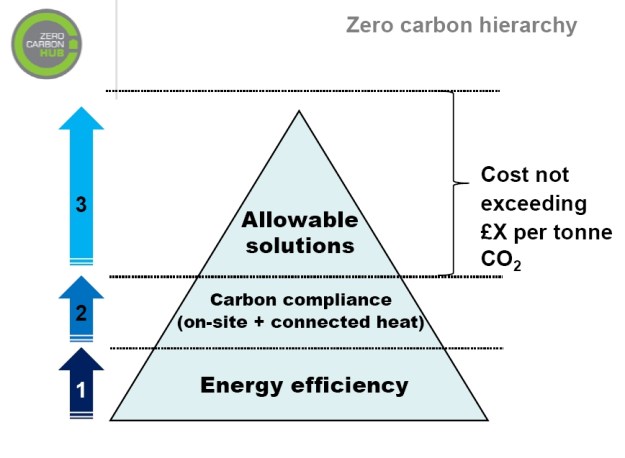
Key to the proposal and principles are three elements expressed in the pyramid:

zero-carbon-hier

There is so much thinking, science , technology and even politics behind this hierarchy that isn’t (imho) expressed in the paper, but was covered in the slides from the session, handed out on USB drive and from here : defining-zero-carbon-homes-presentation2

Some interesting thoughts:

As to the rate of homes being built to CSH 6 (zero carbon) the following profile helps to explain the anticipated progress to 100% post 2016:

of-homes-to-zero-carbon

The aspirational target is a UK version of the German PassivHaus concept.  (as Denise Chevin mentions in Building Its principles are simple – the best way to go low carbon is to build a well-insulated, airtight envelope that is nice to live in. It also comes with a copper-bottomed pedigree, with thousands of completed buildings over its 17-year history.)

Nearly 50% present at event were developers and contractor and saw the on site achieving of standards as most demanding aspect of zero carbon. (Cost and quality) 

Will allowable solutions be just another complex carbon off-setting scheme? Could offsite allowances mean business as usual for designers / developers / builders ?  although 2/3 of those present thought that offsite renewables should n0t be included within carbon compliance.

New build house projects to (could?) decarbonise existing housing stock – this is an exciting new idea but received low interest in terms of potential (votes) from those present 

And as to who should monitor and police zero carbon?  Given three options ( Local Planning Authority/ Building Control Bodies/New form of accredited body) those present opted for c, New form of accredited body.

musing on a carbon 1:5:200

Reading many items and articles on the carbon issues that the built environment faces in the coming years, I have jotted a number of random thoughts in google notebook, which may one day be useful ‘spin’ for example:

…almost every building uses more energy than design calculations …… technology alone is not enough …… design 20%, people 80% … attitudes and behaviour towards energy use need to change …….. it is our responsibility to make sure that the building users understand what they need to do to meet the carbon objectives set at the design stage…… people just change the lightbulbs and appliances as soon as they move in ……. eco bling in buildings is too complex for fm’s so they switch it off and open the window..

And then, describing the 1:5:200 concept to someone today, it clicked, maybe it is the  1:5:200 thinking that joins these snippets together and is a new paradigm required in relation to sustainability and carbon management.

Maybe, if  the impact of construction is set to 1, then could the impact or influence of fm be 5 and the impact of building users 200? (in this thinking the influence of design is 0.1)

(and of course, as with the cost 1:5:200, these are indicative magnitudes to illustrate relationships between construction fm and buildings in use, not absolute figures)

Comments welcome ….

interacting with information

“There’s a clear direction … away from people thinking, ‘This is my PC, this is my hard drive,’ to ‘This is how I interact with information, this is how I interact with the web.'”

Occasionally you come across a quote that reinforces up what you have been trying to communicate for ages, such is the comment above from Dave Armstrong, head of product and marketing for Google Enterprise, reported in the Observer article Google plans to make PC’s history .

This illustrates that the move towards a more web2.0 environment is no more about the technology but about people, trust and empowerment.

Over the last week or so I have seen many examples of the silo approach to information and knowledge, from projects to corporates to universities to industry champions, all concerned over loss of some kind of advantage (claims, profit, competitive edge, intellectual rights etc) in the face of sharing on web2.0 platforms or apps.

Maybe the built environment sector need to look at the mess the music industry has gotten itself into by trying to retain some degree of ownership for a solution.

There is also the generation thing here, as Paul commented at last weeks collaborative champions meeting, Y Gen and Google Gen people are unconscious collaborators , and yet the more influential generation (boomers) maybe stifling such collaboration by taking away and banning collaboration / sharing tools such as facebook and twitter and blogs and ….

There is also a parallel here to the anti-benchmarking school of thought, but history has shown that those who share, learn and benchmark mark with others have gained rather than lost advantage and made progress on many improvement fronts.

Time for us in the built environment to re-evaluate how we  interact with information and the internet…

defining zero carbon

As a post on this blog noted at the end of last year, the definition of zero carbon buildings is currently under consultation by the Department for Communities and Local Government.

I am in full agreement with Casey over at Carbon Limited who blogs for a call to arms on this one, this consultation is so important that all in the built environment should engage with.

The outcome definition will shape and determine design, construction, building services  and facilities management into the future, in a similar (but more profound way) that the HASAW and CDM and other milestone legislations have done.

(from zero carbon consultation:summary)

At the core of the document is the government’s preferred framework for reaching zero carbon. In order of priority:

  1. A minimum standard of energy efficiency will be required.
  2. A minimum carbon reduction should be achieved through a combination of energy efficiency, onsite low and zero carbon (LZC) technologies, and directly connected heat. This is referred to as achieving carbon compliance.
  3. Any remaining emissions should be dealt with using allowable solutions, including offsite energy.

The zero carbon definition will have profound implications for…

… the built environment client in the choice and cost implications

design –  a change the design parameters,

construction, for example with airtight construction calling for a build quality and quality control we are not too good at. (Research at Leeds Met is showing that the cost of retro fixing air leaks in new buildings is  a hugely costly exercise *)

building services – on energy sourcing and management.

And of course on the way buildings are used, run and managed.

If you haven’t read it yet, you can download it here.  or as Casey puts it – get involved or forever bitch about it in the pubs.

(* more on this later)

on web awareness

Paul at ExtranetEvolution AEC conferences, content and ‘unconferences’and Jodie at I have no opinion world architecture festival have commented recently on the low awareness and application of web technologies in the AEC and conference world.  As one would expect following previous posts here, and as a founder to be2camp, I would share the same views, reinforced with recent observations.

I was amazed at the low awareness of web applications recently as I presented a session entitled from Facebook to BIMStorms. I knew I wasn’t going to complete the journey planned through the presentation when only 20% of the 70 people there used Facebook, and when asked if they used Facebook for anything other than social the response was nil, a couple on CAD, but then blanks on twitter, linkedin, BIM, etc. I couldn’t mention Second Life …  And these were 70 of our next generation managers – being engaged in HNC or HND courses at the moment.

Hopefully it has led to working with colleges on raising awareness.

Another day, another course, a different set of organisations – 6 small contractors, discussion on use of IT on sites to enable access to knowledge, communication etc.  Not one would allow laptops or computers on site, quoting a lack of trust of their staff to use responsibly and a security / theft issue.

A reminder that its 80% people management and 20% ICT ???  But maybe the 20% is taking the blindfold off?

Oh and has anyone tried to book a venue for an unconference with open wifi or good connectivity and  power for people to use laptops?  I find this frustratingly difficult as I seek a venue for a half day event next month. Conference organisers are way behind this need. And who feels awkward in using a laptop to make notes or blog, or to use the phone to tweet at a conventional conference?

For many conventional conference attendees, the idea of streaming presentations online will be a novel concept; laptops and mobile phones should remain switched off during sessions; and ‘social networking’ means wine and canapes – not blogs and tweets

And as I write this I see twitter messages from Mel and Paul on identifying who within the built environment sector are really embracing web2.0 technologies, as Mel says who is walking their talk? My reposnse would be:those who engaging with initaiatives such as be2camp, like the Constructing Excellence Collaborative Working Champions who are stepping forward to explore web2.0 in a days workshop in January led by Paul and myself. like the use of Twiiter by Constructing Excellence.  Yes early days but ….

picture that tells a 1000 words

This is cool.

This image, easily generated at Nokia Barcode Generator site contains links to my site.

Anyone with a barcode reader can zap the images and instantly ‘read’ the information and save to contacts.

Also works with text and links.

Could we see all business cards looking like this one day.  Or profile images on social networking sites replaces by the picture that tells a thousand words.

Badges at conferences could be far more interesting, and a great ice breaker as people get close to zap each other.

eco facilities management for government?

The UK  Government has come under criticism recently for not tackling environmental issues with enough vigour to be seen as a role model or exemplar, and failing to meet its own targets.

See: the Sustainable Development Commission report two thirds of departments were not on track to meet the target of reducing emissions by 12.5 per cent by 2010, while a similar report from the National Audit Office criticised civil servants for failing to keep accurate carbon emissions data. Those reports were accompanied by another study from the Commons Public Accounts Committee which claimed rules on sustainable procurement were being widely ignored by civil servants.

Now Companies providing green products and services can now expect a major boost after the government yesterday unveiled its long-anticipated delivery plan for meeting its targets on environmentally sustainable procurement and carbon emissions.

Following on from its recent commitment to ensure all government IT operations are carbon neutral by 2013, the Cabinet Office released a 167-page plan outlining how it intends to ensure departments consider environmental sustainability when making procurement decisions and better meet targets to cut emissions, waste and water use across their facilities.

We can expect these requirements to trickle down the supply chains for service provision (facilities management, IT  and construction) reinforcing the notion of supply chains based on environmental and carbon management, not just cost, and certainly not lowest cost

Source and Links:

UK Governments sustainable procurement and carbon emissions delivery plan announced

Government outlines green procurement overhaul

a smart eco house that daydreams?

Following recent communication with Adam Somlai-Fischer at Zuiprezi, who I hope can get to talk at the be2camp event in October, I took a look at the Reconfigurable House, a concept environment developed by Adam constructed from thousands of low tech components that can be “rewired” by visitors.

So far so good, but reconfigurations can be made endlessly as people change their minds, so that the House can take on completely new behaviours.

Smart homes actually aren’t very smart simply because they are pre-wired according to algorithms and decisions made by designers of the systems, rather than the people who occupy the houses.

so the user gets to configure the usability level, excellent, but:

if the House is left alone for too long, it gets bored, daydreams and reconfigures itself….

The Reconfigurable House is open source, registered through Creative Commons which seems to allow you to download the code and create your very own reconfigurable home, or upload your own configurable devices into the house suite.

Arguments as to who has control of the remote may take on a whole new dimension.

be2camp goes live

BE2Camp, 10 October, London

be2camp

Web 2.0 meets the UK construction industry at a novel new event,

BE2camp, to be held on Friday 10 October at the Building Centre in London.

Having been part of the (international) planning team behind this event, I am delighted that we now have some details confirmed. If you fancy becoming part of the event, whether as a sponsor, a speaker or simply a participant (whether in person or virtually), please join in.

You can also follow developments on twitter by following @be2camp

There will be more here and on the site as the event shapes up. The other members of the planning team have blogs which will I am sure carry be2camp news as well:

EvolutionExtranet (London) Paul Wilkinson

Public Works Blog (Illonois) Pam Broviak

I have no opinions (Sydney) Jodie Miners