CBI low-carbon economy roadmap to 2020

For the first time the UK’s leading business group has set out its vision for a low-carbon economy in a series of climate change roadmaps.  The roadmaps, called ‘Going the Distance’, set out a timetable of action to ensure carbon emissions targets are met, and the measures that will be needed to put the UK in pole position in the development of low-carbon technologies.

Comment: the roadmap could appear to be protecting industry (only a 6% reduction) and focuses heavily on nuclear and carbon capture (but not until 2013), sees the Severn Barrage as the way forward and wants a government led, rather than industry led  initiative.  (what happened to market led economies?)

CBI are proposing the following contributions per sector from 2006 

Industry 6%

Buildings 43%

Transport 29%

Energy 39%

(not sure how much the roadmap avoids double counting, particularly with energy reductions) 


In the buildings roadmap the CBI wants to see:
• Smart meters fitted in homes and businesses so users can see how much power they are using.
• Incentives to encourage consumers to buy more efficient washing machines, fridges and freezers.
• Loft insulation installed in three million homes.
• Agreement on a realistic definition of ‘zero-carbon’ for new homes and business premises.

  Download: Going the distance: the low-carbon buildings roadmap 

Forty percent of the UK’s carbon emissions come from energy consumed in buildings.1 To meet the UK’s 2020 CO₂ target, the CBI believes carbon savings of 43MtCO₂ should come from buildings, equivalent to a 20%reduction from 2006 levels.

Nearly two thirds of these savings can come from energy efficiency measures that will save money as well as carbon, while remaining savings will need to come from renewable and low carbon heat and micro-generation and zero-carbon new buildings. Progress made in decarbonising the UK’s electricity supply will also drive emissions reduction

Related:

Route to Zero

web tech construction

Do you know your Twitter from an Avatar, or RSS from a BIM?

I am currently running an innovation circle for Construction Knowledge Exchange (CKE) looking at the use of web technology in construction at UCLAN.  The first session  took a lightning tour through communication, design and collaboration in the sector, from fax machines to BIM storms.

Innovation circles are based on a cycle of four 2 hour sessions, the content of each being decided by the delegates based upon the first ‘overview’ session.  Web technology in construction flyer

Future sessions will look into the worlds of:

■ Communications—blogs, twitter, skype and conference tools.(Thursday 10th April 1pm)

■ Information—google and wikis

■ Design—beyond CAD to Second Life, BIM and Bimstorms.

…. and, technology (wifi) permitting will be more hands on and interactive wih the web applications. (Why is I find the most trouble some place to get wifi or internet connections is within universities?  OftenI feel like taking the workshop “across the road” to a MacDonalds or Starbucks !)

Following the fourth session the presentation materials will be available here and on slideshare, with a recap at the be2campnorth event on 15th May in Liverpool.

Modern Ada

Yesterday I pledged to post on my blog, a  recognition for my unsung heroines as part of the Ada Lovelace international day of blogging to draw attention to women excelling in technology.  

As I have been drawn into the web of second life, web2.0 and social media I have made contact and friendships with a number of women who not only excel in their professional field but also have a seemingly unlimited supply of energy and innovation.

Through barcamps, Be2camp 2008, twitter and other social apps, friends such as Pam Broviak (Second Life), Krishna De (bizgrowth),  Jodie Miners (be2camp), Su Butcher (architecture), Cindy FrewenWuellner  (futures), Mel Starrs (sustainability), Soulla Stylianou (second life) and of course Suw Charman (social media / kits and mortar) continue to impress with their use and understanding of web technology.

It was through Second Life and  the Public Works sim I met Pam Broviak (or rather her avatar Pam Renoir) and have since shared much on family, social life and all things webby across all manner of web applications. Yet it is Pam’s drive, as her twitter profile states “working to integrate engineering, Web 2.0, & virtual worlds” that continues to amaze and inspire in equal doses.

If there was a nomination for a Modern Ada, Pam would get my vote ( as I know she has the vote of others) in making virtual worlds and web technology have real impact in what is often a cynical and unforgiving industry.

passivhaus innovation circle

The next Innovation Circle Session on ‘Passivhaus’ will look at the possible influencing factors of implementing the Passivhaus principles in the UK.  Friday 20th March 1-3pm at the Adelphi Conference Room, Adelphi Building, UCLan.   


Led by Sabine Engelhardt – Green Cities, Manchester, and Facilitated by George Hall

Details passivhaus innovation-circle-flyer

recession thoughts and tips

The recent excellent BBC Life on Mars series painted a harsh, dark and in many ways ugly portrait of life in Britain in the mid 1970’s. It was in that this environment I started a career in construction, a young trainee QS, working a ‘statutory’ three day week with fuel and power rationing (only able to buy petrol on alternative days depending on the first initial of your surname)

Since then I have experienced and survived the industry’s many cycles of boom and bust, times of recession and times of plenty, often caused by conditions outside of the sector itself.

It wasn’t until a later reading of Charles Handy’s Empty Raincoat that I understood I had developed a strategy for dealing with this cyclic industry. Handy sees the key to surviving change as being the ability to move from one sigmoid curve to the next before the current one peaks, or before the current one becomes a bandwagon and is no longer cutting edge. (see here)

In times of recession, innovation is the hallmark of successful organisations, and of people that survive. In my experience this means looking ahead, identifying the next emerging innovation/theme/idea, and getting rapidly up to speed. Over my career, this has led to moving from work to university, to becoming an expat, to moving from project management into planning, from planning to quality, to TQM, to collaborative working and business improvement, to benchmarking, to fm and then into independent support provision.

The move into planning serves as a good example. I was able to shelter the downturn at the time, being one of the few who could (or wanted to) operate a computer. We are talking 80’s here, the office had one pc shared between a secretary and myself. I cut my teeth on Pertmaster. Initially this produced crude gantt charts as a row of green X’s, but provided a much needed USP to winning work, and was the start of a short career as a computer based planner.

In the world of business improvement, quality, TQM and benchmarking, being part of a supportive network, and having mentors outside of the industry, proved incredibly useful, bringing new learning ideas in to the organisation

All this, I believe, improved the value I was able to add, in addressing the emerging issues that clients were facing. being ready to deal with this emergence meant that I was able to move as doors open, and explore new avenues. The lessons from each of these unexpected events has created a resilience that enables me to work in a number of sectors and areas.

So, here is a very personal guide to survival. It may not be the exact menu for you, but it will, hopefully spark a few thoughts and ideas that will help.

Be Enthusiastic: Recharge your batteries now, get out and do something wild. Appearing tired at work, and not hungry for change, is bad news

Be Ready: Identify the next emerging theme. What skills and knowledge can you acquire that will add value to you and the organisation. Get intelligence and use it.

Be Flexible: Have a plan, but also go with the flow as opportunities emerge. The built environment has a fantastic range of careers and jobs. Consider which areas are more recession proof. Currently these may be sustainability, or BIM (Building Information Modelling), or web based technologies. These are areas that will be more in demand post recession

Be Resilient: Think long term. Arguably its short-termism that has led us into the current mess. Develop a personal and organisational resilience plan that looks at improvement over the long term. Be better when we emerge from this recession.

Stand in the future and observe the industry in 2016/2019 – climate change will not be ‘put on hold’ during the recession – so do you have a route to zero mapped out?

Be Visible: Find a group you can network with, learn from and share with. For me in the past, this has included quality circles, benchmarking clubs or industry improvement groups. More recently, I am a part of many on line forums. Themed networks such as Green Drinks can provide similar opportunities. 

Get a profile inside and outside of the organisation. This is easy to do through web 2,(eg Linkedin) but what does your facebook, myspace, twitter really say about you?  What do you really find out when you google your name, or your organisation. 

Be helped and help: Find a mentor or work with a mentee

And read …  the Empty Raincoat for example

And help is out there.

Supportive resources I am involved with include:

• Mentoring courses (funded)

• Start up support. For example, through Constructing the Future we are offering a free set of modules for women in Lancashire considering startup business or self employment.

• Route to Zero. This is designed to help in the development of resilience strategies

• Surviving the Recession. This is a one-day Evolution-IP survival course for businesses in development

• Green training. It is useful to get a environmental top up to your qualifications (for example the Green Register or others)

• Construction Agency. This is a planned employee/employer agency service for Lancashire that uses RSS, mobile web and Twitter to ‘keep jobs local’ (To be launched mid / late March, but follow @cagency for updates)

For more on the above please feel free to email or twitter or leave comments below and if you found this post useful please share with others …. AddThis Social Bookmark Button:

twittering on the edge of chaos?

It seems everyone is trying to understand and analyse  twitter at the moment, so after nearly a year of twittering , here are my thoughts:

Perhaps it is a little more than coincidence that Twitter has been named after our feathered friends,  as it is very close, in my mind, to the classic edge of chaos example of how birds flock.  

Birds flock  through following a set of unwritten, uncommunicated simple  rules.  Flocking birds have no manual, no procedures to follow, no dos and do nots, no bird etiquette, they just do it , and do it by instinct and in spectacular fashion. 

And they all do it. (Have you ever seen one bird turn the wrong way at the wrong time to create a mangle of free-fall bird feathers – no, never).  

And so it is, could, should? be with Twitter

It works at so many different levels for so many different purposes, and here is its power, it is all things to all people and brilliant for it, and we twitters like them boids, don’t need lists of dos and donts, guidance, rules or twitterquette, we just do it,  we just twitter.  (Maybe this is why many say they just ‘dont get it’ – there is a sense of jumping in and using twitter and see what emerges, rather than a calculated action plan) 

Indeed it is the relationships between the agents (us as twitters, or the birds) and the scope for emergence are is so important in keeping twitter at the edge of chaos.

Chaos theory is often illustrated through the butterfly affect ( a butterflies wings flapping in Chile can cause storms in Europe, a concept I have called small in large out – SILO)   Again Twitter demonstrates this concept incredibly well – one tweet  can spread through the global twitter community probably faster than any other form of communication known. (eg news stories broken through twitter) 

So is twitter really an application of complexity theory in practice, a demonstration of the ‘edge of chaos’ paradigm?   I think so, and  having long used the concepts of complexity theory (simple rules, agents, relationships, SILO and emergence) to allow management system processes and procedures to become so much more effective and efficient, (eg where many ‘control’ procedures can be replaced with a few simple rules)  I see twitter applications having a future within management systems, just not sure exactly how yet!

But … others more learned in the complexity / chaos theory may like to comment, agree  or correct me ?

Oh, and since tweeting I have, through twitter,  purchased a chicken coop, won and let work contracts, helped others win work,  learnt so much, made new friends and contacts, been inspired and shocked, eaten humble pie once or twice and hopefully shared something of use in return.  Fellow twitters have shared births, deaths, job losses and job finds, sadness, anger and great happiness ….. Brilliant.

twittering facilities management

Post UPDATE:

A twitterleague group has been created at  http://www1.twitterleague.com/view_league/181  – this may not be the ideal method in the long run but a good starting point to identify those in FM who use twitter.  I can see the definition of facilities management may well be discussed again as we have fm’s, architects, construction people and property managers in the group.  As it should be !  

To be involved follow @fmleague 


Twitter has certainly become the buzz of the new web applications and for good reasons.  Earlier, last year, I could see that twitter would be big, but didn’t really understand why or how.  Now, after a years use I start to see the benefit, broadly around open communications, learning, sharing and inspiring concepts.  

I am also convinced that twitter can and will have a major part to play within facilities management, in engaging with building users, and even in twittering data from building systems to facilities managers.

Inspired by the work of Su Butcher to create a league of twittering architects I would like to create a directory of those in fm using twitter, and collectively start to explore and pilot using twitter.

If you are in anyway connected with facilities managemement and use twitter, and would be interested in discussing twittering fm, please leave your details as comments to this post or send me a twitter @martinbrown

A quick search on tweepsearch suggests there are only 23 users with facilities management in their profile – but there must be more ( I know there are!)

Carbon Consultation Confusion (update)

There are a number of papers and proposals out for consultation at the moment, one just closed and another still to come.  So as a guide (and really looking for correction here if anyone can add to):

Code for Sustainable Buildings Consultation closed – expected feedback from UKGBC at Eco-Build

Zero Carbon Definition for Housing and Non Domestic – consultation closes 18 March (see my post defining zero carbon – more clarifications (for homes at least))  Doesnt include non domestic definition.

Heat and Energy Saving Strategy – sets out emissions from existing buildings to be approaching zero by 2050 – consultation opened yesterday 

Zero Carbon Definition for Non Domestic Buildings – expected later this year but anticipated to follow the principles in the Defintion for Homes.

*Update:  today National Energy Action (NEA) released their own strategy document entitled “National Energy Efficiency Strategy”. To view this document please Click Here.  According to the paper, this Strategy should establish a Code for Sustainable Existing Homes 

Confused?  It is not clear how these will ‘mash’ together, and indeed that is part of consultation, for example how will the Zero Carbon Definition (for Homes) relate to the Code for Sustainable Homes (in particular CSH6) – will it endorse or replace the CSH definition?

Whatever, this is an important aspect of the future of design, build and fm in the UK. The government are to be congratulated on being open on consultation – it is down to us to respond, make our points known …. for forever hold our peace and as Casey put it bitch in the pub.


For more informed views on LZC (low zero carbon) see Carbon limted blog posts

defining zero carbon – more clarifications (for homes at least)

On Wednesday I sat in on a Zero Carbon Hub consultation event relating to the defining-zero-carbon-homes-presentation2zero carbon definition  for buildings. I did manage to send some tweets via twitter during the session, and here, I have pulled these together to give a view on the consultation paper.

The event was not quite what I was expecting, as confusingly although the document out or consultation is entitled Definition of Zero Carbon Homes and Non Domestic Buildings, it doesn’t, Neil Jefferson head of the Hub informed us, cover Non Domestics – a separate consultation is expected soon.

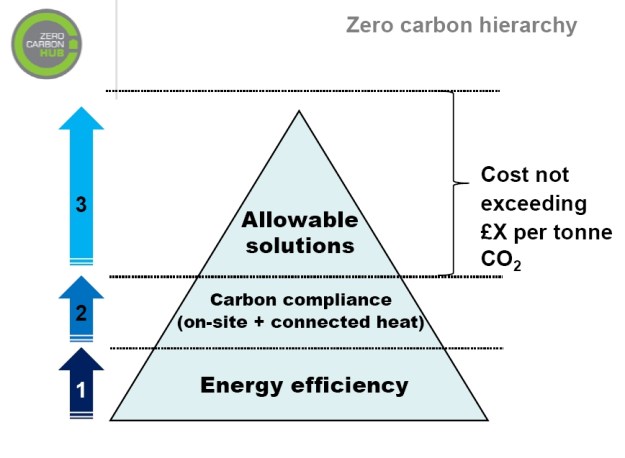
Key to the proposal and principles are three elements expressed in the pyramid:

zero-carbon-hier

There is so much thinking, science , technology and even politics behind this hierarchy that isn’t (imho) expressed in the paper, but was covered in the slides from the session, handed out on USB drive and from here : defining-zero-carbon-homes-presentation2

Some interesting thoughts:

As to the rate of homes being built to CSH 6 (zero carbon) the following profile helps to explain the anticipated progress to 100% post 2016:

of-homes-to-zero-carbon

The aspirational target is a UK version of the German PassivHaus concept.  (as Denise Chevin mentions in Building Its principles are simple – the best way to go low carbon is to build a well-insulated, airtight envelope that is nice to live in. It also comes with a copper-bottomed pedigree, with thousands of completed buildings over its 17-year history.)

Nearly 50% present at event were developers and contractor and saw the on site achieving of standards as most demanding aspect of zero carbon. (Cost and quality) 

Will allowable solutions be just another complex carbon off-setting scheme? Could offsite allowances mean business as usual for designers / developers / builders ?  although 2/3 of those present thought that offsite renewables should n0t be included within carbon compliance.

New build house projects to (could?) decarbonise existing housing stock – this is an exciting new idea but received low interest in terms of potential (votes) from those present 

And as to who should monitor and police zero carbon?  Given three options ( Local Planning Authority/ Building Control Bodies/New form of accredited body) those present opted for c, New form of accredited body.

musing on a carbon 1:5:200

Reading many items and articles on the carbon issues that the built environment faces in the coming years, I have jotted a number of random thoughts in google notebook, which may one day be useful ‘spin’ for example:

…almost every building uses more energy than design calculations …… technology alone is not enough …… design 20%, people 80% … attitudes and behaviour towards energy use need to change …….. it is our responsibility to make sure that the building users understand what they need to do to meet the carbon objectives set at the design stage…… people just change the lightbulbs and appliances as soon as they move in ……. eco bling in buildings is too complex for fm’s so they switch it off and open the window..

And then, describing the 1:5:200 concept to someone today, it clicked, maybe it is the  1:5:200 thinking that joins these snippets together and is a new paradigm required in relation to sustainability and carbon management.

Maybe, if  the impact of construction is set to 1, then could the impact or influence of fm be 5 and the impact of building users 200? (in this thinking the influence of design is 0.1)

(and of course, as with the cost 1:5:200, these are indicative magnitudes to illustrate relationships between construction fm and buildings in use, not absolute figures)

Comments welcome ….