Tag Archives: co2

Running an eco friendly home – Infographic

Interesting infographic courtesy Wickes via http://dailyinfographic.com/

Also interesting to note how many are of these are Green Deal measures and how many behaviour measures, indicating we get greater CO2 and energy reductions through lifestyle choices?

Green Deal Thoughts: Is green deal missing the behaviour measure?

Could Green Deal fail it its core objective of reducing CO2?

Green Deal is a necessary and welcome approach to funding improvement to our built environment fabric, increasing the use of renewable energy, and importantly providing structure to eco-fit work via the awaited PAS 2030 standard.

Yet, could the Green Deal approach be seen as ‘too’ technical and not addressing user and occupant behaviour, increasingly recognised as the key ingredient to CO2 reduction in the built environment.

I was reminded at the recent Lancashire Best Practice Club green deal event that our comfort levels within homes and buildings has increased by around 7 degrees over the last two decades or so.

Those of us who grew up in the 60’s will recall the infamous morning frost on the inside of windows, since when, building insulation has improved, but at the same time we use more and more energy to improve our comfort levels.

There is a danger that, as Green Deal makes home and workplaces more energy efficient, users and occupiers, especially older and vulnerable tenants, will simply take advantage of the increased comfort level and keep their energy levels and costs as before. (And coupled with the Green Deal Loan charge could increase energy bills and repayments) There is also research that suggests what we save on heating bills we spend on other high CO2 emitting  gadgets or travel.

Alongside the measures within Green Deal we need user behaviour measures.

Perhaps one of the easiest would be the ability to openly benchmark our homes or offices against a CO2 league table of homes in the street, offices on a business park.

The technology and devices exist, see Pachube, the EPC iphone app I blogged on in 2010 and for example I can now easily and freely track my cycle rides against other riders on the same segment of road, on the Strava cycle app. Why not track my energy use against other homes and premises?

This behaviour approach now needs the promotion alongside Green Deal technical measures. And Green Deal Assessors have a prime opportunity to introduce such measures.

Related good reading

CIRS – Where occupants are seen as inhabitants and required to sign a sustainability charter

Tenant Behaviour: Five Keys to Meeting Environmental Performance Goals

Half of Multinationals to Choose Suppliers Based on CO2 Emissions

Why monitor construction carbons:  Shortly after writing a comment to a linkedin group on the importance of measuring and understanding construction carbons, through tools such as ConstructCO2, indications of increased focus on carbon performance popped up in a tweet (via Julie Urlaub @TaigaCompany ) regarding an Environmental Leader post that referenced Carbon Trust Report: Half of Multinationals to Choose Suppliers Based on CO2 Emissions 

According to the study, a full half of multinational companies plan to select suppliers based on carbon performance, and that 29% of suppliers are likely to lose their places on green supply chains if they do not have adequate performance records on carbon.

In the U.K., 56% of multinationals said that in the future they expect to drop suppliers based upon low carbon performance, with 74% of the U.K. respondents quoting shareholder pressure as a key driver for them in tackling carbon emissions.

And, although the report has a focus on multinationals, it is not irrelevant to the built environment

Next month Marshalls Plc, a supplier of hard landscaping, will be hosting a United Nations Global Compact Supplier event to educate first-tier suppliers on its approach to environmental issues.

As I posted to the Think Zero group on Linkedin, I still have to hear a good reason why we should not be measuring construction carbons.  Are you tracking your carbon performance – do you have the evidence?

Read more: Carbon performance offers major risk or reward

Construction supply chain footprints

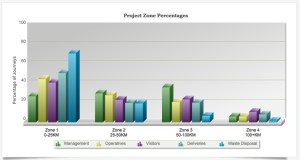
Our construction carbon tool, Constructco2, through its ability to monitor a projects supply footprint is throwing up some interesting issues:

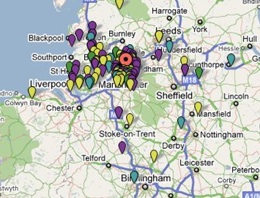
Take a look at a project footprint that has a focus on localism – ie in keeping material, supplier, management and even waste transportation as close as possible to the project:

And then one that doesn’t (which is actually less in construction value):

Across the 80 or so projects on the site we can start to see the travel pattern for materials, people and waste, and how close to the project …

All this starts to position Constructco2 as a possible valuable CSR tool and indicator, monitoring impact of projects on local communities, and starting to raise issues of procurement, appropriate sourcing / specification as well as good on site project management housekeeping

These notes are extracted from my recent ConstructCO2 presentation that is available to view on slideshare. 

For more on information please get in touch or visit Constructco2,and follow links.

Natural Mossland Carbon Capture Scheme – putting a ‘natural’ cost to carbon?

Not to be confused with carbon offsetting.

If we are serious about moving to low and zero carbon construction then this Mosslands conservation project looks like a good approach to capturing all those tricky CO2 emissions from your site or building that cannot be eliminated through good carbon reduction and energy management.

At £30 a tonne/CO2, to capture construction activity CO2 would mean, that for each £million construction spend we would be paying £30,000. (Based on the constructco2 CO2 indicator)

A natural cost on carbon?

The brochure contains some very interesting facts and figures as why peatland and mossland are essential as carbon sinks, more so than trees, and why we need to stop extraction.

NaturalCarbonCaptureBrochure.pdf Download this file     Or view on my posterous blog 

Cost of Carbon: “What was a carrot will now become a stick”

So are we prepared yet for the tranistion to a low carbon economy in the built environment?

Accouncements this week from the UK Government regarding targets for carbon reduction will affect all aspects of energy use, conservation and management. With the built environment contributing to 40% of CO2 emissions the imapct on design, material production, tranport construction and more will be very significant.

Facilities Management and the way we use buildings will most likely be the sector of the built environment to be profoundly affected. Whether the FM sector can rise to the occasion is another question, and one now being debated in FM forums, circles and events. See my thoughts on CSR Wire Talkback   

Indications from the recent Facilities Show in Birmingham (my own questioning of the exhibitors) suggests carbon measurement is just not on many FM providers agenda as yet

Can we be ready for such a dramatic tranistion, which as Derek Deighton explained is a 13 times reduction – a huge undertaking. And its not as if we havent had time to prepare in the last decade or so. Indeed as John Elkington highlighted ‘since Brundtland in 1987 we are still jollying along and still delighting in green or sustainable innovations’ 

What lies ahead in relation to the tranistion for businesses to a low carbon economy has been wonderfully summed up and explained in the May edition of  the Director in the Green Path to Growth article by Alison Coleman:

The UK has pledged to make deep cuts in carbon emissions by 2050. But as new sustainability rules bite, what are the duties of businesses? …

Britain is committed to massive carbon cuts, and whether businesses subscribe to green principles or not, they will be expected to play a key role. The Climate Change Act 2008 set a target for reducing greenhouse gas emissions to 80 per cent below 1990 levels by 2050, which assumes energy efficiency savings of around two per cent per annum for the next 40 years. That’s a big ask.

Although many companies are implementing green operating policies and achieving environmental management standards, the business contribution to the target is being driven by myriad carbon-related sustainability rules. Yet many organisations have yet to understand the cost of compliance

and as to the cost of carbon? …

Tony Rooke, sustainability practice leader at IT services provider Logica, says: “What was a carrot will now become a stick, and with the carbon price set at £12 per tonne of carbon emitted, it could add up to eight per cent to an organisation’s energy costs. What it will do is encourage them to minimise that impact by monitoring energy consumption more closely, and redoubling their efforts to reduce it and avoid waste.

it of course makes good sense:

Alan McGill, a partner in the environmental reporting practice at PricewaterhouseCoopers. “Forget the green agenda and just apply the commercial principles. There are lots of companies looking at operational opportunities to take carbon out and bring benefits to the business.”

People get ready, there’s a CO2  train a comin’ You don’t need no baggage, you just get on board”  With apologies to Curtis Mayfield

I have often said the built environment is a fascinating and great sector to be involved with – and now as we realise the carbon train is a-coming and we see its time to get on board, the journey could get a lot more interesting!

Thoughts?