Tag Archives: constructco2

Construction Carbon Cost and Risk Management

Having effective scenario planning in place within a construction business is essential to developing effective forward looking strategies that protect the business into the future and provide resilience against change.

One of our current uncertainties is related to the price of carbon, and how once the price of carbon has been fixed, how that will impact your business and project costs. It is now only a matter of time before carbon costing becomes established as an indicator and ‘repayment’ cost for your environmental impact

As with the increase cost of waste management over the last decade or so, cost of carbon will, most likely be a supply risk and cost.

The concept of shadow pricing is not new, (based on the lifetime damage costs associated with greenhouse gas emissions)  Applying a shadow cost to your carbon emissions now will enable you to action plan and reduce carbons, reducing exposure to future costs  hitting your business.

A good place to start is through measuring and understanding your project construction carbons with Constructco2 and then applying a carbon cost of £10 per tonne.  If you haven’t measured your construction carbons as yet (why not?) then use the ConstructCO2 benchmark of 96.7 Kg/£K project spend.

How would that cost affect your business? How would you manage projects with this additional cost, and importantly what actions would you take to reduce your project emissions?

Perhaps we should be asking the question will you start?

Many of the contractors, clients and subcontractors we support through constructco2 are seeing cost and bidding benefits. (More)

Useful Background Reading:

Based on recent Huffington Post article  The Benefits of Carbon Shadow Pricing Tyler Elm and Jim Harris

DECC: Carbon Valuation

Five questions to drive sustainable construction

Whilst being a great advocate for learning from others, sharing and benchmarking best practice, often it is essential to ask questions of our approaches to topics such as sustainable construction, before comparing.

In this mornings twitter fed reading stream was an article describing the five questions that Interface ask of themselves.  Interface are world leaders in design, production and sales of environmentally responsible modular carpets “Design is a mindset and sustainability is the journey of a lifetime”

Now whilst Interface’s responses in the article are inspiring, it struck me these are the questions we should all be asking of ourselves. Asking across the built environment, in design and specification, in product manufacture, in construction procurement and supply chains. Asking within project sustainability meetings, within company sustainability development and review sessions, at board level and even in ISO14001 audits.

Asking until we have answers and approaches we can live with.

1. How can we increase use of recycled and bio-based materials? 

2. How can we prevent our materials from ending up in landfill?

3. How can we reduce carbon and GHG emissions and at the same time increase our use of renewable energies?

4. How can we reduce water consumption?

5. How can our clients and customers make decisions about materials based upon trustworthy environmental facts? 

Once you have answers to these questions, you will want to take a look at Five Questions Businesses Must Answer to Advance Toward Sustainability According to Interface, Inc.

Join the discussion on these questions, share your responses and learn from others through twitter with @fairsnape and others, through leaving comments below or getting in touch.

Construction CSR Makeover: can construction learn from Patagonia?


CSR and Transparency seem to be linked buzz words in the world of sustainability at the moment.

Fuelled perhaps by an increase in CSR generally, a growing awareness of social media ‘whistleblowing’, the potential of the Social Value Act and a desire to improve or differentiate sustainability offering in bids and delivery on contracts.

Our Green Vison tweetchat last night concluded construction is ready for and in need of a CSR make over. But where to start? One of the suggestions was to listen to and learn from other sectors.

As if on cue, this  morning I was aleretd to Patagonia’s Footprint Chronicles update.  A grand example of merging CSR, Supply Chain Management, Transparency, Storytelling and using social media to stitch it all together

For our tenth season we have completly revamped the Footprint Chronicles to show a world map of every factory that makes Patagonia clothing and gear, profiles of the social and environmental of key suppliers and fabric mills and profiles of key  independent partners who vet  social and environmental practices throughout our supply chain

The Footprint Chronicles® examines Patagonia’s life and habits as a company. The goal is to use transparency about our supply chain to help us reduce our adverse social and environmental impacts – and on an industrial scale. We’ve been in business long enough to know that when we can reduce or eliminate a harm, other businesses will be eager to follow suit.

View the map 

A great place to start learning where CSR in Construction can go …

Indications that this is possible are emerging. With similar end game intentions, our own constructco2 which maps construction phase carbon emissions, transport and the project supply chain foorprint and Sourcemap a crowdsourced directory of product supply chains and carbon footprints – see for example CITRIS Builing

Your comments are most welcome, engage in the CSR debates on twitter @fairsnape or get in touch to discuss further.  We are helping many construction organisations measure their carbons and re-evaluate their approach to CSR.

ISO14051: Turning waste to gold with ISO standard for environmental management accounting

With the proposed demise of Site Waste Management Plans SWMP under the ‘Greenest Government Ever’ red tape plans, could a new-ish ISO standard that puts costs to the impacts identified under ISO 14001 provide direction, guidance or framework for construction to measure and improve material and energy waste?

The standard, ISO 14051:2011, Environmental management — Material flow cost accounting — assists organizations to better understand the environmental and financial consequences of their material and energy use practices, so that they can identify opportunities for improvement.

The standard uses MFCA, Material flow cost accounting,  which is “applicable to any organisation that uses materials and energy, regardless of their products, services, size, structure, location, and existing management and accounting systems”

MFCA could be applied on a business wide basis across all projects, understanding material, energy and resource inputs, processing and outputs, as well as on a project basis adopting a SWMP format combined with a Carbon plan driven by ConstructCO2 could indeed turn waste into gold.

Background Reading:

Constructing Excellence SWMP position

ISO turn waste into gold  

Measure, Understand and Improve Construction Carbons www.constructco2.com

Constructing CSR iTransparency

I have commented elsewhere on this blog that ‘transparency’, driven by the increasingly easy access to information and the seemingly ubiquitous use of social media, could well become a central theme and driver for sustainability and CSR during 2012 and beyond.

Last week Apple released their supplier responsibility audit report, see the excellent CSRWire article: itransparency: Is Apple Catching Up? by Elaine Cohen (also good reads are Will Apple Finally Embrace Corporate Social Responsibility & Sustainability and on Apples own the supplier responsibility web pages)

Like many users, whilst loving the Apple technology, design and ease of use, as a sustainability advocate, I have always felt uneasy about environmental and social aspects of the Apple organisation. However, with Apple having now set out their stall and commitment to improve, they will be watched closely by CSR observers and others who will undoubtedly use Apple devices and platforms to make any failings and achievements public, and transparent.

Constructing itransparency

I can’t help wondering:

How and when transparency within the built environment will have an impact.

If we were to undertake a ‘deep’ social responsibility audit throughout the sectors supply chain, just what would we find lurking under rocks?

We are starting to have the tools available to understand, for example, ConstructCO2 can measure the carbon and social impact of transport and delivery miles on a construction project, SourceMap can monitor material carbons, from raw material and transportation,  (see construction sourcemap for CITRIS building, Berkley USA), and Living Building Challenge is challenging responsible construction and increasingly we hear of construction organisations looking at or adopting ISO 26000, …. and so on …

So, it may or may not be 2012, but only is it just a matter of time before the sector, like Apple, is forced or nudged towards ‘iTransparency’.

Related reading:  Mapping Transparency – Why it pays to be open 

If you wish to engage in conservations on CSR in construction follow and join me on twitter @fairsnape, subscribe to or share this blog post, or get in touch.

Half of Multinationals to Choose Suppliers Based on CO2 Emissions

Why monitor construction carbons:  Shortly after writing a comment to a linkedin group on the importance of measuring and understanding construction carbons, through tools such as ConstructCO2, indications of increased focus on carbon performance popped up in a tweet (via Julie Urlaub @TaigaCompany ) regarding an Environmental Leader post that referenced Carbon Trust Report: Half of Multinationals to Choose Suppliers Based on CO2 Emissions 

According to the study, a full half of multinational companies plan to select suppliers based on carbon performance, and that 29% of suppliers are likely to lose their places on green supply chains if they do not have adequate performance records on carbon.

In the U.K., 56% of multinationals said that in the future they expect to drop suppliers based upon low carbon performance, with 74% of the U.K. respondents quoting shareholder pressure as a key driver for them in tackling carbon emissions.

And, although the report has a focus on multinationals, it is not irrelevant to the built environment

Next month Marshalls Plc, a supplier of hard landscaping, will be hosting a United Nations Global Compact Supplier event to educate first-tier suppliers on its approach to environmental issues.

As I posted to the Think Zero group on Linkedin, I still have to hear a good reason why we should not be measuring construction carbons.  Are you tracking your carbon performance – do you have the evidence?

Read more: Carbon performance offers major risk or reward

Construction supply chain footprints

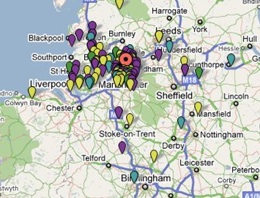
Our construction carbon tool, Constructco2, through its ability to monitor a projects supply footprint is throwing up some interesting issues:

Take a look at a project footprint that has a focus on localism – ie in keeping material, supplier, management and even waste transportation as close as possible to the project:

And then one that doesn’t (which is actually less in construction value):

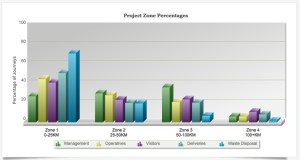
Across the 80 or so projects on the site we can start to see the travel pattern for materials, people and waste, and how close to the project …

All this starts to position Constructco2 as a possible valuable CSR tool and indicator, monitoring impact of projects on local communities, and starting to raise issues of procurement, appropriate sourcing / specification as well as good on site project management housekeeping

These notes are extracted from my recent ConstructCO2 presentation that is available to view on slideshare. 

For more on information please get in touch or visit Constructco2,and follow links.

Towards low carbon construction IGT Report: Government Response

Snippets from todays launch of the Governments Response to the  industry’s Innovation Growth Team Report:

Business Minister Mark Prisk said:

“An efficient, effective and profitable construction industry is at the heart of any growing economy.

“Meeting the UK’s commitment to reducing carbon will affect every aspect of the built environment and has the potential to provide the construction industry with a 40 year programme of work creating great opportunities for growth in the sector.

“Through this joint Government and industry action plan we are making a clear commitment to the low carbon transition which will create the certainty needed for construction companies to invest in essential new skills, processes and products.”

Climate Change and Energy Minister Greg Barker said:

“Improving the energy efficiency of the nation’s buildings is a win-win response to tackling emissions and spiralling fuel costs.

“The Government’s Green Deal will radically transform the energy efficiency of our homes and businesses, and presents a massive opportunity for Britain’s construction industry.

Government Chief Construction Advisor Paul Morrell said:

“I am delighted that the Government has taken on board so many of the recommendations from the IGT report which was developed with expertise from across industry.

“To ensure that construction rises to the low carbon challenge we need to continue this new level of cooperation so I am also pleased that a joint Government and industry board has been set up to ensure implementation of this plan.”

Influence of Construction 

A copy of the Government’s response to the Low Carbon Construction Innovation and Growth Team Report can be found at: http://www.bis.gov.uk/constructionigt


Info from the News Distribution Centre


ConstructCO2 now records zero carbon travel

ConstructCO2, our construction carbon calculator now measures ‘zero’ carbon travel to and from job sites.

Recording and increasing the travel from managers, visitors and operatives who get to site under their own steam (eg walking and cycling) or via car sharing is an important element in reducing construction impact on the environment, travel miles and the associated carbon emissions

It is also an important KPI that measures the projects performance against any green travel or car share plans.

The Zero travel KPI is expressed as a percentage of all travel or can be broken down to percentage of zero carbon travel for managers, visitors or operatives.

It is very very early days as yet, but it looks as through zero carbon travel is below 1% of all people travel. More later when we have more data.

Natural Mossland Carbon Capture Scheme – putting a ‘natural’ cost to carbon?

Not to be confused with carbon offsetting.

If we are serious about moving to low and zero carbon construction then this Mosslands conservation project looks like a good approach to capturing all those tricky CO2 emissions from your site or building that cannot be eliminated through good carbon reduction and energy management.

At £30 a tonne/CO2, to capture construction activity CO2 would mean, that for each £million construction spend we would be paying £30,000. (Based on the constructco2 CO2 indicator)

A natural cost on carbon?

The brochure contains some very interesting facts and figures as why peatland and mossland are essential as carbon sinks, more so than trees, and why we need to stop extraction.

NaturalCarbonCaptureBrochure.pdf Download this file     Or view on my posterous blog