Tag Archives: CSR

corporate social responsibility

175 Little Acts of CSR

Whilst the debate on Linkedin Group CSR in Construction asks why Corporate Social Responsibility is the domain of large organisations, SME  Emanuel Whittaker are pushing ahead with an inspiring CSR approach.  This being their 175th year, the CSR approach for 2012 is aptly called 175 Little Acts of Kindness, setting a target to deliver, record and share 175 CSR themed acts of kindness.

The Emanuel Whittaker  new look web site neatly puts CSR center stage as the envelope or wrap around for many activities (green deal, training and employment, equality and diversity, ISO 14001, carbon management, training, customer care, and more).

In a recent discussion with Rukhsana Nabi, Partnerships Manager at Emanuel Whittaker, she explained that CSR at Emanuel Whittaker reflects the culture, “its who we are and what we do – not a set of processes and procedures” and that the reason for this years initiative is simply to share what we do, rather than a PR or marketing campaign.

Emanuel Whittaker will be sharing their 175 stories during 2012, through their website,  facebook and through twitter @emanuel_whittack, using the #175littleacts hashtag.

Five Emerging Themes in Construction CSR

A recent CSR in construction workshop ran some very interesting discussions on just what CSR in construction is, what it could be and what it should be.

There emerged a number of salient, central themes:

CSR is not a badge, a new lick of paint or indeed something to do to generate responses in bids and PQQ’s to win work, but is something that goes deep into the organisation. It is the brand, image and reputation of the business, in many ways CSR is part of the DNA upon which the business will grow and flourish. Words such as heart or soul of the business become relevant.

CSR thinking will challenge existing business models. We have moved from a era of CSR being bad news, not seen as a business issue, to one of commitment to being responsible and doing good whilst running a business. The challenge businesses may now face is moving forward, how to make a construction business of out doing good, where social responsibility is the vision and core of the organisation. Combining triple line thinking in an integrated strategy and integrated reporting approach will give new perspectives on construction businesses.

CSR approaches cannot be simply imposed top down. Whilst needing strong leadership vision, CSR requires real engagement of all staff and indeed all those who work for the business through the supply chains. Empowering managers to lead on CSR and engaging people in sharing CSR good news stories will become essential.

CSR transparency means all aspects of construction are increasingly on open public display. We cannot put one message to clients in bids, another to staff and still allow conflicting, or perhaps irresponsible practices to exist. The recent Goldman Sachs is a timely reminder that we are in the Age of Damage as described David Jones in Who Cares Wins

The power and potential of social media is yet to be realised. On one hand it presents a phenomenal tool for sharing news, keeping informed and engaging with clients and partners, on the other hand it can be the Achilles heel, rapidly broadcasting irresponsible practices or intentions. Having an appropriately positive approach to Social Media with guidelines or codes of practice for use by staff in the business and on projects will increasingly become high priority.

Supporting built environment organisations on developing CSR strategies it is encouraging to see a real desire for strategic CSR approaches that go beyond the volunteering and sponsorship models. If you wish to engage in conversations on CSR in construction follow and join me on twitter @fairsnape, subscribe to or share this blog post, or get in touch via fairsnape@gmail.com

Bhutan’s ecosystem and green wealth is worth nu 700bn a year

As the UK calls on countries to start green accounting, putting value to nature, biodiversity and ecosystems, Sonam Pelden writing recently in Bhutan Business recently gives a fascinating insight into the country’s Gross National Happiness accounting system. Based not only on the market economy but also natural, social, cultural and human wealth, demonstration perhaps that a triple bottom line economy can work at national levels. A demonstration also then of NSR National Social Responsibility?

A new study on Initial Estimate of Value of Ecosystem Services in Bhutan revealed that the country’s ecosystem is worth more than Nu 700bn a year, much higher than the Gross Domestic Product (GDP) of Nu 72.3bn a year.

The staggering value of the ecosystem in Bhutan was arrived at to come up with a new national accounting system apart from the GDP. The accounting system, based on Gross National Happiness (GNH), would not only count what market economy produces but also consider natural, social, cultural and human wealth. Benefits are in terms of clean air, healthy soil, recreation and other values.

Recognising the value and importance of forests, not just as market value but as environment and social value is a key component. Something we here in the UK need to heed …

Bhutan’s constitution mandates the country to preserve a minimum of 60% forest coverage for all time to come. Today, Bhutan has total forest coverage of 74.5%.

Sonam and Business Bhutan are on twitter at @sonampelden and @business_bhutan

Read Later Connections: from green deal to stargazing and sustainability

A collection of articles saved to Instapaper this last week (mostly from Flipboard)

There is creative reading as well as creative writing.— Ralph Waldo Emerson

Inspiring landlords to take part in the Green Deal 

The UK Government are in the final planning stages of the Green Deal launch, their biggest home improvement scheme since the Second World War. The problems they face, however, are trying to get people involved and inspired enough to invest in the Green Deal.

‘Green’ solar cell made from plants news.cnet.com

A paper published in Scientific Reports today describes an improved method for making electricity-producing “biophotovoltaics” without the sophisticated laboratory equipment previously needed. Researchers said custom-designed chemicals could be mixed with green plants, even grass clippings, to create a photovoltaic material by harnessing photosynthesis.

Four hidden tricks for taking stellar iPhone photos by 

I hate to admit it, but my iPhone is always the first thing I reach for when I spot a photo-worthy scene. Sure, I own a digital camera, but my iPhone is always with me, packs an excellent camera, plus I have the option to edit and share photos instantly.

Why I’ve Stopped Pitching the Business Case for Sustainability By Jennifer Woofter

One of the most frequent questions that I get when I talk to people about my job as a sustainability consultant is this: How can I convince [my boss, my company, my crazy aunt, etc.] that sustainability makes good business sense?

Britain’s best stargazing locations telegraph.co.uk

One of the most ravishing sights on Earth should be the night sky – the brightest stars from the billions in our Milky Way, the streak of meteors, planetary neighbours such as Venus and Jupiter, the glow of other galaxies such as Andromeda.

Light pollution, however, means few experience this free glory.

AASHE Interview Series: John Robinson, Executive Director, UBC Sustainability Initiative

a detailed look into the making of a regenerative building, and what makes CIRS a new kind of “green” building.

John Robinson, the Executive Director of the University of British Columbia’s Sustainability Initiative sat down with AASHE to discuss the recently opened Centre for Interactive Research on Sustainability (CIRS) building.

Stunning Timelapse Video Shows the True Beauty of Yosemite treehugger.com

There’s nothing like a good timelapse video to showcase the beauty of a place or an event. When that place is Yosemite National Park, it’s a recipe for an especially jaw-dropping few minutes. This video, called “Yosemite HD,” is the product of Project Yosemite, a collaborative project by Sheldon Neill and Colin Delehanty to capture the true beauty of the national park.

Building the Sustainability Brand Within

When we think about sustainability strategy we typically think about a series of initiatives around energy efficiency, waste reduction, and product redesign. But our traditional focus on carbon audits and generating Corporate Sustainability Reports (CSR), while important, emphasizes data collection and does not necessarily engage people in ways that generate synergy and build scale. Few companies capitalize on the opportunities sustainability provides for widespread employee engagement and improving the company culture – in effect, “building the brand within.”

‘Microplastic’ threat to shores bbc.co.uk

Microscopic plastic debris from washing clothes is accumulating in the marine environment and could be entering the food chain, a study has warned. Researchers traced the “microplastic” back to synthetic clothes, which released up to 1,900 tiny fibres per garment every time they were washed. Earlier research showed plastic smaller than 1mm were being eaten by animals and getting into the food chain.

Constructing CSR iTransparency

I have commented elsewhere on this blog that ‘transparency’, driven by the increasingly easy access to information and the seemingly ubiquitous use of social media, could well become a central theme and driver for sustainability and CSR during 2012 and beyond.

Last week Apple released their supplier responsibility audit report, see the excellent CSRWire article: itransparency: Is Apple Catching Up? by Elaine Cohen (also good reads are Will Apple Finally Embrace Corporate Social Responsibility & Sustainability and on Apples own the supplier responsibility web pages)

Like many users, whilst loving the Apple technology, design and ease of use, as a sustainability advocate, I have always felt uneasy about environmental and social aspects of the Apple organisation. However, with Apple having now set out their stall and commitment to improve, they will be watched closely by CSR observers and others who will undoubtedly use Apple devices and platforms to make any failings and achievements public, and transparent.

Constructing itransparency

I can’t help wondering:

How and when transparency within the built environment will have an impact.

If we were to undertake a ‘deep’ social responsibility audit throughout the sectors supply chain, just what would we find lurking under rocks?

We are starting to have the tools available to understand, for example, ConstructCO2 can measure the carbon and social impact of transport and delivery miles on a construction project, SourceMap can monitor material carbons, from raw material and transportation,  (see construction sourcemap for CITRIS building, Berkley USA), and Living Building Challenge is challenging responsible construction and increasingly we hear of construction organisations looking at or adopting ISO 26000, …. and so on …

So, it may or may not be 2012, but only is it just a matter of time before the sector, like Apple, is forced or nudged towards ‘iTransparency’.

Related reading:  Mapping Transparency – Why it pays to be open 

If you wish to engage in conservations on CSR in construction follow and join me on twitter @fairsnape, subscribe to or share this blog post, or get in touch.

Sustainability: Breaking on through to the other side

“Break on through to the Other Side”  sang Jim Morrison in the Doors way back in the 60s.

Listening again recently started me thinking of how ‘sustainability’ could be ‘breaking through to the other side’ … to a time / place where sustainability and CSR is the norm rather than something we strive for.

This, however, begs a number of tricky questions and answers

Just what does sustainability and social responsibility really look like? When or how will we know we have arrived? What exactly do we have to ‘break through’? What is the tipping point?

What we should find really exciting is that we dont really know, we dont know where the boundary or tipping point is. Where, what or indeed how far we need to push.  Are we nearly there or light years away?  This makes sustainability an adventure and exploration.

And of course many argue, quite rightly, that sustainability is a journey not a destination or a state of business.

A tipping point may well come when organisations move across a rubicon, from trying to do good whilst making a profit, to making a profit from doing good.  (I am reminded here again of Yvon Chouinard at Patagoniaevery time we do the right thing for the environment we make a profit”)

Have we made sustainability and CSR too intellectual? I fear so. Is it now far too embedded in checklists, processes and systems. We have lost connection with the natural world, with planet earth, the very reason we need sustainability, resilience and CSR?

Perhaps the tipping point to breaking through to the other side is re-igniting this connection, where we dont need a tag, or a label, but doing the right thing as an organisation or individual is the norm and ‘feels’ right, rather than something we do because we are encouraged, nudged or told to do.

Through fairsnape, organisations are supported in understanding their Route to Zero, where zero is a target, the route the more important, and supported in breaking through barriers.

If you are interested in learning more, I invite you to join me in the sustainability and CSR conversations on twitter, to subscribe to this blog or to get in touch at fairsnape for more information

And a thought for the built environment in 2012… what do you see as the sustainability boundaries that we need to break through and move beyond?

Construction #CSR Gen X + Y and a desire to ‘do good’

As part of background reading for construction CSR / Social Media project, focused on employers looking to attract young people into the industry, I came across a fascinating article in the Canadian Globe and Mail, GenY seeks responsible employer who listen.

It struck a real chord with an expression that had been forming over the last few weeks, that “if we dont get sustainability, social media and CSR right then young people will not want to work in construction. But they will want to work for other sectors” A compelling reasons why all this starts in the boardroom both as an organisaiton continuity or survival issue and forward thinking, growth and innovation matter.

And it is very much a social media matter, Gen X and Y will use social media to broadcast negative thoughts and obersvations, as well as positives. (The slide comes from a recent constructing social media presentation)

Corporate social responsibility ranks “quite highly” for Generation Y workers …

“The challenge is that Gen Ys hold organisations to their CSR policy. If they join and they feel that the organisation is not living up to the policy, they will become disengaged, leave the organisation and, even worse, will use social media to broadcast their negative thoughts.”

There are a number of other factors that make a company an employer of choice for Gen Y, such as: meaningful, engaging work and the opportunity to build skills; access to the latest technology; working with friends and co-workers in the same age group; a collaborative work environment and management style, and an organisational capacity for fun.

So what turns them off?

  • Stodgy, traditional companies – “they will join and stay for the money for a while, but then will leave looking for greener pastures.”
  • Managers who are not interested in them as people, or their career progression.
  • No clear line of sight between what they are doing and the big picture.
  • “When the cost of doing anything [long hours] outweighs the benefits [work-life balance].”

Reinvigorating built environment sustainability leadership

An excellent blog post on sustainability.com suggests what a reinvigorated agenda for change may look like.

We could learn a lot from this, for new and reinvigorated leadership in sustainability within the Built Environment sector, particularly in the UK as we move into a new era of green deals, PAS 2030’s and a renewed focus on improving our existing building stock:

Simple: For most, the discussion remains new, the lexicon confusing. We need to quickly and clearly cut through that to reach new audiences.

Fresh: People are jaded. They haven’t given up, but need to be convinced that the next change effort will be different, more meaningful.

Connect: Too many experience sustainability as intellectual, abstract, not very well connected to the here and now. (We need to revisit our understanding and connection to natural cycles of the earth, seasons, solar and lunar, the core purpose of sustainability)

Systemic: Progress to date has been limited because it is too often a single company or other actor leading only within a narrow scope. Solutions must now begin to cross traditional boundaries, create new coalitions and value networks and drive change to scale.

Adaptive: Uncertainty abounds, and yet cannot remain an excuse for further delay or loss of momentum . We must anticipate and react quickly to setbacks, sharp curves and emerging issues, and above all, keep moving.

Collaborative: Even with the explosion of supporting technology, collaboration remains a messy and difficult affair, but if new coalitions are to propagate and succeed, the agents involved must embrace and practice vastly more of it.

Distributed: Globalization and the democratization of communications run counter to the old “cult of the elite.” Leadership is perhaps now far more likely to be bottom-up than top-down, but even if not, the crowd will have the final word.

Policy-Independent: There is consensus (and frustration) that government remains either unwilling or unable to respond. We need a pathway to success that welcomes government if they will play a role, but is not in any way dependent on political leadership.

Re-Generative: While we can – and should – start by revisiting and distilling the wisdom of those who pioneered the sustainability movement, we must also invite present-day and future leaders to augment, refresh and build upon it. In this way, we may create a virtuous cycle of innovation and insight needed to propel us forward.

And I would add:

Visibility, Let’s make use of the explosion and ubiquity of the communication and dialogue tools that social media provides, to increase visibility of best practice, to learn and to share.

Link to original post

Understanding CSR in Construction

Perhaps we need to clarify what we understand by CSR in Construction?

Whether we mean Corporate Social Responsibility, Corporate Sustainable Responsibility or even Carbon Social Responsibility is somewhat irrelevant and I am comfortable with all definitions. What is important of course is how we approach, manage and embed CSR within the organisation.

Probably one of the least effective CSR approaches would be one that is scattergun, uncoordinated and of a tick box nature to enable us just to tick the CSR box for bids, company literature and websites.

CSR starts with understanding the organisations impact, on social, sustainability, education, employment, on the planet, on communities and more. Once that impact is understood, measures can be planned and implemented to minimise or eliminate those impacts. CSR needs real  commitment to integrate responsible practices into daily organisational  operations to address impact.

CSR, as I recently quoted on twitter it is about striving for zero impact and a closed loop system that addresses resources used.

Sources of CSR inspiration I suggest delegates on my CSR events and workshops check out, as they  have significance within construction, include

Yvon Chouinard and the essential reading: Let My People Go Surfing: The Education of a Reluctant Businessman""  (http://amzn.to/otp3vT)  that includes a chapter on how Patagonia as client extends it’s CSR and  environmental values to construction projects.

Secondly the late Ray Anderson, (Interface Flooring) probably the most influential CSR and Sustainability thinker in the built environment. His Mount Sustainability and Zero Mission thinking has inspired many.   Check out Confessions of a Radical Industrialist: How Interface proved that you can build a successful business without destroying the planet""  (http://amzn.to/r00VAJ)

And  for current CSR thinking within the built environment and beyond, check out  the news feeds and articles from leading CSR thinkers on CSRWire.

A recent article written for CSRWire explored the link between CSR, carbon management and localism within construction and FM which fired an interesting debate on a possible new thinking for CSR – Carbon Social Resposnibility

I await to see who will be the first construction organisation in the UK to become members of what I view as the best commitment possible to CSR – the 1% for the Planet movement. That’s one percent of turnover going to offset the impact your organisation may have on the environment. Commitment yes, but perhaps just a fraction of the cost of really addressing construction impact.

(This post was written in connection with the linkedin CSR in Construction group)

Construction supply chain footprints

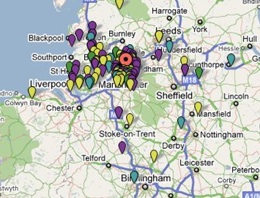
Our construction carbon tool, Constructco2, through its ability to monitor a projects supply footprint is throwing up some interesting issues:

Take a look at a project footprint that has a focus on localism – ie in keeping material, supplier, management and even waste transportation as close as possible to the project:

And then one that doesn’t (which is actually less in construction value):

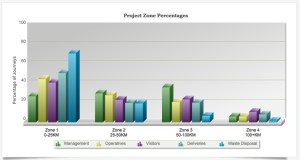
Across the 80 or so projects on the site we can start to see the travel pattern for materials, people and waste, and how close to the project …

All this starts to position Constructco2 as a possible valuable CSR tool and indicator, monitoring impact of projects on local communities, and starting to raise issues of procurement, appropriate sourcing / specification as well as good on site project management housekeeping

These notes are extracted from my recent ConstructCO2 presentation that is available to view on slideshare. 

For more on information please get in touch or visit Constructco2,and follow links.