Tag Archives: sustainability

Beyond sustainability: Buildings are a climate change problem … and also part of the solution.

Buildings are a climate change problem … and also part of the solution. With buildings responsible for an estimated 40% of all carbon emissions and having a huge influence of lifestyle, commerce and industry carbon reduction efforts, we can now longer afford to incrementally be less bad. And this year, 2015, being a significant year for climate change action, with the COP21 in Paris in December and the imminent release of the UN Sustainable Development Goals, it is time to recognise the role of buildings as a climate change solution.

https---img.evbuc.com-https%3A%2F%2Fcdn.evbuc.com%2Fimages%2F15507896%2F145406037897%2F1%2Foriginal

Beyond Sustainability, as you may have seen in the media, via social media or by invite, is our significant event in London on the 5th Oct. The event highlight will be Jason McLennan’s (CEO International Living Futures Institute) first UK keynote, which promises to be an inspiring call to do more good, as being less bad is not just enough anymore

The event will also include an overview of Living Building Challenge and Well Building Standard activity in the UK from Martin Brown, Fairsnape, and Ann Marie Aguilar, Arup Associates.  Hattie Hartman (Sustainability Editor at AJ) will chair a panel debate, featuring regenerative and well being sustainability activity in the UK from a range of presenters.  In addition John Alker UKGBC will introduce the UKGBC’s new campaign ‘Better Places for People‘ 

There will, of course, be opportunity for Q and A panel debates with speakers.

Please take this as your invite to attend. The event will held appropriately, in the wonderful Royal College of Physicians building on Regents Park. More details and how you can you can still register here.

Jason F. McLennan Keynote speaker:

Considered one of the most influential individuals in the green building movement today and the recipient of prestigious Buckminster Fuller Prize (the planet’s top prize for socially responsible design), Jason F. McLennan’s work has made a pivotal impact on the shape and direction of green building in the United States and Canada and he is a much sought after designer, presenter and consultant on a wide variety of green building and sustainability topics around the world.

Integrating environmental management with business strategy. ISO14001:2015 published: Key revisions outlined.

At last, the long awaited next edition of ISO 14001:2015, integrating environmental management with business strategy has been published and available here

ISO-14001-–-5-ways-the-revised-ISO-14001-is-even-better-ENNEW IN ISO 14001 (updated from my blog post 13 July 2015)

ISO 14001:2015 adopts the High Level Structure which is now the required framework for all new and revised management system standards. (We will see the same structure in the new ISO 9001 and other ISO’s )

Strategic environmental management

There is a new requirement to comprehend the context of the organisation determining external and internal issues pertinent to the organisation and the environment, with actions to address them within the Environmental Management System (EMS).

14001 now embeds environmental and sustainability thinking into the high level strategy, vision and policy planning aspects of an organisation and project

Leadership

A new clause has been added with particular responsibilities for top management to express their leadership and commitment to environmental management. Top management may assign this responsibility to others but retain accountability.

14001 calls for increased accountability for the leadership (CSE, MD) of an organisation or project to ensure ongoing commitment and engagement  with environment and sustainability activities in the organisation.

Protecting the environment

Environmental policy shall incorporate a commitment to the ‘protection of the environment’. There is no definition about ‘protection’ that includes ‘prevention of pollution’ and ‘other’ commitments, such as sustainable resource use, climate change mitigation and adaptation, protection of biodiversity and ecosystems, etc.

The 14001 change from protection to prevention is significant, requiring a proactive approach and can be seen to move closer to a restorative thinking towards the environment

Environmental performance

There is a shift in emphasis with regard to continual improvement, from improving the management system to improving environmental performance. The key focus is on improving performance related to the management of environmental aspects. The organisation shall decide on criteria to evaluate its environmental performance, using correct indicators.

Again a significant and proactive change: from monitoring to improving performance

Lifecycle thinking

Organisations will need to extend its control and influence to the environmental impacts from raw material acquisition/generation to end-of-life treatment. This does not imply a requirement to do a life cycle assessment (LCA), just thinking carefully about the stages of product/service that can be controlled or influenced.

There will be much debate on this 14001 change, but indicates a proactive approach to design and specification that takes into account material and building(?) environmental impact through to end of life, encouraging more design for re-use, deconstruction plans and circular economy thinking

Outsourced processes

Organisations need to control or influence outsourced processes.

Will, at last bring contracted-out elements of a project fully into ISO 14001 environmental management, and will undoubtedly see an increase, and reinforcing of 14001 as a contract and subcontract requirement.

Communication

Emphasis on internal and external communication, and equal treatment of both has been added. The decision to communicate externally is retained by the organisation whilst taking into account its compliance obligations.

Welcomed 14001 improvement for the digital and social media age of communications and transparency

Documentation

The term ‘documented information’, is used instead of ‘documents’ and ‘records’. The organisation has the flexibility to conclude when ‘procedures’ are required. Any format (paper, cloud, etc.) would be valid.

Again a welcomed improvement in the digital and social media age of documentation and data management

ISO 14001:2004 TRANSITION

Organisations that are already certified to ISO 14001:2004 will have three years from formal publication of ISO 14001:2015 in which to transfer to the new version of this standard. Based on the current publication schedule, this transition period would end in September 2018.

Working in collaboration with a number of organisation on EMS and 14001 improvement, we have commenced future proofing systems and environmental approaches to address ISO 14001:2015 and in doing so improve integration between sustainability approaches, organisation strategy and governance. Get in touch to find out how this could help your environment management take the next step forward.

Whats new?

14001 Support

It is time to move on from theTriple Bottom Line …

It is time to move on from theTriple Bottom Line …

We have become very familiar with the Triple Bottom Line approach for Sustainability and Corporate Social Responsibility, ie Environment, Society and Economic. It forms the basis of many environmental and sustainability visions, policy statements, and development initiatives.

In the business arena, this is the acknowledged responsible ‘bottom line’ of meeting economic goals (usually profit) whilst also meeting environmental (impact) and social (community) goals in carrying out business activities. The triple bottom line approach provides a practical framework for the development of policies and strategies to drive institutional change.

roots coyo triple bottom line

Triple Bottom Line as drawn by COYO students

And of course we are now familiar with the well used triple bottom line venn diagram. If like me you loved Venn Diagrams at school, then its a real pleasure to see such vital and complex issues such s sustainability expressed as three interwoven circles. The Triple Bottom Line has also been represented as a three legged stool or as three columns.

As mentioned previously on this blog, this triple bottom line thinking can be traced back to Patrick Geddes who, now recognised as the Grandfather of Town and Country Planning coined the triptych Place, Folk and Work. Its current concept however is credited to John Elkington in his 1998 book Cannibals with Forks:Triple Bottom Line of 21st Century Business.

Whilst we can easily identify Geddes’ Place as being the Environment circle, (note, interestingly the Living Building Challenge renamed its Site Petal as Place for version 3), the Work aspect is readily identified as the Economy circle, there is an uneasy fit with people or folk within the Society circle. Are staff part of society, and where do the governance arrangements of a business (including vital for sustainability ISO 9001 related quality and organisational arrangements / controls) fit into the sustainability three circles?

Quad Bottom Line

Quadruple Bottom Line introduces Governance as the fourth ‘Petal’

The Quadruple Bottom Line introduces Governance as the fourth bottom line, or perhaps better, as Culture

Governance, or Culture is defined here as including both the formal business, administrative and ‘control’ processes of an organisation, as well as the informal networks, traditions and cultural and behavioural norms which act as enablers or disablers of sustainable development.

Sustainability governance therefore could include those organisational items that are increasingly seen as the vital enablers for sustainable development – many of which are embedded within the modern sustainability building programmes such as the Living Building Challenge, JUST, or Well Building Standard, including:
Diversity
Equity
Fairpay
Education
Collaborative Working
Working Places
Biophilia
Health and Wellbeing
Happiness
Communications and social media

This new, fourth leaf on the sustainability venn diagram, raises both important questions and huge opportunities for advancing sustainability development, and could usher in a new generation of sustainability thinking.

For example, what are the ‘governance’ issues of construction site facilities, welfare and administration that enable sustainable construction … more

Extract from forthcoming FutuREstotative

Changes to ISO 14001: 2015 identified.

calgary treesThe latest milestone in the ISO 14001 revision process was reached on 2 July 2015 with the issue of ISO/FDIS 14001. This document is the final draft before the publication of the standard (scheduled for September 2015).

The convention at ISO is that only editorial changes to the text are permitted between the issue of the FDIS and final publication of the standard, therefore we can be reasonably sure that FDIS 14001 contains the requirements of the revised version of ISO 14001.

NEW IN ISO 14001

The FDIS 14001 adopts the High Level Structure specified in ISO Annex SL, which is now the required framework for all new and revised management system standards.The ISO team responsible for the revision process (subcommittee ISO/TC 207/SC1) has identified the following emerging changes as a result of their revision. (Comments in italics are mine)

Strategic environmental management

There is a new requirement to comprehend the context of the organisation determining external and internal issues pertinent to the organisation and the environment, with actions to address them within the Environmental Management System (EMS).

14001 now embeds environmental and sustainability thinking into the high level strategy, vision and policy planning aspects of an organisation and project

Leadership

A new clause has been added with particular responsibilities for top management to express their leadership and commitment to environmental management. Top management may assign this responsibility to others but retain accountability.

14001 calls for increased accountability for the leadership (CSE, MD) of an organisation or project to ensure ongoing commitment and engagement  with environment and sustainability activities in the organisation.

Protecting the environment

Environmental policy shall incorporate a commitment to the ‘protection of the environment’. There is no definition about ‘protection’ that includes ‘prevention of pollution’ and ‘other’ commitments, such as sustainable resource use, climate change mitigation and adaptation, protection of biodiversity and ecosystems, etc.

The 14001 change from protection to prevention is significant, requiring a proactive approach and can be seen to move closer to a restorative thinking towards the environment

Environmental performance

The key focus is on improving performance related to the management of environmental aspects. The organisation shall decide on criteria to evaluate its environmental performance, using correct indicators.

Again a significant and proactive change: from monitoring to improving performance

Lifecycle thinking

Organisations will need to extend its control and influence to the environmental impacts from raw material acquisition/generation to end-of-life treatment. This does not imply a requirement to do a life cycle assessment (LCA), just thinking carefully about the stages of product/service that can be controlled or influenced.

There will be much debate on this 14001 change, but indicates a proactive approach to design and specification that takes into account material and building(?) environmental impact through to end of life, encouraging more design for re-use, deconstruction plans and circular economy thinking

Communication

Emphasis on internal and external communication, and equal treatment of both has been added. The decision to communicate externally is retained by the organisation whilst taking into account its compliance obligations.

Welcomed 14001 improvement for the digital and social media age of communications and transparency

Documentation

The term ‘documented information’, is used instead of ‘documents’ and ‘records’. The organisation has the flexibility to conclude when ‘procedures’ are required. Any format (paper, cloud, etc.) would be valid.

Again a welcomed improvement in the digital and social media age of documentation and data management

ISO 14001:2004 TRANSITION

Organisations that are already certified to ISO 14001:2004 will have three years from formal publication of ISO 14001:2015 in which to transfer to the new version of this standard. Based on the current publication schedule, this transition period would end in September 2018.

Source: http://www.industrytoday.co.uk/energy_and_environment/iso-140012015-update-fdis-14001-issued/36699

Related previous iSite blog posts:

14001 Support

Why did I seek to put GreenBIM into Room 101?

Why did I seek to put Green BIM into Room 101 ? Did I not tweet only this week that Green BIM is one of the more important developments in the built environment?

greenBIM 101

The label, or hashtag for GreenBIM is so riddled with issues, I was only able to skim during the 2 mins allowed in the ThinkBIM / Green Vision Room 101 session, and in fact is pre-occupying a lot of thought and space in my forthcoming RIBA book.

However, in 5 bullet points … here goes.

  • BIM (and digital construction) is the most powerful of improvement and collaborative programmes for decades, if not in the history of construction – all BIM should be green – all BIM should be pushing the boundaries and doing more good, not happy just to maintain a business as usual, a sustainability status quo or be incrementally less bad.
  • Every BIM is a core enabler in achieving Construction Vision 2025 through sustainability and carbon targets – requiring net positive approaches. Construction 2025 is not just for GreenBIM’s.
  • One of the fast emerging sectors within the world of sustainability, with a predicted market value in the billions, is the circular economy – every BIM, not just GreenBIM’s should be addressing this concept. In particular, where one building becomes the food, the material farm, for the next building. Am I in danger of creating a new hashtag and meme here: #CEBIM _ Circular Economy BIM anyone?
  • Looking through (BIM) product data sheets we see products and chemicals that are scientifically proven carcinogenic – the formaldehyde, the PVC’s, the styrene – all BIM’s should address these issues on health and wellbeing grounds, not just GreenBIM. It is estimated to take 8 hours per material on Red List transparency to determine exact ingredients – and ensure no redlist prohibited materials, at present this doesn’t make material or product specification through BIM a viable option for LBC, Well Building standard or indeed LEED4 where the Red List thinking is applied
  • Green Vision has embraced Living Building Challenge – where, for accredited projects like the Bullit Centre there are no energy performance gaps – this is what a BIM should achieve on every building, green or not, and fast. Lets seek a net-positive performance gap. This is Construction Vision 2025!

Conclusion: My reason for putting GreenBIM into 101 is more out of frustration than annoyance. We would all agree that all BIM’s should be GreenBIMs, so do we need another label, perhaps, perhaps not, but what we do need to do is to take the agenda from ‘GreenBIM’ sessions to all other BIM events, initiates, software, projects, and make every BIM Green.

I also blogged on this very issue back in 2013 – Do we really need ‘Green BIM’?

It was encouraging to see the Circular Economy feature in a number of presentations at the Green BIM event. For more on circular economy and BIM see my take here: RegenerativeBIM … moving the GreenBIM debate

And, by coincidence or serendipity, I had presented to and participated within a panel debate at Runshaw College on Circular Economy the day before:

The Papal Encyclical relevance to the Built Environment sector

Todays launch of the Papal Encyclical has much relevance for Built Environment sector on sustainability, the relationship of buildings with nature, on waste, energy, health, biophilia and even touching on BIM, (TechnoScience).

There is also a nice resonance with language from standards such as the Living Building Challenge, and other ecological restorative approaches to new perspectives on sustainability.

In particular Paragraph 150 (see below) should become a touchstone for modern, restorative, sustainable design.

It’s a hefty document, but here below are the salient sections relating to the built environment:

26. Investments have also been made … in methods of construction and renovating buildings which improve their energy efficiency. But these good practices are still far from widespread

44. Nowadays, for example, we are conscious of the disproportionate and unruly growth of many cities, which have become unhealthy to live in, not only because of pollution caused by toxic emissions but also as a result of urban chaos, poor transportation, and visual pollution and noise. Many cities are huge, inefficient structures, excessively wasteful of energy and water. Neighbourhoods, even those recently built, are congested, chaotic and lacking in sufficient green space. We were not meant to be inundated by cement, asphalt, glass and metal, and deprived of physical contact with nature.

58. In some countries, there are positive examples of environmental improvement: rivers, polluted for decades, have been cleaned up; native woodlands have been restored; landscapes have been beautified thanks to environmental renewal projects; beautiful buildings have been erected; advances have been made in the production of non-polluting energy and in the improvement of public transportation. These achievements do not solve global problems, but they do show that men and women are still capable of intervening positively.

103. Technoscience, when well directed, can produce important means of improving the quality of human life, from useful domestic appliances to great transportation systems, bridges, buildings and public spaces. It can also produce art and enable men and women immersed in the material world to “leap” into the world of beauty. Who can deny the beauty of an aircraft or a skyscraper?

143. Together with the patrimony of nature, there is also an historic, artistic and cultural patrimony which is likewise under threat. This patrimony is a part of the shared identity of each place and a foundation upon which to build a habitable city. It is not a matter of tearing down and building new cities, supposedly more respectful of the environment yet not always more attractive to live in. Rather, there is a need to incorporate the history, culture and architecture of each place, thus preserving its original identity. Ecology, then, also involves protecting the cultural treasures of humanity in the broadest sense. More specifically, it calls for greater attention to local cultures when studying environmental problems, favouring a dialogue between scientific-technical language and the language of the people. Culture is more than what we have inherited from the past; it is also, and above all, a living, dynamic and participatory present reality, which cannot be excluded as we rethink the relationship between human beings and the environment.

149. The extreme poverty experienced in areas lacking harmony, open spaces or potential for integration, can lead to incidents of brutality and to exploitation by criminal organizations. In the unstable neighbourhoods of mega-cities, the daily experience of overcrowding and social anonymity can create a sense of uprootedness which spawns antisocial behaviour and violence. Nonetheless, I wish to insist that love always proves more powerful. Many people in these conditions are able to weave bonds of belonging and togetherness which convert overcrowding into an experience of community in which the walls of the ego are torn down and the barriers of selfishness overcome. This experience of a communitarian salvation often generates creative ideas for the improvement of a building or a neighbourhood

150. Given the interrelationship between living space and human behaviour, those who design buildings, neighbourhoods, public spaces and cities, ought to draw on the various disciplines which help us to understand people’s thought processes, symbolic language and ways of acting. It is not enough to seek the beauty of design. More precious still is the service we offer to another kind of beauty: people’s quality of life, their adaptation to the environment, encounter and mutual assistance. Here too, we see how important it is that urban planning always take into consideration the views of those who will live in these areas.

180. There are no uniform recipes, because each country or region has its own problems and limitations. It is also true that political realism may call for transitional measures and technologies, so long as these are accompanied by the gradual framing and acceptance of binding commitments. At the same time, on the national and local levels, much still needs to be done, such as promoting ways of conserving energy. These would include favouring forms of industrial production with maximum energy efficiency and diminished use of raw materials, removing from the market products which are less energy efficient or more polluting, improving transport systems, and encouraging the construction and repair of buildings aimed at reducing their energy consumption and levels of pollution.

232. Not everyone is called to engage directly in political life. Society is also enriched by a countless array of organizations which work to promote the common good and to defend the environment, whether natural or urban. Some, for example, show concern for a public place (a building, a fountain, an abandoned monument, a landscape, a square), and strive to protect, restore, improve or beautify it as something belonging to everyone.

What does good ‘Facilities Management Sustainability’ look like? And why aren’t we doing it now?

I was honoured to be invited to the EuroFM ReseCGb8As1WsAA4i1varch Symposium as a guest of EuroFM, held at the recently completed Technology Innovation Centre at Strathclyde University in Glasgow.
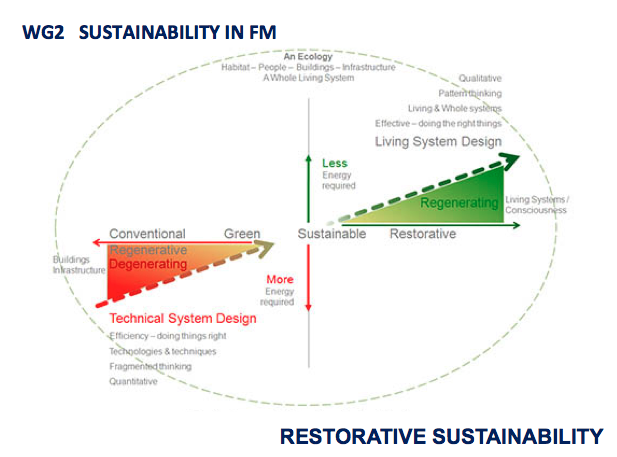
As promised, here are my thoughts from the day, and further links to the issues I raised during the day, in conversation or in the panel presentation/debate:

  • We do not have luxury to continue being incrementally less bad, and with the built environment’s 40% negative impact, the facilities Management sector, (led by the research community) has a huge opportunity and responsibility to flip to being more good.
  • We have been talking about Sustainable FM for at least a couple of decades, but still we haven’t made any real progress. The environmental impact of how we manage facilities is huge,FM Restorative Sustainability but remains something we struggle to fully understand, to measure and to address.
  • It was good to see Restorative Sustainability language within Keith Alexander’s opening presentation – laying down a challenge to the sector to adopt different thinking for sustainable FM
  • However it was disappointing to see FM research updates or proposals that start from a very dated perspective. Starting from Brundtland’s definition is last decades thinking – and has an odd message, perhaps giving licence to do nothing …. far better to adopt Yvon Chouinard’s (Patagonia) approach – ‘ Sustainability means we give back more than we take” – Restorative or Net Positive FM!
  • I did question the “in depth studies into sustainable building schemes” that have not picked up on the relatively new thinking standards such as Living Building Challenge, Well Building Standard, Cradle to Cradle, Circular Economy and so on. FM research has to be credible and leading edge for practice to listen and adopt.
  • Research proposals presented missed the huge opportunities for FM to engage with the wider sustainability agendas, in particular on people and health issues. (Note: the days theme being People Make FM)
  • Indeed the claim that FM contributes to the health and wellbeing of people needs to be backed up with evidence. Anecdotally, it is possible that FM ( and the wider built environment) could be putting people’s health at risk – through continued inclusion of toxic materials in buildings, (PVC? Formaldehyde glues?), a lack of biophilic thinking, promoting lifts over stairways, standing desks, poor air quality, lighting quality and so on. It is on these ‘health’ issues that the Well Building Standard should be a fundamental part of the sustainable FM agenda.
  • I did note that on the tour of the 3 month old BREEAM Excellent TIC Building, prior to the symposium, many of the FM delegates commented on the ‘new building smell’ – unfortunately now an indicator that chemicals may have been used in the finishes and adhesives.CGa3mDhWgAAPrZI
  • It was good to see the work in development on Smart Cities and Internet of Things from Prof Keith Jones at Ruskin University, showing the collaborative joined up research necessary to address complex (as in complexity theory) and wicked problems of sustainable smart cities.
  • Research to Practice was the theme for the end of day panel session where access to research by FM practice was discussed. I still wonder why research is blind to social media? As an example there were only two of us tweeting (myself @fairsnape and Iain @IainMurray) – but still our tweets reached approx 20k accounts, all researchers, would I am sure, like to have seen their research message reach 20k accounts.
  • It was, as ever, a real delight to introduce Living Building Challenge thinking and the Bullitt Centre to the EuroFM Research to Practice panel session. This is where sustainable EuroFM Sustainability FM thinking needs to be, driving a wedge into the future, demonstrating what is possible, not wrestling with a dated definition of sustainability.
  • the World FM Day on 10th June celebrates Building Resilience for the Future as an online debate throughout the day – a great opportunity for the FM Research community to engage and share their work.
  • Also on the 10th June the Brightest Greenest Buildings Europe virtual expo opens – again a free to attend event giving an opportunity to learn, share and engage with others across Europe.UK_collaborative_logo
  • And, also on 10th June, (a busy day!) our Living Building Challenge UK Collaborative meets at Leeds Beckett to explore the issue of healthy and materials.

If any of the above comments seem a little negative and critical, forgive me, but the intention is to be constructively so, and after all, one of the Living Building Challenge advocacy messages is to ‘stir the pot’, … o challenge current thinking.

Related Links:

Living Building Challenge

Well Building Standard (see also Vicki Lockhart Well Building presentation here)

Bullitt Centre  @bullittcentre  and (see also my interview with Denis Hayes)

Bullitt Centre added value report: Optimizing Urban Ecosystem Services: The Bullitt Center Case Study

Bullitt Centre – From Roots to Canopy

Cradle to Cradle

Circular Economy – Circulate

Responsible Business – Yvon Chouinard

Research and Social Media: Rethinking Sustainability Research: Eight Global Challenges and  my presentation to UCLan CSD 

Restorative Sustainability: Future Restorative

Living Building Challenge UK follow @livingbldgUK

Brightest Greenest Buildings EU  – the EU Virtual Expo for Built Environment (opens 10th June)

World FM Day – 10th June – Building Resilience for the Future

The Brightest Greenest Buildings Europe 2015

Untitled2

Brightest! Greenest! Buildings EUROPE Opens 10th June 2015 at 10am CET

The free-to-attend carbon neutral virtual exhibition dedicated to Europe’s most successful and greenest building projects and green building solutions opens on June 10th. 

Following on from the success of last years ExpoC21, (Sustainability Made Cool – my blog review here) the format for this year, under the title of Brightest! Greenest! Buildings, is very different.

UntitledThe Expo will run over a number of months with an evolving focus and a great Schedule of Events.

The launch of Brightest! Greenest! Buildings EUROPE 2015 on 10 June 2015  includes presentations by Delta Development Group, C.F. Møller, The Carbon Trust, MIPIM’s Innovation Forum, OVG Real Estate, Europe’s Green Building Councils, BUILD UPON: Co-Creating Europe’s National Renovation Strategies, launch of baseEUcities, and many more!

Brightest! Greenest! Buildings EUROPE 2015, as a virtual exhibition has been designed and organised an international team to promote the greenest building projects and associated solutions in Europe. Our exhibition and conference will reach 50+ countries in the European market in a very efficient manner. Last year, we had the participation of over 1500 of the greenest and most successful real estate investors, project developers, designers, green building consultants and rating tool assessors and other services as well as and technologies, products, and materials providers.

Organized under the patronage of the European Commission, Brightest! Greenest! Buildings EUROPE 2015 is very low cost for exhibitors, free for attendees, eliminates travel time and the associated carbon emissions, and benefits from the support Green Building Councils across Europe as well as other expert organisations. From our current partnerships and future efforts, we believe we will easily reach our target of 10000 high quality attendees and strong media coverage during the 12 month exhibition period.

Our introduction brochure and website – www.BrightestGreenestBuildings.eu – provides all the information about the event, the great organizing team, and the promotional plan and highlights from last year’s event. Booth features are described in the “Why Exhibit” section. Exhibitors can also configure their virtual booths in just a couple of hours using their existing promotional material.

We invite you to take a demonstration tour with our team of the virtual trade fair platform to see first hand how this works. Tours are scheduled at 3:30pm (Central European Time) on Tuesdays and Wednesdays and at 10:30am on Fridays. Please note, the deadline to register to exhibit for the 10 June launch event is 29 May 2015.

UK_collaborative_logoAs in 2014, the UK Living Building Challenge Collaborative will have a presence at Brightest! Greenest! Buildings EUROPE 2015, join us on the 10th June and throughout the exhibition!

Related: Why EXPOC21 is a vital event for the built environment

Tesla’s Powerwall: a game changer for BIM and Built Environment Sustainability?

Following the announcement from Elon Musk, we have seen energy and sustainability commentators proclaiming the new Tesla PowerWall a game changer for energy management, and for good reasons, moving from centralised energy to local energy management.tesla-demand

Tesla estimate that with only 9 million Powerwall devices, carbon targets to address climate change can be achieved and that’s not such a big number given the number of cars in the world. What happens when every home, office, building has a Powerwall (or similar: there will be others) enabling local energy management, connected to the internet of course.

The Information Age Is Over. Welcome to the Infrastructure Age.

The Powerwall has also be heralded as an example of the emerging ’world view’ age, we are leaving the Age of Information to enter an Age of Infrastructure. An age that will focus on the way not only energy but how information is managed, transported and communicated, constantly and in real time – the Infrastructure of Information.

Imagine future Building Information Management models that up date instantly and constantly based on incoming data feeds from building’s internet of things , from weather, from other BIM’s building user data and so on

The age of Infrastructure, in which the internet of things is a key element will mash up physical and cyber spaces. Will BIM’s also start to blur the boundary between physical and web space, making Augmented Reality the tip of an iceberg. Building Infrastructure Management anyone?

But of course there is the security aspect:

There are the inevitable dangers that come with infusing physical space with all the vulnerabilities of cyberspace. People will hack your building; they’ll inject malicious code into delivery drones; stealing your phone might become the same thing as stealing your car.

Whilst this could well give us near perfect buildings and facilities, it could also take us one step closer to the Blade Runner vision of cities and buildings that is the antithesis of the environment, restorative sustainability thinking movement, and a danger “We’ll still be mining unsustainably to support our glorious batteries and photovoltaics and smart dance clubs”

It is shaping up to be an incredible fast paced journey ahead for the built environment and even more reason for sustainability watchdogs, and for educational focus.

Sources/Credits:

Tesla’s new Powerwall battery could be world-changing

Tesla Powerwall: Game-changing batteries for homes and businesses, starting at $3,000

The Information Age Is Over. Welcome to the Infrastructure Age.

The Internet of Things (IoT)— an integrated fabric of devices, data, connections, processes, and people.

RegenerativeBIM … moving the GreenBIM debate

green bimBuilding Information Management offers huge benefits to Sustainability and to GreenBuild, but needs to move from GreenBIM to RestorativeBIM

Bringing together the two most important themes of todays built environment, Sustainability and BIM, the ThinkBIM and Green Vision programmes at Leeds Beckett are setting the agenda for GreenBIM.

However we need to guard against GreenBIM falling into a trap of being Sustainability and BIM as usual, but to move GreenBIM into the visionary, Regenerative Sustainability arena, as adopted by Green Vision through their association with the Living Building Challenge.

Rethinking BIM for the Ecological Age

It does seems a waste that all the creative and innovative thinking and energy being put into BIM should only incrementally improve built environment sustainability, and that we will be a little less bad next year, a bit more less bad by 2018

Aligning the innovation of BIM and the forward thinking of Regenerative Sustainability provides an immense opportunity that could and should powerfully push the overall built environment agenda forward. And, through the intelligence of a RegenerativeBIM, ensure that each element, not just the building, contributes in a net-positive manner, doing more good, not just doing incrementally less bad.

Where GreenBIM is today and where Green BIM needs to be, RegenerativeBIM.

Where GreenBIM is today and where Green BIM needs to be, RegenerativeBIM.

Imagine then if every building, indeed every ‘facility’ was designed, constructed and operated through a RegenerativeBIM, that;

> is designed and constructed specifically in relation to its ‘place’, positively impacting and benefiting its immediate environment.

> becomes a provider of water, cleaning all that falls on the building and providing clean water to adjacent facilities.

> generates more energy than required and contributes the net positive difference to nearby homes, community buildings.

> contains no harmful materials. There should be no place in a GreenBIM for materials on Red Lists. An intelligent RestorativeBIM could not allow materials or products such as PVC, formaldehyde, or SPF’s. Every Product Data Sheet would include the elements of the Living Product Challenge, with every product having a net-positive Handprint

>  are based on biophilic and biomimic principles. RegenerativeBIM would constantly ask the question, How would nature approach this?

> focus on a positive, salutogenetic health principle – on making people healthy, not as present on the negative stopping people getting less ill. (Big difference!)

> cleans the air, emitting better quality than intaking.

> delights and encourages creativity …

> intelligently and digitally inspires and educate the next …. BIM.

Such an approach is not only possible but arguably the responsible approach we must take. An approach that in a short time could be the accepted way of designing, constructing and maintaining buildings.

OLYMPUS DIGITAL CAMERA

These ideas will be explored further in upcoming ‘GreenBIM’ events hosted through Green Vision, ThinkBIM and CE Yorkshire.

Watch this space.