Tag Archives: Twitter

on integrated, clustered project management …

There have been a good number of conversations on twitter recently in discussing collaborative procurement and collaborative contract management. It is amazing that such a dialogue can take place in just 140 characters at a time, reinforcing the potential of twitter and why there should be more adoption within the built environment for knowledge and improvement share.

 Su Butcher over at Just Practicing blogged on the design and build conversation, and to pick up on that (and to complete a few promises for more information to those in the twitter conversations) here is my contribution, that links together D+B, PQQ,s Clustering and Integrated Project Management


opps v costs


Early engagement in a project is essential for all parties and stakeholders, to ensure best possible outcomes for meeting client / end users needs, value, quality, time, sustainability, and community impact.  The classic chart opposite that shows opportunities for change (read improvement, or adding value) mapped against cost of doing the same demonstrates the potential of early involvement.

Typically – (I would say historically but I know it is current, and even the term historically adds some kind of respectability to poor practice) the contracting team is not appointed until the brief and design are ready for build. Even worst the project build team is not assembled until after the main contractor and then progressively throughout the construction programme. 

Design Build moves the engagement of the project design and build main players to earlier in the process, often following brief or concept design. This is good yet still leaves these parties out of the brief and out of any value management exercise, where undoubtedly they can add real value. 

Bringing the project design and build teams in on day or week zero can be achieved through mature frameworks and or relationships, along with mature cost and contract arrangements. End users and FM should likewise be part of the early engagement, or ideally there first , engaging the others as the project process drivers.


clusters

This leads to an Integrated Project Team, which looks, feels and acts very differently from a traditional project organisational structure. Issues such as co location in one office, shared and seconded staff across the project all add to an effective delivery of value.  But as has been commented in the twitter conversations this approach is rarely practiced to its full potential, and arguably not since Building Down Barriers.

(But see the Highways Agency ECI, Early Contractor Involvement approach)

In addition, whilst the contractor may be engaged at an earlier stage, to add value they really need to engage with their supply chains, ideally adopting clusters around elements of construction. This allows specialist and build-ability knowledge into design, but necessitating. again mature, supplier relationships or ready-to-go (RTG) clusters.

Appointment of the players in this collaborative and integrated model requires careful selection, and arguably cost should not feature at all. Ideally trusted players from previous contracts, ie supply chains or clusters would be assembled, as happens elsewhere in other sectors.  

Such integrated approaches are essential in achieving improvement to predictability of time and cost, adding value and meeting the project objectives.

Pre-Qualification Questions, PQQ’s, interviews, visits, collaborative workshops etc as part of the selection should focus on procuring the designers, contracting,  facilities management teams etc based on such issues as proven approaches to achieving requirements and reducing budget costs through tackling waste in the process. There is estimated to be 30% waste of time, material, effort, documentation management  etc in the overall project process – and so really tackling this can produce far greater savings than through selection on price to get lowest or best value prices.  (But the thread of Higher Costs from Lower Prices is another blog subject!, as is the poorly understood difference between cost and price) 

I guess I should point out that a far amount of my support time to clients, contracts and contractors is spent on facilitating this type of integrated working, or some of the individual components thereof.  

And the interest in this approach?  Well that would appear to be on the increase (at least on paper unfortunately), as, in current economic circumstances, contractors seek approaches that would offer improved value and reduce costs for their clients in an attempt to differentiate them from competition and win work.  

The culture of mistrust and baggage of the industry though really prevents real progress. But, as we cannot fix the problems of today’s industry with the thinking that created the problems – new thinking is required, new thinking in terms of early engagement, integrated, clustered project management.

_______________________

Twitter Conversationists in their own words (twitter profiles) included:

The_Architect : Manchester, UK. Chartered Architect, Music lover. Frank Lloyd Wright expert and a Romantic soul.

LizMale: Buckinghamshire. PR consultant specialising in UK construction and sustainability in the built environment

EEPaul: SE England, London SE3, Woking London-based blogger on IT, SaaS, construction, PR, marketing and Web 2.0 stuff (also a Crewe Alex FC fan, Wikipedian, cyclist)

Fairsnape: Forest of Bowland Lancs UK. Supporting, shaping and commenting on trends, web stuff, improvements and futures in the built environment

Melstarrs: London or Leeds, UK Green Building Design Engineer and Accreditation Professional (CIBSE, BREEAM & LEED)

ConstructingExc: London. Constructing Excellence is the single organisation charged with driving the change agenda in construction, housing and regeneration.

SuButcher: Essex, UK Practice Manager for No-nonsense Architects Barefoot & Gilles. Tweets on the UK Construction and Property Industry, blog at http://www.justpractising.com

Geoffwilkinson: UK Building Regulations Expert, Fire Engineer, Arsenal Fan, Partial to the odd Real Ale

PaulDohertyAIA: Shanghai. New York Architect, Living and Working in Shanghai, China

HotelDesignsCroydon, Surrey. we are the online magEzine for the hotel interior design industry featuring directory, news, reviews and more!

using twitter in the built environment?

Next week, the 12 – 15th May, sees a series of built environment ‘events’ in the UK:

All of these will use twitter as a ‘backchannel’ to enable off line chat, discussion or commentary on the events.  Each of the events has a twitter hashtag   ( #be2campnorth   #sustnow and  #FACshow09 )

The use of twitter will also allow those not able to attend  to keep in touch with real time happenings within the events, and also enable input into sessions from more than just those attending.  All increasing the scope, reach and impact of the events

I did consider putting together a top 10 reasons and benefits of tweeting, why construction and facilities management should twitter, why managers should let their staff twitter and indeed why managers themselves should!.  

However, far better to get a collaborative list from built environment people who use twitter and realise its value (you know who you are!) 

So in preparation for the potentially unprecedented flurry of twitter use next week what are your reasons to use twitter? (add to comments below and I will compile)

be2camp north shapes up

www-constInterested in the Built Environment?  Not sure about Web 2.0, social media, blogs, Twitter and the like?

Then Be2camp North is the event for you.

Following on from the world’s first Web 2.0 construction event, in London in October 2008, Be2camp North in Liverpool on 15 May brings together people interested in how Web 2.0 can help industry professionals create a more sustainable built environment. From using social media for marketing to GIS, BIM and virtual worlds, Be2camp will stimulate and challenge how you use the web. Find out more at http://www.be2camp.comJust looking at the potential scope and range of topics for the up coming be2camp north event in Liverpool on the 15th May.

be2camp

The topics and themes for the day are shaping up as follows?  Where else will you be able to get the following for ‘free’ ?

Register Here

Topics:

Ada Lovelace Day – Women and technology (Suw Charman-Anderson – via Skype)

Geographical information

  • Geographical information and urban design (Rollo Home)
  • Earth Exchange, map mashups for construction (Alex Albon)
  • Geo-caching – talk and game (Martin Brown and others)

Second Life + other Virtual Worlds

  • Wikitecture – a Second life view from USA (Keystone Bouchard)
  • Pivote – Second Life emergency training (Dave @ Daden)
  • Maybe a Second Life contribution from Leeds? (Angrybeth)
  • SL Pennine Lancs (elevate) visualisation (Jeff Smithson)
  • Sustainability Now 2009: lessons from the latest virtual exhibition (Phil Clark / UBM?).

Ubiquitous computing

  • Arduino session (Amon Katz)
  • The internet of things – Adrian McEwen

BIM

Other topics

  • Web 2.0 and construction PR and marketing (Paul Wilkinson)
  • Social media guide for AEC people: out of beta (Pam Broviak)
  • Online communities: the Constructing Excellence collaborative working champions (Martin Brown / Paul Wilkinson)
  • Bazaart: Street art and urban design (Daniel Gilbert)
  • Possible Passiv Haus link with San Fransisco
  • CWC recession survival guide launch?
  • Kalexo: new levels of interaction in construction collaboration (TBC – possibly input from California)

What would you like to see?  Please use the be2camp discussion forums feature to:

  • volunteer to speak on an existing topic/idea
  • suggest additional or alternative speakers
  • suggest additional or alternative topics
  • nominate speakers where nobody is currently listed
  • volunteer a presentation, a story or anecdote of your own

Background:

The Be2camp concept started as a Twitter conversation between Martin Brown and Paul Wilkinson, following Martin’s attendance at Barcamp-type events, suggesting we do ‘something’ for the (UK) built environment. This discussion was picked by Jodie Miners in Australia, through Twitter, and through conversations within Second Life with Pam Broviakfrom Illinois, USA. The timing of Be2camp 2008 was fixed to coincide with Jodie’s visit to the UK, while Pam helped coordinate Be2camp’s Second Life activities. So now you know who to contact, praise or blame!

web tech construction

Do you know your Twitter from an Avatar, or RSS from a BIM?

I am currently running an innovation circle for Construction Knowledge Exchange (CKE) looking at the use of web technology in construction at UCLAN.  The first session  took a lightning tour through communication, design and collaboration in the sector, from fax machines to BIM storms.

Innovation circles are based on a cycle of four 2 hour sessions, the content of each being decided by the delegates based upon the first ‘overview’ session.  Web technology in construction flyer

Future sessions will look into the worlds of:

■ Communications—blogs, twitter, skype and conference tools.(Thursday 10th April 1pm)

■ Information—google and wikis

■ Design—beyond CAD to Second Life, BIM and Bimstorms.

…. and, technology (wifi) permitting will be more hands on and interactive wih the web applications. (Why is I find the most trouble some place to get wifi or internet connections is within universities?  OftenI feel like taking the workshop “across the road” to a MacDonalds or Starbucks !)

Following the fourth session the presentation materials will be available here and on slideshare, with a recap at the be2campnorth event on 15th May in Liverpool.

recession thoughts and tips

The recent excellent BBC Life on Mars series painted a harsh, dark and in many ways ugly portrait of life in Britain in the mid 1970’s. It was in that this environment I started a career in construction, a young trainee QS, working a ‘statutory’ three day week with fuel and power rationing (only able to buy petrol on alternative days depending on the first initial of your surname)

Since then I have experienced and survived the industry’s many cycles of boom and bust, times of recession and times of plenty, often caused by conditions outside of the sector itself.

It wasn’t until a later reading of Charles Handy’s Empty Raincoat that I understood I had developed a strategy for dealing with this cyclic industry. Handy sees the key to surviving change as being the ability to move from one sigmoid curve to the next before the current one peaks, or before the current one becomes a bandwagon and is no longer cutting edge. (see here)

In times of recession, innovation is the hallmark of successful organisations, and of people that survive. In my experience this means looking ahead, identifying the next emerging innovation/theme/idea, and getting rapidly up to speed. Over my career, this has led to moving from work to university, to becoming an expat, to moving from project management into planning, from planning to quality, to TQM, to collaborative working and business improvement, to benchmarking, to fm and then into independent support provision.

The move into planning serves as a good example. I was able to shelter the downturn at the time, being one of the few who could (or wanted to) operate a computer. We are talking 80’s here, the office had one pc shared between a secretary and myself. I cut my teeth on Pertmaster. Initially this produced crude gantt charts as a row of green X’s, but provided a much needed USP to winning work, and was the start of a short career as a computer based planner.

In the world of business improvement, quality, TQM and benchmarking, being part of a supportive network, and having mentors outside of the industry, proved incredibly useful, bringing new learning ideas in to the organisation

All this, I believe, improved the value I was able to add, in addressing the emerging issues that clients were facing. being ready to deal with this emergence meant that I was able to move as doors open, and explore new avenues. The lessons from each of these unexpected events has created a resilience that enables me to work in a number of sectors and areas.

So, here is a very personal guide to survival. It may not be the exact menu for you, but it will, hopefully spark a few thoughts and ideas that will help.

Be Enthusiastic: Recharge your batteries now, get out and do something wild. Appearing tired at work, and not hungry for change, is bad news

Be Ready: Identify the next emerging theme. What skills and knowledge can you acquire that will add value to you and the organisation. Get intelligence and use it.

Be Flexible: Have a plan, but also go with the flow as opportunities emerge. The built environment has a fantastic range of careers and jobs. Consider which areas are more recession proof. Currently these may be sustainability, or BIM (Building Information Modelling), or web based technologies. These are areas that will be more in demand post recession

Be Resilient: Think long term. Arguably its short-termism that has led us into the current mess. Develop a personal and organisational resilience plan that looks at improvement over the long term. Be better when we emerge from this recession.

Stand in the future and observe the industry in 2016/2019 – climate change will not be ‘put on hold’ during the recession – so do you have a route to zero mapped out?

Be Visible: Find a group you can network with, learn from and share with. For me in the past, this has included quality circles, benchmarking clubs or industry improvement groups. More recently, I am a part of many on line forums. Themed networks such as Green Drinks can provide similar opportunities. 

Get a profile inside and outside of the organisation. This is easy to do through web 2,(eg Linkedin) but what does your facebook, myspace, twitter really say about you?  What do you really find out when you google your name, or your organisation. 

Be helped and help: Find a mentor or work with a mentee

And read …  the Empty Raincoat for example

And help is out there.

Supportive resources I am involved with include:

• Mentoring courses (funded)

• Start up support. For example, through Constructing the Future we are offering a free set of modules for women in Lancashire considering startup business or self employment.

• Route to Zero. This is designed to help in the development of resilience strategies

• Surviving the Recession. This is a one-day Evolution-IP survival course for businesses in development

• Green training. It is useful to get a environmental top up to your qualifications (for example the Green Register or others)

• Construction Agency. This is a planned employee/employer agency service for Lancashire that uses RSS, mobile web and Twitter to ‘keep jobs local’ (To be launched mid / late March, but follow @cagency for updates)

For more on the above please feel free to email or twitter or leave comments below and if you found this post useful please share with others …. AddThis Social Bookmark Button:

twittering on the edge of chaos?

It seems everyone is trying to understand and analyse  twitter at the moment, so after nearly a year of twittering , here are my thoughts:

Perhaps it is a little more than coincidence that Twitter has been named after our feathered friends,  as it is very close, in my mind, to the classic edge of chaos example of how birds flock.  

Birds flock  through following a set of unwritten, uncommunicated simple  rules.  Flocking birds have no manual, no procedures to follow, no dos and do nots, no bird etiquette, they just do it , and do it by instinct and in spectacular fashion. 

And they all do it. (Have you ever seen one bird turn the wrong way at the wrong time to create a mangle of free-fall bird feathers – no, never).  

And so it is, could, should? be with Twitter

It works at so many different levels for so many different purposes, and here is its power, it is all things to all people and brilliant for it, and we twitters like them boids, don’t need lists of dos and donts, guidance, rules or twitterquette, we just do it,  we just twitter.  (Maybe this is why many say they just ‘dont get it’ – there is a sense of jumping in and using twitter and see what emerges, rather than a calculated action plan) 

Indeed it is the relationships between the agents (us as twitters, or the birds) and the scope for emergence are is so important in keeping twitter at the edge of chaos.

Chaos theory is often illustrated through the butterfly affect ( a butterflies wings flapping in Chile can cause storms in Europe, a concept I have called small in large out – SILO)   Again Twitter demonstrates this concept incredibly well – one tweet  can spread through the global twitter community probably faster than any other form of communication known. (eg news stories broken through twitter) 

So is twitter really an application of complexity theory in practice, a demonstration of the ‘edge of chaos’ paradigm?   I think so, and  having long used the concepts of complexity theory (simple rules, agents, relationships, SILO and emergence) to allow management system processes and procedures to become so much more effective and efficient, (eg where many ‘control’ procedures can be replaced with a few simple rules)  I see twitter applications having a future within management systems, just not sure exactly how yet!

But … others more learned in the complexity / chaos theory may like to comment, agree  or correct me ?

Oh, and since tweeting I have, through twitter,  purchased a chicken coop, won and let work contracts, helped others win work,  learnt so much, made new friends and contacts, been inspired and shocked, eaten humble pie once or twice and hopefully shared something of use in return.  Fellow twitters have shared births, deaths, job losses and job finds, sadness, anger and great happiness ….. Brilliant.

twittering facilities management

Post UPDATE:

A twitterleague group has been created at  http://www1.twitterleague.com/view_league/181  – this may not be the ideal method in the long run but a good starting point to identify those in FM who use twitter.  I can see the definition of facilities management may well be discussed again as we have fm’s, architects, construction people and property managers in the group.  As it should be !  

To be involved follow @fmleague 


Twitter has certainly become the buzz of the new web applications and for good reasons.  Earlier, last year, I could see that twitter would be big, but didn’t really understand why or how.  Now, after a years use I start to see the benefit, broadly around open communications, learning, sharing and inspiring concepts.  

I am also convinced that twitter can and will have a major part to play within facilities management, in engaging with building users, and even in twittering data from building systems to facilities managers.

Inspired by the work of Su Butcher to create a league of twittering architects I would like to create a directory of those in fm using twitter, and collectively start to explore and pilot using twitter.

If you are in anyway connected with facilities managemement and use twitter, and would be interested in discussing twittering fm, please leave your details as comments to this post or send me a twitter @martinbrown

A quick search on tweepsearch suggests there are only 23 users with facilities management in their profile – but there must be more ( I know there are!)

defining zero carbon – more clarifications (for homes at least)

On Wednesday I sat in on a Zero Carbon Hub consultation event relating to the defining-zero-carbon-homes-presentation2zero carbon definition  for buildings. I did manage to send some tweets via twitter during the session, and here, I have pulled these together to give a view on the consultation paper.

The event was not quite what I was expecting, as confusingly although the document out or consultation is entitled Definition of Zero Carbon Homes and Non Domestic Buildings, it doesn’t, Neil Jefferson head of the Hub informed us, cover Non Domestics – a separate consultation is expected soon.

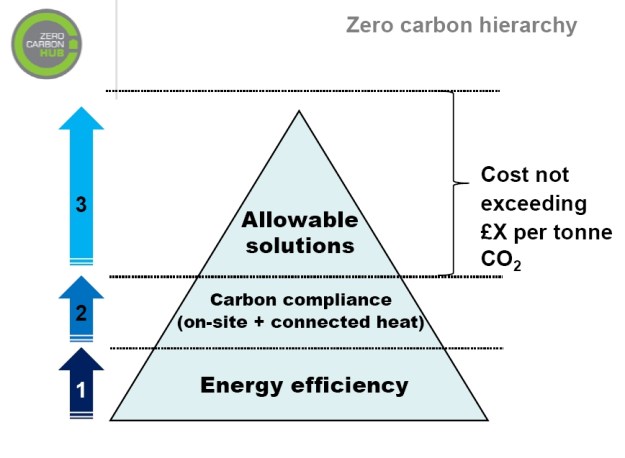
Key to the proposal and principles are three elements expressed in the pyramid:

zero-carbon-hier

There is so much thinking, science , technology and even politics behind this hierarchy that isn’t (imho) expressed in the paper, but was covered in the slides from the session, handed out on USB drive and from here : defining-zero-carbon-homes-presentation2

Some interesting thoughts:

As to the rate of homes being built to CSH 6 (zero carbon) the following profile helps to explain the anticipated progress to 100% post 2016:

of-homes-to-zero-carbon

The aspirational target is a UK version of the German PassivHaus concept.  (as Denise Chevin mentions in Building Its principles are simple – the best way to go low carbon is to build a well-insulated, airtight envelope that is nice to live in. It also comes with a copper-bottomed pedigree, with thousands of completed buildings over its 17-year history.)

Nearly 50% present at event were developers and contractor and saw the on site achieving of standards as most demanding aspect of zero carbon. (Cost and quality) 

Will allowable solutions be just another complex carbon off-setting scheme? Could offsite allowances mean business as usual for designers / developers / builders ?  although 2/3 of those present thought that offsite renewables should n0t be included within carbon compliance.

New build house projects to (could?) decarbonise existing housing stock – this is an exciting new idea but received low interest in terms of potential (votes) from those present 

And as to who should monitor and police zero carbon?  Given three options ( Local Planning Authority/ Building Control Bodies/New form of accredited body) those present opted for c, New form of accredited body.

sustainability and the crunch

The UKGBC released results of a survey earlier this week, which should be seen as important reminder that sustainability is here to stay despite the economic situation.

Results released today from a poll held during a webinar hosted by the UK Green Building Council have revealed that British companies see sustainability as a growth area over the next 3 years, despite the current financial crisis. More than 92% of respondents felt that sustainability would either grow as an issue or stay at the same level despite the credit crunch.

27% said that the financial crisis has had no adverse effect on their organisation’s efforts to tackle sustainability and more than half (55.54%) said it had caused it to become an even bigger focus for them over the past 6 months.

The general consensus from respondents was that during these times of uncertainty, it is important for government to stick to ambitious green targets, maintaining the direction of travel for policy and regulation. More than 96% either agreed or strongly agreed with this statement.

This was supported recently via colleague Pam Broviak, who recently sent live tweets and comments (via Twitter) from the US GreenBuild08 conference:

Me: whats the buzz re green v credit crunch ?

Pam:  everyone says it really hasn’t affected it a lot

Of course if we consider the triple bottom line, of environmental, social AND economic sustainability this makes sense. But as has been commented here before the survivors of this financial crisis will be those who have resilient practices and approaches in place – and that this must include social and environmental

twitter and facility user feedback

Today at be2camp I will be discussing the use of twitter as an approach to post occupant evaluation and facility user feedback.

This discussion needs your input …. Tweet what you feel about your facilities, where you are now, and tweet as you think about how your office, your building, your ‘comfort’ environment, affects you …

Tweet to @postocc and lets see what happens ….  Thank you

And remember to follow @be2camp for today’s event – questions to @be2camp will be picked up by those in the Building Centre , London