Author Archives: martin brown

REGENERATION 2016

Great news is that Regeneration, the very successful and innovative European, Living Building Challenge, 64 hours design competition is back for another edition in April 2016. The event to be held in the Italian Trento region is organised by Carlo, Paola and team at the Macro Design Studio in Revereto.

The event will take place at Centrale Fies, Dro (Trento – Italy), on April, 13th to 16th, 2016


The competition is open to professionals (architects, engineers, environmental sustainability and landscape experts) in Europe, under 35 years old. The deadline for the request of participation is next January 29th, 2016. 15 of the best applicants will be selected on the basis of the documentation submitted.

The applicant form can be downloaded from here 

The event is 64 non-stop hours of integrative design in which each team, assisted by tutors expert of LBC, will compete in designing the best redevelopment project of an existing local public building. There will be side events i.e. a final conference open to the public on the issues of LBC as well as the final presentation of the projects, with the proclamation of the best project by an international jury.

And, once again I am delighted to have been asked to tutor the teams on aspects and insights of the Living Building Challenge.

As you know, The Living Building Challenge™ is a building certification program, advocacy tool and philosophy that defines the most advanced measure of sustainability in the built environment possible today and acts to rapidly diminish the gap between current limits and the end-game positive solutions we seek. LBC is a Visionary Path to a Regenerative Future.
It is administered by The International Living Future Institute (ILFI) based in Seattle (WA), a hub for visionary programs that promotes a sustainability that is Socially Just, Culturally Rich and Ecologically Restorative SM. ILFI is partner and scientific advisor of Macro Design Studio and the Living Building Challenge Collaborative: Italy in organizing REGENERATION.

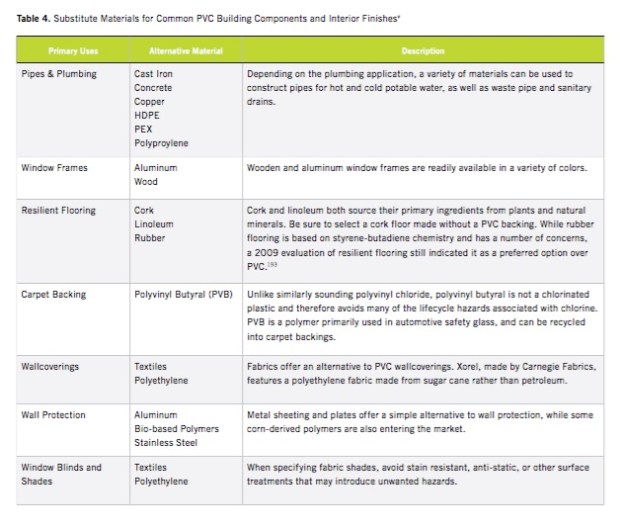
Avoiding PVC health hazards through substitute materials.

Aside from building materials that present obvious and accepted hazards to health (asbestos, leadpaint etc) it is PVC that generates the most discussion when exploring the Materials RedList imperative in Living Building Challenge training or workshop sessions. To design and construction buildings that are PVC free seems impossible to many, but LBC projects are doing just that through viable alternatives.
PVC imageThe Perkins+Will white paper, Healthy Environments, Whats New (and Whats Not) with PVC published last week (16th Nov) reviewed why PVC is on their ‘precautionary list’ in light of recent advances in PVC chemistry and manufacture. The white paper, a collaboration with the Healthy Building Network, to promote health in the built environment, concluded that despite advances in production, PVC should remain on their precautionary list.

Influential materials rating systems, including the Living Building Challenge building certification and Cradle to Cradle product certifications recommend avoiding PVC. Influential building owners such as Kaiser Permanente and Google have adopted PVC avoidance policies. Perkins+Will, an international architecture practice with about 1,000 architects, included PVC in its Precautionary List as a substance for which to seek alternatives.

“Exposure to a single PVC fire can cause permanent respiratory disease… Due to its intrinsic hazards, we support efforts to identify and use alternative building materials that do not pose as much risk as PVC to fire fighters, building occupants or communities.”  Richard M Duffy, International Association of Fire Fighters139

This does not mean that Perkins+Will has eliminated the specification of all PVC-based products. Instead, in keeping with the precautionary principle, when evidence indicates a relevant adverse finding as it relates to human health or negative environmental impact, Perkins+Will seeks to, where possible and appropriate, present alternatives to building owners for their consideration. The goal is to empower design teams to make informed decisions, recognising that this is an issue where scientific certainty is elusive.

Perkins+Will includes PVC on the Precautionary List because it presents hazards to people and the environment, beginning with its synthesis and continuing through its manufacture into products, use, and additional significant hazards during its disposal or recycling.

The white paper includes detailed analysis on the Health Hazards Associated With PVC and Hazardous Emissions from PVC, but the section on Avoiding PVC hazards through substitute materials will be of great help for those seeking PVC free constructions.

Avoiding PVC hazards through substitute materials

Mobilising the Construction Sector for Climate Action

We now know that buildings and the built environment are a key factor to our climate change problem, whilst at the same time, a vital part of climate change solutions.

2015 is seen by many as the turning point in the fight against climate change. In December, France hosts the 21st “Conference of the Parties”, or COP21, with a goal of reaching a binding agreement to limit global warning to between 1.5degC to 2degC.

Without significant action by the built environment sector, this target can not be met

December 2015 


The built environment sector’s crucial role in mitigating climate change is finally being recognised. For the first time in the history of climate negotiations, A ‘Buildings Day’ will be held December 3 at the COP21 UN conference on climate change in Paris.

  • Helping to put the buildings and construction sector on the below 2 °C path
  • Aligning existing initiatives, commitments and programmes to achieve greater scale and increase the pace of efficiency actions
  • Catalysing stronger collaboration and targeting sectoral and cross sectoral climate action and solutions for all

17062008118

Now then, is the time for every built environment organisation; funder; client; designer; constructor; and maintainer, to revisit and to recommit to sustainability goals that will not only seek to limit global warming through reducing carbon and other greenhouse gas emissions, but also seek to be net positive.

More than 30 per cent of global greenhouse gas emissions are buildings related, with emissions from buildings set to double by 2050 if we continue business as usual. Not addressing climate change will increase the risks and vulnerability of countries, regions and local communities. The forecast rapid urbanisation, without action will accelerate impacts.

Yet:

  • The built environment sector offers one of the most cost-effective and economically beneficial paths for reducing energy demand and associated emissions while at the same time supporting adaptation and resilience to climate change.
  • Many low-energy, renewable and deep renovation solutions are available. Proven policy, finance and technology actions exist.
  • The economic, health, and social benefits of sustainable buildings are significant. Buildings provide shelter, places to live, work, learn and socialise, directly affecting our daily lives. Providing more than 50 per cent of global wealth, and one of the largest employers at local level, the sector also offers a path to poverty alleviation.
  • Buildings are long-term ventures. Today’s new buildings are tomorrow’s existing stock. Failure to act now would lock in growth in GHG emissions for decades.

Better Build Green is the World Green Building Council’s new campaign which focuses on the UN climate change negotiations – COP21 in Paris. The campaign aims to show the world that green buildings offer one of the best and most cost-effective ways to tackle climate change and help keep global temperature rises within the two degrees limit. The message is simple: not only had we better build green if we are to reach a two-degree world tomorrow, but we are better off today if we do.

Sources:

UN Environment Programme Buildings Day 

Friends of Europe

Better Build Green

The New Economy – Why Buildings Matter in Fights Against Climate Change

Fairsnape iSite: Beyond Sustainability

Quartz: healthy product datasets for BIM?

When we know what our buildings are made of, we can make informed choices by selecting materials that are healthier for occupants and have a lesser impact on our environment*

This blog regularly covers the intersection between sustainable, healthy products (for example the Living Building Challenge Red List) and BIM. Indeed the selection of materials and products based on biological health, as well as environmental impact and functional performance within ‘sustainable construction’ should be a no brainer.

We are not so good at using data in construction, and although this is improving as BIM becomes more established, there remains a gap in useful product health data sheets that carry material or product ingredients. Projects that use a rigorous material schedule such as the ILFI Red List often find themselves unpacking designs and material specification in order to understand product recipes and seek safe alternatives.

The Quartz Common Products Database, a collaborative initiative from Flux, HBN, thinkstep and Google was launched at VERGE 2015 at the end of October.  Quartz is an open database of composition, health hazard and environmental impact data for building products. It looks a promising contribution to a greater understanding of material health impacts and, being open source, paves the way for inclusion and alignment with BIM’s and the Product Data Sheets currently being compiled by CIBSE, NBS and others.

“Quartz aims to bridge the gaps between information, knowledge, and action, leading to less toxic, lower-impact building materials”

The Quartz database (www.quartzproject.org) will provide a collection of product profiles for commonly used building materials. Specifically:
● Quartz is a free and open dataset, integrating both LCA and health-hazard data into a single information source using widely accepted and consistent methodologies, such as Pharos Project/GreenScreen hazard screening, TRACI 2.1, and ISO14044.
● Data is vendor-neutral and covers 100 building products across a range of categories, such as concrete, drywall and insulation. Products are compared by composition, health impacts, and environmental impacts.
● Data is licensed under Creative Commons BY 4.0, meaning there is no restriction on the use, redistribution, or modification of the data. This openness will enable the AEC community and the general public to become more educated about the potential
impacts of materials in buildings and communities, and to put this data to creative and productive use.
● Through consistent language and metrics, stakeholders will be empowered to have productive dialogue with building products manufacturers, driving the industry towards increased sustainability  (From Quartz Press Release)

Health profile

Quartz Health Profile for polyvinyl chloride membrane, prohibited by ILFI Living Building Challenge Red List but in common use in construction.

Here in the UK this could be seen as timely launch, with the Considerate Constructors Scheme promoting a Construction Occupational cancer awareness campaign on sites. A welcomed campaign and one that should start with product specification using data such as Quartz to remove such toxic materials from construction.

“Sites need to proactively eliminate harmful substances, when this isn’t achievable working methods and equipment must be substituted for safer alternatives (CCS)”

By focusing only on construction site, we are not learning from the past, and it is the same thinking as we were a few decades ago when the focus was on ‘safe’ handling of asbestos.

In todays climate of CSR, (Corporate Social Responsibility), where Do No Harm is a common-place construction value, specifying, procuring and installing products that cause ill health in production, in installation and in use should be deemed as socially irresponsible.

Note – a very useful guide to Nine Green Product databased for Architects, Specifiers and Consumers was published to Architect Magazine on Nov 10th 

In 2015 we should have a much more mature approach to health – not to be content with one that seeks only to reduce impact on health but an approach that seeks to improve health, through biophilic material inclusion and a salutogenic approach.

*from http://quartzproject.org/

Base EU Cities – In The Presence of Greatness

post.inddI was fortunate to attend the conference session of BaseEUcities in Brussels late last month. Sandrine Dixson Decleve (chair BaseEUCities advisory board, and Director CISL)  introduced the day as being in ‘the presence of greatness’, and undoubtedly that was to be the case, not only from the speakers and panelists but in discussions throughout the networking sessions.

File 03-11-2015, 08 42 57Keynote for the morning was Jeremy Rifkin economic, social theorist and author (the Third Industrial Revolution and recently the Zero Marginal Cost Society amongst many). According to The “European Energy Review” “Perhaps no other author or thinker has had more influence on the EU’s ambitious climate and energy policy”

Key to Rifkin’s keynote is the emergence and then convergence of innovation in three key areas – communications, energy, and transportation. This led to the fist industrial revolution in the UK, driven by coal, printing and the railways, the second industrial revolution was based on centralised power, cheap oil, telecommunications and the combustion engine ….. and now we heading into a third industrial revolution as we see the internet, IOT and virtual collaboration converging with a shift in energy production, ownership and conservation along radical innovations in transportation – not only vehicle but digital transportation of materials. (think Amazon and iTunes)

Rifkin’s delivery at BaseEUCities was just under an hour of linked thoughts, without aids or slides, and this is his skill, to connect and articulate a number of seemingly disconnected concepts into economic theories.

“The digital economy will revolutionise every commercial sector, disrupt the workings of virtually every industry, bring with it unprecedented new economic opportunities, put millions of people back to work, democratise economic life and create a more sustainable low-carbon society to mitigate climate change”  Rifkin in Huffington Post

At a private conference dinner the evening before, where Rifkin also spoke, Jorgen Randers, (a distinguished Norwegian economist and author of 2052 A Global Forecast for the Next 40 years, a much acclaimed sustainability publication) wasn’t too happy with Rifkin’s delivery, comparing it to building blocks being throw at you, rather than carefully constructed into a solid wall of economic theory. Frank Schwallba-Hoth (Founder of Green Party, Germany) responded that whilst you may or may not agree with Rifkin, his delivery, thinking and conclusions were to be admired.

And I agree, it is necessary to move away from a limiting cause and effect approach, the world isn’t like that anymore, if it ever was. We need more of Rikfin’s style, more complexity theory thinking – of fractuals thinking  and emergence from simple rules.
File 03-11-2015, 09 25 48

Graeme Moxton Sec Gen Club of Rome, added to the debate at the conference, arguing for political change and leadership for redistribution of wealth, energy and that greening is not negative for GDP growth but vital.

John Elkington, the final speaker for the day, summed up the days debates identifying three themes,  a New Normal, Corporations are key to Cities and a move from Incremental to Exponential Solutions

Listening to and participating in the days debates (in particularly listening to and reading extracts from Rifkin) you cannot help but think of the emergence of BIM, (Building Information Management) and how it is now transforming the AEC (Architecture, Engineering and Construction) sector.

Is BIM innovative and contributing to and shaping the third industrial revolution? or is it a consequence of the convergence of digital communications, new energy thinking and innovations in transportation? Which ever way it is, is BIM taking us towards a Rifkin future of Zero Marginal Costs?

Once we have, for eg, standard digital construction models, when each building is an energy production unit and we are 3D printing with local materials, the price of construction will tumble close to zero marginal cost, determined by the market, not by the cost of production. As has, music, books and other commodities following suit..

File 03-11-2015, 09 25 17And it isn’t all positive news. Rifkin talked of the dangers in externalising the nervous system of human race through Internet of Things , Alexander Der Croo Deputy Prime Minister of Belgium, who kicked off the conference, championing the digital era, warned that the IoT has a 1984 dark side we must all guard against.

And the sustainability dimension? After two industrial revolutions and now seemingly unsolvable climate change, our eco systems just cannot keep up with our interference, and as Rifkin commented “there is no guarantee for our species” – making the ending of using fossil fuel and emergence of restorative and regenerative sustainability so utterly vital.

……

For more on the BaseEUCities events see

#EUCities hashtagged feeds

BaseEUCities: the Conference storify

BaseEUCities: the Parallel sessions storify

BaseEUCities virtual exhibition continues for a few more weeks at http://virtualbasecities.com/

Beyond sustainability: Buildings are a climate change problem … and also part of the solution.

Buildings are a climate change problem … and also part of the solution. With buildings responsible for an estimated 40% of all carbon emissions and having a huge influence of lifestyle, commerce and industry carbon reduction efforts, we can now longer afford to incrementally be less bad. And this year, 2015, being a significant year for climate change action, with the COP21 in Paris in December and the imminent release of the UN Sustainable Development Goals, it is time to recognise the role of buildings as a climate change solution.

https---img.evbuc.com-https%3A%2F%2Fcdn.evbuc.com%2Fimages%2F15507896%2F145406037897%2F1%2Foriginal

Beyond Sustainability, as you may have seen in the media, via social media or by invite, is our significant event in London on the 5th Oct. The event highlight will be Jason McLennan’s (CEO International Living Futures Institute) first UK keynote, which promises to be an inspiring call to do more good, as being less bad is not just enough anymore

The event will also include an overview of Living Building Challenge and Well Building Standard activity in the UK from Martin Brown, Fairsnape, and Ann Marie Aguilar, Arup Associates.  Hattie Hartman (Sustainability Editor at AJ) will chair a panel debate, featuring regenerative and well being sustainability activity in the UK from a range of presenters.  In addition John Alker UKGBC will introduce the UKGBC’s new campaign ‘Better Places for People‘ 

There will, of course, be opportunity for Q and A panel debates with speakers.

Please take this as your invite to attend. The event will held appropriately, in the wonderful Royal College of Physicians building on Regents Park. More details and how you can you can still register here.

Jason F. McLennan Keynote speaker:

Considered one of the most influential individuals in the green building movement today and the recipient of prestigious Buckminster Fuller Prize (the planet’s top prize for socially responsible design), Jason F. McLennan’s work has made a pivotal impact on the shape and direction of green building in the United States and Canada and he is a much sought after designer, presenter and consultant on a wide variety of green building and sustainability topics around the world.

Integrating environmental management with business strategy. ISO14001:2015 published: Key revisions outlined.

At last, the long awaited next edition of ISO 14001:2015, integrating environmental management with business strategy has been published and available here

ISO-14001-–-5-ways-the-revised-ISO-14001-is-even-better-ENNEW IN ISO 14001 (updated from my blog post 13 July 2015)

ISO 14001:2015 adopts the High Level Structure which is now the required framework for all new and revised management system standards. (We will see the same structure in the new ISO 9001 and other ISO’s )

Strategic environmental management

There is a new requirement to comprehend the context of the organisation determining external and internal issues pertinent to the organisation and the environment, with actions to address them within the Environmental Management System (EMS).

14001 now embeds environmental and sustainability thinking into the high level strategy, vision and policy planning aspects of an organisation and project

Leadership

A new clause has been added with particular responsibilities for top management to express their leadership and commitment to environmental management. Top management may assign this responsibility to others but retain accountability.

14001 calls for increased accountability for the leadership (CSE, MD) of an organisation or project to ensure ongoing commitment and engagement  with environment and sustainability activities in the organisation.

Protecting the environment

Environmental policy shall incorporate a commitment to the ‘protection of the environment’. There is no definition about ‘protection’ that includes ‘prevention of pollution’ and ‘other’ commitments, such as sustainable resource use, climate change mitigation and adaptation, protection of biodiversity and ecosystems, etc.

The 14001 change from protection to prevention is significant, requiring a proactive approach and can be seen to move closer to a restorative thinking towards the environment

Environmental performance

There is a shift in emphasis with regard to continual improvement, from improving the management system to improving environmental performance. The key focus is on improving performance related to the management of environmental aspects. The organisation shall decide on criteria to evaluate its environmental performance, using correct indicators.

Again a significant and proactive change: from monitoring to improving performance

Lifecycle thinking

Organisations will need to extend its control and influence to the environmental impacts from raw material acquisition/generation to end-of-life treatment. This does not imply a requirement to do a life cycle assessment (LCA), just thinking carefully about the stages of product/service that can be controlled or influenced.

There will be much debate on this 14001 change, but indicates a proactive approach to design and specification that takes into account material and building(?) environmental impact through to end of life, encouraging more design for re-use, deconstruction plans and circular economy thinking

Outsourced processes

Organisations need to control or influence outsourced processes.

Will, at last bring contracted-out elements of a project fully into ISO 14001 environmental management, and will undoubtedly see an increase, and reinforcing of 14001 as a contract and subcontract requirement.

Communication

Emphasis on internal and external communication, and equal treatment of both has been added. The decision to communicate externally is retained by the organisation whilst taking into account its compliance obligations.

Welcomed 14001 improvement for the digital and social media age of communications and transparency

Documentation

The term ‘documented information’, is used instead of ‘documents’ and ‘records’. The organisation has the flexibility to conclude when ‘procedures’ are required. Any format (paper, cloud, etc.) would be valid.

Again a welcomed improvement in the digital and social media age of documentation and data management

ISO 14001:2004 TRANSITION

Organisations that are already certified to ISO 14001:2004 will have three years from formal publication of ISO 14001:2015 in which to transfer to the new version of this standard. Based on the current publication schedule, this transition period would end in September 2018.

Working in collaboration with a number of organisation on EMS and 14001 improvement, we have commenced future proofing systems and environmental approaches to address ISO 14001:2015 and in doing so improve integration between sustainability approaches, organisation strategy and governance. Get in touch to find out how this could help your environment management take the next step forward.

Whats new?

14001 Support

From the Greenest Government Ever to Green Industry Bashers

A posting on Think Left (1) on August 29 by Pam Field @earwiggle asked the question Why is the Tory Government Hammering Green Industry? and included the following incredible list of this governments achievements to date:

From the Greenest Government Ever, to within a few months, and as Pam Field comments, behaving like the most foolish, selfish  government in living memory – if not ever.

(1) The purpose of Think Left is to present a view of politics from a left-wing perspective

(2) added by me

Modern Slavery Bill: transforming construction CSR and supply chain management.

No responsible organisation in construction would want any association with modern day construction slavery, forced employment, child or migrant exploitation as we read increasingly often in the mainstream news, for example Qatar construction or closer to home with construction gangmaster organisations. Hence the Modern Slavery Bill should be welcomed by the built environment sector.

Included within the Modern Slavery Bill introduced on 31 August 2015 (coming into affect on 31 October 2015) is a clause that has significance for most construction organisations – the Transparency in Supply Chains (TISC) clause.

We have introduced a transparency in supply chains clause to the Modern Slavery Bill. This will require businesses above a certain size threshold to disclose each year what they have done to ensure that there is no modern slavery in their supply chains and own business. This will be a truly world-leading measure. There are similar transparency requirements in California, but they only apply to businesses producing goods for sale, whereas this disclosure will apply regardless of what it supplies, whether goods or services.
Minister for Modern Slavery and Organised Crime, Karen Bradley

What does the Bill and Transparency Clause mean for construction:

Chris Blythe, CE CIOB in Foreword to the CIOB Dark Side of Construction publication: The dark side – the systematic exploitation of millions of vulnerable migrants – is rarely acknowledged, even by the clients and multinationals that commission and create our shiny new cities. Our sector is rife with human rights abuses. Bonded labour, delayed wages, abysmal working and living conditions, withholding of passports and limitations of movement are all forms of modern slavery.

The scope of the TISC clause will cover construction products companies importing goods or components to the UK, as well as contractors and consultancies operating in the home markets and/or overseas.

The Modern Slavery Bill (with its Transparency in Supply Chains clause) will transform and elevate construction CSR and Supply Chain Management as important legislative responsibility processes.

Organisations with a turnover of £36 million will have to:

  • publish a “slavery and human trafficking statement” setting out the steps it has taken to ensure that slavery and human trafficking is not taking place in its supply chains and within its own business.
  • From October 2016, to publicly share their policies and strategies to tackle modern slavery in their supply chains.

Guidance on what might be included in such a statement:

  • Companies’ due diligence processes relating to slavery and human trafficking in their supply chains;
  • Reporting on the parts of companies’ supply chains where there is a risk of slavery and trafficking taking place, and how to assess and manage such a risk;
  • Reporting on staff training on slavery and human trafficking;
  • Reporting on companies’ effectiveness in ensuring that slavery and trafficking are not taking place in their businesses or supply chains.

“Implications of non-compliance with this reporting obligation in such a morally compelling context could leave a large dent in an otherwise sterling company reputation” Victoria Ball, projects & construction associate at law firm Trowers & Hamlins

“It will involve a deep dive into the supply chain to understand what’s really going on many tiers down – getting visibility of the many layers to truly see the conditions of workers at the bottom of the chain. The message to companies is clear – it is no longer an option to stay below the radar, refuse to take responsibility for problems in your supply chain and hope you won’t get exposed.”Cindy Berman, head of knowledge & learning ETI

What is not so clear is where the responsibility under the Bill rests for SME’s below the threshold that have organisations above the threshold within their supply chains. Most construction organisations procuring goods and services from large product distributors or manufacturers.

Actions construction and built environment organisations should take?

  • Embed Modern Slavery into CSR policies and statements, where, arguably there should be a statement anyway if base on a recognised CSR structures(eg ISO 26001, Global Reporting Initiative (GRI), JUST, Global Compact or the Human Rights Charter)
  • Understand the concept of Transparency in Supply Chains (TISC)
  • Include questions statements in supplier procurement processes. (And probably best to do so for all suppliers who are close to or over the threshold)
  • Develop a PQQ and Project Bid standard text.
  • Understand what an annual“slavery and human trafficking statement” for your organisation could look like

And of course, these good practices should be adopted even if below the £36million turnover threshold as a matter of social responsible construction.

Sources:

Related iSite blogs:

JUST: a social justice label for construction …

Constructing CSR iTransparency 

Understanding CSR in Construction

It is time to move on from theTriple Bottom Line …

It is time to move on from theTriple Bottom Line …

We have become very familiar with the Triple Bottom Line approach for Sustainability and Corporate Social Responsibility, ie Environment, Society and Economic. It forms the basis of many environmental and sustainability visions, policy statements, and development initiatives.

In the business arena, this is the acknowledged responsible ‘bottom line’ of meeting economic goals (usually profit) whilst also meeting environmental (impact) and social (community) goals in carrying out business activities. The triple bottom line approach provides a practical framework for the development of policies and strategies to drive institutional change.

roots coyo triple bottom line

Triple Bottom Line as drawn by COYO students

And of course we are now familiar with the well used triple bottom line venn diagram. If like me you loved Venn Diagrams at school, then its a real pleasure to see such vital and complex issues such s sustainability expressed as three interwoven circles. The Triple Bottom Line has also been represented as a three legged stool or as three columns.

As mentioned previously on this blog, this triple bottom line thinking can be traced back to Patrick Geddes who, now recognised as the Grandfather of Town and Country Planning coined the triptych Place, Folk and Work. Its current concept however is credited to John Elkington in his 1998 book Cannibals with Forks:Triple Bottom Line of 21st Century Business.

Whilst we can easily identify Geddes’ Place as being the Environment circle, (note, interestingly the Living Building Challenge renamed its Site Petal as Place for version 3), the Work aspect is readily identified as the Economy circle, there is an uneasy fit with people or folk within the Society circle. Are staff part of society, and where do the governance arrangements of a business (including vital for sustainability ISO 9001 related quality and organisational arrangements / controls) fit into the sustainability three circles?

Quad Bottom Line

Quadruple Bottom Line introduces Governance as the fourth ‘Petal’

The Quadruple Bottom Line introduces Governance as the fourth bottom line, or perhaps better, as Culture

Governance, or Culture is defined here as including both the formal business, administrative and ‘control’ processes of an organisation, as well as the informal networks, traditions and cultural and behavioural norms which act as enablers or disablers of sustainable development.

Sustainability governance therefore could include those organisational items that are increasingly seen as the vital enablers for sustainable development – many of which are embedded within the modern sustainability building programmes such as the Living Building Challenge, JUST, or Well Building Standard, including:
Diversity
Equity
Fairpay
Education
Collaborative Working
Working Places
Biophilia
Health and Wellbeing
Happiness
Communications and social media

This new, fourth leaf on the sustainability venn diagram, raises both important questions and huge opportunities for advancing sustainability development, and could usher in a new generation of sustainability thinking.

For example, what are the ‘governance’ issues of construction site facilities, welfare and administration that enable sustainable construction … more

Extract from forthcoming FutuREstotative