Author Archives: martin brown

“the future will require us to build better places”: Preston Tithebarn

Juxtapositoning of messages today:

… that the Tithebarn project in Preston has got (yet another) go ahead:

Preston’s £700m Tithebarn scheme has been given the go-ahead by a High Court judge. (LEP)

… that a survey from the Guardian on the future of the High St reveals that over 70% feel the high street doesn’t have a future, and that recent news re Thorntons. Jane Norman, TJ Hughes and Habitat is “a structural change and more bad news will follow”

… as James Kunstler says in  The Geography of Nowhere: Rise and Decline of America’s Man-made Landscape""  (currently reading):

 ‘The future will require us to build better places, or the future will belong to other people in other societies.’

Artists impression of Preston Tithebarn project – or is it Arndale Manchester, or the Bull Ring – or … nowhere?

Interesting times

#tweetchats … observations + how to

What is a tweetchat? In my view: a global online brainstorm: a fast paced collection of expert opinion, links, references, questioning, learning but above all sharing around the theme of the chat.

“A tweet chat is a pre-arranged chat that happens on Twitter through tweets that include a predefined hashtag to link those tweets together in a virtual conversation” Formal Twitter tweet chats are arranged in advance and occur at set times. They may include a formal agenda with a specific leader or “speaker”, or they might involve a free flowing discussion between all participants.

Dont attempt to make too much sense of it at the time, dive in, chat and share. Make sense of it later (which makes the output and transcripts very important). A brilliant use of twitter!

Having participated in a number of tweetchats over tha last few months #futrchat, #CSRchat and the more frivolous #sugarfreetweets for example, I recently took on the task of oragnising and facilitaing #GVisChat ‘Future of Energy in Buildings’ for Green Vision.

For an inaugural chat it worked well, with thought leaders and seasoned tweeters conversing and sharing with those who made their first tweet during the chat, which has to be a result.

Here then are my thoughts and observations:

Preparation:

  • Choose a hashtag and check it hasnt been used for another chat.
  • Most hashtags end ‘chat’ which has become a notation for tweetchat.Make the hashtag simple and memorable
  • Get the word out there – through twitter but also through related groups, forums both online and real.
  • Get the time and date agreed: Check there are no other big, subject related chats scheduled around the same time: Balance between working day time (9-5) and a global enthusiast though leader chat: It does seem the popular time is 7, 8 or 9 pm UK time for a global input. (and looking at a recent spreadsheet of existing scheduled chats, USA tweeters would appear to be more comfortable with the tweetchat format.)
  • Have instructions you can point to in order to help participants, for eg: How to take part in a tweet chat and How to join up to twitter (you don’t want to exclude those not on twitter who may see the whole twitter thing a bit of a dark mystery)
  • Agree roles – I think there are three, a facilitator, a subject driver and an amplifer See below  (I did all three so it can be done but … wow – it gets busy)
  • Agree Questions in advance, say 5 or 6 but be prepared to change and flex with the direction the chat may take.

Setting up to capture: 

Register the hashtag with  tweetchat.. Tweetchat provides a nice simple format that puts you in the ‘tweetchat room’ for the chosen hashtag and automatically adds the hashtag. Overall though I find tweetdeck easier to use during the chat.

‘Facilitating’ the chat:

  • Introduce topic, and the first question.  The start of the chat was probably the most ‘awkward’: unlike real meetings there are not many signals to pick up on that people are there and ready to go so you have to dive in. I had a sense of I was waiting for tweeters and they for me to kick off.
  • Welcome – be sure to welcome people as they enter the chat, that is make their first hashtaged contribution
  • Let twitter know the chat is running
  • Feed in the questions – the skill would appear to be in introducing next question at the right time, not too soon or too late – keep the fast pace going…
  • Amplify good points (ie RT and add to)
  • Praise good points being made, thank people for links (as you would in a real world brainstorm)
  • Challenge, question, throw in off the wall out there concepts to widen the discussion (eg future of energy chat led to possibility of building on the moon)
  • Give time checks, especially towards the close  – the 60mins flies past rather swiftly!
  • Watch for contributions from people forgetting or not using the hashtag and RT them so they get into the mix. (and remind people to use the # and Q and A numbering)

During the chat I used tweetdeck so I could have a DM channel open for closed communication with other hosts and a timeline to watch for related tweets from friends who forgot the hashtag!

Post Chat

Use a service such as the brilliant Tweetbinder to capture the tweets as well as statistics on the tweetchat.

Drop the tweets into Storify to create a transcript

Use the tweets and links to craft an interview sytle article for publication on blogs or elsewhere

Thanks:  These are my observations and lessons learnt from organising a tweetchat for the first time. I do hope they help and encourage you to get involved in a chat and to facilitate, they are great fun, generate a real buzz and to me prove the potential business and learning power of twitter is yet to be fully realised

I am indebted to Cindy @Urbanverse, a great friend and seasoned tweetchat expert for help and guidance


Towards low carbon construction IGT Report: Government Response

Snippets from todays launch of the Governments Response to the  industry’s Innovation Growth Team Report:

Business Minister Mark Prisk said:

“An efficient, effective and profitable construction industry is at the heart of any growing economy.

“Meeting the UK’s commitment to reducing carbon will affect every aspect of the built environment and has the potential to provide the construction industry with a 40 year programme of work creating great opportunities for growth in the sector.

“Through this joint Government and industry action plan we are making a clear commitment to the low carbon transition which will create the certainty needed for construction companies to invest in essential new skills, processes and products.”

Climate Change and Energy Minister Greg Barker said:

“Improving the energy efficiency of the nation’s buildings is a win-win response to tackling emissions and spiralling fuel costs.

“The Government’s Green Deal will radically transform the energy efficiency of our homes and businesses, and presents a massive opportunity for Britain’s construction industry.

Government Chief Construction Advisor Paul Morrell said:

“I am delighted that the Government has taken on board so many of the recommendations from the IGT report which was developed with expertise from across industry.

“To ensure that construction rises to the low carbon challenge we need to continue this new level of cooperation so I am also pleased that a joint Government and industry board has been set up to ensure implementation of this plan.”

Influence of Construction 

A copy of the Government’s response to the Low Carbon Construction Innovation and Growth Team Report can be found at: http://www.bis.gov.uk/constructionigt


Info from the News Distribution Centre


Use of social media can lead to innovative #smworkplace employees

Following my last blog on Social Media in the workplace two very interesting links have come to light:

From Business Insider:

As elaborated by the Harmon research on social media productivity … inclusive collaboration will unleash huge organizational potential for knowledge discovery with benefits including greater innovation, reducing time spent searching for information and elimination of duplicated effort.

and

Innovation comes also by multidisciplinary collaboration … with … social media are a means to this end, obstructing this opportunity will do more harm than good in the long term. Adaptation and transformation of people, processes and technology will have to occur sooner or later, because both the organization and the competitive landscape will demand this.

(my emphasis)

And from Tools for internal communications back in Jan 2010:

Melcrum have also begun a major research project into the use of social tools for internal communications; initial findings confirm “widespread adoption, a clear business case and visible return on investment for communicators.”

“Many organizations have now moved beyond the experimentation phase and begun embedding social media into the way they do business,” said Victoria Mellor, CEO of Melcrum. “There is a fundamental shift happening with how information flows inside an organization. Peer-to-peer online networks are enabling real-time feedback from employees to inform decision-making, not to mention facilitating collaboration between remote workers,” she added.

social media in the workplace

Workplaces need social media. Martin Pickard @FMGuru posted a question on twitter this morning on (should we) use Social Media in the Workplace in preparation for a debate this week. These debates are happening across all sectors, particularly so within the built environment, but I find it odd that we are have these debates at all and wonder:

  • What do I tell my son who is learning how to use facebook and how to blog at school, with QR codes to promote school sports day results, that when he starts work he wont be allowed to use such skills?
  • Did we have these discussions when the telephone or fax was introduced. (Lets send a hand written note around, get people together to explore whether we should allow the telephone on to sites)
  • Or indeed when email was introduced. I work with construction contractors who still do not allow computers on site, emails are send to an info@ address, printed in the head office and taken to sites by the contracts manager. We laugh at this now, but are we doing the same on social media?

Lets think about social media as collaboration and communication. Do we really want to have a debate as to whether we need ‘communication’ in the work place? Or whether we want people to work together, to collaborate?

Increasingly we shore up our policies and employee guidelines preventing the use of social media rather then guidelines on responsible behaviour. Better to have a workforce of ambassadors across social media than a frustrated annoyed workforce who criticise or worse during their own time or in their lunch times?

If we start to use the expression of ‘Real Time Web’ rather than social media it opens the door to thinking about using it as a tool for learning, sharing, communicating and gathering the intelligence an organisation needs (market, client, comptetitors, innovations etc)

Google have enabled Real Time as part of their search options. Staff can now see who has tweeted, blogged or shared anything they search for. Should we hence prevent the use of Google.  We cannot stop the use of social media or real time web, are we (as employers, managers, directors etc) just trying to stick more and more fingers in the soon to break dam?

Reading the traits of successful collaborative leaders for a piece of work with an innovative construction organisation and I see time and time again that a collaborative leader, (to which most built environment leaders would profess to be) is one that is connected, internally and externally across many sectors, through, yes, social media as well as traditional media. (Blog post to come)

Increasingly I am working with organisations who are waking up to the use of social media applications to improve winning work potential, from gathering leads/market/client/competitor intelligence, to gathering evidence for PQQ’s (from eg project blogs) to collaborative writing of responses and much more. (Follow me on @fairsnape for more on this)

Related links:

Using social media can help boards be better on sustainability. (CSRWire Talkback Blogpost)

Why FM needs to go social (a @be2camp FMX Article with @EEPaul)

Top 10: uses of social media to win work (check back after 23rd June after my session with Lancs Construction Best Practice Club)

ISO 50001 Energy Management Standard issued

ISO has issued ISO 50001, a new standard for energy management systems that aims to help organisations establish systems and processes to improve their energy performance, including efficiency and consumption. It will of course be of particular interest to facilities management organisations who will undoubtedly be asked to manage facilities to ISO 50o01

Firmly aligned with ISO 9001 and 14001, the standard is based on the well proven Plan Do Check Act Deming cycle of continuous improvement.

Plan : conduct an energy review and establish  baseline energy performance indicators (EnPIs), objectives, targets and action plans

Do : implement the energy management action plans.

Check : monitor and measure processes and the key characteristics of its operations that determine energy performance against the energy policy and objectives and report the results.

Act : take actions to continually improve energy performance and the EnMS.

ISO have issued a brochure providing back ground information to the standard

The future is influence? my thoughts from #commschat

I listened in and contributed to a great twitter @commschat debate yesterday evening. The main focus of the chat was around the importance of influence and the place of Peerindex with @azeem.

Part of the commschat transcipt can be found here

Whilst the chat seemed aimed more at PR professionals (which I confess, I am not) a lot of the more technical comments passed me by, but one or two gems started me thinking, or rather confirmed some of my thinking on the importance of influence Particularly as social media use becomes more main stream in the built environment. Here then are my thoughts.

One take away was the concept of ‘Peer Influence Leaders’ which I now see as increasingly important in PR and indeed in social media generally.

A while ago I supported a Macmillan group in the Midlands on awareness of the use of social media in their fund raising activities. I suggested they look for the top 50 influential tweeters within their area and start following, start conversations, pick up on the twitter buzz and link their funding activities accordingly.

Until recently it has been difficult to determine just who are the top (twitter) influencers are in the built environment (construction, design, FM etc But with the curation of the tCntop100 lists for construction and architects we are starting to get an understanding.

OK we may not fully understanding the scoring or alogorithms yet, and the movement in the rankings (that would have kept Fluff Alan Freeman happy for many pop pickers) suggests influence is a fluid, transient thing. Indeed as mentioned yesterday it has to be earnt and sustained.

Now if construction, design, and FM organisations and or their PR companies look to get a good message, new product, award, sustainable achievement into the industry then by engaging with the say top 50 for that discipline, who in turn are more likely to retweet, mention or comment onward to their peers would make brilliant sense. Conversely are those not engaging with these influences are missing an increasingly important element of PR

In a chat with Paul Wilkinson @EEPaul, earlier today on this subject, Paul mentioned the concept of ‘Amplifiers’ ie those whose influence is such that they can amplify messages. I like this concept, and when coupled with a maven ….

This of course could bring additional pressure to those on the (tCn top100) lists who would not want to be used as PR publicity retweeters, and reinforces the need for engaging, building trust and relationships.

And, one comment at #commschat  that I am still thinking through from @EbA :

 @fairsnape: Excellent point @EbA: @azeem where does emotional intelligence come in? If at all #CommsChat

Thoughts and comments very welcomed …

ConstructCO2 now records zero carbon travel

ConstructCO2, our construction carbon calculator now measures ‘zero’ carbon travel to and from job sites.

Recording and increasing the travel from managers, visitors and operatives who get to site under their own steam (eg walking and cycling) or via car sharing is an important element in reducing construction impact on the environment, travel miles and the associated carbon emissions

It is also an important KPI that measures the projects performance against any green travel or car share plans.

The Zero travel KPI is expressed as a percentage of all travel or can be broken down to percentage of zero carbon travel for managers, visitors or operatives.

It is very very early days as yet, but it looks as through zero carbon travel is below 1% of all people travel. More later when we have more data.

feedbackfeedforward for a FM led built environment sector.

Back in 2004/5 I chaired a Constructing Excellence working group, aBeCFM, an collaborative exercise between BE (now Constructing Excellence) and CFM (Centre for Facilities Management) with a remit to explore the collaboration and integrated working across the built environment sectors of design, construction and facilities management.

Following an article in Modern Building Services “What if we bought everything in reverse order” and an associated twitter conversation, I have dusted down the recommendations from the abecfm working group below. They are as relevant today as then, maybe more so in light of the Governments Construction Strategy.

Central thinking was feedbackfeedforward that recognised FM’s unique position and role to feedback of facility knowledge to design / construction at the start of a project and to feedforward facility knowledge into the organisation for organisational improvement.

The feeding back and feeding forward of building in use data and facilities management knowledge is key in helping to close the loop between RIBA stages 7 and 1. (Which should never have been illustrated as a linear process)

  • FM to act as broker for collaborative and integrated process. Early involvement of FM must be a given 
  • Extend culture of collaboration throughout the facilities life cycle, from concept to destruction (Would probably call this Cradle to Cradle now!)
  • Increase awareness of design, construction and fm leverage through better understanding of 1:5:200 ratios 
  • Facilities Management to drive a built environment collaborative approach to sustainability.
  • Adopt a collaborative improvement framework for an integrated FM led sector (such as EQFM or Be Excellent)
  • Assess value for all stakeholders –more focus on value management. Include whole life value statements with all design proposals
  • Integrate processes to address complexity, particularly at interfaces and handover stages
  • Share knowledge for innovation and learning feedback/feedforward 
  • Address people and leadership issues necessary for the transition to an integrated and collaborative, FM led industry

Unfortunately the abecfm.com website that contained more detail and signposted to references and case studies has been removed. But hopefully we can track it down and give it the light of day once again.

Government Construction Strategy – have we been here before?

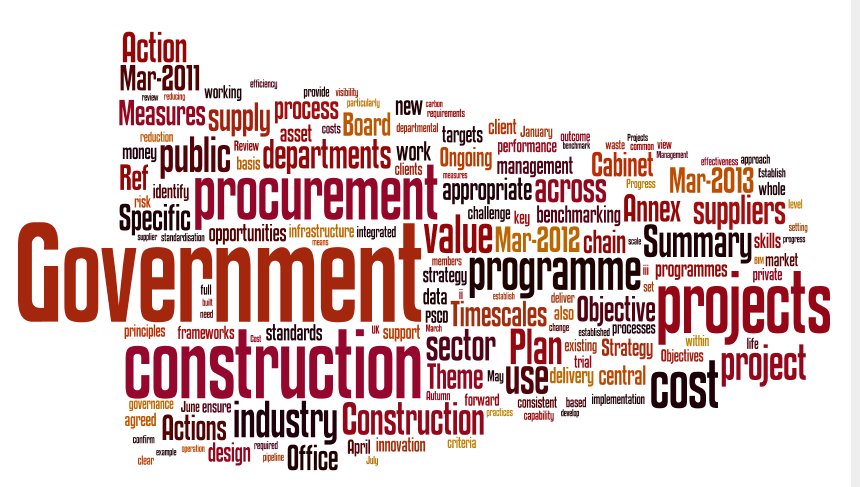
The Government have recently published its Construction Strategy, aiming to address

… widespread acknowledgement across Government and within industry – backed by recent studies – that the UK does not get full value from public sector construction; and that it has failed to exploit the potential for public procurement of construction and infrastructure projects to drive growth.

This strategy changes that. It calls for a profound change in the relationship between public authorities and the construction industry to ensure the Government consistently gets a good deal and the country gets the social and economic infrastructure it needs for the long-term.

However, on a first few readings of the paper I find it un-inspiring and not representative of the current era for the built environment. With the possible exception of a luke warm, suck it and see approach to BIM there is very little in the strategy that we havent seen before in strategies, white papers and policy documents.  A wasted opportunity?

In an era of joined up thinking, collaborative and integrated working it would have been good to see this a built environment strategy, rather than continue the silo thinking of treating construction as a stand alone.

It is therefore disappointing to see that facilities management would appear to have been downgraded to asset management, and although the paper recognises the importance of a whole life thinking approach, it is a view from a building as an asset, a product,  rather than a facility that enables business.

Post-handover defects are a regular feature of construction projects, leading to the cost of remediation (and frequently the higher cost of resolving disputes). Even when there are no latent defects, it is still rare to find that a built asset performs exactly in accordance with its design criteria (and particularly in terms of energy efficiency, for example).

Integration of the design and construction of an asset with the operation phase should lead to improved asset performance. This has been demonstrated in projects which have integrated design and construction with whole-life operation. The same alignment can be created by requiring those who design and construct buildings to prove their operational performance for a period of say three to five years. Proposals for this will be developed with the Government Property Unit to ensure alignment with subsequent arrangements for facilities management.

The 3 – 5 year proving period has been suggested and trialed before – back as I recall in the mid 1990’s as part of the Building Down Barriers programme. And way way back in 1934 Alfred Bosom was saying the same thing (” our production costs are some 30% higher than they should be due to bad building layout”)

The strategy rightly sees procurement as a barrier, but the approach is

To develop a range of overarching procurement strategies appropriate to the whole programme.

Hmmm, havent we been doing that since Latham ? We now have PAS91 which the strategy calls to be better embedded, but to develop even more ….?

And on sustainability

To deliver future carbon reductions in the Government estate through the procurement of new construction, for example by developing approaches to appraising construction projects on a whole life carbon basis including embodied carbon, and working with departments and industry to deliver existing and emerging Strategy for Sustainable Construction targets.

but for the detail action plan and targets we have to wait for the governments response to the IGT Low Carbon Construction Report

Not sure if it is a mistake or not, but note the approach to reducing carbon is through  the procurement of new construction – not all construction – ie is it omitting refurbishment of existing property?

I didn’t expect the strategy to be explicit on social media, but I would have liked to seen communications addressed. Communication, or lack of, are at the root of most of construction problems. As we are seeing the increased use of ICT, Web Technology and yes, Social Media, in other Government sectors it would have been good to see it put on the radar for construction.

Also missing from a forward looking strategy is the need to address diversity – not only in gender, but in age, abilities, ethnicity etc. Without diverse views, opinions and approaches we will continue with our mono-centric approach.  The Government can act as a real role model and driver for construction here. As Einstein said – we cannot fix today’s problems with the same kind of thinking that created them! 

Read the paper here: Government-Construction-Strategy