Category Archives: comment

Lean BIM: Six reasons why construction needs to embrace BIM alongside Lean Thinking

Combining Lean Construction thinking (in the shape of Last Planner approaches) and BIM (Building Information Management) on construction projects can enable big reductions on time, cost, waste and stress, and in doing so improve profits, capability, staff wellbeing and reputation.

My recent ‘Lean BIM’ lecture at Leeds Beckett, explored and discussed with case studies, how achieving the 30% construction strategy cost saving target is within reach.

Lean thinking and last planner approaches should be seen as collaborative working preparation for BIM. Both share similar aims – ‘producing  the right product at the right time in the right quantity for the customer and to produce exactly what you need and nothing more’.

Here are 6 of the many compelling reasons for adopting ‘Lean BIM’ …

  1. BIM in conjunction with lean construction (ie Last Planner approaches) can get construction activity closer to the Honda expression of “everything we do … goes into everything we do” (Currently only 40-60% of what we do in construction goes into what we do, ie what we get paid for or hand over to our customers).
  2. BIM, like lean construction thinking forces us to focus on the end game first, understanding client value and pulling that value through design and construction.
  3. BIM, like Last Planner will reduce firefighting and stress on project management team.
  4. BIM will drive lean and predictable programming and material sequencing.
  5. BIM will streamline the supply value stream for materials, enabling just in time supply, adding value and reducing unnecessary costs.
  6. BIM will greatly assist in improving information flow and communications, between project partners and supply chain. Techniques such as the TQM / Toyota ‘5 whys‘ repeatedly shows communication as the root cause of many if not all costly problem

However,  embracing  both BIM and Lean has a number of essential pre-requisites, for example

  1. BIM and Lean construction both need construction leadership at organisation and at project level.
  2. Contractor core processes (eg design and construction) need to be shaped around Lean Thinking and BIM requirements.
  3. BIM Is a people collaboration mindset. Even on BIM projects, approaches such as last planner are essential to ensure people (the last planner) involvement in project short-term planning and improvement, and
  4. Early contractor and supply chain involvement with strong collaborative culture must be in place.

“The construction aspects of projects is the easy bit – “a doddle”  … The harder, more complex bit is the collaborative working ‘glue’ that surrounds the design, build and operation of the facility, whether BIM is used or not” John Lorimer (In PPP Publication)

Sustainability through Diversity

On the 14th october I presented the above pecha kucha to Be2Camp Be2campOxon event on Ada Lovelace Day, taking the perspective of a young Ada, looking to a career in construction, in sustainability, in IT, in BIM, and the challenges she may face. Not only a glass ceiling but perhaps a triple glazed ceiling.

Initial thinking was triggered by the excellent Nilofer Merchant article in TIME You Are the Industry. You Must Be the Change, pointing out to Satya Nadella, Microsoft that it is not good enough to call for change in the (IT) sector – but that those in power, like Satya Nadella, should affect change.

And so it is in the built environment, particularly construction, where it is no longer acceptable for industry leaders, industry groups and strategy authors to record the fact we have a gender and diversity problem – but time to do something about it and affect change.

2050: A built environment digital future within a climate hell?

15005533690_89bee8ef08_zCan a digital future help the built environment adapt to or mitigate a climate hell?  Two reports issued recently (01 Sept) caught my interest, both based on 2050 timelines:

Built Environment 2050: (BE2050) A report on our digital future by the influential group of young construction professionals. BIM2050,  illustrating the need for organisations to consider new skills, new processes and strategies around emerging digital technologies, with a focus around a BIM future The report comprises essays focusing on three key areas; education and skill; technology and process; and the culture of integration, highlighting risks, challenges, opportunities and benefits that come with large scale innovation and game-changing new technologies. Graham Watts, CIB comments in the intro  “It is an important discussion document of ideas and concepts that will, I hope, spark debate in the wider construction community.”

and, the other report issued on 01 Sept?

Reports form the Future, United Nations report, based on 2050 weather forecasts and reports warning of floods storms and searing heat in what it describes as a climate hell. (A Bulgarian weather forecaster in 2050 shows a red map with temps of 50deg) The blatant doomsday, disaster movie (think day after tomorrow) nature of the report is intentional, raising awareness in advance of the upcoming UN Climate change summit in New York, encouraging a faster response to climate issues.

So how can the built environment, itself responsible for a whooping negative 40% impact on climate change, adapt, mitigate and address climate change and how will a digital future contribute?   

The future of our industry is facing a high degree of  complexity, extreme competition and uncertainty with respect to the outcomes of climate change, availability of resources and the disruptive nature of innovation.

Regardless of their origin, (climate change) factors will indirectly stimulate a rate of change in our sector, which will have a direct impact on every aspect of the built environment as we know it.( BE2050)

The emerging, regenerative sustainability, (eg Living Building Challenge) thinking considers:

– The need to start doing more good, not just continue being less bad, flip from ‘nearly zero’, or ‘zero’ to net positive and heal the future. Not only in water and energy, but also in waste and addressing circular economy thinking.

– Addressing the wider health impact of buildings and facilities – removing harmful and toxic materials from the built environment in production, construction, in use and in disposal (or recycling)

– Working together in what may seem unconventional collaborations

– Create a new responsible industry! Turning the traditional social image of construction on its head

Given this, how will a digital future contribute? 

When reflecting upon Building Information Modelling in its context to a sustainability race, one realises that BIM is not just about modelling or intelligent design, but ultimately represents our emerging digital capabilities as an industry, and our future potential to meet these demands. (BE 2050)

After all it is big data, driven from BIM applications that is driving innovative approaches such as seeing buildings as material banks, not waste generators. The BE2050 report invites an ongoing debate, one absolutely essential to keep BIM and Digital approaches from falling into a bubble, (BIM for BIM’s sake?) and start debating the wider contribution for eg :

– Product data libraries that carriers health and material recipe composition to enable informed decisions through digital value engineering

– BIM approaches that  address functional and financial reuse and reincorporation of buildings and products from end of one building’s life into the next.

– BIM education that removes discipline silo’s and places BIM as a powerful tool to progress restorative sustainability approaches

Both reports are to be welcomed in the ongoing debate to correct the built environments sustainability failings of the past and face up to responsibilities for the future…

What can social media offer in support of Construction Innovation, Information, Process and Management?

Today’s construction and built environment sector faces exciting but immense cultural, societal and technological changes. This is evidenced through a myriad of issues; a rapid escalation in the need for improved sustainability; better information management and advanced construction techniques; to test and challenge established practices.

While these challenges are significant, there are a number of platforms and tools that can improve communication, learning and sharing – not least social media. The core challenge here is “what can social media offer in support of Construction Innovation, Information, Process and Management?”


My guest editorial to Construction Innovation, Information, Process and Management (Volume 14 Issue 3) provides a snapshot of social media (past, present and future), including why and how this new collection of tools can be used to purposefully improve construction.

33314c001

Why Use Social Media in Construction

Social media, alongside web 2.0 applications have been major disrupters for many industries, from music to books thorough to newspapers and journalism. These disruptions have led to new platforms and avenues for future innovation and creativity. Just how much social media, BIM/modelling, and the move towards transparent, responsible sustainability will disrupt construction and the built environment in coming years is one of the salient questions to address (and one that makes construction such an exciting industry).

Social media is by no means a panacea solution for construction improvement or, indeed, a means of replacing all construction communication. It is, however, a vital tool in today’s construction improvement “toolbox”. The discussion now needs to move beyond social media as a technology to social media as a crucial enabler.


Access the full article here (may require registration) 

Getting lost in maps

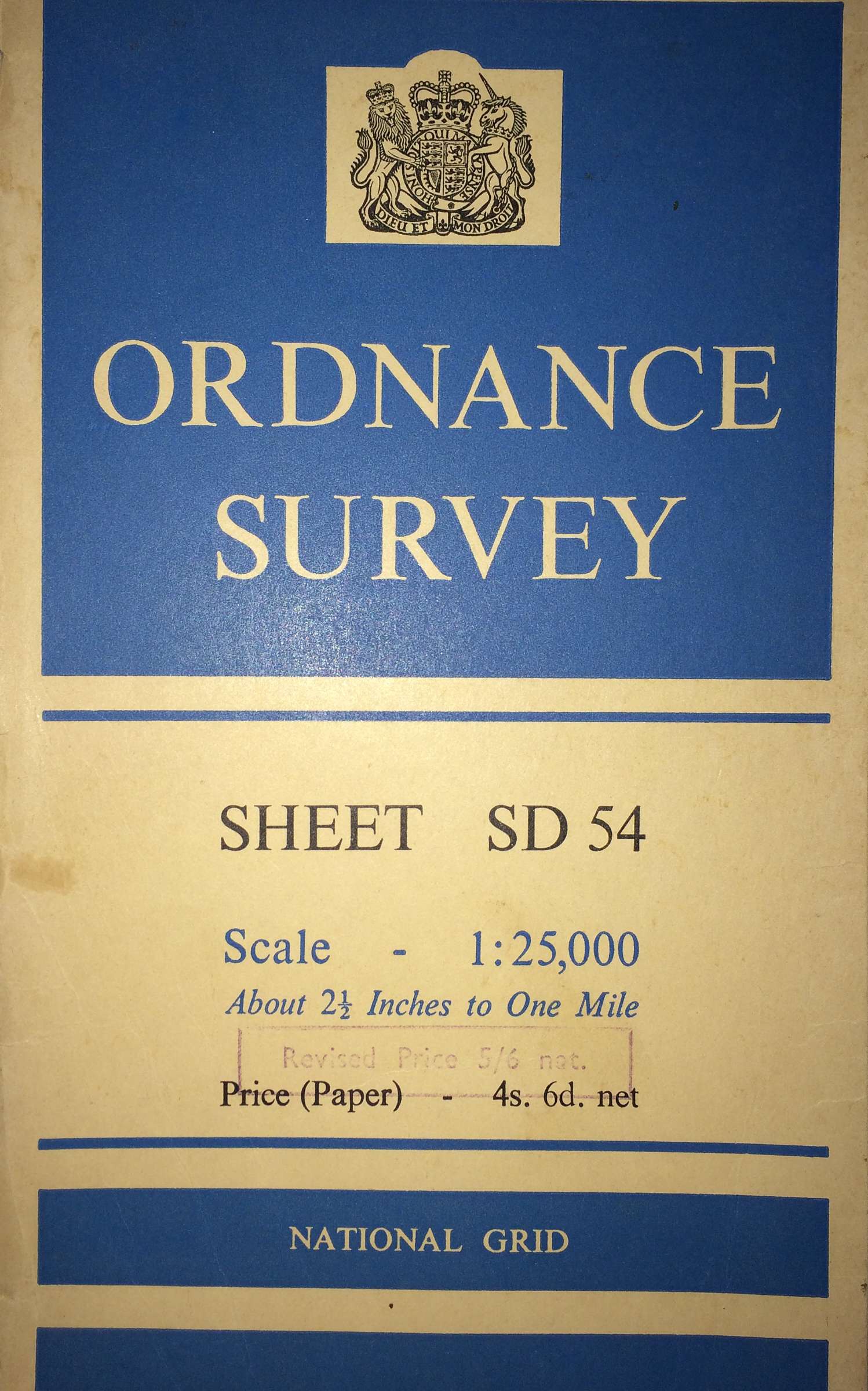
photo (4)Its not often that I blog here on my fascination with maps. But yesterday’s find in a charity shop, a 1955 map of my home area, an OS Sheet SD54 1:25,000, brought home once again how wonderful it is to get lost in maps.

 
Its fascinating to see how both the natural and man made landscape changes over decades and indeed how cartography styling changed.
 
 
 photo (5)                   photo (6)
 
The nearby Beacon Fell, my  ‘get out for a short cycle or walk’ area,  shows hardly any trees in 1955, it is today just about 90% forested, unfortunately with many non native trees, although there is a programme to remove or to thin these in progress.
 
The circular one way road, that now has umpteen Strava segments and a favourite for Preston boy racers had not been built, neither has ‘the tarn’ (now an SSSI), the visitor centre or any of the car parks!

Fairsnape Fell was dangerously close to Yorkshire (!) and noted as being in the Bowland Forest, Higher Division. My home village of Inglewhite just on the southern edge of the map proudly displays a P (Post Office) – now sadly gone, a couple of decades ago.

The map, reprinted in 1956 with minor corrections is based upon 1907-1930 surveys, is littered with the beautiful icons and information typical of a bygone cartographic era.

photo (3)The scale bar gives measurement in furlongs, in feet, in yards and in miles. The magnetic declination is a whopping 10 deg west, which must have been the cause of many scouting,  map to compass navigation mistakes. (It is now zero, or just swinging back in parts of the UK)  In a seemingly odd mix of metric and imperial, the grid is based on 1km squares, but we are reassuringly told that one square inch presents 99.619 acres on the ground. 
 
The original cost of the printed map was 2s 6d net, with a cover price of 4/6 later revised to 5/6. (Thats 27p in real money)
 
I am assuming for practical cost reasons rather than an environmental considerations, it is stated that “to save paper the reference tables of Conventional Signs are omitted and published separately”
 
Wonderful.

#SustLdrConv – Update to our autumn series.

Sustainability is moving into new territories, with new leaders and leadership styles. Social media is increasingly being used as a tool for engaging, learning and sharing to further the emerging collective of sustainability leadership and organizational development approaches.

Because we realized how much “socialising” sustainability leadership could impact our sustainable future, Andrea Learned  (Seattle based writer and social strategist for sustainable business and so much more)  and I decided to collaborate, across “the pond” and a continent to develop the #SustLdrConv (Sustainability Leadership Conversation) Twitter chat.

We know that our combined individual professional expertise and solid sustainability social networks results in a thoughtful and fun transfer of sustainability learning across sectors. Since we launched the chat in July of 2013, the built environment has been the root of our explorations, but our conversations since have also included organisational leadership authors, corporate sustainability directors and open forums on women in leadership, among other topics.

Our May chat with Denis Hayes of The Bullitt Foundation was incredibly rich.

We are excited for our fall schedule that includes:

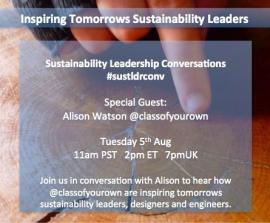
BuOSfWeIUAAG1tHAugust 5: Alison Watson of Class Of Your Own discussed how she is inspiring and educating the next generation of sustainability leaders in construction and design and more, (see storify of the conversation from Andrea Learned here

September 2: Tabitha Crawford, SVP of sustainability and innovation for Balfour Beatty Investments, and the author of Five Epic Mistakes of Sustainability in Higher Education.

October 7: We go live from #SXSWEco (guests TBA) in Austin.

***

Select archived Storify summaries of past #SustLdrConv:

Aman Singh of CSRWire (April 1, 2014)

Peggy Ward of Kimberly-Clark (February 4, 2014)

#SustLdrConv happens the first Tuesday of the month at 11 am PT, 2 pm ET, 7 pm UK.

This article also appears on Andreas blog at http://learnedon.com/

Restorative Sustainability – Once something exists, no one can say it’s impossible

Insights from a Sustainability Leadership Conversation with Denis Hayes:

Martin Brown and Andrea Learned

As part of the Sustainability Leadership Conversation series we held a twitter conversation with Denis Hayes, founder of EarthDay and CEO of the Bullitt Center in Seattle – the worlds greenest commercial building. The full transcript from the conversation can be found on storify, with insights from others, but here is an summary of insights, compiled from Denis’ tweets

MB: What is inspiring you at the moment?

Denis: Big change happening, but is it fast enough? That’s the question. I’m inspired by huge amount of talent and money flowing to sustainability investment and by young people rolling up sleeves to make things better.

MB: What are your views on Effecting Change

Denis: Media plays big role, for example President Obama engaging meteorologists, trusted and relevant Best place to effect change is in City Hall – whether as employees, elected, NGO, advocate. I’m bullish on cities right now.

MB:  … and on Nature and Natural Laws?

Denis: We have been breaking lots of little laws in the built environment. Now the big law, Nature’s laws, are catching up with us. You can’t break Nature’s laws.  When you try, you wind up proving them.

We need to align human and natural laws, then economy will fall into place.

And yes I agree we need more circular  thinking, buildings only ‘borrow’  materials, we need to design with senescence in mind, the Building’s not mine. Biomimicry just makes good sense, nature has been beta testing ideas for millions of years, the least we can do is observe and learn.

 MB: What is the role of Big Data in sustainability?

Denis: Analysis of big data is key, living buildings need cerebral cortexes and Central Nervous System to function, big data helps see patterns, offers vast potential, but right now there is too much noise and not enough signal and analysis.

MB: How important is Equity within ‘Restorative Sustainability’?

Denis: For too many people, environmental performance is a luxury. Race or income shouldn’t determine whether your building is full of poison. Everyone deserves clean air to breathe.

MB: Why the Living Building Challenge as the standard for the Bullitt Centre?

Denis: The LBC is most ambitious metric for sustainability in built environment. It’s hugely challenging.  LBC Buildings sequester carbon, generate more energy than use, remove toxics from ecosystem and promote human health. LBC Buildings have no toxics, compost all waste, use only rainwater and sun, they put water back into soil to recharge aquifer. All are natural ideas.

“But the Bullitt Center is about opening a wedge into the future. Once something exists, no one can say it’s impossible”

MB:  why after 40 years of Earth Day are we still pessimistic?

Denis: 40 years happened. Still possible to mitigate worst impacts, but is now expensive and difficult instead of cheap and easy.   Not too early to think about Earth Day 2020, aka ED50, a month long Earth Celebration

MB:  where Next?

Denis: I’m writing a book – COWED – with my wife about the impacts of bovines on North America.   COWED is not anti-cow but “pro-cow but with limits.” 93 million cows in America are way too many.

MB: And finally your views on twitter and (sustldrconv) tweetchats?

Denis: This is an exciting day to be doing this with @fairsnape @AndreaLearned and with the new NCA out, the chatter class is talking climate change

This article was originally co-authored by Martin Brown and Andrea Learned with contributions from Denis Hayes and Brad Khan. 

Denis Hayes, founder of EarthDay and CEO of the Bullitt Center in Seattle – the worlds greenest commercial building. Brad Khan is Principal at GroundWork Stratries and communications consultant to the Bullitt Centre in Seattle

Martin Brown @fairsnape is a UK built environment sustainability and social media advocate, Andrea Learned @AndreaLearned is a US based social engagement and thought leadership strategist. Both are Guardian Sustainability Business contributors and are co-founders of Sustainability Leadership Conversations, a transatlantic and global twitter based social media programme that enables sustainability leadership sharing.

Contact us to discuss support in amplifying your messages, experiences and commitment within the sustainability leadership arena through our monthly #SustLdrConv series and other social media programmes.

So, the CAT is 40 years old!

Cretan-windmillJim Perrin, one of the UK’s leading outdoor essayists, wrote in Environment Now (and included in his Yes, to Dance, Essays from Outside the Stockade collection) of impressions from an early visit to Centre for Alternative Technology and interviews with early managers, Gerard Morgan-Grenville, Bod Todd, Tim Brown and others, highlighting some of the issues that are still hot debate topics now as then:

“constant points of reference are an awareness of whether fuel sources are renewable or exhaustible, whether the effects on the environment are benign or prejudicial”

“Scatological instincts find plenty to amuse us amongst the composts and manures and watering cans labelled pee … inviting contribution for composting. (As Prince Charles did on his 1978 visit) And in the same male toilet there are also baby changing facilities … “

Perrin describes the prejudice CAT had to face at the time … “Communists, thats what they are and Hippies, and Vegans, making a fortune from visitors, all on social security …”

Roger Harrabin, writing in the Guardian today (01 August 2014), picks up on the same hippy stereotype:

‘Hippies in a slate quarry in Wales are celebrating four decades of green revolution this weekend, having transformed the character of a local town, pioneered new energy technologies and constructed a water-powered railway’

But, as Harrabin rightly points out that whilst many of the Centre’s alternative technologies are no longer considered alternative, “the centre’s original aim to democratise technology remains unfulfilled, and there is a realisation that its mission is far from complete. Its radical recipes for achieving a zero-carbon Britain remain unpalatable to politicians and the public” 

See Zero Carbon Britain at http://zerocarbonbritain.org/ 

I first visited CAT in the mid/late 70’s (before the water powered cable car was installed) with a head full of west coast rock, (welsh rockers Man in particular), probably on a wet day as part of the then regular climbing trips to Mid and North Wales. Maybe looking for alternatives to my career which had just changed from Quantity Surveying to Site Engineering. Or looking for a UK equivalent to the Whole Earth Catalogue, and trying to understand Stay Hungry and Foolish.

As it happened it didn’t change my career, then, but planted seeds to later incorporate alternative approaches into my construction thinking, in what would later become ‘sustainability’, mainstream in construction and become a huge part of my now independent career and enable me to continue challenging.

So Happy Birthday CAT – and as Jim Perrin wrote:

“Go to the Centre for Alternative Technology, Go for a day. Go for a weekend or a weeks course… Go and soak up the ambiance of a lovely place. Go and acquaint yourself with a more than normally altruism intelligent and gentle community of people”

Image: Centre for Alternative Technology Blog: http://blog.cat.org.uk/

Wellness and Happiness: The Next Built Environment / CSR Frontier

Update 30/11/16  BREEAM and WELL Alignment review – more good or less bad?

Update 27/10/14:  The International WELL Building Institute launched the WELL Building Standard Version 1.0, as a publicly available standard which focuses on enhancing people’s health and well-being through the built environment, at the inaugural WELL Building Symposium in New Orleans. The WELL Building Standard v1.0 can be applied to new construction and major renovations of commercial and institutional buildings, tenant improvements, and core and shell developments.

Original post …

Salutogenesis – a term we should become familiar with.

It describes an approach that focuses on factors that promote human health and wellness, rather than on factors that prevent disease and ill health (I am indebted to my partner Prof. Soo Downe for introducing me to this concept from the world of childbirth and health, but that has profound implications for built environment sustainability)

And whilst wellness and health is a relatively new emergent for CSR – the built environment is now right at the center. Designing and constructing sustainable buildings isn’t rocket science, we have the methodology and technology, but designing and constructing buildings that improve wellness and health, not just reduce the negative impact on health, is the next frontier for the built environment sector.

It is one that requires different design thinking, requires collaboration with others in the health sector, and it appears to be rising rapidly on the CSR agenda. For example,

  • “Companies that ignore the environmental and social impacts of their buildings could risk miserable workers and low productivity,” Russ Blinch wrote in Guardian Sustainable Business
  • Scandinavian firm Sustainia has based its Guide to Co-Creating Health report on the correlation between what’s good for the planet is what’s good for you — and that healthy people are the single most important resource within the transition to a sustainable future.
  • Increasing the safety of buildings; promoting safe, careful use and management of toxic substances at home and in the workplace; and better water resource management are three of WHO’s 10 facts on preventing disease through healthy environments.
  • Nonprofit BSR argues in A New CSR Frontier: Business and Population Health that companies have yet to realise the full potential of extending health and sustainability initiatives across their entire value chains to include suppliers, local communities and the general public

The Built Environment Sector

And there is encouraging and inspiring approaches emerging from within the built environment sector itself, for example:

  • The WELL Building Standard is the first protocol of its kind to focus on “improving human wellness within the built environment by identifying specific conditions that, when holistically integrated into building interiors, enhance the health and wellbeing of the occupants.” The WELL Building Standard is a performance-focused system for measuring, certifying and monitoring features of the built environment that impact human health and wellbeing including air, water, nourishment, light, fitness, comfort and importantly mind.
  • Workplace Productivity and Health from the World Green Build Council reports on the emerging body of evidence suggesting that the physical characteristics of buildings and indoor environments can influence worker productivity and occupant health and well-being, making a robust business case for health, wellbeing and productivity improvements in green buildings.

While these are welcome signs, we need to be cautious of building approaches that focus solely on energy performance without considering occupant long term health.

Setting it apart from the more established building certification schemes, the Living Building Challenge from the International Living Futures Institute, a regenerative sustainability approach that falls in line with my definition of salutogenesis – focusing on doing more good, not ‘just’ less bad – majors on health across its petals and imperatives.

For example, the Red List of Materials, (within the LBC) takes a precautionary principle approach, (if there is any doubt a material or design may have any negative impact on health we should not be using it), It encourages biophilia thinking in design, (ie the health benefits arising from association with nature), along with air quality, natural daylight and more

Greening the Construction Office

And it’s not just a design issue for the built environment, but one that construction organisations are in need of addressing. For example temporary office and working accommodation for construction projects can benefit greatly from a health and wellness approach. Recently U.K. Building Editor Sarah Richardson discussed the problems of stress and ill health in construction workplaces, not a new issue as The Health and Safety Executive found in 2007. With 88 percent of those working in U.K. construction experiencing some kind of work-related stress, perhaps it’s not surprising considering the often-dire site office accommodations.

In fact, when was the last time we saw any thought given to health issues, effective daylight and fresh air or greenery within the office?

Martin, through Fairsnape is a built environment consultant, strategist and advocate for sustainability, CSR, social media and collaboration. He provides commentary on the sector at http://www.fairnsape.com.

This article was originally written for CSRWire

(Enabling) Sharership is the new Leadership

17062008118“Sharership is the new Leadership” Sylvie Sasaki Property Plan A project manager at Marks and Spencer blogging today in Building reminded me this great comment from Jim McLelland @SustMeme), illustrating how social media has progressed to a powerful medium for sharing valuable information  Something not fully recognised or acknowledge by many construction organisation leaders.

Indeed what is key for leadership is to ‘enable‘ sharing through social media, yet many leaders don’t encourage, even actively discourage the use of social media, presenting a negative rather than positive role model. And this presents problems for a digital construction future. I  still hold by comments I made in the Guardian Sustainable Business pages back in 2012:

The biggest barrier to social media take up lies at board and director levels. Most staff within construction organisations will use social media in some personal capacity, a skill and resource to be harnessed for organisational good.

The first and perhaps the most dynamic step an organisation can therefore take in embracing social media and in preparing for Building Information Management, is to ensure that construction directors and boards understand the benefits that managed social media strategies can bring, and enable real open sharing and collaboration.

Sylvie Sasaki Property is right to warn against online networks becoming silos. Yet we can see an emergence of a new connected construction generation, connected in real-time across organisations, sectors and countries, indeed across existing silos, often under the umbrella of hashtags, forming digital communities of practice.

These groupings of sharing conversations, with focus on sustainability, building information management and collaborative working, with participants that are both generous and expert. Helping others long before and after help is needed and in one or more areas that others value and acknowledge. A prime example is the #UKBIMCrew digital community

And all this represents additional pressure on leaders, and on the importance of having robust social media strategies and protocols in place for staff.  Indeed the rise of social media has led to a communications shift in the way construction shares information and participates in conversations. Now based on engagement, relationships and trust, replacing the historical construction approaches of competitiveness, and fear of sharing.

Please do get in touch: Knowing where to start with social media as a construction director or leader can be confusing, but we can provide a no nonsense introduction and strategic approach.  This topic is explored further in my article to be published in Construction Innovation: Information, Process, Management later this year.