Category Archives: construction

Construction supply chain footprints

Our construction carbon tool, Constructco2, through its ability to monitor a projects supply footprint is throwing up some interesting issues:

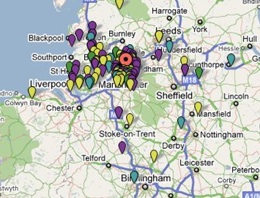
Take a look at a project footprint that has a focus on localism – ie in keeping material, supplier, management and even waste transportation as close as possible to the project:

And then one that doesn’t (which is actually less in construction value):

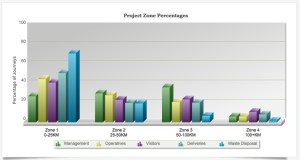
Across the 80 or so projects on the site we can start to see the travel pattern for materials, people and waste, and how close to the project …

All this starts to position Constructco2 as a possible valuable CSR tool and indicator, monitoring impact of projects on local communities, and starting to raise issues of procurement, appropriate sourcing / specification as well as good on site project management housekeeping

These notes are extracted from my recent ConstructCO2 presentation that is available to view on slideshare. 

For more on information please get in touch or visit Constructco2,and follow links.

Great Green Deal Re-Skilling?

Following on from the depressing news that Construction lacks green, key business and foresight skills, in particular 43% of employers dont feel they understand the implications of green issues, or ability to identify the training needs, are we facing a green deal barrier?

Need for New Skills

We read in the Low Carbon Plan from the Government, (“much re-skilling of the construction industry to deliver the planned targets of greenhouse gas reduction by at least 34% by 2020 and 80% by 2050″),  from the IGT Report of the need for green skills, we read that PAS 2030 and Green Deal codes of conduct will access sustainability skills, training and development. The FMB Cut the Carbon programme focuses on the need for new skills.

Will it turn out OK?

Rob Hopkins in his Transition Handbook, (see my blog back in 2008 time for built environment transition?) in a futures scenario talked about the Great Construction Reskilling, the NEF paper, How it all turned out ok celebrates how we recovered our lack of traditional skills, succeeded in addressing the localism issue and turned energy ineffective buildings into models of zero carbon. (again my blog: How it all turned out OK in 2050)

Who is defining …

But do we have an understanding of what green skills mean? Is it just an understanding of good sustainability awareness (eliminating waste, reducing carbon, buying local etc), Is it technical, natural materials (see the Transition Culture archive for reskilling) or is it something more deeper, profound.

Green Re-skilling starts at the board level…

Do we imply the reskilling is just for operatives, or wider to include supervisors, managers and (in my view essential) board directors and senior managers? Maybe this isn’t a training issue to be lodged with the HR team but one of crucial CSR strategy for organisation? (see A Low Carbon Diet For Construction Boards)

A question then …

What are construction boards, contractors, installers, training organisations, industry bodies doing, plan to do, or indeed have done to understand and address sustainability skills.

Construction lacks green, key business and foresight skills

Construction lacks essential skills. A recent poll of 1,450 construction employers, conducted by Construction Industry Training Board and Sector Skills Council, CITB-ConstructionSkills, skills gaps such as understanding the implications of green issues (43%), identifying potential new business (39%) and not having sufficient IT skills (43%) were all areas picked out by industry managers and supervisors as lacking in their organisations.

In addition, a third (32%) of employers said that keeping up to date with the latest innovations, products and techniques was an important concern for their business. A further 32% also stated that their management team’s ability to identify the training needs of staff was an area that needed improvement.

Begs the question what have we been doing in the world of construction improvement over the last two decades since these skills were identified in seminal reports, eg Egan , Latham and others.

Importantly it also demonstrates a lack of awareness and vision at board, owner or senior management levels to identify, acknowledge and prepare for emerging trends, particularly in the sustainability, IT and social media arena.

Links:

A Low Carbon Diet For Construction Boards (CSRWire post by Martin Brown)

Future Proofing the Boardroom – Part One: Grounding and Stargazing (CSRWire post by Lucy Marcus)

Link to CITB 

Towards low carbon construction IGT Report: Government Response

Snippets from todays launch of the Governments Response to the  industry’s Innovation Growth Team Report:

Business Minister Mark Prisk said:

“An efficient, effective and profitable construction industry is at the heart of any growing economy.

“Meeting the UK’s commitment to reducing carbon will affect every aspect of the built environment and has the potential to provide the construction industry with a 40 year programme of work creating great opportunities for growth in the sector.

“Through this joint Government and industry action plan we are making a clear commitment to the low carbon transition which will create the certainty needed for construction companies to invest in essential new skills, processes and products.”

Climate Change and Energy Minister Greg Barker said:

“Improving the energy efficiency of the nation’s buildings is a win-win response to tackling emissions and spiralling fuel costs.

“The Government’s Green Deal will radically transform the energy efficiency of our homes and businesses, and presents a massive opportunity for Britain’s construction industry.

Government Chief Construction Advisor Paul Morrell said:

“I am delighted that the Government has taken on board so many of the recommendations from the IGT report which was developed with expertise from across industry.

“To ensure that construction rises to the low carbon challenge we need to continue this new level of cooperation so I am also pleased that a joint Government and industry board has been set up to ensure implementation of this plan.”

Influence of Construction 

A copy of the Government’s response to the Low Carbon Construction Innovation and Growth Team Report can be found at: http://www.bis.gov.uk/constructionigt


Info from the News Distribution Centre


feedbackfeedforward for a FM led built environment sector.

Back in 2004/5 I chaired a Constructing Excellence working group, aBeCFM, an collaborative exercise between BE (now Constructing Excellence) and CFM (Centre for Facilities Management) with a remit to explore the collaboration and integrated working across the built environment sectors of design, construction and facilities management.

Following an article in Modern Building Services “What if we bought everything in reverse order” and an associated twitter conversation, I have dusted down the recommendations from the abecfm working group below. They are as relevant today as then, maybe more so in light of the Governments Construction Strategy.

Central thinking was feedbackfeedforward that recognised FM’s unique position and role to feedback of facility knowledge to design / construction at the start of a project and to feedforward facility knowledge into the organisation for organisational improvement.

The feeding back and feeding forward of building in use data and facilities management knowledge is key in helping to close the loop between RIBA stages 7 and 1. (Which should never have been illustrated as a linear process)

  • FM to act as broker for collaborative and integrated process. Early involvement of FM must be a given 
  • Extend culture of collaboration throughout the facilities life cycle, from concept to destruction (Would probably call this Cradle to Cradle now!)
  • Increase awareness of design, construction and fm leverage through better understanding of 1:5:200 ratios 
  • Facilities Management to drive a built environment collaborative approach to sustainability.
  • Adopt a collaborative improvement framework for an integrated FM led sector (such as EQFM or Be Excellent)
  • Assess value for all stakeholders –more focus on value management. Include whole life value statements with all design proposals
  • Integrate processes to address complexity, particularly at interfaces and handover stages
  • Share knowledge for innovation and learning feedback/feedforward 
  • Address people and leadership issues necessary for the transition to an integrated and collaborative, FM led industry

Unfortunately the abecfm.com website that contained more detail and signposted to references and case studies has been removed. But hopefully we can track it down and give it the light of day once again.

Government Construction Strategy – have we been here before?

The Government have recently published its Construction Strategy, aiming to address

… widespread acknowledgement across Government and within industry – backed by recent studies – that the UK does not get full value from public sector construction; and that it has failed to exploit the potential for public procurement of construction and infrastructure projects to drive growth.

This strategy changes that. It calls for a profound change in the relationship between public authorities and the construction industry to ensure the Government consistently gets a good deal and the country gets the social and economic infrastructure it needs for the long-term.

However, on a first few readings of the paper I find it un-inspiring and not representative of the current era for the built environment. With the possible exception of a luke warm, suck it and see approach to BIM there is very little in the strategy that we havent seen before in strategies, white papers and policy documents.  A wasted opportunity?

In an era of joined up thinking, collaborative and integrated working it would have been good to see this a built environment strategy, rather than continue the silo thinking of treating construction as a stand alone.

It is therefore disappointing to see that facilities management would appear to have been downgraded to asset management, and although the paper recognises the importance of a whole life thinking approach, it is a view from a building as an asset, a product,  rather than a facility that enables business.

Post-handover defects are a regular feature of construction projects, leading to the cost of remediation (and frequently the higher cost of resolving disputes). Even when there are no latent defects, it is still rare to find that a built asset performs exactly in accordance with its design criteria (and particularly in terms of energy efficiency, for example).

Integration of the design and construction of an asset with the operation phase should lead to improved asset performance. This has been demonstrated in projects which have integrated design and construction with whole-life operation. The same alignment can be created by requiring those who design and construct buildings to prove their operational performance for a period of say three to five years. Proposals for this will be developed with the Government Property Unit to ensure alignment with subsequent arrangements for facilities management.

The 3 – 5 year proving period has been suggested and trialed before – back as I recall in the mid 1990’s as part of the Building Down Barriers programme. And way way back in 1934 Alfred Bosom was saying the same thing (” our production costs are some 30% higher than they should be due to bad building layout”)

The strategy rightly sees procurement as a barrier, but the approach is

To develop a range of overarching procurement strategies appropriate to the whole programme.

Hmmm, havent we been doing that since Latham ? We now have PAS91 which the strategy calls to be better embedded, but to develop even more ….?

And on sustainability

To deliver future carbon reductions in the Government estate through the procurement of new construction, for example by developing approaches to appraising construction projects on a whole life carbon basis including embodied carbon, and working with departments and industry to deliver existing and emerging Strategy for Sustainable Construction targets.

but for the detail action plan and targets we have to wait for the governments response to the IGT Low Carbon Construction Report

Not sure if it is a mistake or not, but note the approach to reducing carbon is through  the procurement of new construction – not all construction – ie is it omitting refurbishment of existing property?

I didn’t expect the strategy to be explicit on social media, but I would have liked to seen communications addressed. Communication, or lack of, are at the root of most of construction problems. As we are seeing the increased use of ICT, Web Technology and yes, Social Media, in other Government sectors it would have been good to see it put on the radar for construction.

Also missing from a forward looking strategy is the need to address diversity – not only in gender, but in age, abilities, ethnicity etc. Without diverse views, opinions and approaches we will continue with our mono-centric approach.  The Government can act as a real role model and driver for construction here. As Einstein said – we cannot fix today’s problems with the same kind of thinking that created them! 

Read the paper here: Government-Construction-Strategy


Ten tips: building green for contractors on a budget

Ever-changing regulations surrounding environmental policy require contractors to re-examine business practices on a regular basis. Unfortunately, contractors are left to interpret a great deal of industry regulations on their own. Among these confounding regulations are those concerning environmental protection.

Guest blogger, Kirsten Bradleyworking to educate professionals and their lawyers about construction industry regulations in the USA has the following advice … and although USA focused, these tips make good sense elsewhere … 

Once contractors have worked their way through the legal jargon found in many environmental policies, they might feel overwhelmed about what exactly their responsibilities are. Fortunately, however, a number of services and products have been created to help eco-friendly contractors.

The National Association of Home Builders plans to roll out the first and only national ratings standard for remodeled homes this year. Contact them for more information on how green products will affect ratings. (In the UK we wait for the Green Deal installers’ Code of Practice and a Publicly Available Specification (PAS) for the retrofitting of energy efficiency measures in domestic and non-domestic buildings)

  • Taking advantage of tax credits and other applicable programs, contractors can offset some of the additional costs they might incur by using eco-efficient approaches to building.
  • Enroll in green building event, training seminars and/or certification programs. (For example, the U.S. Green Building Council backs the LEEDHomes Raters program Home Raters are qualified to assess the degree to which a home has been constructed according to accepted standards of environmental sustainability)
  • Educate yourselves. Sign up for REGREEN, a program that distributes information about how to build green on a smaller scale. The U.S. Green Building Council partnered with The American Society of Interior Designers Foundation to create REGREEN, the first countrywide green residential remodeling manual for existing homes
  • If you think your customers don’t know or care about green building initiatives, think again. A February 2011 poll of Angie’s List members found that 50% of respondents plan to include green building elements in their home this year, but first they want to learn more. Educate yourself so that you will be able to educate your customer and market your services better.
  • According to some estimates, existing homes account for 94% of buildings in the U.S. The average age of these homes is 30 years, which means they often have drafty doors and windows as well as poorly insulated walls, attics and crawl spaces. Additionally, these properties are responsible for 21% of the nation’s carbon emissions. Herein lies a huge profit opportunity for contractors who educate themselves on green remodeling and market themselves to the right crowd.
  • Look at purchasing a green performance bond for your projects in addition to required contractor license bonds . Clients prefer working with professional contractors who are licensed and bonded because they appreciate the extra layer of financial protection
  • For smaller projects, check out the Habitat for Humanity ReStore as a resource. ReStore resale outlets sell reusable and surplus building materials to the public at low costs. Merchandise at the restore is especially good for home remodeling projects
  • Draw up window plans that take full advantage of passive solar energy and help maintain proper indoor temperature. Contractors should always verify that all windows are strategically placed in beneficial locations. This is a great example of implementing inexpensive, eco-conscious design that has a real impact on sustainability.
  • The cost of renewable products like solar platforms decreases as the technology gains traction with the buying public. Installing new products in today’s construction projects will play a large role in increasing eco-friendly building and, in turn, drive down costs.
  • Consider that building a completely new structure using eco-friendly processes might be easier and cheaper than retro-fitting an existing structure that has inherent design flaws.

Contractors who take advantage of green building will not only save money over the long haul, but also promote health benefits from building structures without toxic, energy-wasting materials.

What do you do – do you have any tips for improving green build?

 Kirsten Bradley is working to educate professionals and their lawyers about construction industry regulations through SuretyBonds with a special interest in helping contractors access more green building resources. Follow Kirsten on twitter @suretybond

Natural Mossland Carbon Capture Scheme – putting a ‘natural’ cost to carbon?

Not to be confused with carbon offsetting.

If we are serious about moving to low and zero carbon construction then this Mosslands conservation project looks like a good approach to capturing all those tricky CO2 emissions from your site or building that cannot be eliminated through good carbon reduction and energy management.

At £30 a tonne/CO2, to capture construction activity CO2 would mean, that for each £million construction spend we would be paying £30,000. (Based on the constructco2 CO2 indicator)

A natural cost on carbon?

The brochure contains some very interesting facts and figures as why peatland and mossland are essential as carbon sinks, more so than trees, and why we need to stop extraction.

NaturalCarbonCaptureBrochure.pdf Download this file     Or view on my posterous blog 

Removing the hoardings – Making education projects learning projects

I have visited many school construction projects of late, for a number of contracting organisations across the UK, and have notice they all have one thing in common, a hoarding or barrier between them and the school. Most have received credit (from considerate constructor scheme, health and safety, ISO14001 auditors etc) for the effectiveness of the barrier.

These hoardings represent a barrier between school and project, removing the children and teaching staff from what should be viewed as a unique learning opportunity. If the school is lucky they will have a chained section or peep hole to look through or perhaps a PR’d site tour, all badged by the contractors as evidence of engagement with schools.

Further, in the current risk adverse environment,  advice from consultants is Complete segregation of site from the school wherever possible. 

Should we not be looking to remove barriers, not create more?

All education projects should be learning projects.
Construction projects in schools and other educational establishments present learning opportunity on a wide range of themes, from project management to crafts and skills, from technology and science to sustainability. They also present a fantastic opportunity for designers and contracts to harness student environmental and sustainability thinking on future school facilities. And yet we isolate them. 

Real Engagement
There are win-wins for both. Those in the construction or maintenance sector can really engage with school users, improving their own and the industry image, developing relationships for future work and future recruitment, whilst the educational sector can benefit from real time learning of curriculum subjects.

Safeguarding
 There obviously has to be a considered approach to such sharing. CRB checks are not seen as enough, token even. Safeguarding awareness must become a mandatory induction aspect for all working on educational construction/refurb/maintenance/fm projects.

Through Classofyourown projects we have been working to remove these barriers for a few years now, and in association with The Athena Programme have started to roll out a certified safeguarding awareness programme for those in the built environment


How will construction deal with open supply chain carbon transparency

http://www.youtube.com/v/g30laGwoYTU?fs=1&hl=en_US&rel=0

Have long followed the work of Sourcemap, an open source project to map supply chain transparency. Using one of the examples on the site (usually an iPod or the IKEA bed) creates a great discussion in my sustainability workshops and classes.

A recent and informative article on Business of Fashion under the heading of Fashion2.0 talks of Icebreaker and their baacodes, Patagonia and their Footprint Chronicles website , WalMart, IKEA, and others, all tracking the carbons and transport miles of production and assembly.

In construction we are only just starting to think about the carbons of what we do, for constructC02 for example. Who will be the first construction organisation to opening and publicly track the real carbon and construction miles for a project.

And where will the driver or the pressure to do so come from?

As Sourcemap is open, there is in my mind a great student research project here to map the source carbons and carbon footprint for a complete construction project or new build home. Lets really start to understand the impact of construction!